Obstructive sleep apnea (OSA) is repeated collapse of the upper airway during sleep while the chest and diaphragm keep trying to breathe, causing apneas and hypopneas, oxygen desaturation and arousals that fragment sleep. The classic patient is an obese man with a thick neck, loud snoring, witnessed pauses in breathing, daytime sleepiness, morning headaches and hard-to-control hypertension: the STOP-BANG mnemonic below captures most of those clues. Diagnosis needs polysomnography or a home sleep apnea test: an apnea-hypopnea index (AHI) of 5 or more with symptoms, or 15 or more regardless, is OSA (15-29 moderate, 30 or more severe). Positive airway pressure (CPAP or auto-CPAP) is first-line, alongside weight loss; tirzepatide has been FDA-approved since December 2024 for moderate-to-severe OSA in adults with obesity.
The mnemonic: STOP-BANG
STOP-BANG is a real, validated screening questionnaire (University Health Network), so learning it teaches both the exam vignette and the clinical tool.
| Letter | Question | Exam translation |
|---|---|---|
| S | Snoring loud enough to be heard through closed doors, or the bed partner elbows you | Loud snoring in the stem |
| T | Tired, fatigued or sleepy in the daytime (falling asleep driving or talking) | Excessive daytime sleepiness |
| O | Observed stopping breathing, choking or gasping during sleep | Partner-witnessed apneas |
| P | High blood Pressure, or treated for it | Hypertension, often resistant |
| B | BMI over 35 kg/m² | Obesity |
| A | Age over 50 | Middle-aged or older |
| N | Neck circumference 40 cm (16-inch collar) or more | "Thick neck" |
| G | Gender male | Man |
Scoring: 0-2 "yes" answers = low risk, 3-4 = intermediate, 5-8 = high risk. Two or more STOP answers plus male sex, BMI over 35 or a large neck also counts as high risk. A questionnaire screens; it never diagnoses (AASM). For a 3-second version, remember O.S.A.: Obese, Snoring, Apneic.
Pathophysiology: a floppy tube with the motor still running
- The pharynx is a soft, collapsible tube. During sleep the throat muscles relax and the tissues close in, with the tongue falling back or the soft palate blocking airflow.
- Anything that narrows the tube adds risk: obesity (fat deposits in the neck), a large neck, tongue or tonsils, a small or short lower jaw, sleeping on the back, alcohol, smoking and sedatives.
- Endocrine links: hypothyroidism, acromegaly (excess growth hormone), high insulin levels and polycystic ovary syndrome.
- Respiratory effort continues against the closed airway; that is the defining contrast with central sleep apnea, where the brain stops sending the signal to breathe.
- Each event ends with an arousal that reopens the airway, so sleep fragments (daytime sleepiness), and the repeated drops in oxygen are linked to hypertension and cardiovascular disease.
Presentation
- At night: loud snoring, witnessed pauses, choking or gasping, restless sleep, waking to urinate (nocturia).
- By day: excessive sleepiness, unrefreshing sleep, morning headaches, poor concentration and memory, irritability, low libido or other sexual dysfunction, drowsy driving.
- Exam: obesity, large neck (17 inches or more in men, 16 or more in women), crowded oropharynx, large tongue or tonsils, retrognathia.
- Who has it: estimated 14% of men and 5% of women, and 70-80% of patients evaluated for bariatric surgery.
- Children: large tonsils and adenoids, a small jaw, obesity, or low muscle tone (Down syndrome, cerebral palsy). Look for snoring, mouth breathing, restless sleep, bed-wetting, hyperactivity and poor attention at school, daytime sleepiness and slow growth.
Complications
- Hypertension, often difficult to control; it is one of the reasons the AASM suggests treating OSA with PAP.
- Arrhythmias (especially atrial fibrillation), coronary artery disease, heart failure and stroke.
- Motor vehicle and work accidents from sleepiness.
- Type 2 diabetes.
- Secondary erythrocytosis: nocturnal hypoxemia stimulates erythropoietin, so EPO is high or inappropriately normal, unlike the low or low-normal EPO of polycythemia vera.
- Pulmonary hypertension and cor pulmonale, especially when obesity hypoventilation coexists (see cor pulmonale).
- Screen for OSA in secondary or resistant hypertension.
OSA vs its look-alikes
| OSA | Central sleep apnea | Obesity hypoventilation syndrome | Narcolepsy | |
|---|---|---|---|---|
| Problem | Airway collapses | Brain stops sending breathing signals | Obesity causes hypoventilation | Loss of orexin (hypocretin) neurons in type 1 |
| Respiratory effort during events | Present | Absent | Hypoventilation | Normal breathing |
| Classic causes or clues | Obesity, thick neck, tonsils, alcohol | Heart failure with Cheyne-Stokes breathing, stroke or brainstem lesions, opioids, high altitude | Obesity + high CO2 while awake | Sleep attacks, cataplexy, sleep paralysis, vivid dreamlike hallucinations |
| Key test | Sleep study (AHI) | Sleep study shows central events | Arterial blood gas while awake | Sleep study + multiple sleep latency test |
| Treatment | CPAP, weight loss, alternatives below | Treat the cause; CPAP, BPAP or ASV (ASV with caution in heart failure with reduced ejection fraction, where a trial showed harm); oxygen | PAP (CPAP or BPAP), weight loss | Modafinil or other wake-promoting drugs, sodium oxybate |
Awake hypercapnia in OHS means chronic respiratory acidosis with a compensatory rise in bicarbonate. The full sleepiness differential is in the narcolepsy drawing guide.
Diagnosis
- Questionnaires are not enough. The AASM (2017) recommends against diagnosing OSA with clinical tools or questionnaires alone.
- Polysomnography or a home sleep apnea test (technically adequate device) for uncomplicated adults with signs and symptoms of moderate-to-severe OSA. If a home test is negative, inconclusive or inadequate, do polysomnography.
- In-lab polysomnography instead of home testing for significant heart or lung disease, possible respiratory muscle weakness, awake or suspected sleep hypoventilation, chronic opioid use, prior stroke or severe insomnia.
- Hypopnea scoring: the AASM scoring manual counts a reduction in flow linked to a 3% desaturation or an arousal (an alternative rule uses 4% desaturation alone). The respiratory disturbance index adds respiratory effort-related arousals to the AHI.
| AHI (events per hour) | Meaning |
|---|---|
| Under 5 | Normal in adults |
| 5-14 | Mild OSA when typical symptoms are present |
| 15-29 | Moderate OSA (counts as OSA even without symptoms) |
| 30 or more | Severe OSA |
Treatment ladder
- Positive airway pressure: the AASM recommends PAP for OSA with excessive sleepiness and suggests it for impaired sleep-related quality of life or comorbid hypertension. CPAP or auto-adjusting PAP (APAP) is preferred over bilevel PAP; therapy can start with APAP at home or an in-lab titration, with education built in.
- Weight loss and habits: lose weight, sleep on the side, avoid alcohol and sedatives (for example benzodiazepines), stop smoking.
- Tirzepatide (Zepbound): a weekly GIP/GLP-1 receptor agonist injection whose December 2024 approval made it the first drug approved for OSA: moderate-to-severe OSA in adults with obesity, together with diet and exercise. In the two 52-week trials (AHI 15 or more, BMI 30 or more) AHI fell by about 25-29 events per hour vs about 5 with placebo, with 18-20% weight loss. Its label carries a boxed warning for thyroid C-cell tumors in rodents, and it is contraindicated with a personal or family history of medullary thyroid cancer or with MEN 2.
- Oral appliances: mandibular advancement (repositioning) mouthpieces that hold the lower jaw forward, or tongue-retaining devices, an alternative for people who cannot tolerate or do not want PAP.
- Hypoglossal nerve stimulation: an implanted device that stimulates the hypoglossal nerve so the tongue moves forward during sleep. It was first FDA-approved in 2014 for adults (22 or older) with moderate-to-severe OSA (AHI 20-65) who had failed or could not tolerate PAP and had no complete concentric collapse at the soft palate.
- Surgery: for adults who cannot tolerate or do not accept PAP, the AASM recommends discussing referral to a sleep surgeon if BMI is under 40 and to a bariatric surgeon if BMI is 35 or more. Options include tonsillectomy, removal of soft palate and throat tissue (uvulopalatopharyngoplasty), jaw (maxillomandibular) advancement and, as a last resort, tracheostomy.
- Children: adenotonsillectomy often cures OSA caused by large tonsils and adenoids; CPAP, nasal steroids and weight loss are alternatives.
Practice question
A 48-year-old man is evaluated for hypertension that remains at 158/96 mm Hg despite three medications. His wife reports loud snoring and pauses in his breathing, and he has dozed off at red lights. He wakes with headaches most mornings. BMI is 37 kg/m² and neck circumference is 44 cm. Hemoglobin is 17.9 g/dL. Which is the most appropriate next step to confirm the diagnosis?
A. Arterial blood gas B. Epworth Sleepiness Scale score C. JAK2 V617F mutation testing D. Overnight pulse oximetry E. Polysomnography
Answer: E. He scores 7 of 8 on STOP-BANG (snoring, tired, observed apneas, pressure, BMI over 35, neck 40 cm or more, male), so the pretest probability of moderate-to-severe OSA is high. A sleep study that measures airflow, respiratory effort and oxygen saturation is required to diagnose OSA and calculate the AHI. A home sleep apnea test is an acceptable alternative in uncomplicated adults, but in-lab polysomnography is preferred if hypoventilation or significant heart or lung disease is suspected.
- A: an arterial blood gas looks for awake hypercapnia (obesity hypoventilation syndrome) but cannot diagnose OSA.
- B: the Epworth scale measures sleepiness; the AASM recommends against diagnosing OSA with questionnaires alone.
- C: his erythrocytosis is most likely secondary to nocturnal hypoxemia. Polycythemia vera, with low EPO and a JAK2 mutation, is not the first thought here.
- D: oximetry alone records desaturation but not airflow or effort, so it cannot separate obstructive from central events or give an AHI.
Once confirmed, he should start CPAP or APAP with weight loss; if the AHI shows moderate-to-severe OSA, tirzepatide is an option given his obesity.
Key takeaways
- STOP-BANG: Snoring, Tired, Observed apneas, Pressure, BMI over 35, Age over 50, Neck 40 cm or more, Gender male; 5-8 = high risk.
- OSA = airway collapse with continued effort; central sleep apnea = no effort (heart failure with Cheyne-Stokes, opioids, stroke, altitude).
- Diagnose with polysomnography or a home sleep apnea test, never a questionnaire alone; AHI 5 or more with symptoms, or 15 or more regardless; 30 or more is severe.
- Complications: resistant hypertension, arrhythmias (especially atrial fibrillation), heart failure, stroke, crashes, secondary erythrocytosis, pulmonary hypertension.
- Treatment: CPAP or APAP first, plus weight loss; tirzepatide for moderate-to-severe OSA with obesity; oral appliance, hypoglossal nerve stimulation or surgery if PAP fails; adenotonsillectomy in children.
Sources
- Clinical Practice Guideline for Diagnostic Testing for Adult Obstructive Sleep Apnea — American Academy of Sleep Medicine, J Clin Sleep Med (2017)
- Treatment of Adult Obstructive Sleep Apnea With Positive Airway Pressure: AASM Clinical Practice Guideline — J Clin Sleep Med (2019)
- Referral of Adults With Obstructive Sleep Apnea for Surgical Consultation: AASM Clinical Practice Guideline — J Clin Sleep Med, via PubMed Central (2021)
- FDA Approves First Medication for Obstructive Sleep Apnea — U.S. Food and Drug Administration (2024)
- Zepbound (tirzepatide) Prescribing Information — Eli Lilly (revised 2026)
- Inspire Upper Airway Stimulator, PMA P130008 — FDA Premarket Approval database (2014)
- STOP-Bang Questionnaire — University Health Network
- Obstructive Sleep Apnea (OSA) — Merck Manual Professional Edition (2026)
- Obstructive Sleep Apnea (OSA) in Children — Merck Manual Professional Edition (2026)
- Central Sleep Apnea (CSA) — Merck Manual Professional Edition (2026)
- Sleep Apnea: Causes and Risk Factors — National Heart, Lung, and Blood Institute (2025)
- Obesity Hypoventilation Syndrome (OHS) — MedlinePlus Medical Encyclopedia (2025)
Visual explanations from the StepGenie QBank
Infographics StepGenie drew to explain questions in its own QBank, matched to this article's topic. Each caption is the takeaway of the question it explains.
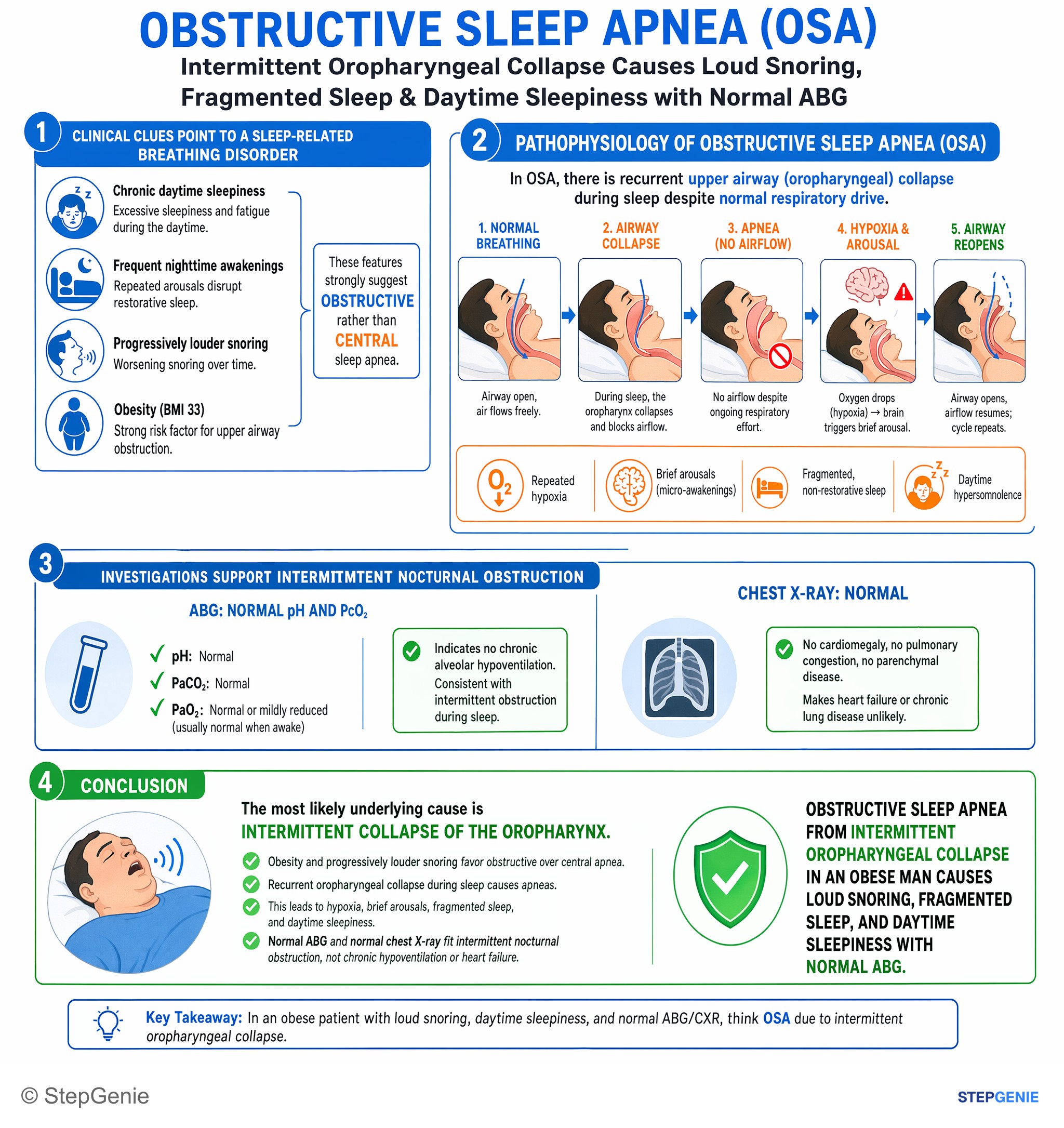
Obstructive sleep apnea from intermittent oropharyngeal collapse in an obese man causes loud snoring, fragmented sleep, and daytime…
USMLE Step 1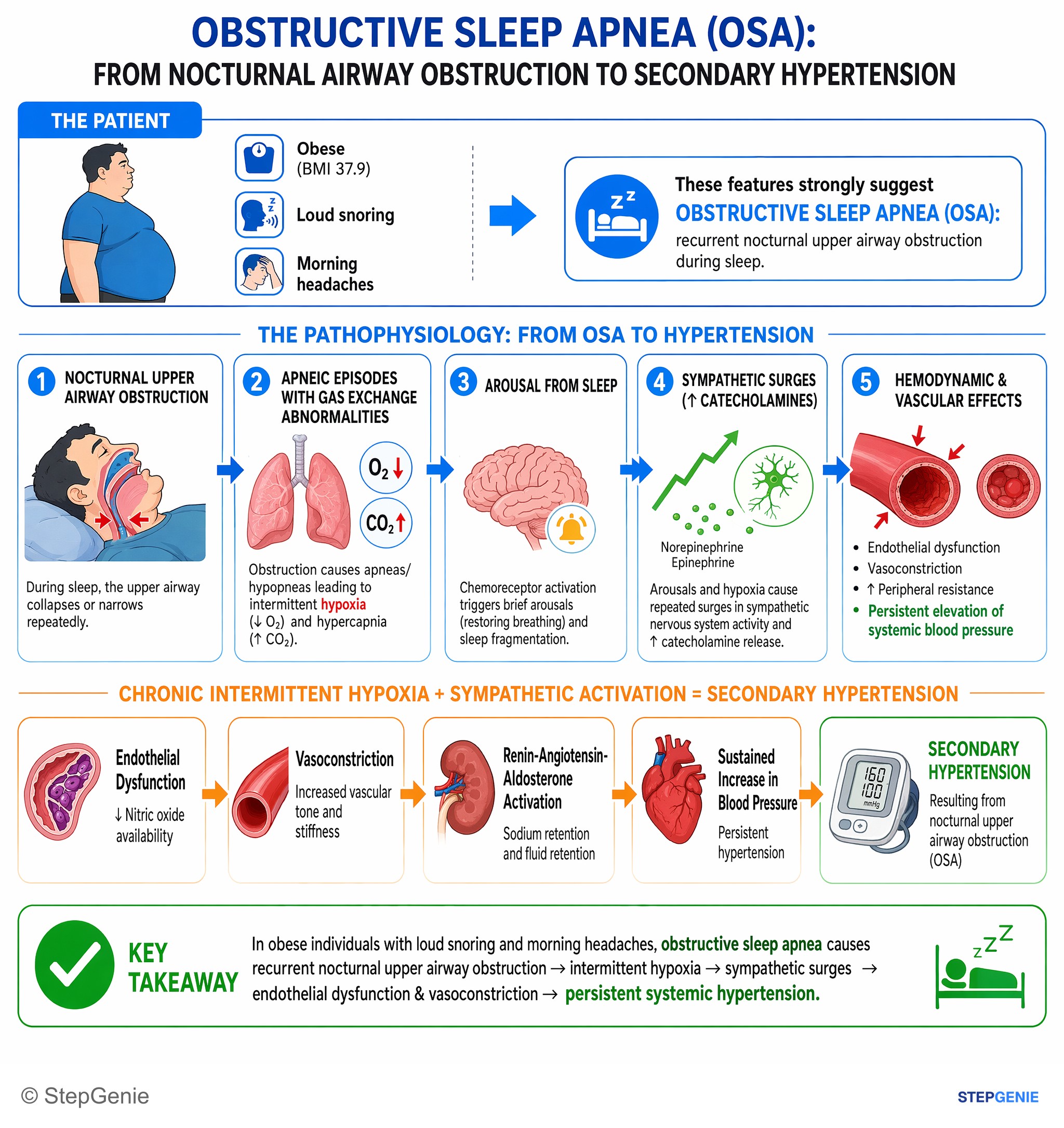
Obstructive sleep apnea from nocturnal upper airway obstruction causes intermittent hypoxia, sympathetic surges, and secondary systemic…
USMLE Step 2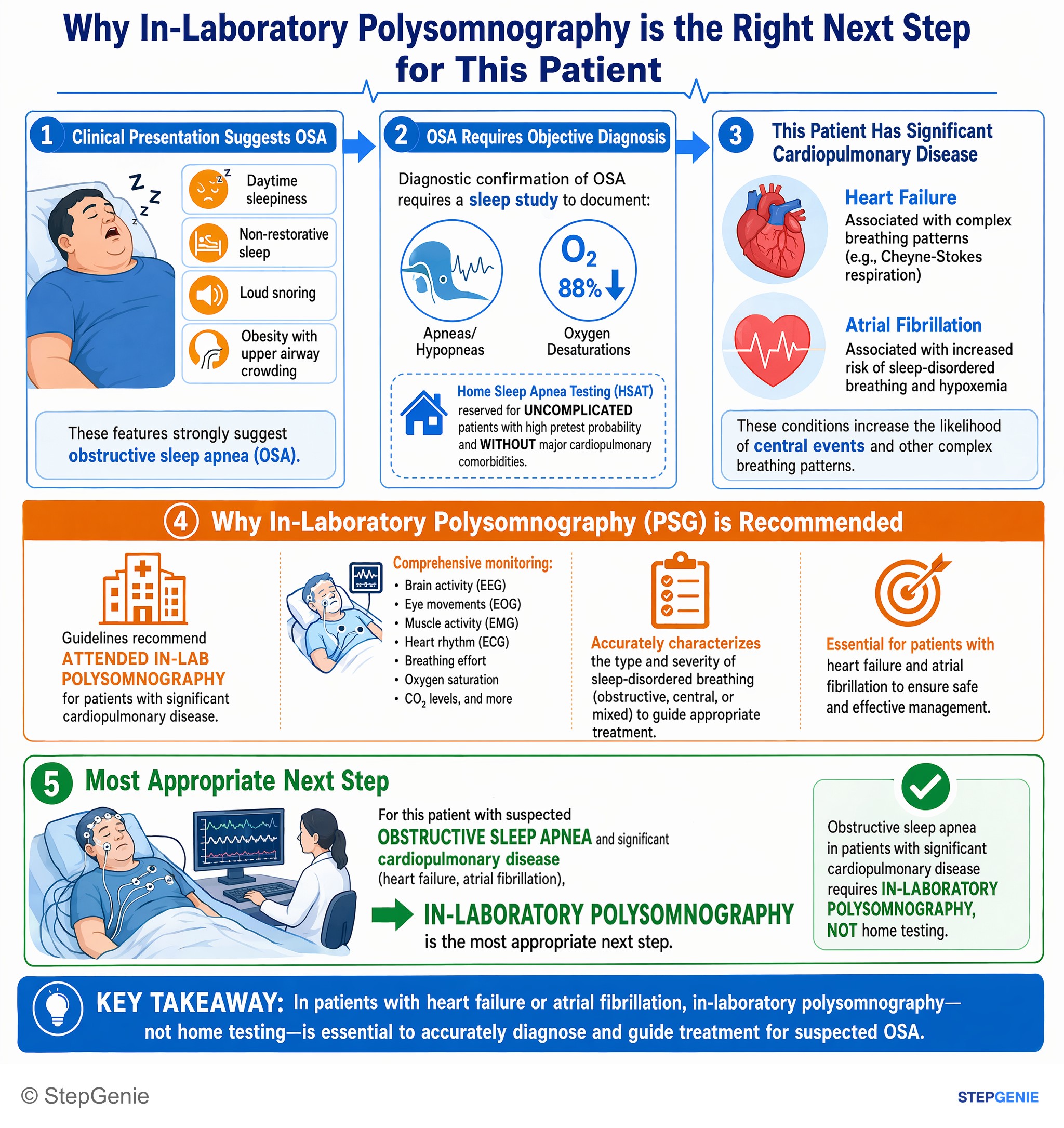
Obstructive sleep apnea in a patient with significant cardiopulmonary disease (heart failure, atrial fibrillation) requires in-laboratory…
USMLE Step 2Frequently Asked Questions
What is a good mnemonic for obstructive sleep apnea?
STOP-BANG is the most useful because it is also a validated screening questionnaire. It stands for Snoring, Tired during the day, Observed pauses in breathing, high blood Pressure, BMI over 35, Age over 50, Neck circumference of 40 cm or more, and male Gender. Five to eight yes answers mean high risk, three to four intermediate and zero to two low. A high score only raises suspicion; a sleep study is still needed to diagnose OSA.
How is obstructive sleep apnea diagnosed?
OSA is diagnosed with a sleep study, either in-lab polysomnography or a home sleep apnea test with a technically adequate device. The AASM recommends against diagnosing it from questionnaires alone. Home testing suits uncomplicated adults with a high likelihood of moderate to severe OSA, while in-lab polysomnography is preferred for people with significant heart or lung disease, neuromuscular weakness, hypoventilation, chronic opioid use, prior stroke or severe insomnia, and after a negative or inadequate home test.
What AHI counts as mild, moderate and severe sleep apnea?
The apnea-hypopnea index is the number of apneas and hypopneas per hour of sleep. In adults, an AHI of 5 to 14 with typical symptoms is mild OSA, 15 to 29 is moderate and 30 or more is severe. An AHI of 15 or more counts as OSA even when the person has no symptoms. The respiratory disturbance index is similar but also counts respiratory effort-related arousals.
What is the first-line treatment for obstructive sleep apnea?
Positive airway pressure is first-line, using continuous (CPAP) or auto-adjusting (APAP) devices that splint the airway open; the AASM prefers these over bilevel devices for routine OSA. Weight loss, side sleeping and avoiding alcohol and sedatives help. For people who cannot use PAP, options include oral appliances that pull the jaw forward, hypoglossal nerve stimulation and surgery, and adenotonsillectomy is the usual first treatment for children with large tonsils and adenoids.
Is tirzepatide approved for sleep apnea?
Yes. In December 2024 the FDA approved tirzepatide (Zepbound), a weekly injection that activates GIP and GLP-1 receptors, for moderate to severe obstructive sleep apnea in adults with obesity, used with a reduced-calorie diet and more physical activity. It was the first drug approved for OSA. In two 52-week trials the AHI fell by about 25 to 29 events per hour compared with about 5 on placebo. The FDA links that improvement mainly to weight loss. One trial enrolled people already using PAP and the other people unable or unwilling to use it.
What is the difference between obstructive and central sleep apnea?
In obstructive sleep apnea the upper airway collapses but the chest and diaphragm keep trying to breathe, so respiratory effort continues during each event. In central sleep apnea the brain temporarily stops sending signals to the breathing muscles, so effort and airflow stop together. Central apnea is linked to heart failure with Cheyne-Stokes breathing, stroke or brainstem disease, opioid painkillers and high altitude, and treatment starts with the underlying cause.