Frontotemporal dementia (FTD) is a favorite on USMLE because it tests pattern recognition: a relatively young patient (often 45–65) with prominent personality/behavior or language changes before major memory impairment. If Alzheimer disease is “can’t remember,” FTD is “not acting like themselves” (or “can’t speak normally”)—and that distinction drives your differential, imaging choices, and board-style vignettes.
What Exactly Is Frontotemporal Dementia?
Frontotemporal dementia is a group of neurodegenerative disorders characterized by progressive degeneration of the frontal and/or anterior temporal lobes, leading to:
- Behavioral disinhibition, apathy, executive dysfunction (frontal lobe features), and/or
- Primary progressive aphasia (dominant temporal/frontal language network involvement)
High-yield definition (testable phrasing)
FTD = early-onset dementia with early behavior/personality or language changes and relative sparing of episodic memory early.
Why It Happens: Pathophysiology (Step 1–Relevant)
FTD is not one single pathology—it’s a clinicopathologic umbrella. What Step 1 wants you to know is the protein and anatomic patterns.
Key proteinopathies
Common abnormal aggregates include:
- Tau (FTLD-tau)
- Seen in some familial forms and certain clinicopathologic subtypes
- TDP-43 (FTLD-TDP)
- Also strongly associated with ALS spectrum disease
- Less commonly: FUS protein inclusions
Neuroanatomy that explains symptoms
- Frontal lobe degeneration → disinhibition, apathy, poor judgment, impaired executive function
- Anterior temporal lobe degeneration → semantic loss, language comprehension deficits
- Orbitofrontal cortex involvement → socially inappropriate behavior, impulsivity
- Anterior cingulate involvement → apathy, reduced motivation
Genetics (HY associations)
A substantial minority of cases are familial. Boards often test these names:
- MAPT (tau) mutation
- GRN (progranulin) mutation
- C9orf72 repeat expansion
- HY tie-in: FTD + ALS spectrum
Clinical Presentation: How FTD Shows Up on USMLE
The “classic” vignette
A middle-aged patient with new, progressive:
- Personality change (“different person”)
- Socially inappropriate behavior (e.g., rude comments, impulsive spending)
- Loss of empathy
- Compulsive behaviors (pacing, repetitive rituals)
- Hyperorality (binge eating, new sweet cravings)
And crucially:
- Memory may be relatively preserved early, especially compared with Alzheimer disease.
Major Clinical Subtypes (Know These Patterns)
1) Behavioral variant FTD (bvFTD)
Most common subtype.
High-yield features
- Disinhibition
- Apathy/inertia
- Loss of empathy
- Perseverative/compulsive behavior
- Hyperorality/dietary changes
- Executive dysfunction (planning, organization)
Clue: family says “they’re acting strangely,” not “they’re forgetting everything.”
2) Primary Progressive Aphasia (PPA)
FTD can present predominantly with language dysfunction. Two common patterns:
Nonfluent/agrammatic variant
- Effortful, halting speech
- Agrammatism (“telegraphic speech”)
- Speech apraxia may be present
Semantic variant
- Fluent but empty speech
- Loss of word meaning (impaired naming/comprehension)
- “What is a ‘chair’?” type of semantic erosion
Boards love: language variant + younger age + focal frontotemporal atrophy.
3) FTD with Motor Neuron Disease (FTD-ALS spectrum)
Key association: TDP-43 pathology and/or C9orf72
Look for:
- Behavior/language change plus
- Upper and/or lower motor neuron signs (weakness, fasciculations, hyperreflexia)
Diagnosis: What Tests Show (and What They Don’t)
FTD is primarily a clinical diagnosis supported by imaging. Lab tests are mostly to rule out reversible causes of cognitive/behavioral change.
Neuropsych findings
- Executive dysfunction early
- Social cognition deficits
- Memory may be less impaired early than in Alzheimer disease
Imaging (very testable)
MRI (or CT)
- Frontal and/or anterior temporal atrophy
- Often asymmetric (can be more prominent on one side)
FDG-PET
- Frontal/anterior temporal hypometabolism (supportive when MRI is equivocal)
Quick imaging contrast table
| Disease | Typical early symptom | MRI finding (classic) | Pathology buzzwords |
|---|---|---|---|
| FTD | Behavior/personality or language change | Frontal/anterior temporal atrophy | Tau, TDP-43, FUS |
| Alzheimer | Memory impairment | Hippocampal/medial temporal atrophy | -amyloid, tau tangles |
| Dementia with Lewy bodies | Visual hallucinations + parkinsonism | Often nonspecific atrophy | -synuclein (Lewy bodies) |
| Normal pressure hydrocephalus | Gait → urinary → dementia | Enlarged ventricles | “Wet, wobbly, wacky” |
Labs to consider (rule-outs)
Not “FTD labs,” but common workup items:
- TSH, B12, CMP, CBC
- Consider HIV/syphilis testing when risk factors exist
Treatment: What You Can (and Can’t) Fix
Core concept
FTD has no disease-modifying therapy. Management is symptomatic and safety-focused.
Behavioral symptoms
- SSRIs (often used for disinhibition, compulsions, irritability)
- Sometimes trazodone for behavioral regulation/sleep
- Structured routines + caregiver support are huge
What to avoid or use cautiously (HY)
- Antipsychotics: may be used for severe agitation/psychosis, but weigh risks (sedation, metabolic effects, QT prolongation; EPS risk in parkinsonian syndromes)
- Cholinesterase inhibitors (donepezil, rivastigmine) and memantine: benefit is clear in Alzheimer disease, but often limited/variable in FTD and may worsen behavior in some patients (a common teaching point)
Supportive care
- Speech therapy (especially in PPA)
- Occupational therapy, safety evaluations (driving, finances)
- Early caregiver counseling (burnout is common)
High-Yield Associations & “Classic Traps”
HY associations
- Younger onset than Alzheimer disease (often 45–65)
- Early behavior change or aphasia > memory impairment early
- FTD + ALS → think TDP-43 and C9orf72
- Frontal/anterior temporal atrophy on imaging
Common test traps
- “Dementia” ≠ “memory first.” If the stem emphasizes disinhibition, poor judgment, loss of empathy, or language—FTD climbs to the top.
- Depression vs FTD: apathy can mimic depression, but FTD tends to show progressive disinhibition/executive dysfunction and objective cognitive/behavior changes noted by others.
- Alzheimer vs FTD: Alzheimer is more episodic memory early; FTD is more personality/language early.
First Aid Cross-References (What to Connect While Studying)
In First Aid, FTD is typically covered in the Neuro—Dementia/Neurodegenerative area alongside Alzheimer disease, Lewy body dementia, Parkinson disease dementia, and Huntington disease. While page numbers vary by edition, link it conceptually to these First Aid anchors:
- Dementia differentials (FTD vs Alzheimer vs Lewy body vs vascular vs NPH)
- Protein aggregation diseases
- Tauopathies and other inclusion disorders
- ALS associations
- Clinical overlap with FTD in some patients (TDP-43/C9orf72 concept)
If you’re annotating First Aid: write “behavior/language first + frontal/temporal atrophy” next to FTD, and add “TDP-43/C9orf72 ↔ ALS” in the margin.
Rapid Review (Exam-Day Bullets)
- FTD: early-onset dementia with personality/behavior changes or progressive aphasia
- Memory often spared early (relative to Alzheimer)
- Pathology: tau, TDP-43, (± FUS)
- Imaging: frontal/anterior temporal atrophy; PET shows hypometabolism there
- Association: FTD-ALS spectrum (think TDP-43 and C9orf72)
- Treatment: supportive + SSRIs for behavior; cholinesterase inhibitors are not reliably helpful
Visual explanations from the StepGenie QBank
Infographics StepGenie drew to explain questions in its own QBank, matched to this article's topic. Each caption is the takeaway of the question it explains.
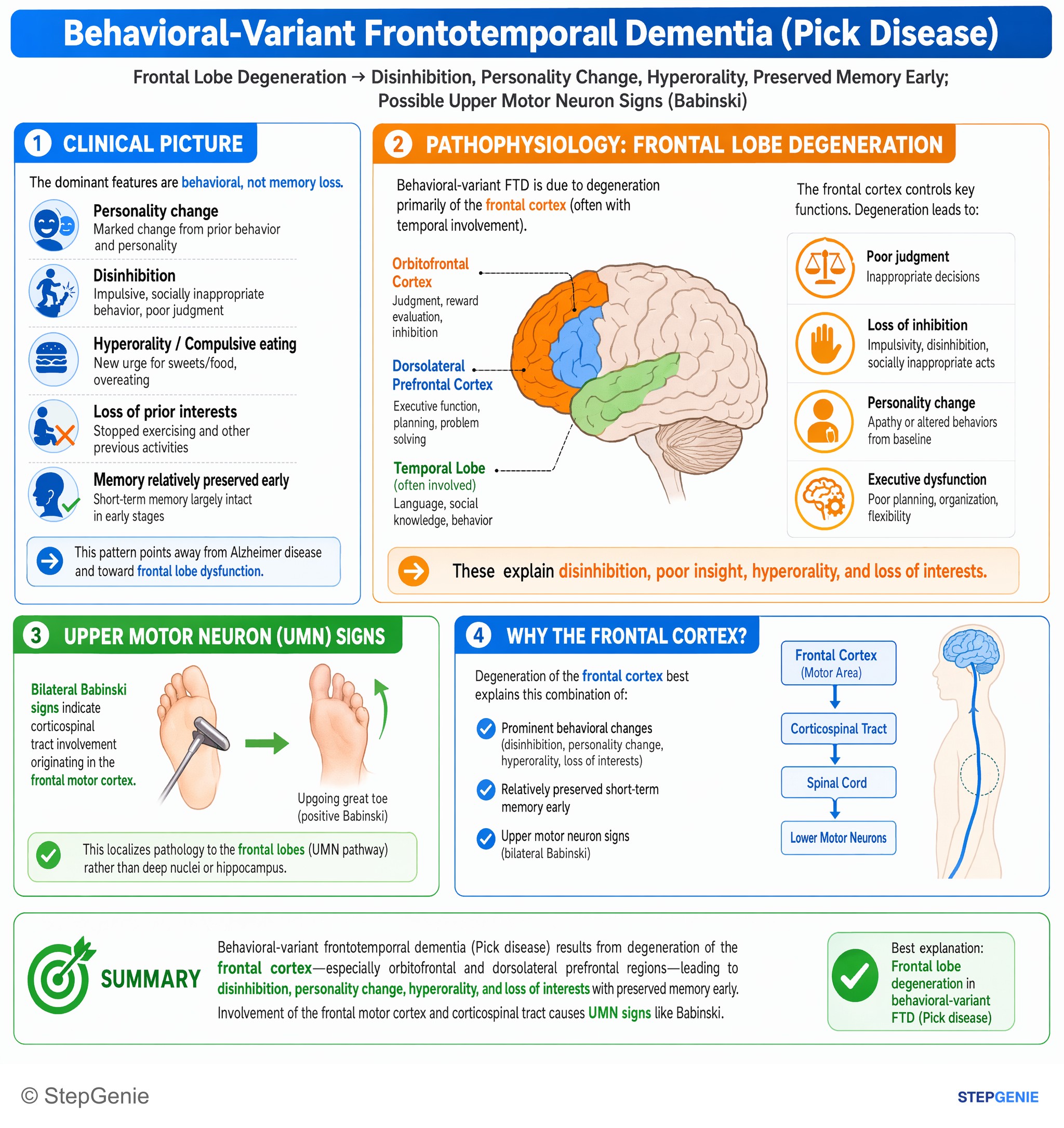
Behavioral-variant frontotemporal dementia: frontal lobe degeneration → disinhibition, personality change, hyperorality, preserved memory…
USMLE Step 1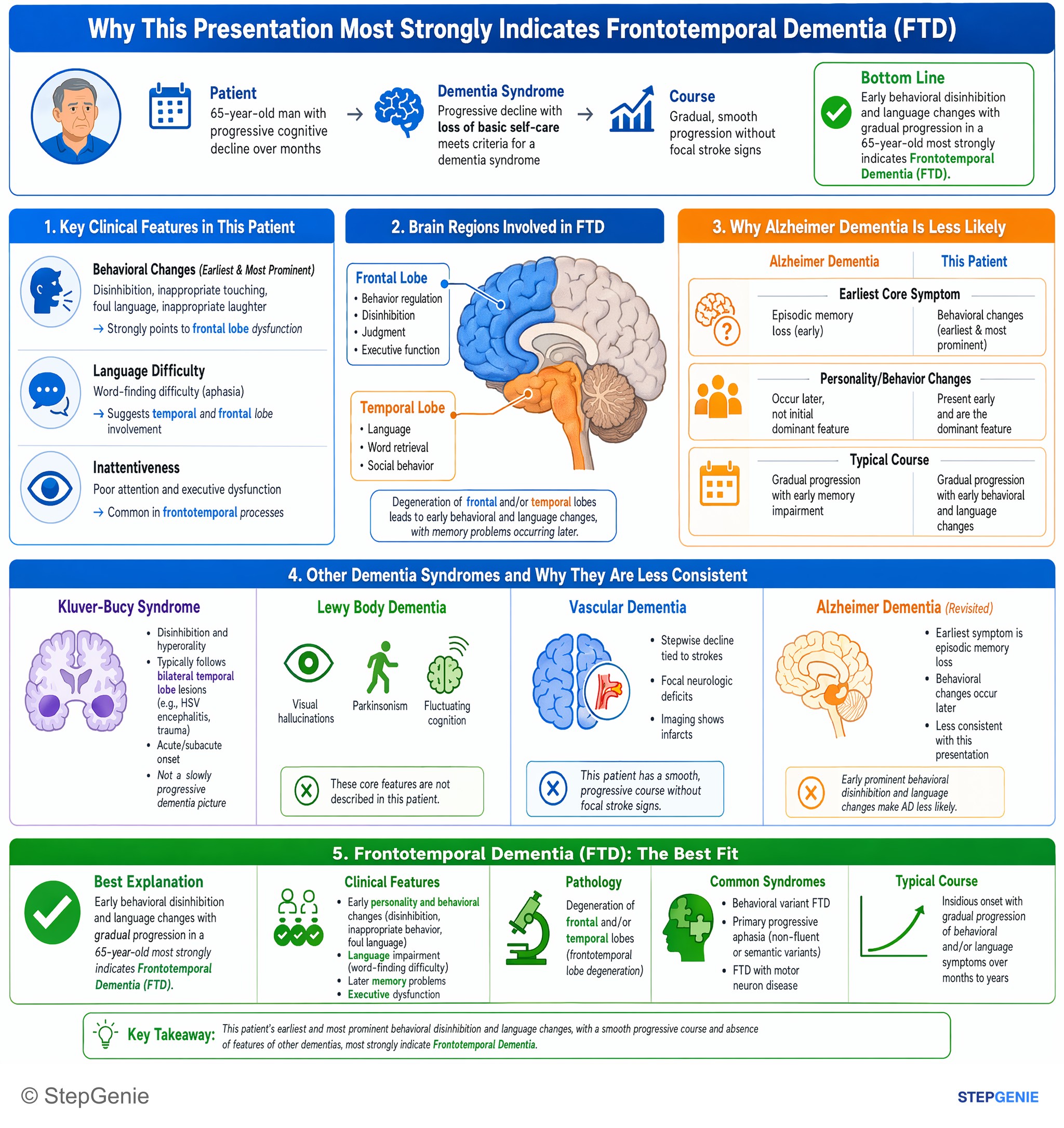
Frontotemporal dementia causes early personality/behavioral disinhibition and language changes, with later memory issues; frontotemporal…
USMLE Step 1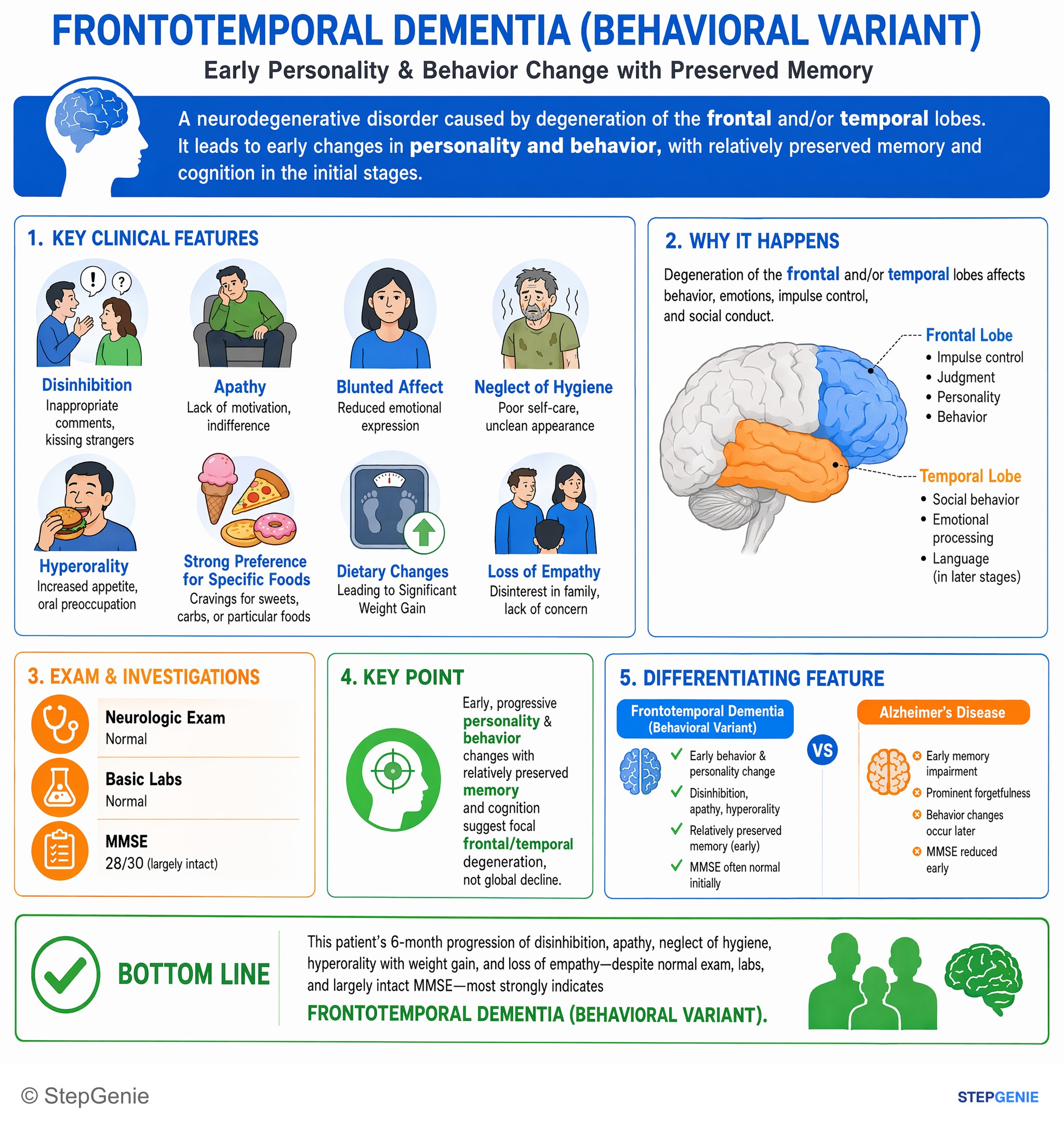
Frontotemporal dementia (behavioral variant) causes early personality/behavior change, disinhibition, hyperorality, with relatively…
USMLE Step 2Frequently Asked Questions
How do you tell frontotemporal dementia from Alzheimer disease on a vignette?
Frontotemporal dementia is distinguished by early personality, behavior, or language change with relative sparing of episodic memory early. A typical clue is a younger patient who is “not acting like themselves” or “can’t speak normally,” whereas Alzheimer disease classically begins with memory impairment. Imaging also differs: FTD shows frontal and/or anterior temporal atrophy, while Alzheimer disease more often shows hippocampal or medial temporal atrophy.
Why does frontotemporal dementia cause disinhibition, apathy, and socially inappropriate behavior?
These symptoms happen because frontotemporal dementia preferentially degenerates frontal networks involved in judgment, motivation, and social behavior. Frontal lobe degeneration leads to disinhibition, apathy, poor judgment, and executive dysfunction. Orbitofrontal cortex involvement is linked to impulsivity and socially inappropriate behavior, while anterior cingulate involvement contributes to reduced motivation and apathy.
What are the classic imaging findings in frontotemporal dementia?
The classic imaging finding in frontotemporal dementia is frontal and/or anterior temporal atrophy on MRI or CT, often with asymmetric involvement. If structural imaging is equivocal, FDG-PET can provide supportive evidence by showing frontal or anterior temporal hypometabolism. These patterns fit the clinical picture of early behavioral, personality, or language changes rather than early prominent memory loss.
What protein abnormalities are high-yield in frontotemporal dementia?
The high-yield protein abnormalities in frontotemporal dementia are tau and TDP-43, with FUS inclusions being less common. FTD is a clinicopathologic umbrella rather than a single pathology, so boards focus on these protein patterns along with the affected brain regions. TDP-43 is especially important because it is strongly associated with the FTD-ALS spectrum.
What is the treatment approach for frontotemporal dementia?
Treatment for frontotemporal dementia is symptomatic and safety-focused because there is no disease-modifying therapy. SSRIs are often used for disinhibition, compulsions, and irritability, and trazodone may help with behavioral regulation or sleep. Supportive care such as speech therapy, occupational therapy, structured routines, caregiver support, and safety evaluations is important, while cholinesterase inhibitors and memantine have limited or variable benefit and may worsen behavior in some patients.