Narcolepsy is one of those Step questions that looks like “sleep medicine” but actually tests neurophysiology + pharm in disguise. If you can recognize the classic symptom cluster and tie it to loss of hypocretin (orexin) neurons, you’ll nail most NBME-style stems in seconds.
The Draw-it-out Method (30 seconds, blank paper)
Draw a stick figure collapsed next to a bed, with 4 icons floating around them:
- “Zzz” bubble over their head (sleep attacks)
- Smiley face + lightning bolt to knees (cataplexy triggered by emotion)
- Ghost sitting on chest (sleep paralysis)
- Dream cloud spilling into the room (hypnagogic/hypnopompic hallucinations)
Under the drawing, write:
“REM leaks into wakefulness”
That’s the entire disease in one line.
One-liner (the “why” behind every symptom)
Narcolepsy = daytime sleep attacks + REM intrusion (cataplexy, hallucinations, sleep paralysis) due to loss of hypothalamic orexin/hypocretin neurons.
High-yield core pathophysiology
What’s actually broken?
- Loss of orexin (hypocretin)-producing neurons in the lateral hypothalamus
- Leads to unstable sleep-wake switching → REM features show up during wakefulness
Classic association (testable)
- HLA-DQB1*06:02 association (autoimmune tendency)
- Low CSF hypocretin (orexin) is highly suggestive (especially narcolepsy type 1)
The “CHESS” symptom cluster (your mental checklist)
Use CHESS to remember narcolepsy’s big features:
- Cataplexy
- Hallucinations (hypnagogic/hypnopompic)
- Excessive daytime sleepiness
- Sleep paralysis
- Sleep-onset REM
Quick clarifiers that save points
- Cataplexy = sudden loss of muscle tone triggered by emotion (laughing, surprise)
- Consciousness is preserved (this is how you separate it from many seizure stems)
- Hypnagogic hallucinations = as you’re falling asleep
- Hypnopompic hallucinations = as you’re waking up
What you’ll see on sleep studies (Step 1 + Step 2 favorite)
| Test | Key narcolepsy finding | Why it matters |
|---|---|---|
| Polysomnography (overnight) | Can show short sleep latency and early REM | Helps rule out other sleep disorders first |
| Multiple Sleep Latency Test (MSLT) | Mean sleep latency < 8 minutes + ≥ 2 SOREMPs (sleep-onset REM periods) | Most testable diagnostic pattern |
SOREMPs are the exam’s way of saying: REM is showing up way too early.
Narcolepsy vs “fake-outs” (fast differential)
Narcolepsy vs seizures
- Narcolepsy/cataplexy: emotion trigger, brief, no postictal confusion, awareness intact
- Seizure: can have postictal state, tongue biting, incontinence, not specifically emotion-triggered
Narcolepsy vs insomnia
- Narcolepsy: excessive daytime sleepiness + REM intrusion
- Insomnia: trouble falling/staying asleep; no cataplexy/REM intrusion symptoms
Narcolepsy vs obstructive sleep apnea (OSA)
- OSA: snoring, witnessed apneas, morning headaches, obesity; sleepiness from fragmented sleep
- Narcolepsy: cataplexy/hallucinations/paralysis, often normal overnight sleep time but abnormal REM regulation
Treatment: what to pick on exams
Daytime sleepiness (first-line)
- Modafinil / armodafinil
- Wake-promoting; commonly tested as first-line
- Alternatives: methylphenidate, amphetamines (more side effects, but still testable)
Cataplexy (and REM intrusion symptoms)
- SSRIs/SNRIs or TCAs
- They suppress REM, reducing cataplexy and hallucinations
- Sodium oxybate (GHB)
- Improves cataplexy and daytime sleepiness; taken at night
- High-yield caution: CNS depressant, abuse potential, respiratory depression risk
Rapid-fire USMLE pearls (the “don’t miss” list)
- Narcolepsy type 1 = narcolepsy with cataplexy (classically linked to low CSF orexin)
- REM normally has atonia; cataplexy is basically REM atonia intruding into wakefulness
- Patients often enter REM within minutes of falling asleep (SOREMP)
- Stems love triggers like: “laughing makes them collapse” + “vivid dreams while falling asleep” + “can’t move on waking”
Mini self-check (1 question)
If a patient has sudden knee-buckling after laughing, but remains aware and recovers quickly, what mechanism is most likely?
Answer: REM atonia intruding into wakefulness due to loss of hypothalamic orexin (hypocretin) neurons.
Visual explanations from the StepGenie QBank
Infographics StepGenie drew to explain questions in its own QBank, matched to this article's topic. Each caption is the takeaway of the question it explains.
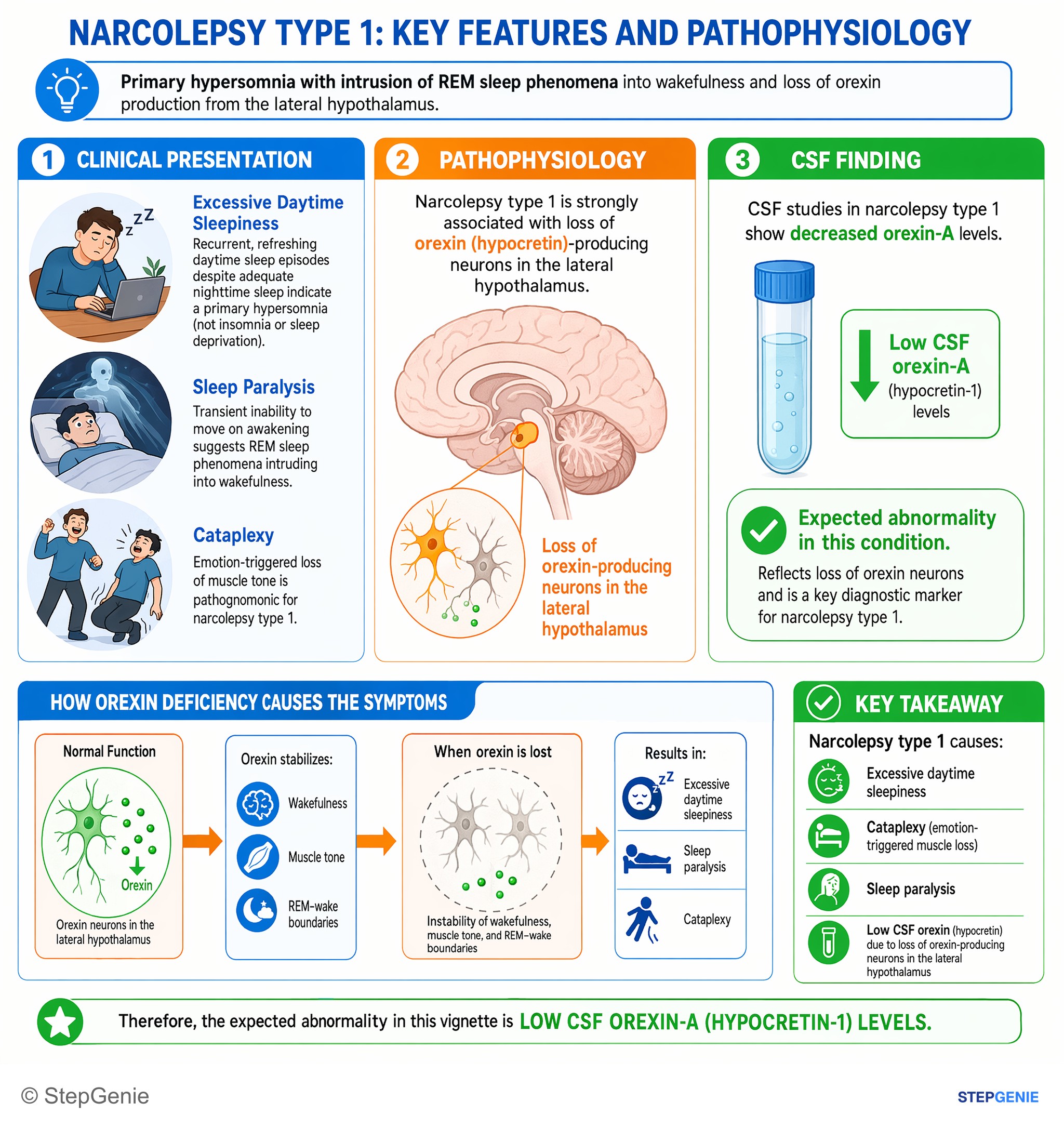
Narcolepsy type 1 causes excessive daytime sleepiness, cataplexy, sleep paralysis and is associated with low CSF orexin (hypocretin) from…
USMLE Step 1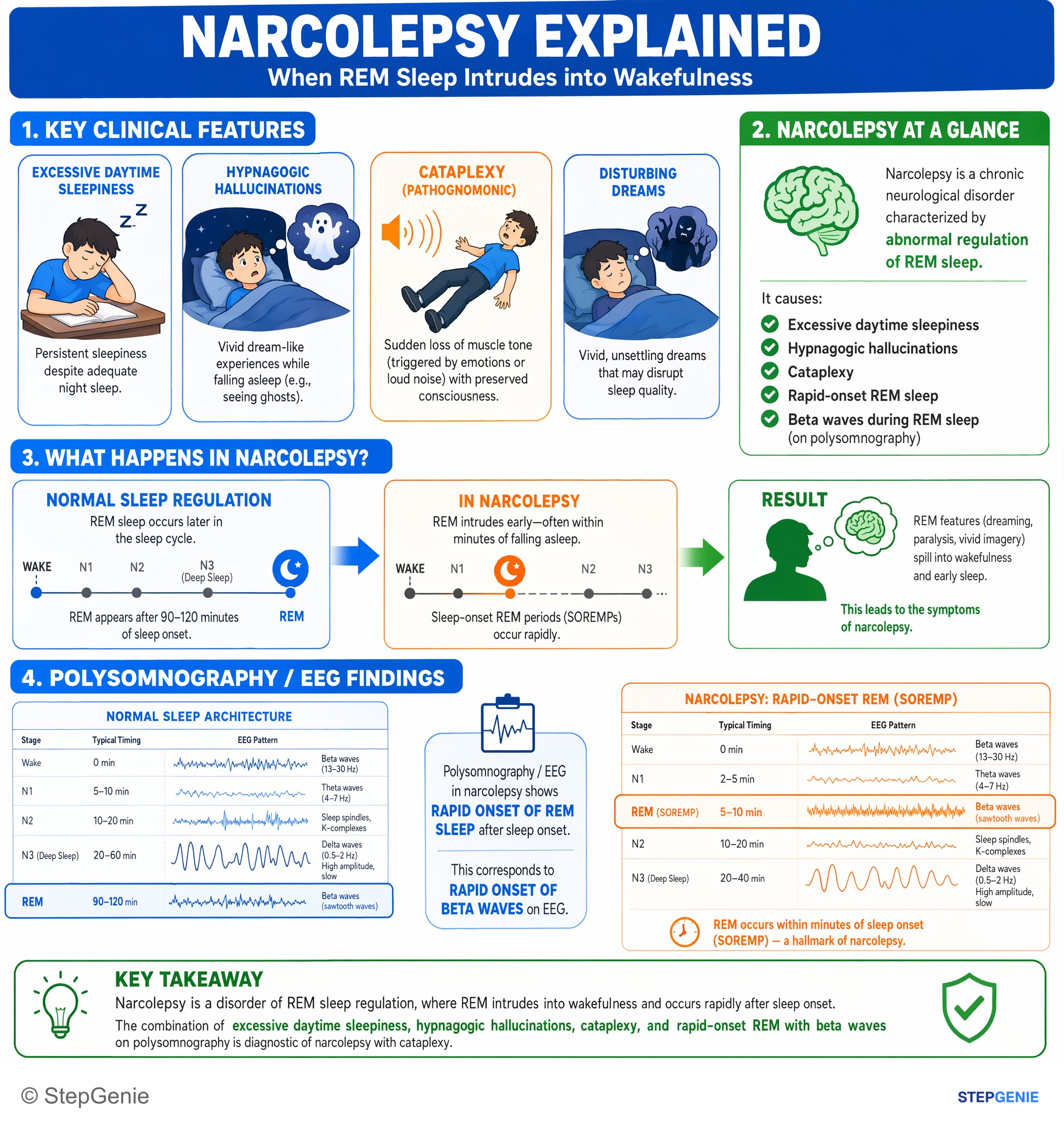
Narcolepsy causes daytime sleepiness, hypnagogic hallucinations, cataplexy, and shows rapid-onset REM sleep with beta waves on…
USMLE Step 1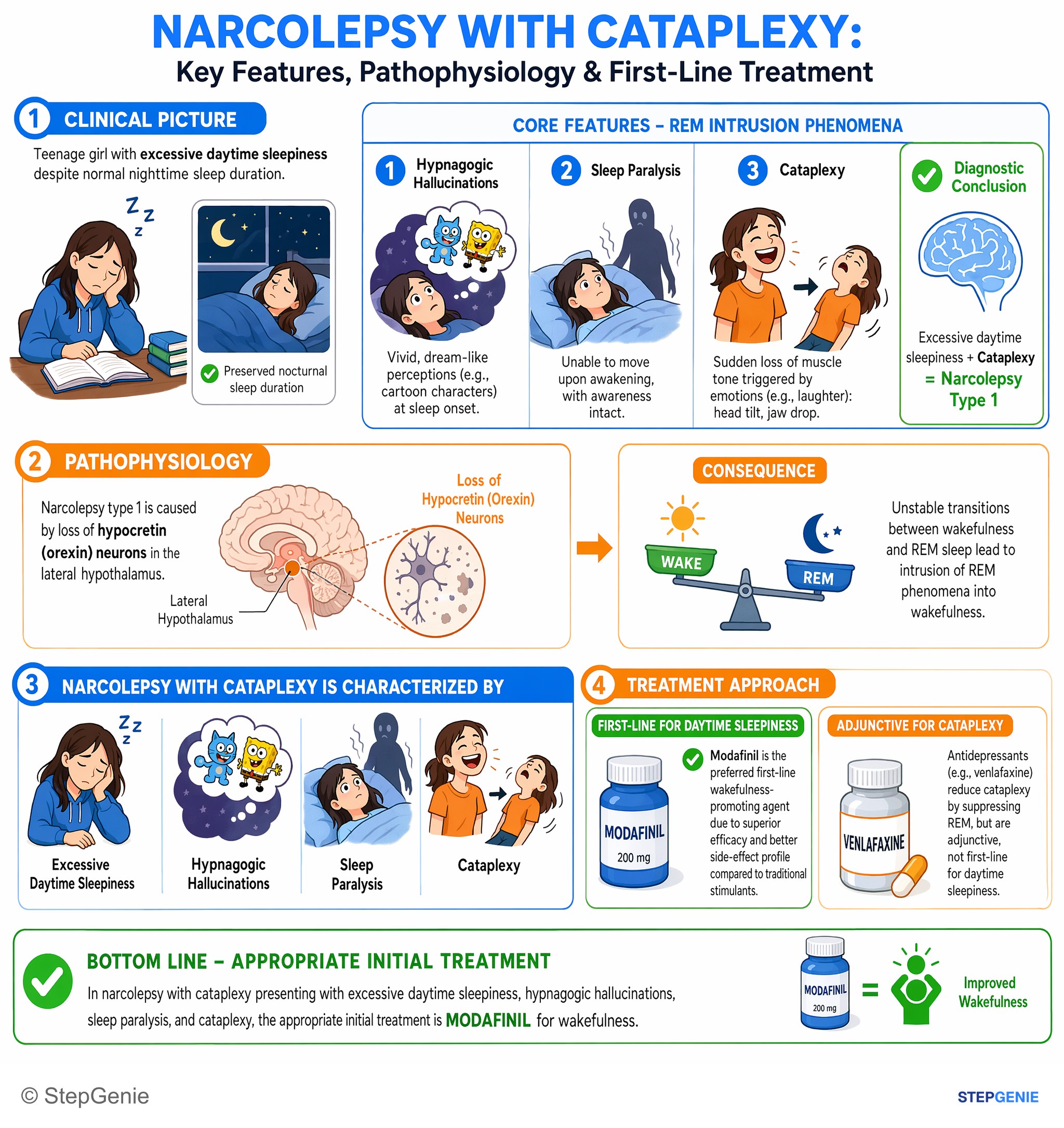
Narcolepsy with cataplexy: excessive daytime sleepiness, hypnagogic hallucinations, sleep paralysis, cataplexy → treat initially with…
USMLE Step 2Frequently Asked Questions
Why does narcolepsy cause cataplexy, sleep paralysis, and vivid hallucinations?
Narcolepsy causes these symptoms because REM sleep features leak into wakefulness. The core problem is loss of orexin, also called hypocretin, neurons in the lateral hypothalamus, which makes sleep-wake switching unstable. As a result, REM phenomena appear at the wrong times: cataplexy reflects REM atonia during wakefulness, and hallucinations or sleep paralysis occur around sleep onset or awakening.
How do you tell narcolepsy with cataplexy from a seizure on exam questions?
Narcolepsy with cataplexy is suggested by emotion-triggered, brief loss of muscle tone with preserved awareness and no postictal confusion. Seizures are more likely to have a postictal state, tongue biting, or incontinence and are not specifically triggered by emotions. A classic narcolepsy clue is collapsing after laughing or surprise while remaining conscious and recovering quickly.
What sleep study findings are most diagnostic for narcolepsy?
The most testable diagnostic pattern is on the Multiple Sleep Latency Test: mean sleep latency under 8 minutes with at least 2 sleep-onset REM periods. This shows that REM is occurring too early. Overnight polysomnography can also show short sleep latency and early REM, and it helps rule out other sleep disorders before confirming the narcolepsy pattern.
What is the first-line treatment for daytime sleepiness in narcolepsy?
Modafinil or armodafinil is first-line for excessive daytime sleepiness in narcolepsy. These are wake-promoting medications and are commonly tested as the preferred initial choice. Other stimulants such as methylphenidate and amphetamines are alternatives, but they have more side effects. For cataplexy and other REM intrusion symptoms, exams often point instead to REM-suppressing drugs or sodium oxybate.
What clues point to narcolepsy instead of obstructive sleep apnea or insomnia?
Narcolepsy is suggested by excessive daytime sleepiness plus REM intrusion symptoms such as cataplexy, sleep paralysis, and hypnagogic or hypnopompic hallucinations. Obstructive sleep apnea instead points to snoring, witnessed apneas, morning headaches, and obesity, with sleepiness from fragmented sleep. Insomnia is trouble falling or staying asleep and does not cause cataplexy or the characteristic REM-related symptoms.