You need a fast, sticky way to recall Alzheimer disease (AD) on test day—something you can picture in 3 seconds and then expand into high-yield facts. Here’s a quick-hit mnemonic that maps directly to USMLE-relevant pathology, genetics, neurotransmitters, and clinical patterns.
The Acronym Trick: ALZHEIMER
Think: “ALZHEIMER steals your memories” — each letter is a testable hook.
A — Aβ (Amyloid-β) plaques
- Extracellular neuritic/senile plaques made of Aβ.
- Produced from APP via β-secretase + γ-secretase cleavage.
- Classically starts in hippocampus/entorhinal cortex → early short-term memory loss.
One-liner: AD = extracellular Aβ plaques + intracellular tau tangles.
L — Loss of cholinergic neurons (nucleus basalis of Meynert)
- ↓ Acetylcholine due to degeneration of basal forebrain cholinergic neurons.
- Treatment targets this: acetylcholinesterase inhibitors improve symptoms.
One-liner: Basal forebrain cholinergic loss → treat with AChE inhibitors.
Z — “Zooming” progressive decline (gradual, not stepwise)
- Slow, progressive dementia over years.
- Helps distinguish from:
- Vascular dementia (often stepwise decline)
- Normal pressure hydrocephalus (gait/urinary issues prominent early)
- Delirium (acute, fluctuating attention)
H — Hippocampal atrophy
- Early involvement → anterograde amnesia (can’t form new memories).
- Imaging (conceptually): medial temporal lobe/hippocampal atrophy.
E — Early symptom: episodic memory loss
- Early: repetitive questions, misplacing objects, missing appointments.
- Later: language impairment, visuospatial deficits, executive dysfunction.
USMLE vibe: memory first (hippocampus), then global cognitive decline.
I — Intracellular tau tangles
- Neurofibrillary tangles are intracellular, made of hyperphosphorylated tau.
- Tau normally stabilizes microtubules; when hyperphosphorylated → microtubules destabilize → neuronal dysfunction/death.
M — Mutations / genetics (APP, PSEN1, PSEN2; APOE ε4)
High-yield genetics:
- Early-onset familial AD (autosomal dominant):
- APP (chromosome 21)
- Presenilin 1 & 2 (components of γ-secretase complex)
- Down syndrome (trisomy 21) → ↑ APP gene dosage → early AD pathology.
- APOE ε4: ↑ risk and earlier onset (not deterministic).
E — Elderly (age is biggest risk factor)
- Age is the strongest risk factor for sporadic AD.
- Also consider comorbid vascular risk factors as contributors to cognitive decline (even if primary diagnosis is AD).
R — Rx: symptomatic treatment
- Donepezil, rivastigmine, galantamine (AChE inhibitors) → mild symptomatic benefit.
- Memantine (NMDA receptor antagonist) → used in moderate-to-severe disease.
- Core point: these do not cure; they may slow symptom progression.
Visual/Mnemonic Device (Shareable Image-in-Your-Head)
Picture a brain-shaped museum:
- Outside the building are sticky “Aβ gum blobs” stuck to the walls (extracellular plaques).
- Inside, the hallways have twisted rope tangles around the support beams (intracellular tau tangles).
- The museum’s “Memory Wing” (hippocampus) is crumbling first.
- The tour guide whispers: “No acetylcholine left—nucleus basalis is closed.”
If you can recall gum outside + ropes inside, you’ll nail plaques vs tangles every time.
High-Yield “Don’t Mix These Up” Table
| Feature | Alzheimer disease | Vascular dementia | Lewy body dementia | Frontotemporal dementia |
|---|---|---|---|---|
| Course | Gradual progressive | Stepwise | Fluctuating cognition | Often earlier onset |
| Early hallmark | Episodic memory loss | Executive dysfunction | Visual hallucinations, parkinsonism | Personality/behavior, language |
| Pathology | Aβ plaques, tau tangles | Infarcts, small vessel disease | α-synuclein Lewy bodies | Pick bodies (tau) in some types |
| Key neurochem | ↓ ACh | Variable | ↓ dopamine + cholinergic deficits | Variable |
The USMLE One-Liner You Should Memorize
Alzheimer disease = progressive memory-first dementia with hippocampal atrophy, extracellular Aβ plaques (APP via β/γ secretase) + intracellular hyperphosphorylated tau tangles, and loss of basal forebrain cholinergic neurons treated symptomatically with AChE inhibitors ± memantine.
Visual explanations from the StepGenie QBank
Infographics StepGenie drew to explain questions in its own QBank, matched to this article's topic. Each caption is the takeaway of the question it explains.
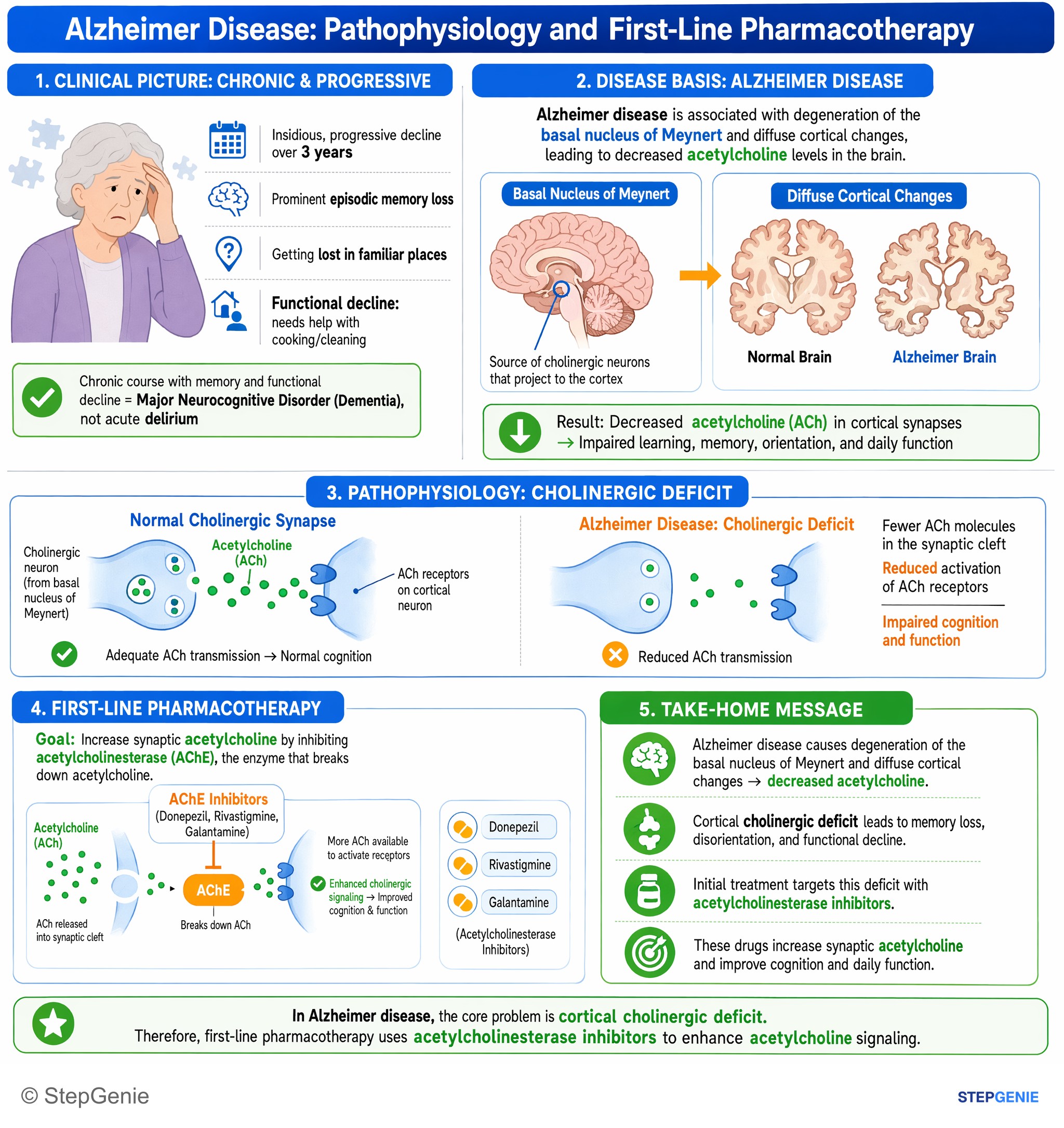
Alzheimer disease causes cortical cholinergic deficit; initial treatment uses acetylcholinesterase inhibitors that enhance acetylcholine…
USMLE Step 1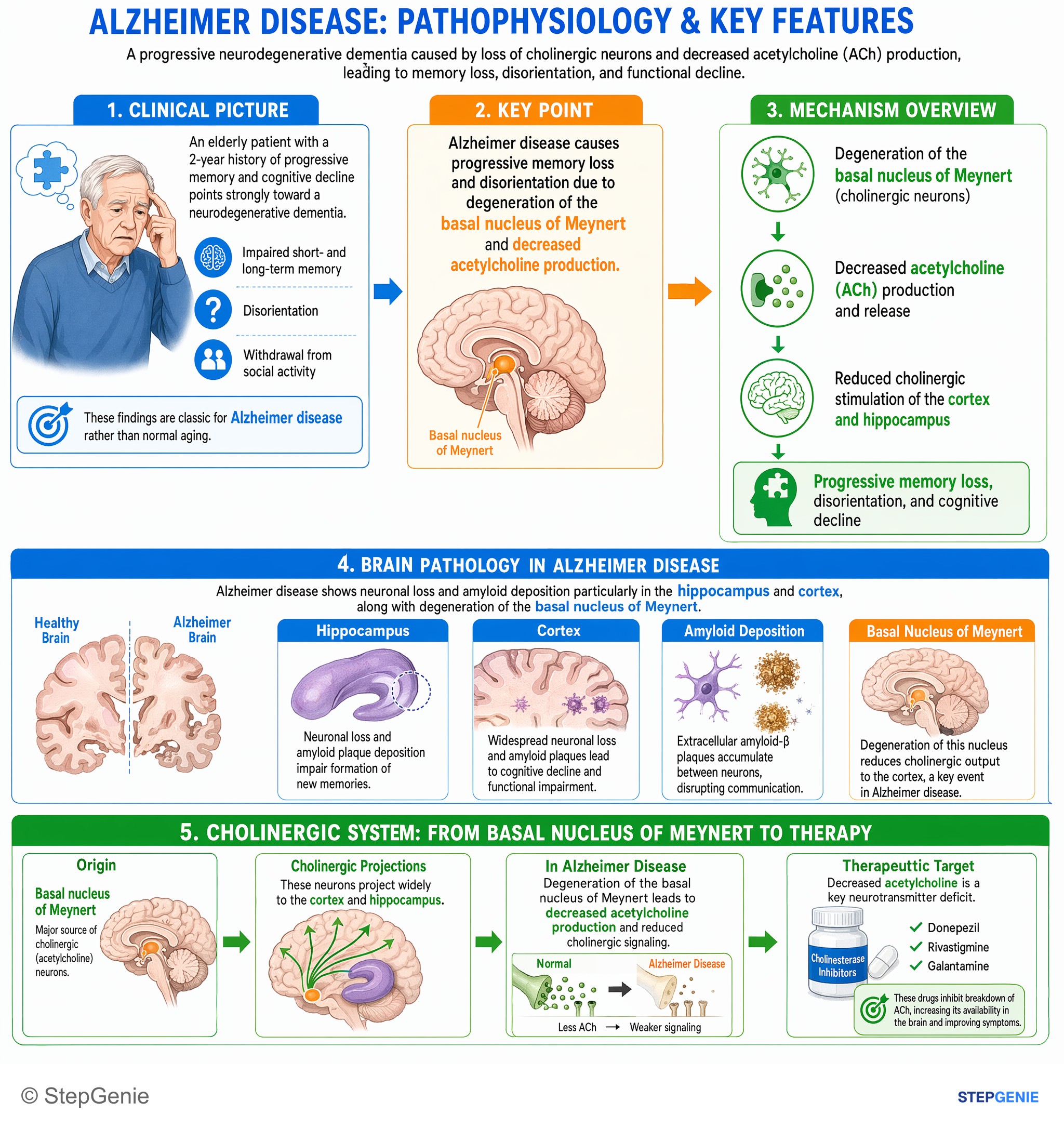
Alzheimer disease causes progressive memory loss and disorientation due to degeneration of basal nucleus of Meynert and decreased…
USMLE Step 1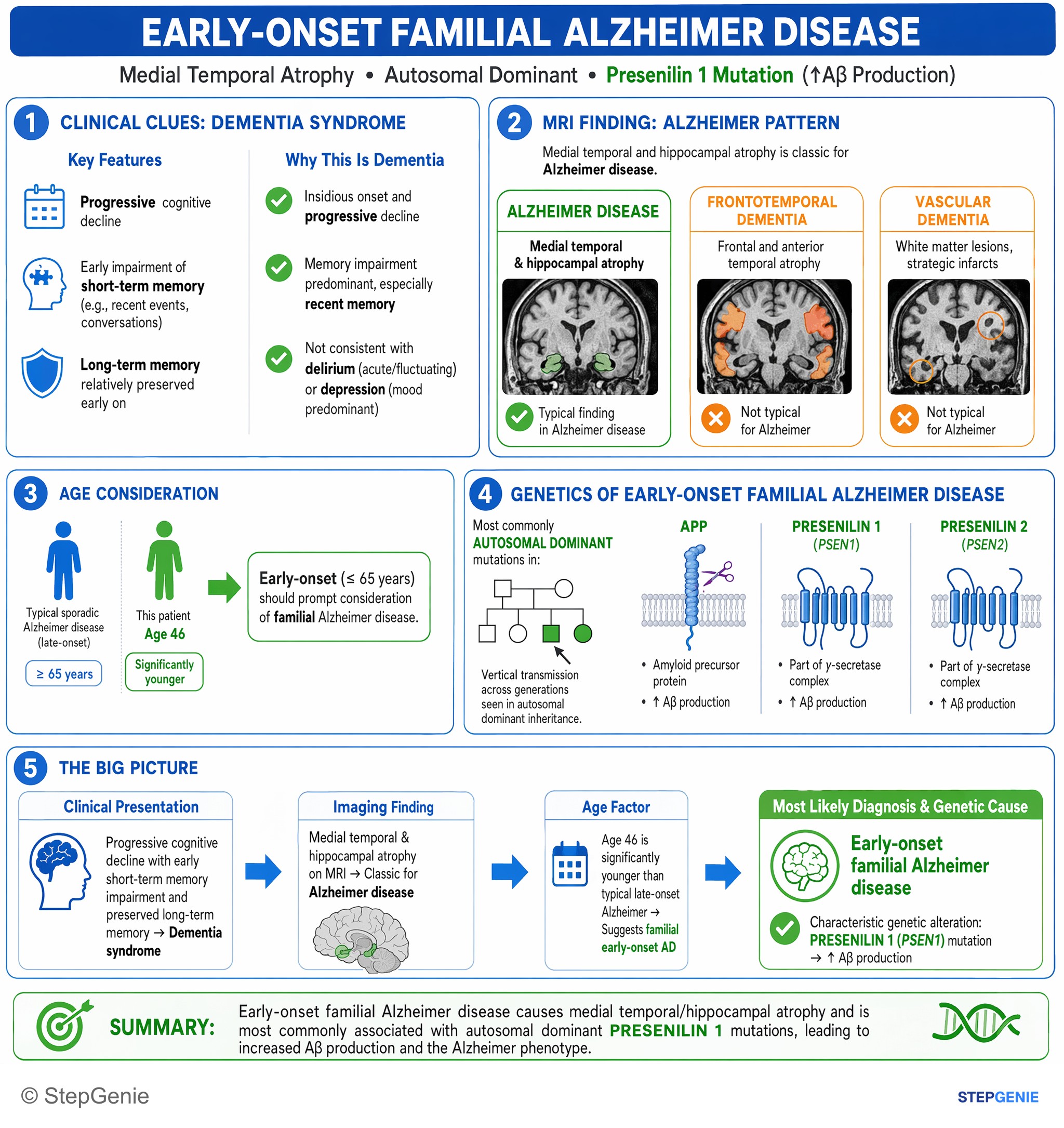
Early-onset familial Alzheimer disease causes medial temporal/hippocampal atrophy and is associated with autosomal dominant presenilin 1…
USMLE Step 1Frequently Asked Questions
Why does Alzheimer disease cause early short-term memory loss?
Alzheimer disease causes early short-term memory loss because it begins in the hippocampus and entorhinal cortex, which are critical for forming new memories. This early hippocampal involvement leads to anterograde amnesia, so patients have trouble making new memories. Clinically, that shows up as episodic memory loss such as repetitive questions, misplacing objects, and missing appointments.
How do you tell Alzheimer disease from vascular dementia, normal pressure hydrocephalus, or delirium?
Alzheimer disease is distinguished by a slow, progressive, memory-first decline rather than an abrupt or stepwise pattern. Vascular dementia often declines in a stepwise fashion, normal pressure hydrocephalus has prominent early gait and urinary symptoms, and delirium presents acutely with fluctuating attention. A classic Alzheimer pattern is gradual episodic memory loss followed later by broader cognitive deficits.
What are the plaques and tangles in Alzheimer disease?
In Alzheimer disease, the plaques are extracellular neuritic or senile plaques made of amyloid-beta, while the tangles are intracellular neurofibrillary tangles made of hyperphosphorylated tau. Amyloid-beta is produced from APP through beta-secretase and gamma-secretase cleavage. Tau normally stabilizes microtubules, but when it becomes hyperphosphorylated, microtubules destabilize and neurons become dysfunctional and die.
What neurotransmitter deficit is seen in Alzheimer disease, and how is it treated?
Alzheimer disease is associated with decreased acetylcholine from loss of cholinergic neurons in the basal forebrain, especially the nucleus basalis of Meynert. This is why acetylcholinesterase inhibitors such as donepezil, rivastigmine, and galantamine are used for symptomatic benefit. In moderate-to-severe disease, memantine, an NMDA receptor antagonist, may also be used, but these treatments do not cure the disease.
What genetics are high-yield for Alzheimer disease?
High-yield Alzheimer genetics include early-onset familial mutations in APP, PSEN1, and PSEN2, as well as APOE ε4 as a risk factor for sporadic disease. APP is on chromosome 21, so Down syndrome increases APP gene dosage and leads to early Alzheimer pathology. APOE ε4 increases risk and is associated with earlier onset, but it is not deterministic.