Benzodiazepines show up everywhere on Step—panic attacks in the ED, alcohol withdrawal on the wards, pre-op anxiety, and the occasional “my patient is getting paradoxically worse” curveball. Here are 3 quick, high-yield tips that are easy to memorize and even easier to apply on test day.
Tip #1: Know the mechanism and the antidote (aka the “Cl–” story)
The one-liner
Benzos increase the frequency of GABA chloride channel opening → hyperpolarize neurons → fast anxiolysis/sedation.
Flumazenil is the competitive antagonist at GABA.
Visual / mnemonic device
“BENZO = BeNds the NeurON into Zzz… by letting Cl– in more often.”
Picture a door (GABA channel) with a bouncer named Ben who doesn’t open it wider—he just opens it more times so more Cl– flows in.
High-yield Step facts
- GABA is a ligand-gated chloride channel (fast inhibitory neurotransmission).
- Barbiturates increase duration (not frequency) of opening—Step loves that contrast.
- Flumazenil pitfall: can precipitate seizures in chronic benzo users (and in mixed overdoses with proconvulsants like TCAs). Use thoughtfully.
Tip #2: Use benzos for the right indications (and know the “big 3” test favorites)
The one-liner
Benzos are best for acute, short-term control: panic, alcohol withdrawal, and status epilepticus.
Visual / mnemonic device
“Benzos put out fires—don’t use them to heat the house.”
They’re great for acute flames (seizure, withdrawal, severe panic), but bad as a long-term “heater” due to dependence/tolerance.
High-yield indications table
| Clinical scenario | Why benzos help | Common examples to know |
|---|---|---|
| Acute panic / severe anxiety | Rapid onset anxiolysis | Alprazolam, lorazepam (short-acting options show up) |
| Alcohol withdrawal (including delirium tremens) | Cross-tolerant with alcohol at GABA; prevent seizures | Chlordiazepoxide, diazepam, lorazepam |
| Status epilepticus (acute abortive therapy) | Quickly enhances inhibition | Lorazepam (common), diazepam |
| Procedural sedation / anesthesia adjunct | Anxiolysis + anterograde amnesia | Midazolam |
| Acute agitation/catatonia | Calms/sedates; can be diagnostic/therapeutic | Lorazepam challenge (catatonia) |
Step-style pearl: For long-term anxiety disorders, first-line is usually SSRIs/SNRIs (and CBT). Benzos are often bridge therapy while SSRIs take effect.
Tip #3: Side effects = “4 D’s,” plus the lethal combo you must recognize
The one-liner
Benzos cause sedation and dependence—and can be deadly with other CNS depressants.
Visual / mnemonic device
The “4 D’s” of benzos:
- Drowsiness
- Depressed reflexes/coordination (ataxia)
- Dependence (tolerance + withdrawal)
- Down the hatch → worse with Downers (alcohol, opioids)
High-yield adverse effects & test traps
- CNS depression: somnolence, confusion, impaired psychomotor performance → fall risk (especially elderly).
- Respiratory depression: classically low risk alone, but high risk in combination with alcohol, opioids, barbiturates.
- Anterograde amnesia (midazolam is a classic association in procedural settings).
- Paradoxical disinhibition (rare but testable): agitation, aggression, impulsivity—more likely in kids/elderly.
- Dependence & withdrawal: anxiety, tremor, insomnia, and seizures in severe withdrawal.
- Withdrawal risk increases with high dose, long duration, and short-acting agents (e.g., alprazolam).
Rapid comparison you can memorize
| Feature | Benzodiazepines | Barbiturates |
|---|---|---|
| GABA effect | ↑ frequency | ↑ duration |
| Safety | Safer margin, esp. alone | Narrow therapeutic index |
| Overdose concern | Worse with other depressants; flumazenil exists (with caveats) | Respiratory depression; no easy reversal |
10-second exam wrap-up (the “If you remember nothing else” list)
- Mechanism: ↑ frequency of GABA opening → ↑ Cl– influx.
- Go-to uses: acute panic, alcohol withdrawal, status epilepticus, procedural sedation.
- Big dangers: sedation/falls, dependence/withdrawal seizures, and synergistic respiratory depression with opioids/alcohol; flumazenil can trigger seizures in dependent patients.
Visual explanations from the StepGenie QBank
Infographics StepGenie drew to explain questions in its own QBank, matched to this article's topic. Each caption is the takeaway of the question it explains.
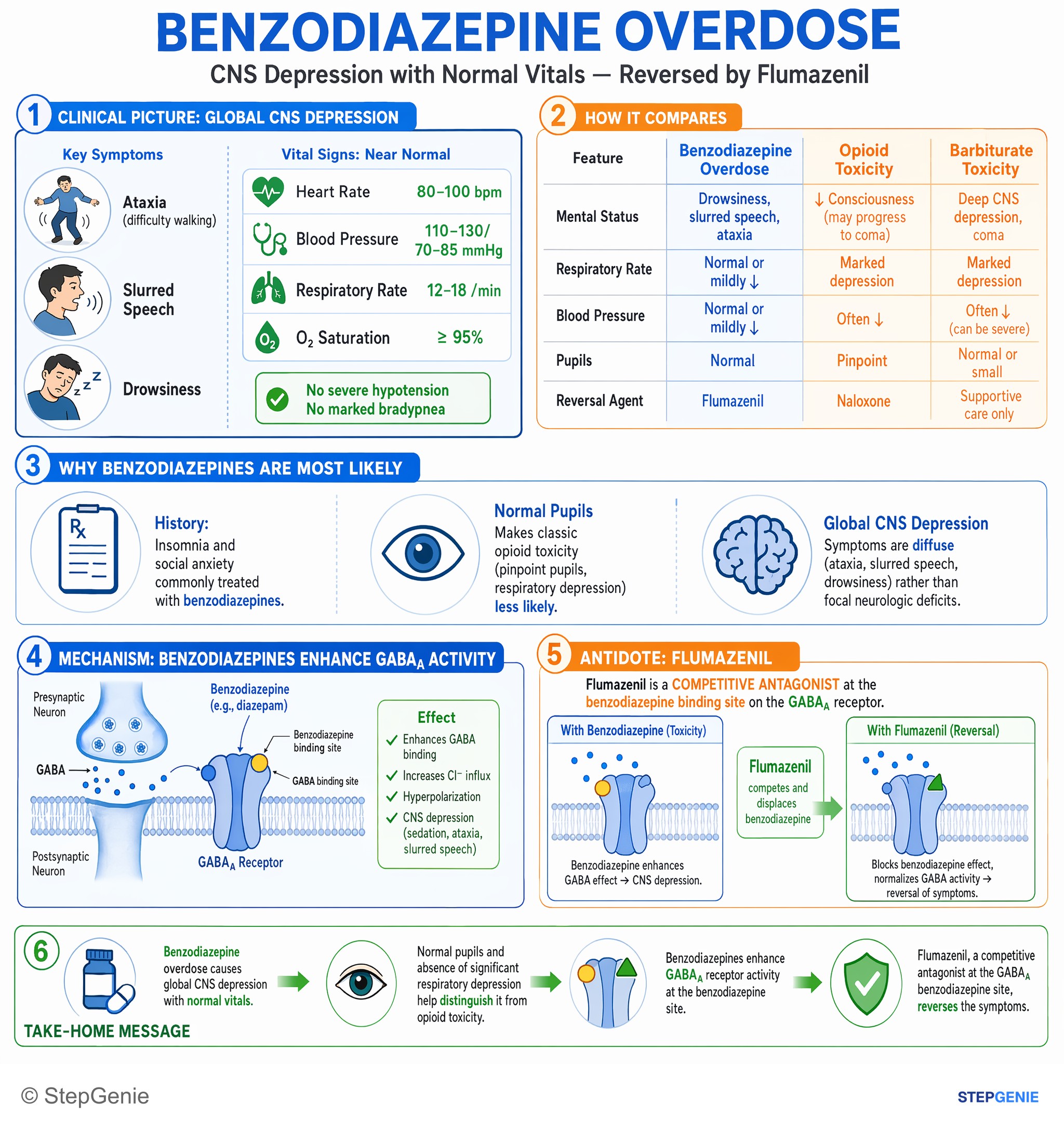
Benzodiazepine overdose causes CNS depression with normal vitals; reversed by flumazenil, a competitive GABAA receptor antagonist at the…
USMLE Step 1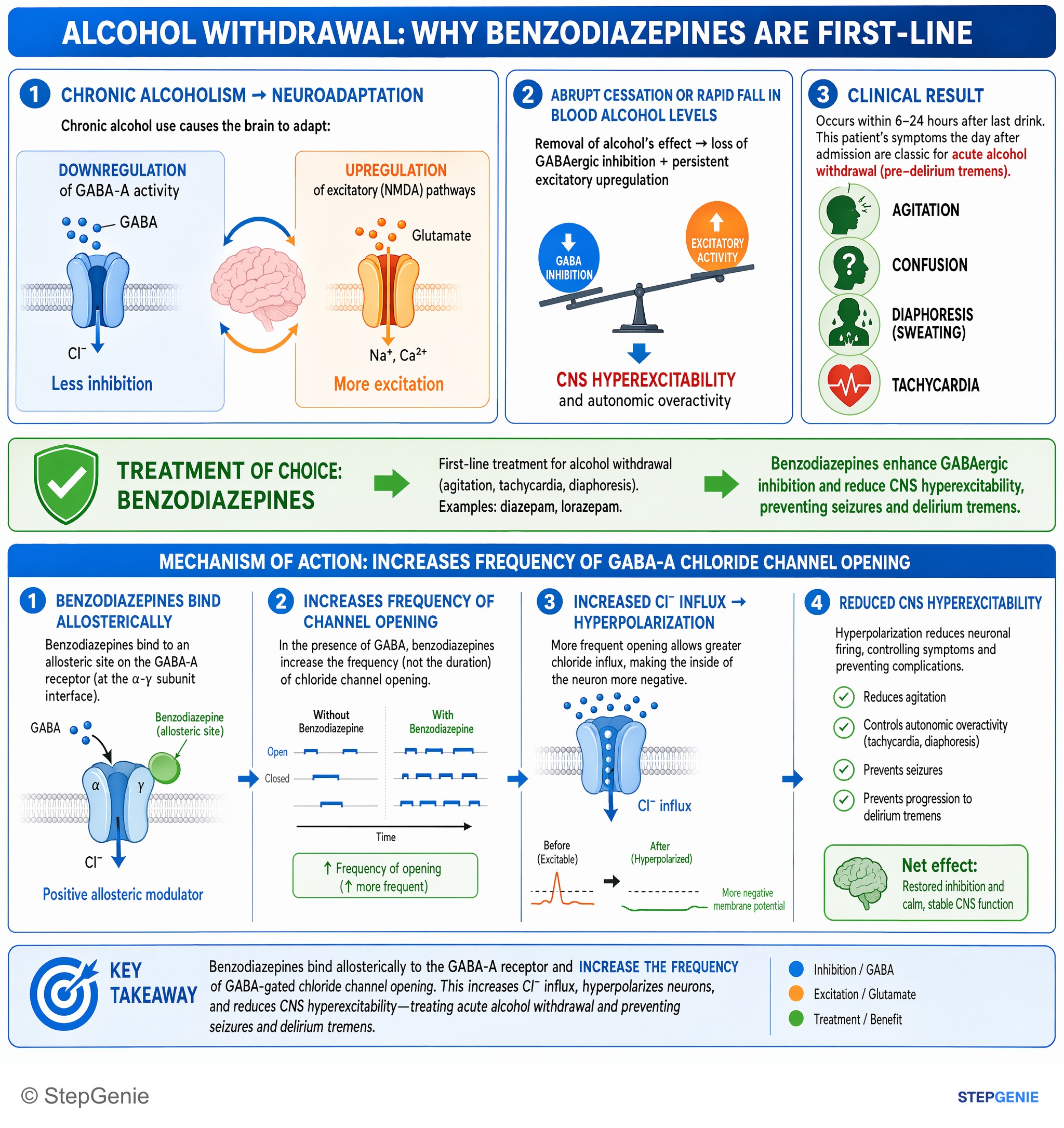
Alcohol withdrawal (agitation, tachycardia, diaphoresis) is treated with benzodiazepines, which increase frequency of GABA-A chloride…
USMLE Step 1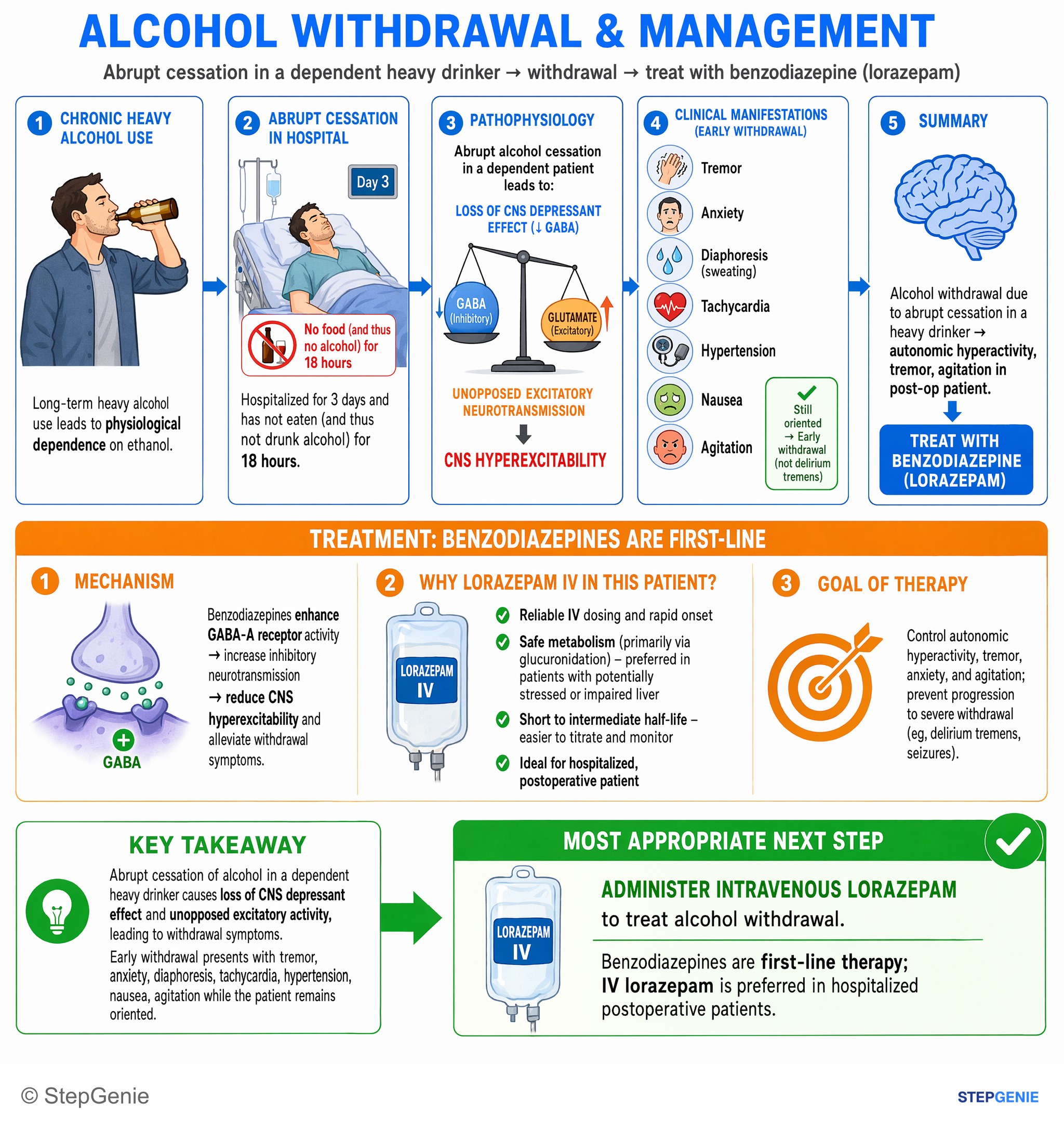
Alcohol withdrawal due to abrupt cessation in a heavy drinker → autonomic hyperactivity, tremor, agitation post-op → treat with…
USMLE Step 2Frequently Asked Questions
How do benzodiazepines work, and how are they different from barbiturates?
Benzodiazepines increase the frequency of GABAA chloride channel opening, which increases chloride influx, hyperpolarizes neurons, and produces rapid anxiolysis and sedation. The key contrast is that barbiturates increase the duration of GABAA channel opening rather than the frequency. This distinction is a classic exam favorite because both drug classes act at GABAA but change channel behavior in different ways.
What are the main Step-style uses of benzodiazepines?
The classic high-yield uses are acute panic or severe anxiety, alcohol withdrawal, status epilepticus, and procedural sedation. Benzodiazepines are best for short-term, rapid control because they work quickly. Common examples include lorazepam and diazepam for status epilepticus, chlordiazepoxide for alcohol withdrawal, and midazolam for procedural sedation because of its anxiolytic and amnestic effects.
Why aren’t benzodiazepines first-line for long-term anxiety disorders?
Benzodiazepines are not preferred for long-term anxiety because they are better suited for acute, short-term control and carry risks of dependence and tolerance. For long-term anxiety disorders, first-line treatment is usually SSRIs or SNRIs along with CBT. On exams, benzodiazepines are often presented as bridge therapy while SSRIs take effect rather than as the main chronic treatment.
What side effects and overdose risks should I know for benzodiazepines?
The key adverse effects are drowsiness, impaired coordination or reflexes, dependence, and worsening toxicity with other CNS depressants. Benzodiazepines can cause somnolence, confusion, impaired psychomotor performance, fall risk, anterograde amnesia, and sometimes paradoxical disinhibition such as agitation or aggression. Respiratory depression is usually low risk when taken alone, but becomes much more dangerous when combined with alcohol, opioids, or barbiturates.
When is flumazenil dangerous in benzodiazepine overdose?
Flumazenil can be dangerous because it may precipitate seizures in chronic benzodiazepine users and in mixed overdoses involving proconvulsant drugs such as TCAs. Although it is a competitive antagonist at GABAA, it is not automatically safe to give just because benzodiazepines are involved. The major exam pitfall is recognizing that reversal can worsen the situation in dependent patients or certain coingestions.