Generalized anxiety disorder (GAD) is one of those Step 1 topics that seems “soft” until it shows up as a classic vignette: months of excessive, hard-to-control worry + physical tension symptoms, with normal labs and no single trigger. The trick is to recognize the pattern, separate it from panic disorder and medical mimics, and know the core treatments and mechanisms.
Where GAD Fits in the USMLE Psychiatry Map
On exams, GAD lives in the anxiety disorders bucket (alongside panic disorder, phobias, social anxiety). It’s not “fear of one thing”—it’s diffuse, persistent worry across multiple life domains.
First Aid cross-reference (Psychiatry):
- First Aid for the USMLE Step 1 → Psychiatry → Anxiety disorders (GAD vs panic vs phobias), defense mechanisms, and drug adverse effects (SSRIs/SNRIs, benzos, buspirone).
Definition (The Step 1 Version)
Generalized anxiety disorder = excessive anxiety and worry occurring more days than not for at least 6 months, about a number of events or activities, that is difficult to control and causes impairment.
Diagnostic Core (High Yield)
- Duration: months
- Content: multiple domains (work, health, family, finances)
- Control: hard to control
- Associated symptoms: at least 3 (more on this below)
Pathophysiology: What’s Going On Under the Hood?
Step 1 won’t usually demand a full circuit diagram, but it will expect you to connect GAD to neurotransmitters, limbic activity, and stress biology.
Key Neurobiology Themes
- Increased amygdala reactivity and altered regulation by prefrontal cortex → overestimation of threat, persistent worry.
- GABA: relative decreased inhibitory tone is a common testable concept for anxiety (why benzodiazepines, which enhance GABA-A, work quickly).
- Serotonin (5-HT) and norepinephrine (NE) dysregulation → rationale for SSRIs/SNRIs as first-line maintenance.
- HPA axis overactivity (stress response) is often discussed in anxiety broadly; chronic stress can reinforce autonomic symptoms and hypervigilance.
Genetics and Risk
- Moderate heritability; often comorbid with mood disorders.
- Risk increases with chronic stress, certain personality traits (high neuroticism), and adverse life events.
Clinical Presentation: How It Shows Up on Vignettes
Think “worrier + tension + insomnia.” Patients usually aren’t having discrete “attacks”—they’re persistently keyed up.
Core Symptoms (Remember “WATCHERS”)
For GAD, associated symptoms include at least 3 of the following (for months):
- Worry (excessive, hard to control)
- Anxiety/restlessness or feeling keyed up
- Tension (muscle tension)
- Concentration difficulty (“mind going blank”)
- Hyperarousal/irritability
- Energy decreased (fatigue)
- Restlessness (overlaps, but commonly tested)
- Sleep disturbance
(Official DSM-style set is: restlessness, fatigue, difficulty concentrating, irritability, muscle tension, sleep disturbance.)
Common Physical Findings (Often in the stem)
- Muscle tension, headaches
- GI upset (nausea, diarrhea)
- Tremulousness
- Sympathetic symptoms (not as “episodic” as panic)
High-Yield Comorbidities
- Major depressive disorder
- Other anxiety disorders
- Substance use (self-medication with alcohol/benzos)
Diagnosis: Criteria + Rule-Outs (Very Testable)
GAD is a clinical diagnosis. Step 1 loves asking you to rule out conditions that can look like anxiety.
Diagnostic Checklist (Practical)
- Excessive worry about multiple areas
- More days than not for months
- Difficult to control
- associated symptoms
- Causes clinically significant distress/impairment
- Not due to substance/medical condition
- Not better explained by another psychiatric disorder
Medical Mimics to Exclude (Classic Step 1)
| Mimic | Clues | Workup/Hint |
|---|---|---|
| Hyperthyroidism | weight loss, heat intolerance, tremor | Low TSH, high T4 |
| Pheochromocytoma | episodic headaches, sweating, palpitations | metanephrines |
| Arrhythmia | palpitations, syncope | ECG |
| Asthma/COPD | dyspnea, wheeze | PFTs |
| Substance-induced anxiety | caffeine, stimulants, cocaine, withdrawal | history + tox screen |
| Medication-induced | albuterol, levothyroxine excess, steroids | med list |
Differentiating GAD from Related Disorders (Favorite Exam Move)
| Disorder | Key Feature | Duration/Pattern |
|---|---|---|
| GAD | chronic, diffuse worry + tension | months, most days |
| Panic disorder | recurrent panic attacks + fear of future attacks | attacks are episodic |
| Social anxiety disorder | fear of negative evaluation | social/performance situations |
| Specific phobia | fear of a specific object/situation | immediate fear response |
| PTSD | trauma + intrusion/avoidance + mood/cognition changes + arousal | month after trauma |
| OCD | intrusive thoughts + compulsions | ritualistic behaviors |
| Illness anxiety | fear of having illness despite reassurance | minimal/no somatic symptoms |
Treatment: First-Line, Alternatives, and Mechanisms (Step 1 Essentials)
First-Line (Long-Term Control)
- CBT (especially cognitive restructuring + worry exposure/management)
- SSRIs (e.g., sertraline, escitalopram)
- SNRIs (e.g., venlafaxine, duloxetine)
High-yield pharmacology note: SSRIs/SNRIs take weeks to work. Early transient anxiety can happen—sometimes clinicians use short-term adjuncts.
Second-Line / Adjunct Options
- Buspirone (great Step 1 drug)
- Hydroxyzine (sometimes used short-term; sedating antihistamine)
- Benzodiazepines (short-term, acute relief; avoid long-term dependence)
The “Why” Behind the Drugs (Mechanisms You Can’t Miss)
SSRIs/SNRIs
- Increase serotonergic (and for SNRIs, noradrenergic) signaling.
- Adverse effects (HY): GI upset, sexual dysfunction, insomnia/sedation, initial anxiety activation; serotonin syndrome risk with combinations.
Buspirone (High Yield)
- Mechanism: 5-HT partial agonist
- Use: GAD (not acute panic relief)
- Key features:
- No sedation, no respiratory depression
- No dependence (unlike benzos)
- Takes 1–2+ weeks to work
First Aid cross-reference: often listed under anxiolytics with the key line “5-HT1A partial agonist used for GAD.”
Benzodiazepines
- Mechanism: increase frequency of GABA-A channel opening
- Pros: rapid symptom relief
- Cons: sedation, falls, dependence, withdrawal (can cause seizures), respiratory depression when combined with other CNS depressants
High-Yield Associations & Exam Tips
What the vignette usually looks like
- “For the past 8 months she has felt on edge and worries about work performance, finances, and family health… difficulty sleeping… muscle tension… trouble concentrating.”
Common question styles
- Pick the diagnosis (GAD vs panic vs thyroid disease)
- Pick first-line management (CBT + SSRI/SNRI)
- Pick the best add-on if worried about dependence (buspirone)
- Mechanism questions (buspirone = 5-HT1A partial agonist, benzos = GABA-A frequency)
Red flags that point away from GAD
- Discrete episodes peaking within minutes → think panic attack
- Single trigger (e.g., spiders) → specific phobia
- Trauma + flashbacks/nightmares → PTSD
- Unexpected weight loss + heat intolerance → hyperthyroidism
Rapid Review Table (Last-Minute Step 1)
| Category | GAD High-Yield |
|---|---|
| Duration | months |
| Core | Excessive worry about multiple domains, hard to control |
| Symptoms | : restlessness, fatigue, poor concentration, irritability, muscle tension, sleep disturbance |
| First-line tx | CBT + SSRI/SNRI |
| Key alt | Buspirone (5-HT partial agonist; delayed onset; no dependence) |
| Big rule-out | Hyperthyroidism, substance/medication induced anxiety |
Quick Practice: One-Liner Recall (Useful on Test Day)
- GAD = months of excessive, uncontrollable worry + 3+ tension/insomnia/concentration symptoms; treat with CBT + SSRI/SNRI, consider buspirone; avoid chronic benzos.
Visual explanations from the StepGenie QBank
Infographics StepGenie drew to explain questions in its own QBank, matched to this article's topic. Each caption is the takeaway of the question it explains.
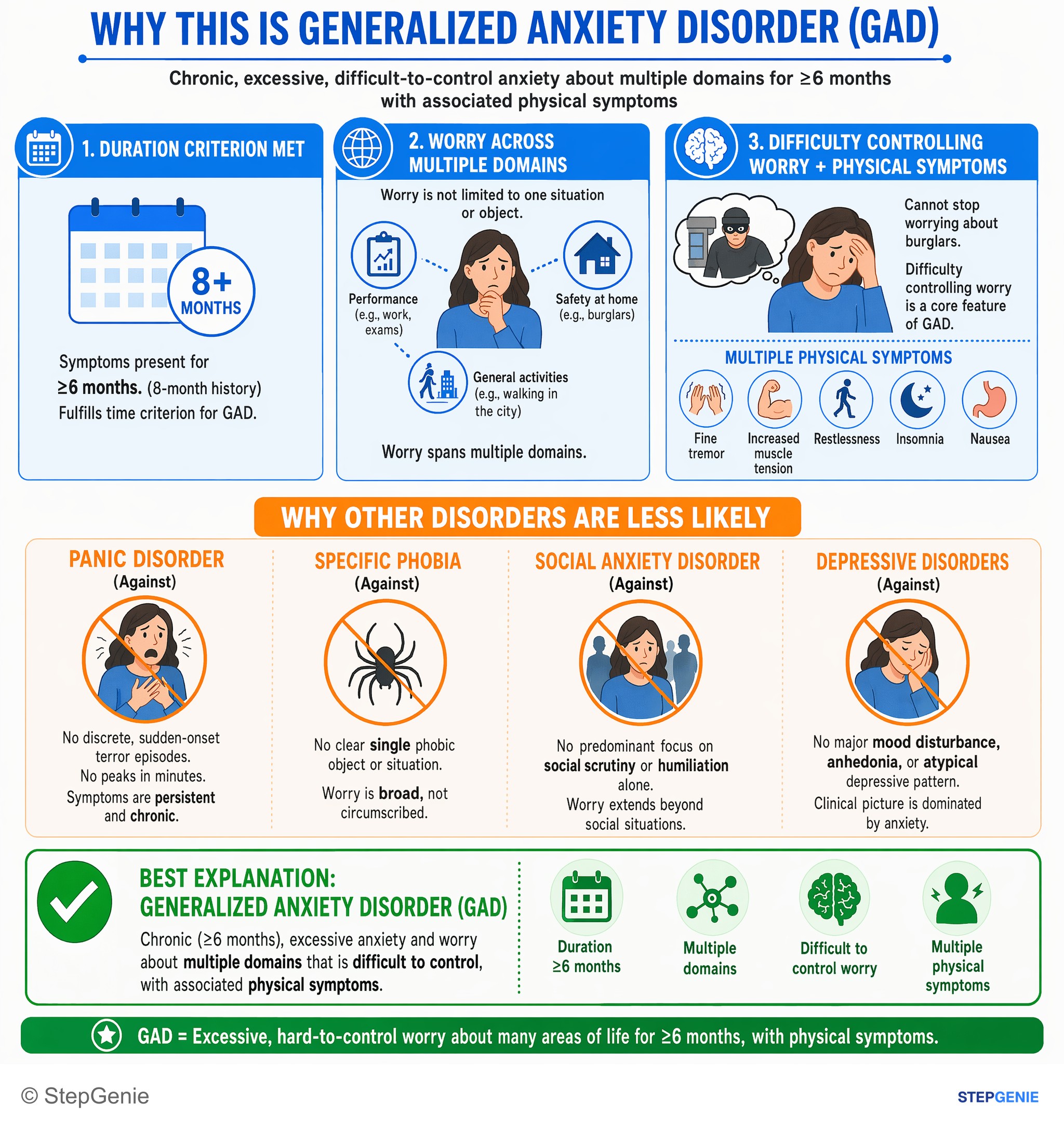
Generalized anxiety disorder = chronic, excessive, difficult-to-control anxiety about multiple domains for ≥6 months with physical…
USMLE Step 2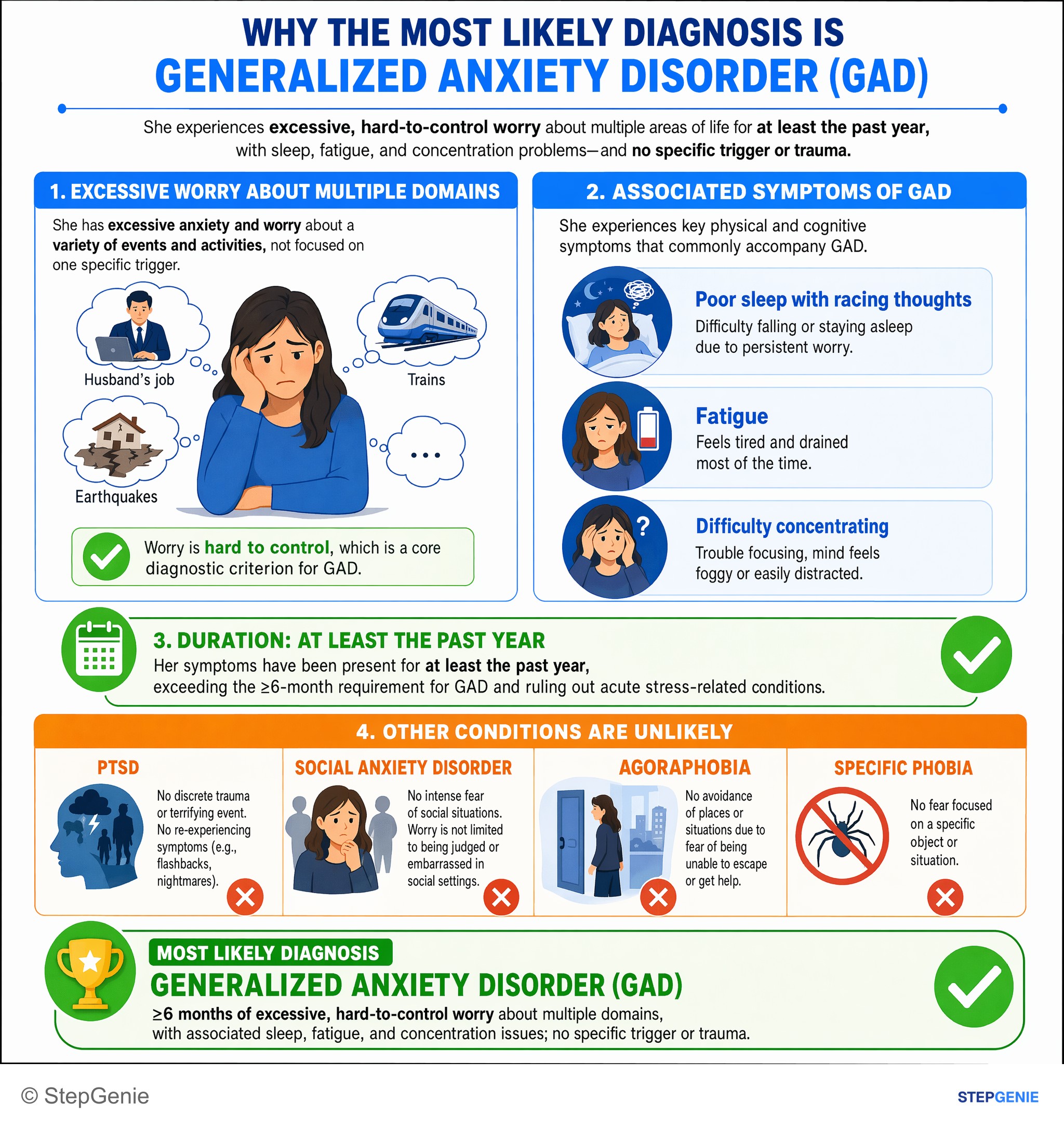
Generalized anxiety disorder: ≥6 months of excessive, hard-to-control worry about multiple domains with sleep, fatigue, and concentration…
USMLE Step 2Frequently Asked Questions
How do you tell generalized anxiety disorder from panic disorder on a vignette?
Generalized anxiety disorder is distinguished by chronic, diffuse worry with physical tension symptoms, while panic disorder features recurrent episodic panic attacks and fear of future attacks. In GAD, the anxiety is present more days than not for at least 6 months, spans multiple life domains, and is hard to control. Patients are often persistently keyed up rather than having discrete attacks.
What are the diagnostic criteria for generalized anxiety disorder that matter for Step 1?
The key criteria are excessive, hard-to-control worry about multiple areas of life occurring more days than not for at least 6 months, plus at least 3 associated symptoms. These symptoms include restlessness, fatigue, difficulty concentrating, irritability, muscle tension, and sleep disturbance. The symptoms must cause distress or impairment and not be due to a substance, medical condition, or another psychiatric disorder.
What medical conditions can mimic generalized anxiety disorder on Step 1?
Several medical and substance-related problems can mimic generalized anxiety disorder, so GAD remains a clinical diagnosis after rule-outs. High-yield mimics include hyperthyroidism, pheochromocytoma, arrhythmia, asthma or COPD, substance-induced anxiety from caffeine, stimulants, cocaine, or withdrawal, and medication-induced symptoms from albuterol, excess levothyroxine, or steroids. Exam stems often give clues like low TSH, episodic symptoms, syncope, wheeze, or a medication history.
What is the first-line treatment for generalized anxiety disorder?
First-line treatment for generalized anxiety disorder is CBT along with SSRIs or SNRIs for long-term control. CBT commonly focuses on cognitive restructuring and worry exposure or management. SSRIs such as sertraline and escitalopram, and SNRIs such as venlafaxine and duloxetine, are emphasized because serotonin and norepinephrine dysregulation are part of the disorder’s biology, although these medications take weeks to work.
Why do benzodiazepines work quickly in generalized anxiety disorder?
Benzodiazepines work quickly because they enhance GABA-A signaling, which increases inhibitory tone. Anxiety is linked in part to relatively decreased GABA-mediated inhibition, along with increased amygdala reactivity and altered prefrontal regulation, so boosting GABA can rapidly reduce symptoms. On exams, they are framed as short-term or acute relief options rather than ideal long-term therapy because of dependence concerns.