If antipsychotics feel like an endless list of side effects, receptors, and “-pines,” you’re not alone. The trick is to draw one picture that you can recreate in 20 seconds—then hang every drug and adverse effect on that sketch. This post gives you a shareable draw-it-out method plus the USMLE one-liners that turn typical vs atypical antipsychotics into a quick recall win.
The 20-second “Draw-it-out” map (Typical vs Atypical)
Grab a pen and draw this simple layout:
- Draw a stick neuron → dopamine synapse → another neuron. Label the receptor D2.
- Above it, draw a second receptor labeled 5-HT2A (serotonin).
- On the left, write TYPICAL = D2 block (strong).
- On the right, write ATYPICAL = 5-HT2A block + D2 block (weaker).
- Underneath, draw three boxes:
- Motor (Nigrostriatal)
- Pituitary (Tuberoinfundibular)
- Reward/Thought (Mesolimbic & Mesocortical)
Now connect the dots:
- Mesolimbic D2 blockade → helps positive symptoms
- Nigrostriatal D2 blockade → EPS
- Tuberoinfundibular D2 blockade → ↑ prolactin
That’s the core. Everything else is “which drugs do this most” and “what extra receptors they hit.”
One-liner concept (the whole topic in one sentence)
Typical antipsychotics are “pure D2 blockers” (great for positive symptoms but cause EPS + hyperprolactinemia), while atypicals add strong 5-HT2A blockade (less EPS, better for negative symptoms—at the cost of metabolic and drug-specific toxicities).
Visual mnemonic: “Two knobs on the same stereo”
Picture a stereo with two knobs you can turn down:
- D2 knob = dopamine signaling
- 5-HT2A knob = serotonin “brake” on dopamine pathways
Typical antipsychotics crank down D2 hard → quieter “positive symptom noise” but you also mute dopamine where you shouldn’t (movement + prolactin issues).
Atypicals turn down 5-HT2A strongly and D2 moderately → reduces dopamine blockade in motor pathways relative to limbic pathways → less EPS, plus often better negative symptom coverage.
High-yield receptor logic (Step-friendly)
Typical (1st gen) = strong D2 antagonism
Mechanism: D2 blockade in mesolimbic → ↓ positive symptoms (hallucinations, delusions).
Trade-off: D2 blockade elsewhere causes predictable toxicity.
Atypical (2nd gen) = 5-HT2A antagonism + D2 antagonism (or partial agonism)
- 5-HT2A antagonism tends to increase dopamine release in nigrostriatal pathways, which helps reduce EPS risk versus pure D2 blockade.
- Several have additional receptor effects that explain sedation, orthostasis, anticholinergic effects, and weight gain.
Typical vs Atypical: “What they treat” quick table
| Class | Best at improving | Less effective for | Classic exam phrasing |
|---|---|---|---|
| Typical (1st gen) | Positive symptoms | Negative symptoms, cognitive symptoms | “Strong D2 blockade → EPS, ↑ prolactin” |
| Atypical (2nd gen) | Negative symptoms (and positive) | — | “5-HT2A > D2 blockade → less EPS, more metabolic” |
The toxicity map (draw this under your sketch)
1) EPS (Nigrostriatal D2 blockade)
Time course matters—USMLE loves this.
- Acute dystonia (hours–days): neck spasm, torticollis, oculogyric crisis
- Treat: benztropine or diphenhydramine
- Akathisia (days–weeks): “I can’t sit still”
- Treat: beta-blocker (e.g., propranolol) ± benzo
- Parkinsonism (weeks): bradykinesia, rigidity, tremor
- Treat: benztropine or amantadine
- Tardive dyskinesia (months–years): choreoathetoid movements, lip smacking
- Treat: VMAT2 inhibitors (valbenazine, deutetrabenazine)
- Key: often irreversible; risk increases with duration
High-yield: Low-potency typicals have less EPS but more anticholinergic + sedation + orthostasis.
2) Neuroleptic Malignant Syndrome (NMS) — the “don’t miss”
Trigger: D2 blockade (often after starting/increasing antipsychotic).
Findings: fever, “lead-pipe” rigidity, autonomic instability, AMS, ↑ CK.
Treatment: stop agent + supportive care; dantrolene and/or bromocriptine are classic.
Differential high-yield: NMS vs serotonin syndrome
- NMS: rigidity, slower onset
- Serotonin syndrome: hyperreflexia/clonus, faster onset
3) Hyperprolactinemia (Tuberoinfundibular D2 blockade)
Dopamine normally inhibits prolactin. Block D2 → ↑ prolactin →
- galactorrhea, amenorrhea, infertility
- sexual dysfunction, gynecomastia
Most associated: typicals, and risperidone/paliperidone among atypicals.
4) Metabolic syndrome (Atypicals, especially some)
Weight gain, insulin resistance, dyslipidemia → monitor:
- BMI/weight, waist circumference
- A1c or fasting glucose
- lipids, BP
Drug list you actually need (with the “why” attached)
Typical antipsychotics: remember “High potency = High EPS”
High potency: Haloperidol, fluphenazine, trifluoperazine
- More EPS, more NMS, more hyperprolactinemia
- Less sedation/anticholinergic than low potency
Low potency: Chlorpromazine, thioridazine
- More anticholinergic (dry mouth, constipation, urinary retention), sedation (H1 block), orthostasis (α1 block)
- Less EPS than high potency
- Extra classic associations:
- Chlorpromazine: corneal deposits, photosensitivity (classically taught)
- Thioridazine: retinal deposits, QT prolongation (classically taught)
Atypical antipsychotics: anchor them to “signature toxicities”
Here’s the Step-style quick table.
| Drug | High-yield “signature” | Why it matters on exams |
|---|---|---|
| Clozapine | Agranulocytosis, seizures, myocarditis; marked weight gain | Reserved for treatment-resistant schizophrenia; requires ANC monitoring |
| Olanzapine | Big metabolic/weight gain | Think “metabolic monster” |
| Quetiapine | Sedation (H1), orthostasis (α1); relatively low EPS | Useful when EPS risk is a concern; also used in bipolar depression clinically |
| Risperidone / Paliperidone | Hyperprolactinemia, EPS at higher doses | “Atypical that behaves typical-ish” |
| Ziprasidone | QT prolongation | ECG risk factor question |
| Aripiprazole | Partial D2 agonist; can cause akathisia | Less prolactin elevation; “stabilizer” concept |
Mini-one-liner:
- Clozapine = “best efficacy, worst monitoring.”
- Olanzapine = “weight gain king.”
- Risperidone = “prolactin problem.”
- Ziprasidone = “QT question.”
- Aripiprazole = “partial agonist; may make you restless.”
The “Boards love this” clinical use map
Schizophrenia spectrum (primary indication)
- Treat positive symptoms with either class
- Atypicals have advantage for negative symptoms and lower EPS (in general)
Acute agitation / delirium (common inpatient scenario)
- Haloperidol is a classic (watch QT, EPS, NMS)
Bipolar disorder (Step 2-style crossover)
Many atypicals are used for:
- acute mania (often with mood stabilizer)
- bipolar depression (specific agents—varies)
Rapid-fire recall (shareable)
- Typical = D2 block hard → EPS + ↑ prolactin
- Atypical = 5-HT2A block + weaker D2 block → less EPS, more metabolic
- High potency typicals → high EPS
- Low potency typicals → more anticholinergic + sedation + orthostasis
- NMS = fever + rigidity + autonomic instability + ↑ CK → dantrolene/bromocriptine
- Clozapine = agranulocytosis (ANC monitoring) + seizures + myocarditis
- Ziprasidone = QT prolongation
- Risperidone = ↑ prolactin
Try it: the 10-second exam strategy
When you see an antipsychotic question, ask:
- Is this EPS vs metabolic vs prolactin vs NMS?
- If EPS/prolactin: think typicals or risperidone/paliperidone
- If metabolic: think olanzapine/clozapine
- If agranulocytosis: clozapine
- If QT prolongation: ziprasidone (and also some typicals—context matters)
Visual explanations from the StepGenie QBank
Infographics StepGenie drew to explain questions in its own QBank, matched to this article's topic. Each caption is the takeaway of the question it explains.
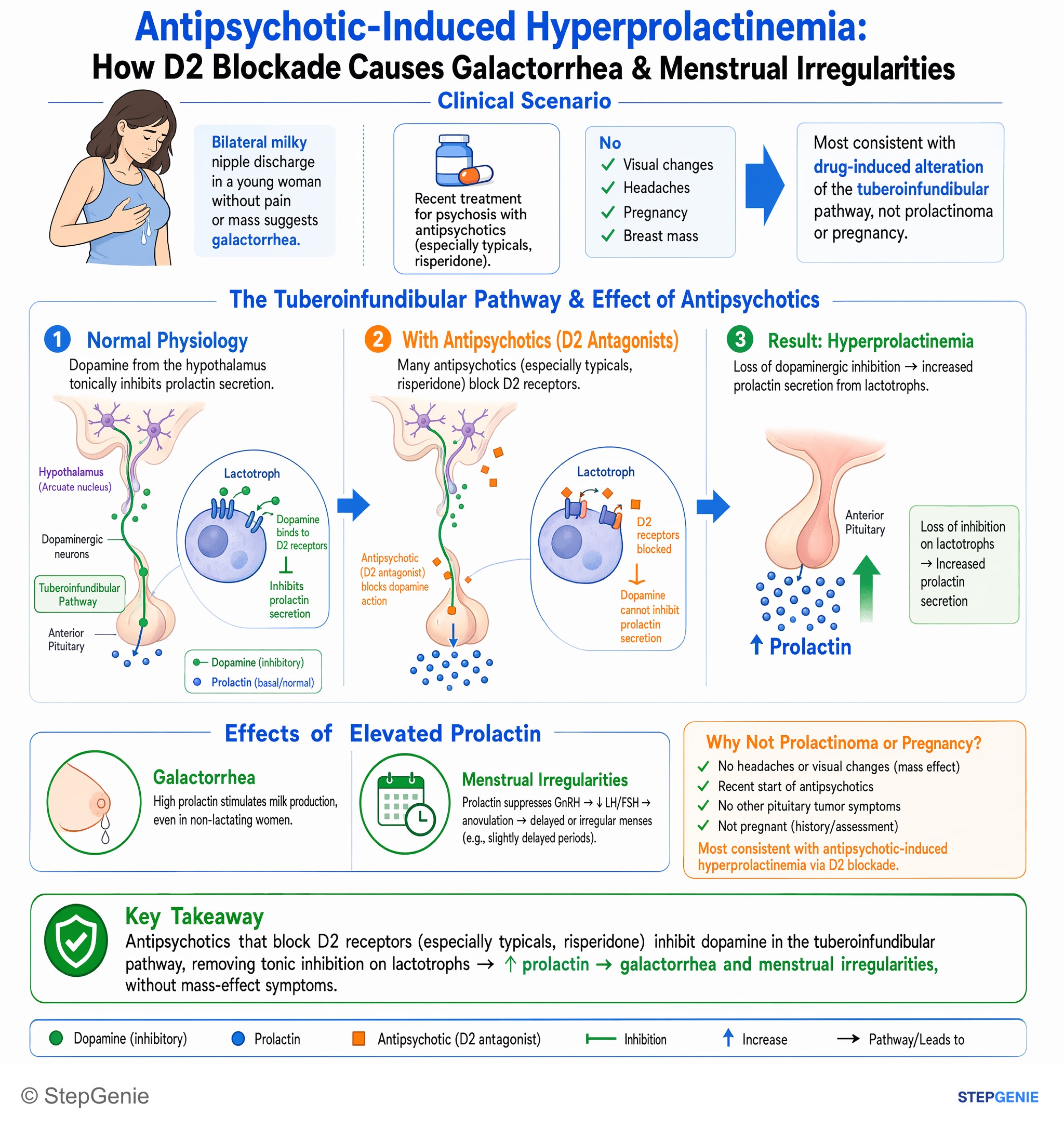
Antipsychotic-induced hyperprolactinemia from D2 blockade in the tuberoinfundibular pathway causes galactorrhea and menstrual…
USMLE Step 1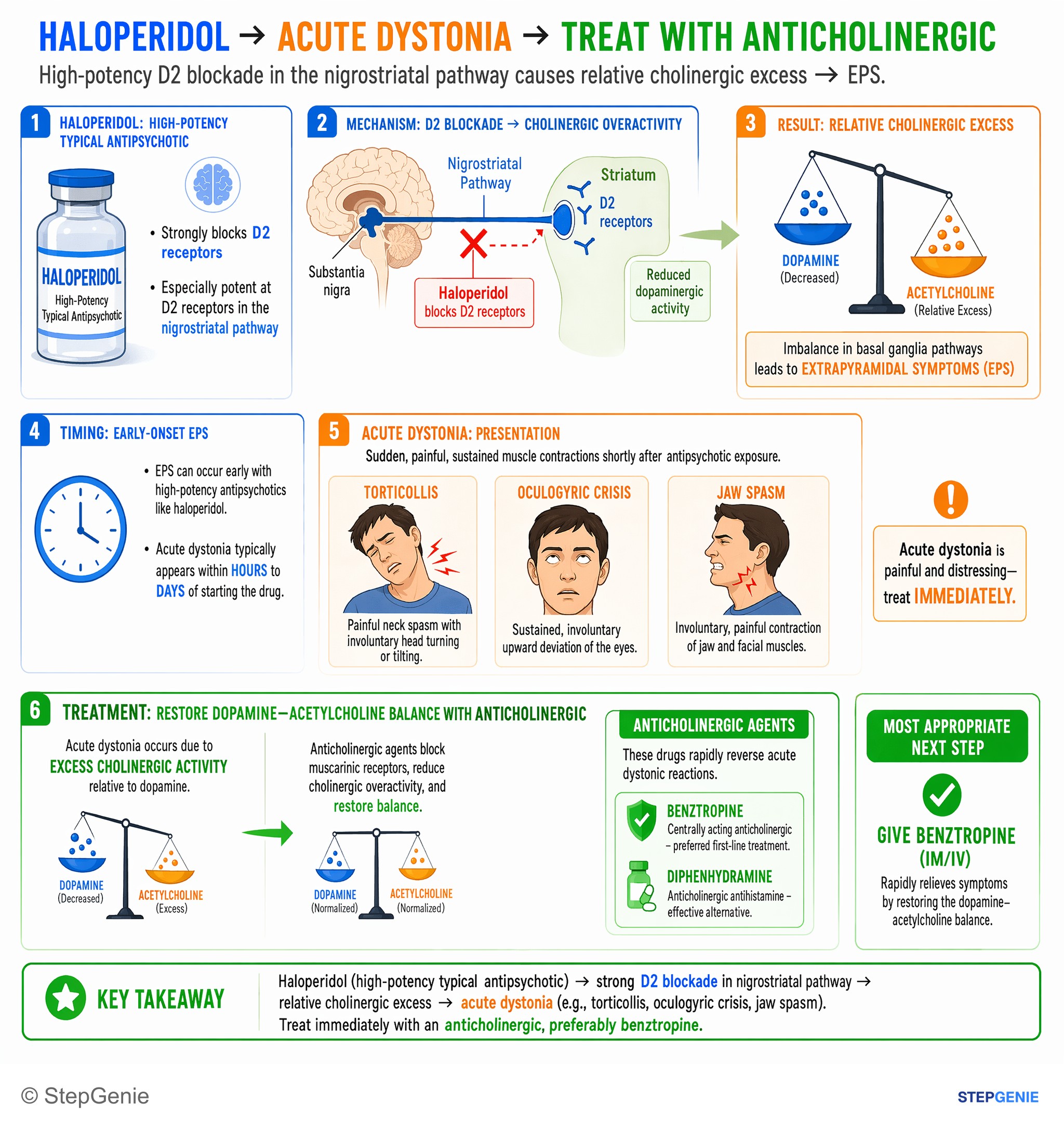
Acute dystonia from high-potency antipsychotic (haloperidol) → painful neck spasm/torticollis → treat immediately with anticholinergic…
USMLE Step 2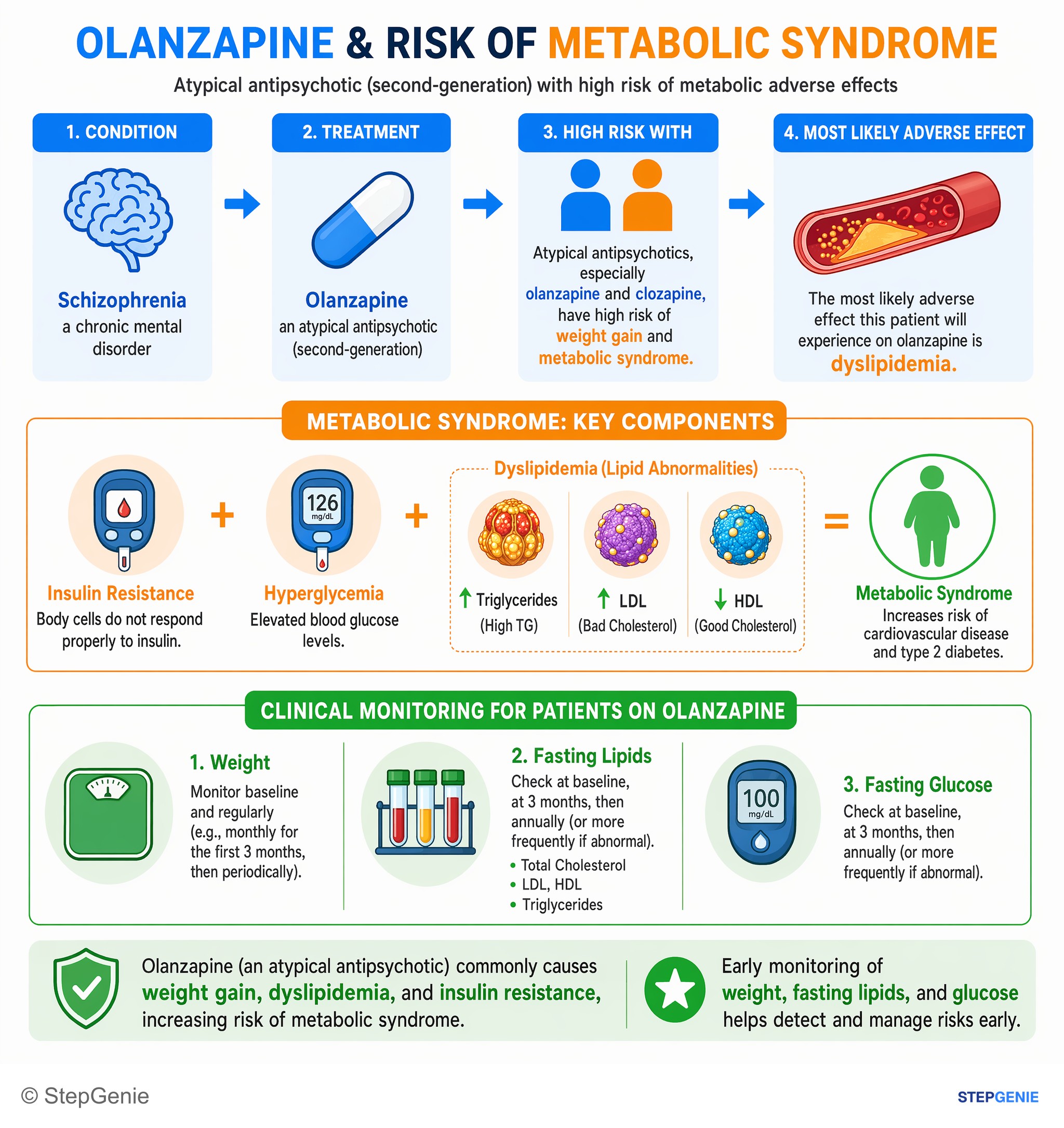
Olanzapine (an atypical antipsychotic) commonly causes weight gain, dyslipidemia, and insulin resistance, increasing risk of metabolic…
USMLE Step 1Frequently Asked Questions
Why do typical antipsychotics cause more EPS and hyperprolactinemia than atypical antipsychotics?
Typical antipsychotics cause more EPS and hyperprolactinemia because they strongly block D2 receptors. D2 blockade in the nigrostriatal pathway produces extrapyramidal symptoms, while D2 blockade in the tuberoinfundibular pathway raises prolactin because dopamine normally inhibits prolactin release. Atypical antipsychotics add strong 5-HT2A blockade with weaker D2 effects, which lowers EPS risk compared with pure D2 blockade.
How do you tell neuroleptic malignant syndrome from serotonin syndrome on exams?
Neuroleptic malignant syndrome is suggested by rigidity and a slower onset, whereas serotonin syndrome is associated with hyperreflexia and clonus and has a faster onset. NMS is triggered by D2 blockade, often after starting or increasing an antipsychotic, and classically presents with fever, lead-pipe rigidity, autonomic instability, altered mental status, and elevated CK.
What is the treatment for the different extrapyramidal symptoms caused by antipsychotics?
Treatment depends on which extrapyramidal symptom is present. Acute dystonia, which appears within hours to days, is treated with benztropine or diphenhydramine. Akathisia, which develops over days to weeks, is treated with a beta-blocker such as propranolol with or without a benzodiazepine. Parkinsonism is treated with benztropine or amantadine, while tardive dyskinesia is treated with VMAT2 inhibitors such as valbenazine or deutetrabenazine.
Which antipsychotics are most associated with hyperprolactinemia?
Hyperprolactinemia is most associated with typical antipsychotics and with risperidone or paliperidone among atypical agents. The mechanism is tuberoinfundibular D2 blockade, because dopamine normally inhibits prolactin. When that inhibition is removed, prolactin rises and can cause galactorrhea, amenorrhea, infertility, sexual dysfunction, and gynecomastia.
What are the highest-yield signature toxicities of clozapine, olanzapine, and low-potency typical antipsychotics?
Clozapine is classically associated with agranulocytosis, seizures, myocarditis, and marked weight gain, and it requires ANC monitoring because it is reserved for treatment-resistant schizophrenia. Olanzapine is known for major metabolic and weight gain effects. Low-potency typical antipsychotics are linked to more anticholinergic effects, sedation, and orthostasis, with chlorpromazine causing corneal deposits and photosensitivity and thioridazine causing retinal deposits and QT prolongation.