You’re staring at a psych vignette and it sounds like schizophrenia… but the timeline doesn’t fit. On USMLE, psychosis questions are often “diagnosis by duration,” and the test writers love to hide the correct answer in the time course + trigger + return to baseline. Let’s walk through a classic Q-bank style case of Brief Psychotic Disorder—and then systematically eliminate every tempting distractor.
Tag: Psychiatry > Psychotic & Mood Disorders
The Vignette (Q-bank style)
A 26-year-old woman is brought to the ED by her roommate for “acting bizarre” for the past 4 days. She has been talking to people who aren’t there, insists that the TV is sending her coded messages, and was found pacing all night. She is intermittently disorganized, alternating between tearfulness and agitation.
Her roommate reports this began shortly after the patient learned her younger sister died unexpectedly. The patient has no psychiatric history, no substance use, and no medical problems. Vitals are normal. Physical and neurologic exams are unremarkable. Urine toxicology screen is negative. Basic labs are within normal limits.
Which diagnosis best fits?
Step-wise Approach (How to Think Like the Exam)
When psychosis is in the stem, lock in these three questions:
- Is this primary psychiatric vs substance/medical?
- Negative tox screen + normal vitals/exam/labs helps.
- What is the duration of psychotic symptoms?
- Is there a mood episode driving the psychosis?
- If psychosis occurs only during mood episodes → mood disorder with psychotic features.
- If psychosis occurs outside mood episodes → consider schizoaffective or primary psychotic disorder.
Here, the clue combo is loud:
- Acute onset
- Duration: 4 days
- Triggered by severe stressor
- No prior history
- Return to baseline is implied/expected
- No substances/medical cause identified
Correct Answer: Brief Psychotic Disorder
Core Definition (USMLE-friendly)
Brief psychotic disorder = sudden onset of psychotic symptoms lasting ≥ 1 day but < 1 month, followed by full return to premorbid functioning.
Diagnostic Requirements (big picture)
- At least one of the following (often multiple):
- Delusions
- Hallucinations
- Disorganized speech
- Grossly disorganized or catatonic behavior
- Duration: 1 day to < 1 month
- Not better explained by:
- substance/medication
- another medical condition
- mood disorder with psychotic features
- schizophrenia spectrum disorders with longer duration
High-yield extras
- Can be with marked stressors (“brief reactive psychosis”)—exactly like this vignette.
- Treatment often includes:
- Short-term antipsychotic (especially if dangerous/gravely disabled)
- Benzodiazepines for acute agitation
- Hospitalization if safety concerns
- Prognosis is generally good, but recurrence can happen.
Why Each Answer Choice Matters (Systematic Distractor Breakdown)
Below is the kind of “duration + context” table that wins points on Step.
Time-Course Cheat Table
| Disorder | Psychosis? | Duration requirement | Key distinguishing feature |
|---|---|---|---|
| Brief psychotic disorder | Yes | 1 day–<1 month | Often stress-triggered; full return to baseline |
| Schizophreniform | Yes | 1–6 months | Schizophrenia picture but shorter |
| Schizophrenia | Yes | ≥6 months (with ≥1 month active) | Functional decline common |
| Delusional disorder | Yes (delusions) | ≥1 month | No prominent hallucinations/disorganization; functioning relatively preserved |
| Schizoaffective | Yes + mood episodes | ≥2 weeks psychosis without mood | Mood episodes present for majority of illness |
| MDD/Bipolar w/ psychotic features | Yes (during mood) | N/A | Psychosis occurs only during mood episodes |
| Substance/med-induced psychosis | Yes | Variable | Temporal link to substance/withdrawal; tox may help but isn’t perfect |
Distractor 1: Schizophreniform Disorder
Why it tempts you: This looks like schizophrenia—hallucinations, delusions, disorganization.
Why it’s wrong here: The duration is only 4 days.
- Schizophreniform requires ≥ 1 month symptoms and < 6 months total duration.
USMLE pearl:
If the stem says “it’s been a few weeks” → schizophreniform starts entering the chat.
If it’s “several months” → schizophrenia territory.
Distractor 2: Schizophrenia
Why it tempts you: Classic positive symptoms + disorganization.
Why it’s wrong here: Timeline is way too short.
- Schizophrenia requires continuous disturbance for ≥ 6 months (including prodromal/residual periods), with ≥ 1 month of active-phase symptoms.
Extra high-yield clue:
Schizophrenia often has functional decline (work/school/social). Many brief psychotic vignettes emphasize that the patient was previously high-functioning.
Distractor 3: Delusional Disorder
Why it tempts you: She has fixed false beliefs (TV messages).
Why it’s wrong here: Delusional disorder is not usually associated with:
- prominent hallucinations
- disorganized behavior/speech
- broad functional impairment
Also, delusional disorder requires ≥ 1 month of delusions. This is 4 days.
USMLE shortcut:
Delusional disorder = “otherwise normal life, but one bizarre belief (often nonbizarre), for at least a month.”
Distractor 4: Bipolar I Disorder with Psychotic Features
Why it tempts you: The patient is agitated, pacing, not sleeping—could be mania.
Why it’s wrong here: The stem doesn’t give a clear manic episode:
- Mania requires ≥ 1 week (or any duration if hospitalization is needed) of persistently elevated/irritable mood plus increased energy and other manic symptoms (grandiosity, pressured speech, flight of ideas, risky behavior, etc.).
Most importantly:
In mood disorders with psychotic features, psychosis occurs only during mood episodes. This vignette centers psychosis after stress, without a defined mood syndrome driving it.
Test-writer trick:
“Not sleeping” alone is not mania—psychosis and acute stress can also disrupt sleep.
Distractor 5: Major Depressive Disorder with Psychotic Features
Why it tempts you: There’s a major stressor and tearfulness.
Why it’s wrong here: MDD requires ≥ 2 weeks of depressive symptoms (SIGECAPS), and psychotic features are typically mood-congruent (e.g., guilt, deserved punishment, nihilism).
Here, symptoms are 4 days, and psychosis is not framed as occurring exclusively during a depressive episode.
Distractor 6: Schizoaffective Disorder
Why it tempts you: You might think “psychosis + mood symptoms.”
Why it’s wrong here: Schizoaffective requires:
- a major mood episode (MDD or manic) present for the majority of the illness and
- ≥ 2 weeks of psychosis without mood symptoms
This case is too short overall and doesn’t establish the required mood-psychosis relationship.
Distractor 7: Substance/Medication-Induced Psychotic Disorder
Why it tempts you: Always a top cause of acute psychosis in real life and on exams.
Why it’s wrong here (based on the stem):
- Negative tox screen
- No substance history
- No autonomic instability or sympathomimetic signs
But here’s the nuance that’s high-yield:
A negative tox screen does not rule out everything (some substances may not appear, timing matters, and synthetic drugs vary). The exam usually helps you by providing additional clues like:
- dilated pupils, tachycardia, severe hypertension (stimulants)
- diaphoresis, agitation, hyperthermia
- track marks, paraphernalia, recent medication change (steroids, dopaminergic meds)
Distractor 8: Psychotic Disorder Due to Another Medical Condition
Why it tempts you: Acute onset psychosis can be neurologic/endocrine/infectious.
Why it’s wrong here: The vignette purposely gives reassuring data:
- normal vitals
- unremarkable neuro exam
- normal basic labs
- no delirium picture
High-yield medical causes to keep on your radar (when the stem points you there):
- Thyroid disease (hyperthyroid can look manic/psychotic)
- Temporal lobe epilepsy
- Anti-NMDA receptor encephalitis (psychiatric symptoms + seizures/dyskinesias/autonomic instability, often young women)
- Neurosyphilis, HIV
- Brain tumor, CNS infection
- Delirium (waxing/waning attention, disorientation)
Rapid-Fire “If They Change One Detail…” (Exam Pattern Recognition)
- If symptoms last 12 hours after a stressor → not brief psychotic disorder (needs ≥ 1 day); consider acute stress reaction or evolving process.
- If symptoms last 2 months → schizophreniform (if schizophrenia-like).
- If symptoms last 8 months → schizophrenia.
- If there’s one fixed delusion for 2 months, minimal impairment → delusional disorder.
- If psychosis occurs only during mania → bipolar with psychotic features.
- If there are mood episodes and also ≥ 2 weeks of psychosis without mood symptoms → schizoaffective.
- If fluctuating consciousness/inattention → delirium, not a primary psychotic disorder.
Take-Home High-Yield Summary
- Brief psychotic disorder is a time-course diagnosis: 1 day to < 1 month, with full return to baseline.
- Look for acute onset, often after a major stressor, with no substance/medical driver.
- Most common distractors are schizophreniform (≥1 month) and mood disorders with psychotic features (psychosis restricted to mood episodes).
- Always rule out substance/medical causes when the stem gives you clues—but don’t overrule the provided vignette data.
Visual explanations from the StepGenie QBank
Infographics StepGenie drew to explain questions in its own QBank, matched to this article's topic. Each caption is the takeaway of the question it explains.
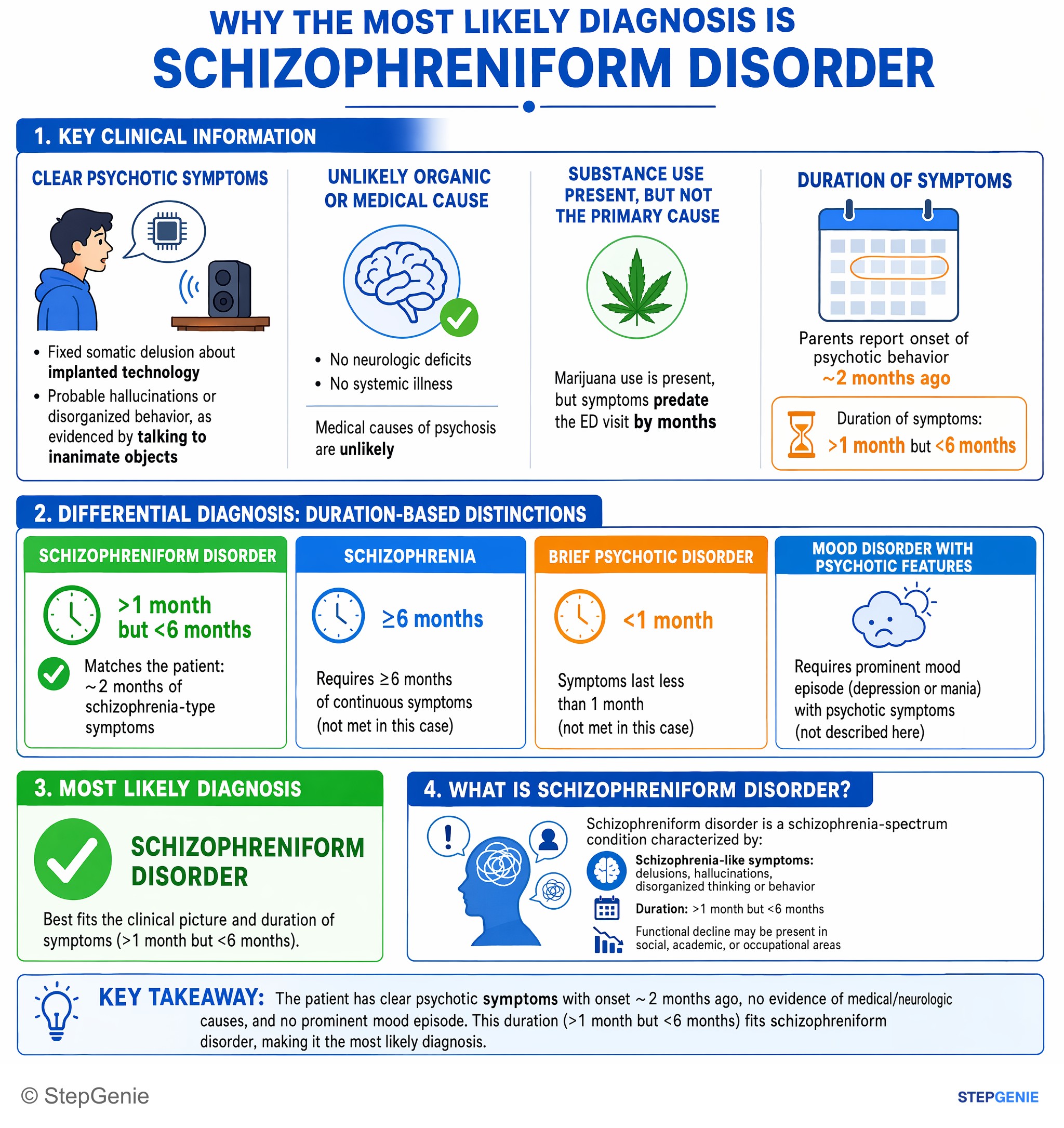
Schizophreniform disorder: schizophrenia-spectrum symptoms (delusions, hallucinations, disorganized behavior) lasting >1 month but <6…
USMLE Step 2Frequently Asked Questions
How do you diagnose brief psychotic disorder on a vignette?
Brief psychotic disorder is diagnosed when psychotic symptoms start suddenly, last at least 1 day but less than 1 month, and are followed by full return to premorbid functioning. Typical symptoms include delusions, hallucinations, disorganized speech, or grossly disorganized or catatonic behavior. The diagnosis also requires ruling out substances, medications, medical causes, mood disorders with psychotic features, and longer-duration schizophrenia spectrum disorders.
What clues help you tell brief psychotic disorder from schizophrenia or schizophreniform disorder?
The key clue is duration. Brief psychotic disorder lasts 1 day to less than 1 month, schizophreniform disorder requires at least 1 month but less than 6 months, and schizophrenia requires at least 6 months of continuous disturbance with at least 1 month of active symptoms. Brief psychotic disorder also often has acute onset, can follow a severe stressor, and is expected to have full return to baseline.
Why isn’t this vignette bipolar disorder or major depression with psychotic features?
It is not a mood disorder with psychotic features if the psychosis is not clearly occurring only during a mood episode. The exam approach is to ask whether a mood episode is driving the psychosis. If psychosis occurs only during mood episodes, think mood disorder with psychotic features. If psychosis occurs outside mood episodes, consider schizoaffective disorder or a primary psychotic disorder instead.
How do you rule out substance-induced or medical psychosis on exams?
You first decide whether the psychosis is primary psychiatric or caused by substances or a medical condition. Helpful clues for a primary psychiatric process are a negative urine toxicology screen, normal vital signs, an unremarkable physical and neurologic exam, and basic labs within normal limits. Those findings make a substance-related or medical cause less likely in a vignette like this one.
What is the typical treatment for brief psychotic disorder?
Treatment often includes a short-term antipsychotic, especially if the patient is dangerous or gravely disabled. Benzodiazepines can be used for acute agitation, and hospitalization may be needed if there are safety concerns. The disorder generally has a good prognosis, although recurrence can happen, so management focuses on acute stabilization and protection during the episode.