Persistent depressive disorder (PDD), the DSM-5 diagnosis that absorbed dysthymia and chronic major depression, is depressed mood for most of the day, more days than not, for at least 2 years in adults (at least 1 year in children and adolescents, whose mood can be irritable), plus at least 2 of 6 associated symptoms, with no symptom-free stretch longer than 2 months. Duration is what separates it on exams: major depressive disorder (MDD) needs 5 symptoms for 2 weeks, cyclothymic disorder needs 2 years of low-grade highs and lows, and adjustment disorder starts within 3 months of a stressor. Treatment follows general depression guidance: an antidepressant (SSRIs are often the first choice) and psychotherapy, often combined.
DSM-5-TR criteria at a glance
| Criterion | Requirement |
|---|---|
| A. Mood and duration | Depressed mood most of the day, more days than not, for at least 2 years; in children and adolescents, mood can be irritable and 1 year is enough |
| B. Associated symptoms | At least 2 of 6 while depressed: poor appetite or overeating, insomnia or hypersomnia, low energy or fatigue, low self-esteem, poor concentration or difficulty making decisions, hopelessness |
| C. Chronicity | Never without the A and B symptoms for more than 2 months at a time |
| D. Overlap with MDD | Full MDD criteria may be present continuously for 2 years; when MDD criteria are met, both diagnoses are given |
| E. No mania or hypomania | Never a manic or hypomanic episode; a past episode points to a bipolar disorder |
| F and G. Other exclusions | Not better explained by a psychotic disorder; not caused by a substance, medication or another medical condition such as hypothyroidism |
| H. Impact | Clinically significant distress or impairment |
Mnemonic for criterion B: HE'S 2 SAD. Hopelessness, Energy low, Self-esteem low, 2 = you need at least two, Sleep too much or too little, Appetite poor or overeating, Decisions and concentration difficult.
Specifiers worth recognizing:
- Onset: early (before age 21) or late (age 21 or older).
- Pattern over the last 2 years: with pure dysthymic syndrome (no full major depressive episode), with persistent major depressive episode (full criteria met throughout), or with intermittent major depressive episodes, with or without a current episode.
- DSM-5-TR changes: the parenthetical "(dysthymia)" was dropped from the name, because PDD is broader than the old DSM-IV dysthymic disorder, and only two feature specifiers still apply: with anxious distress and with atypical features. Exams and searchers still use "dysthymia."
Comparison table: PDD vs its look-alikes
| Disorder | Time requirement | Symptom threshold | Deciding rule | Classic stem clue |
|---|---|---|---|---|
| Persistent depressive disorder | 2 years (1 year in youth) | Depressed mood + at least 2 of 6 | No gap over 2 months; never mania or hypomania | "I've felt down for as long as I can remember" |
| Major depressive disorder | 2 weeks | At least 5 of 9, including depressed mood or loss of interest | Discrete episodes; an episode lasting 2 years or more also qualifies for PDD | "For the past month I can't get out of bed," with anhedonia or guilt |
| PDD + a major depressive episode ("double depression") | Chronic low mood, then a superimposed episode | Full MDD criteria on top of the PDD baseline | Diagnose both | Chronically gloomy patient who is much worse over the last few weeks |
| Cyclothymic disorder | 2 years (1 year in youth) | Many periods of hypomanic and depressive symptoms, none meeting full episode criteria | Symptoms at least half the time; no gap over 2 months | "Up and down for years, but never severe" |
| Bipolar II disorder | Hypomanic episode of at least 4 days + a major depressive episode | Full hypomanic and full major depressive episodes | Any hypomanic episode rules out PDD | Depressed patient with past spells of little sleep, high energy and big plans |
| Adjustment disorder with depressed mood | Starts within 3 months of a stressor | Distress out of proportion to the stressor or impaired function, below another disorder's threshold | Ends within 6 months after the stressor or its consequences end | "Since I lost my job..." |
Go deeper on the neighbors: major depressive disorder, cyclothymia and adjustment disorder.
How to separate them in 10 seconds
- Count the time. Weeks point to MDD; years point to PDD or cyclothymic disorder; onset within 3 months of a stressor points to adjustment disorder.
- Look for highs. Subthreshold hypomanic symptoms for years suggest cyclothymic disorder; a full hypomanic episode means bipolar II. PDD allows neither.
- Check the symptom list. PDD's criterion B list has no anhedonia, excessive guilt, psychomotor change or suicidal ideation. When those appear in a chronically low patient, look for a superimposed major depressive episode.
- Rule out medical and substance causes before calling it primary: thyroid disease, medications and alcohol or other substances.
Clinical picture and exam pearls
- Insidious onset, often in adolescence, with a course that can last years or decades. Patients may be habitually gloomy, pessimistic, self-critical and passive, and may describe it as "just my personality."
- Children and adolescents: irritability can replace sadness, and the duration requirement drops to 1 year.
- Double depression is common: most people with PDD have at least one major depressive episode during their lives.
- Comorbidity: anxiety disorders, substance use disorders and personality disorders such as borderline personality disorder are more likely.
- More common in women, and it can run in families.
- Suicide risk is increased, so ask directly about suicidal thoughts even when symptoms seem mild.
Treatment
| Step | What to do | Why |
|---|---|---|
| Rule out mimics | TSH and basic labs; review medications and substance use | Hypothyroidism and substances can cause chronic depressive symptoms |
| Screen for bipolar disorder | Ask about past mania, hypomania and family history before starting an antidepressant | An antidepressant can trigger a mixed or manic episode in bipolar disorder |
| Medication | SSRIs are often the first choice, as for depressive disorders in general; fluoxetine, sertraline, paroxetine and imipramine (among other drugs) beat placebo in a 2014 meta-analysis of dysthymia and chronic depression trials | Response can be slower and less complete than in MDD |
| Psychotherapy | CBT, interpersonal therapy, or CBASP, the psychotherapy developed specifically for chronic depression | Interpersonal therapy alone did less well than interpersonal therapy plus medication |
| Combine | Medication plus psychotherapy | Linked to higher response rates and better functioning, although research in PDD is limited |
| Safety | Assess suicide risk at baseline and monitor early in treatment | Antidepressants carry a boxed warning for suicidal thoughts in children, adolescents and young adults |
Drug classes, side effects and switching rules are in SSRIs, SNRIs, TCAs and MAOIs.
Practice question
A 34-year-old accountant asks for help because she has "always been a gloomy person" and is tired of feeling this way. For the past 3 years she has felt down on most days, sleeps poorly and feels like a failure. The longest she remembers feeling like herself was about 6 weeks last summer. She still enjoys her weekly book club, has missed no work and denies periods of elevated mood, decreased need for sleep or racing thoughts. She has no recent major stressor. She drinks one glass of wine a week, and her TSH is normal. Which of the following is the most likely diagnosis?
- A. Adjustment disorder with depressed mood
- B. Bipolar II disorder
- C. Cyclothymic disorder
- D. Major depressive disorder
- E. Persistent depressive disorder
Answer: E. She has depressed mood on most days for more than 2 years, two associated symptoms (insomnia and low self-esteem), no symptom-free period longer than 2 months, distress from her symptoms, no history of hypomania, and no medical or substance explanation.
Why the others are wrong:
- A: adjustment disorder requires an identifiable stressor, with symptoms starting within 3 months of it; she has none, and her symptoms have lasted 3 years.
- B: bipolar II needs at least one hypomanic episode of 4 or more days plus a major depressive episode; she denies elevated mood.
- C: cyclothymic disorder needs repeated periods of hypomanic symptoms as well as depressive ones.
- D: MDD needs at least 5 of 9 symptoms, including depressed mood or loss of interest, for 2 weeks. She has three (low mood, insomnia and feelings of failure) and her interests are preserved.
Follow-up: a year later she stops going to her book club and has 3 weeks of poor concentration, psychomotor slowing and thoughts that she would be better off dead. She now meets MDD criteria on top of PDD ("double depression"): both are diagnosed, her suicide risk must be assessed directly, and treatment is an antidepressant plus psychotherapy.
Key takeaways
- PDD = depressed mood most days for 2 years or more (1 year or more in youth, mood can be irritable) + at least 2 of 6 symptoms (HE'S 2 SAD).
- No symptom-free period longer than 2 months, and never a manic or hypomanic episode.
- MDD is weeks and 5 of 9 symptoms; if full MDD criteria are met during PDD, diagnose both (double depression).
- Cyclothymic disorder has 2 years of subthreshold highs and lows; adjustment disorder is stressor-linked and time-limited.
- DSM-5-TR dropped "(dysthymia)" from the name, but the old term still shows up in questions.
- Treat as for depression generally: an antidepressant, often an SSRI, plus psychotherapy (CBT, interpersonal therapy or CBASP), after screening for bipolar disorder and assessing suicide risk.
Sources
- Depressive Disorders — Merck Manual Professional Edition (2026)
- Persistent Depressive Disorder — StatPearls, NCBI Bookshelf (2024)
- DSM-IV to DSM-5 Dysthymic Disorder/Persistent Depressive Disorder Comparison — SAMHSA, NCBI Bookshelf
- Persistent Depressive Disorder: DSM-5-TR changes — American Psychiatric Association (2022)
- Persistent Depressive Disorder (Dysthymia): criteria and specifiers — PsychDB (2021)
- Persistent depressive disorder — MedlinePlus Medical Encyclopedia (2024)
- Cyclothymic Disorder — Merck Manual Professional Edition (2026)
- Bipolar Disorders — Merck Manual Professional Edition (2026)
- Adjustment Disorders — Merck Manual Professional Edition (2026)
- Zoloft (sertraline) prescribing information — DailyMed (2023)
- Identifying subgroups with differential response to CBASP versus escitalopram during the first eight weeks of treatment in outpatients with persistent depressive disorder — European Archives of Psychiatry and Clinical Neuroscience (2023)
Visual explanations from the StepGenie QBank
Infographics StepGenie drew to explain questions in its own QBank, matched to this article's topic. Each caption is the takeaway of the question it explains.
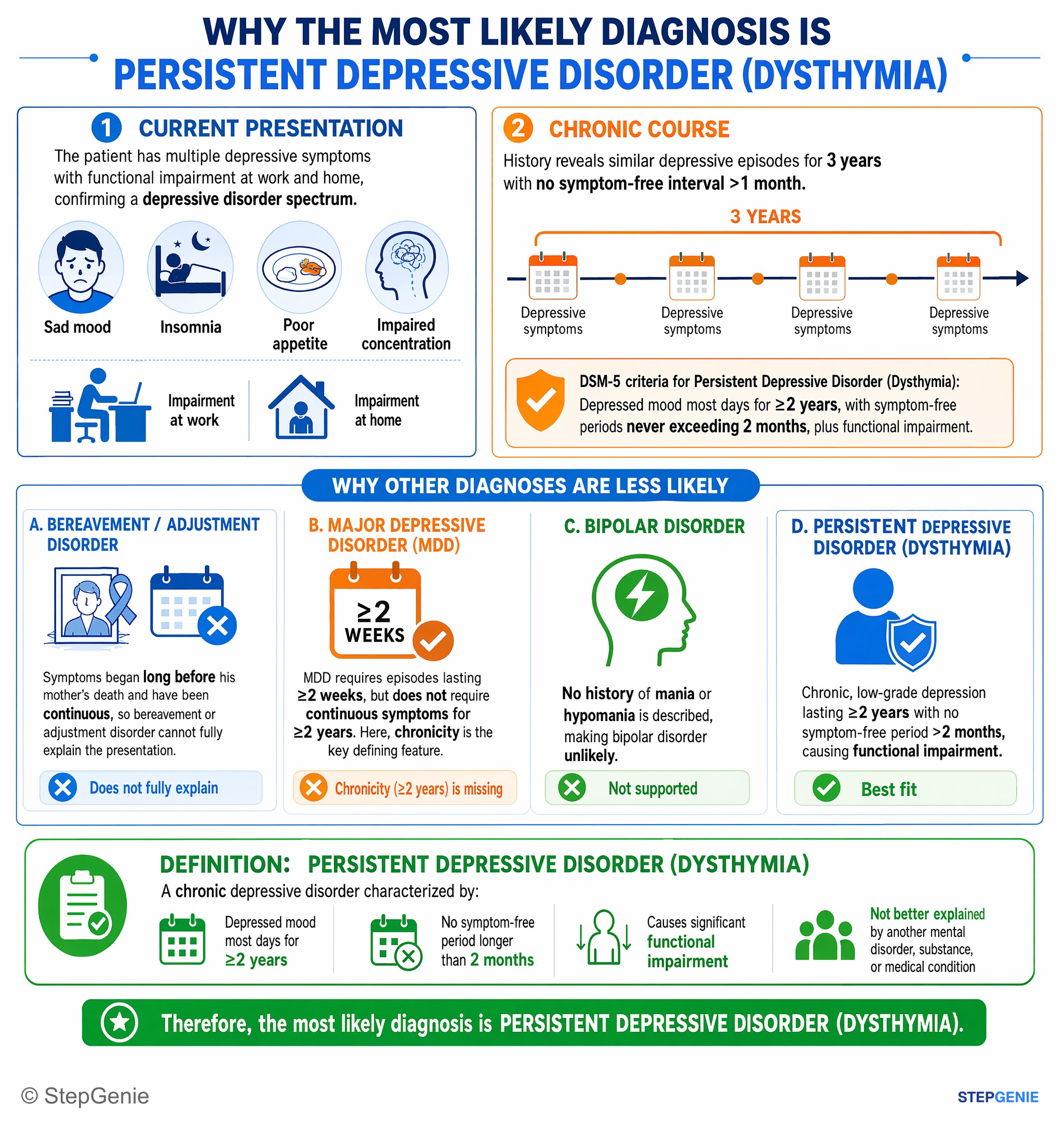
Persistent depressive disorder: chronic, low-grade depression lasting ≥2 years with no symptom-free period >2 months, causing functional…
USMLE Step 2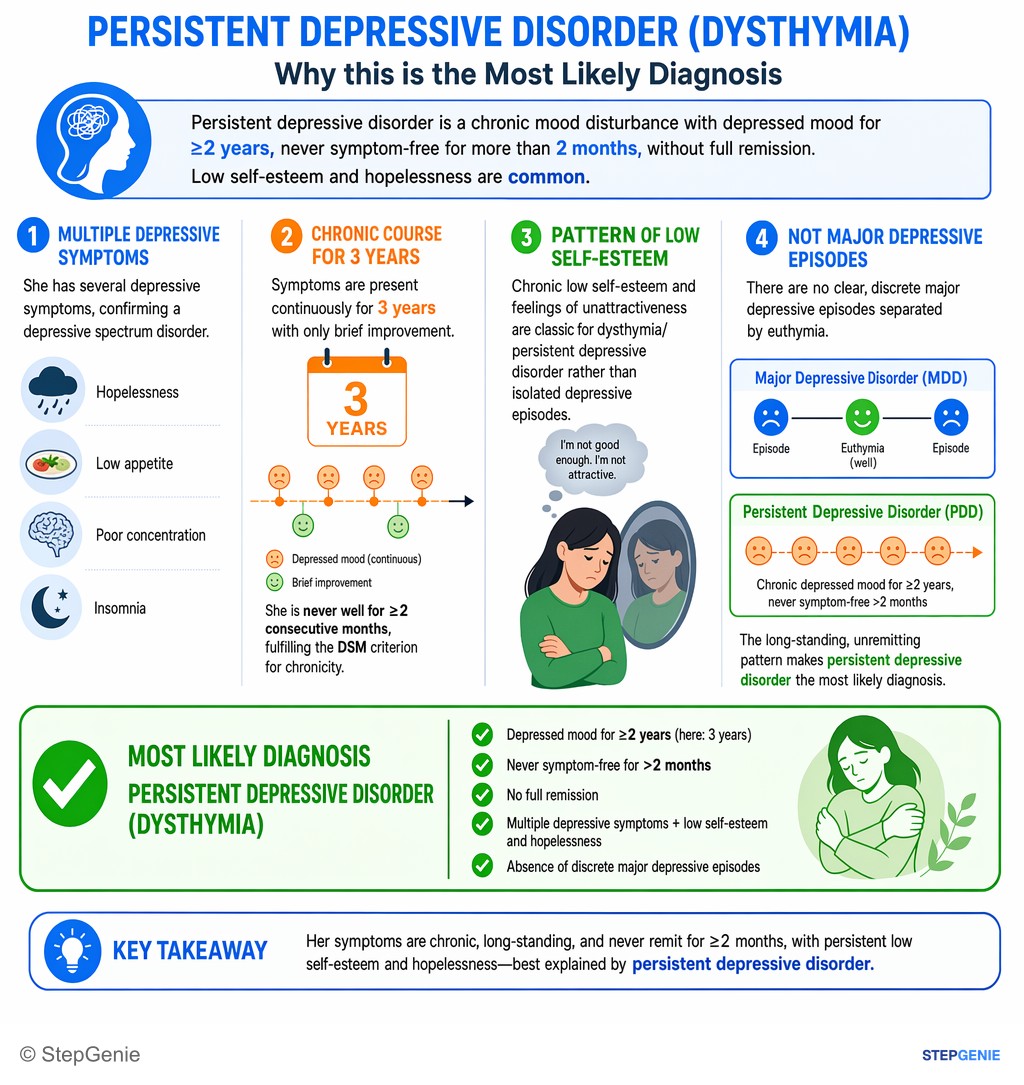
Persistent depressive disorder = chronic depressed mood ≥2 years, never symptom-free >2 months, without full remission; low self-esteem…
USMLE Step 2Frequently Asked Questions
What is the difference between persistent depressive disorder and major depressive disorder?
Persistent depressive disorder is defined by duration: depressed mood most days for at least 2 years (1 year in children and adolescents) with at least 2 of 6 associated symptoms. Major depressive disorder requires at least 5 of 9 symptoms, including depressed mood or loss of interest, nearly every day for at least 2 weeks. The two can coexist; when full major depression criteria are met during persistent depressive disorder, both diagnoses are made.
Is dysthymia the same as persistent depressive disorder?
Mostly, but not exactly. DSM-5 created persistent depressive disorder by combining the older diagnoses of dysthymic disorder and chronic major depressive disorder, so it covers more people than DSM-IV dysthymia did. For that reason DSM-5-TR dropped the word dysthymia from the diagnosis name, although the term is still widely used, including in exam questions.
What are the DSM-5-TR criteria for persistent depressive disorder?
Depressed mood for most of the day, more days than not, for at least 2 years in adults or 1 year in children and adolescents, in whom mood can be irritable. At least 2 of these must be present: poor appetite or overeating, insomnia or hypersomnia, low energy, low self-esteem, poor concentration or indecision, and hopelessness. The person has never been symptom-free for more than 2 months at a time and has never had a manic or hypomanic episode, and the symptoms are not explained by a psychotic disorder, a substance or another medical condition.
What is double depression?
Double depression is the informal term for a major depressive episode superimposed on persistent depressive disorder. The classic patient has felt chronically low for years and then has a few weeks of markedly worse symptoms such as anhedonia, guilt, psychomotor slowing or suicidal thoughts. Both diagnoses are made, and most people with persistent depressive disorder have at least one major depressive episode during their lives.
How is persistent depressive disorder different from cyclothymic disorder?
Both last at least 2 years in adults (1 year in children and adolescents) and allow no symptom-free period longer than 2 months. Persistent depressive disorder involves only depressive symptoms and excludes any history of mania or hypomania. Cyclothymic disorder involves numerous periods of both hypomanic and depressive symptoms, present at least half the time, that never meet full criteria for a hypomanic or major depressive episode.
What is the first-line treatment for persistent depressive disorder?
Treatment follows general depression guidance: an antidepressant, most often an SSRI, and psychotherapy such as cognitive behavioral therapy, interpersonal therapy or CBASP, a therapy designed for chronic depression, and the two are often combined. Medication may work more slowly and less completely than in major depression. Before starting an antidepressant, clinicians screen for a personal or family history of bipolar disorder and assess suicide risk.