All four classes raise synaptic monoamines: SSRIs block serotonin (5-HT) reuptake, SNRIs block serotonin and norepinephrine reuptake, TCAs block both but also block muscarinic, histamine H1 and alpha-1 receptors (and cardiac sodium channels in overdose), and MAOIs stop the breakdown of norepinephrine, serotonin and dopamine. SSRIs are usually the first choice because they have a wide safety margin; TCAs are dangerous in overdose (wide QRS: give IV sodium bicarbonate) and MAOIs cause hypertensive crises with tyramine. The traps that recur: serotonin syndrome when serotonergic drugs are combined, the 2-week washout between an MAOI and other antidepressants (5 weeks after fluoxetine), and the boxed warning for suicidal thoughts in children, adolescents and young adults.
The four classes at a glance
| SSRIs | SNRIs | TCAs | MAOIs | |
|---|---|---|---|---|
| Mechanism | Block 5-HT reuptake | Block 5-HT and NE reuptake | Block NE and 5-HT reuptake, plus muscarinic, H1 and alpha-1 blockade | Inhibit MAO, so NE, 5-HT and dopamine are not broken down |
| Drugs | Fluoxetine, sertraline, paroxetine, citalopram, escitalopram, fluvoxamine | Venlafaxine, desvenlafaxine, duloxetine; milnacipran (US: fibromyalgia only) | Amitriptyline, nortriptyline, imipramine, desipramine, clomipramine, doxepin | Phenelzine, tranylcypromine, isocarboxazid, selegiline patch |
| Classic uses | MDD, GAD, panic disorder, PTSD, OCD, social anxiety, PMDD | MDD, GAD; duloxetine for diabetic neuropathic pain, fibromyalgia, chronic musculoskeletal pain | Neuropathic pain, migraine prevention (amitriptyline), OCD (clomipramine), enuresis (imipramine); rarely depression now | Refractory or atypical depression |
| Signature adverse effects | Sexual dysfunction, GI upset, hyponatremia (SIADH), bleeding, QT prolongation (citalopram) | SSRI-like plus dose-related rise in blood pressure | Anticholinergic, sedation, weight gain, orthostatic hypotension, conduction delay | Hypertensive crisis with tyramine or sympathomimetics |
| Biggest danger | Serotonin syndrome when combined with other serotonergic drugs (alone, a wide safety margin) | Serotonin syndrome; hypertension | Overdose: wide QRS, arrhythmias, seizures | Hypertensive crisis; serotonin syndrome |
Antidepressants usually start working in about 2-3 weeks (sometimes as early as 4 days or as late as 8 weeks), so "no response after 5 days" is not treatment failure.
SSRIs: the default first choice
SSRIs are often the initial drugs of choice: they have a wide therapeutic margin, need little dose adjustment, and have minimal cardiac and anticholinergic effects.
- Sexual dysfunction occurs in more than half of patients; nausea and loose stools are common early.
- Hyponatremia from SIADH: older and volume-depleted patients are at highest risk. A confused older adult with a low sodium after starting an SSRI is a classic stem (see SIADH vs psychogenic polydipsia).
- Bleeding: risk rises with aspirin, NSAIDs, warfarin and other anticoagulants.
- Citalopram causes dose-dependent QT prolongation (torsades risk): the maximum is 40 mg/day, and 20 mg/day for patients over 60, with hepatic impairment, CYP2C19 poor metabolizers or those on CYP2C19 inhibitors such as cimetidine.
- Fluoxetine has a very long half-life, so it is least likely to cause discontinuation symptoms, and an MAOI must wait 5 weeks after it is stopped.
- Paroxetine may cause the most weight gain of the SSRIs. Fluoxetine and paroxetine are also strong CYP2D6 inhibitors and fluvoxamine strongly inhibits CYP1A2 and 2C19 (see the CYP450 guide).
- Mania switch: screen for bipolar disorder before starting; an antidepressant alone can unmask mania (see bipolar I vs II).
- Discontinuation symptoms after abrupt stops: nausea, chills, muscle aches, dizziness, anxiety, irritability, insomnia and fatigue. Taper instead.
- Pregnancy: late-pregnancy exposure to SSRIs and SNRIs may raise the risk of persistent pulmonary hypertension of the newborn and of neonatal complications (respiratory distress, feeding difficulty, jitteriness, irritability).
SNRIs: SSRI effects plus norepinephrine
- Venlafaxine: dose-related increases in systolic and diastolic blood pressure, so blood pressure is checked before and during treatment. Its discontinuation symptoms can be marked; some patients need to taper over months.
- Duloxetine: approved for MDD, GAD, diabetic peripheral neuropathic pain, fibromyalgia and chronic musculoskeletal pain. Avoid it with substantial alcohol use or chronic liver disease (hepatotoxicity), and watch for urinary hesitancy.
- Milnacipran is approved in the US only for fibromyalgia, not depression.
- SNRIs and TCAs are first-line drugs for neuropathic pain, and duloxetine is better tolerated than TCAs.
TCAs: effective, but every receptor is hit
Think of the side effects receptor by receptor:
| Blocked target | Result |
|---|---|
| Muscarinic | Dry mouth, constipation, urinary retention, blurred vision, confusion; dangerous with angle-closure glaucoma or BPH |
| H1 | Sedation, weight gain |
| Alpha-1 | Orthostatic hypotension, falls and fractures |
| Cardiac sodium channels (overdose) | QRS widening, ventricular arrhythmias |
- Secondary amines (nortriptyline, desipramine) are better tolerated than tertiary amines (amitriptyline, imipramine). Amitriptyline is not recommended for older patients or those with cardiac disease because of strong anticholinergic effects.
- Contraindications: coronary artery disease, certain arrhythmias, angle-closure glaucoma, BPH and hiatal hernia.
- Classic niche uses: clomipramine for OCD (its seizure risk rises with dose, so the adult maximum is 250 mg/day; see the OCD question); imipramine as temporary adjunctive therapy for enuresis in children aged 6 or older; amitriptyline for migraine prevention in patients with insomnia.
TCA overdose: the Step favorite
- Anticholinergic toxidrome (fever, dilated pupils, dry warm skin, decreased bowel sounds, altered mental status) plus seizures, hypotension and arrhythmias. Symptoms usually start within 2 hours; no clinical or ECG signs by 6 hours suggests no significant overdose.
- ECG: QRS over 100 ms predicts seizures and over 160 ms predicts ventricular arrhythmias; an R wave over 3 mm in aVR strongly predicts both.
- Treatment: IV sodium bicarbonate (bolus about 1 mEq/kg) for QRS over 100 ms, seizures or instability, aiming for a serum pH of 7.5-7.55; benzodiazepines for seizures; fluids, then norepinephrine, for hypotension; activated charcoal within 2 hours.
- Avoid: physostigmine, flumazenil and class IA, IC and III antiarrhythmics.
MAOIs: the diet and drug-interaction class
- Uses: refractory or atypical depression, typically when SSRIs and other treatments fail; phenelzine's label says it should rarely be the first antidepressant used.
- Tyramine crisis: gut MAO normally breaks down dietary tyramine. On an MAOI, tyramine from aged cheese, cured meats (salami, pepperoni), pickled herring, sauerkraut, yeast extract, beer and wine triggers a hypertensive crisis: occipital headache, palpitations, neck stiffness, nausea, vomiting, sweating, dilated pupils and photophobia. Phenelzine's label recommends IV phentolamine (an alpha blocker).
- Never combine with: SSRIs, SNRIs, TCAs, meperidine, dextromethorphan, sympathomimetics, buspirone or bupropion. Wait 2 weeks after stopping an MAOI before starting another antidepressant, and 5 weeks after fluoxetine before starting an MAOI.
- Hidden MAOI: the antibiotic linezolid is a reversible, nonselective MAO inhibitor; SSRI labels contraindicate both linezolid and IV methylene blue.
- Selegiline patch: no special diet at 6 mg/24 hours; tyramine restrictions apply at 9 and 12 mg/24 hours.
Serotonin syndrome vs NMS
Serotonin syndrome appears within 24 hours in most cases, usually within 6 hours, of starting or raising a serotonergic drug. Merck names SSRI plus tramadol as the most common cause; SSRI plus an MAOI, linezolid or meperidine are classic high-risk pairs, and triptans, dextromethorphan and St. John's wort contribute.
- Findings: agitation and delirium; tachycardia, hypertension, hyperthermia, sweating, diarrhea; tremor, hyperreflexia and clonus.
- Hunter criteria: a serotonergic drug plus spontaneous clonus, or tremor with hyperreflexia, or inducible or ocular clonus with agitation, sweating, or hypertonia with temperature above 38°C.
- Treatment: stop all serotonergic drugs, give benzodiazepines, cool, and add cyproheptadine if symptoms persist.
Neuroleptic malignant syndrome follows dopamine blockade (antipsychotics, metoclopramide) or withdrawal of levodopa, usually in the first 2 weeks, and develops over days: severe rigidity with decreased reflexes, high fever, altered mental status, autonomic instability and a raised CK. Treat with cooling, benzodiazepines, dantrolene and bromocriptine or amantadine. More detail: serotonin syndrome vs NMS.
Beyond the big four (all currently US-approved)
| Drug | Mechanism | Remember |
|---|---|---|
| Bupropion | NE and dopamine reuptake inhibitor | No sexual side effects; helps smokers quit; dose-related seizures (0.4% at high doses), so contraindicated in bulimia or seizure-prone patients |
| Mirtazapine | Alpha-2 antagonist (also 5-HT2, 5-HT3 and H1 blockade) | Weight gain, sedation, fewer sexual side effects |
| Trazodone | Serotonin modulator | Sedation, priapism |
| Esketamine nasal spray | NMDA receptor antagonist | Treatment-resistant depression (alone or with an oral antidepressant) and, with an oral antidepressant, MDD with acute suicidal ideation or behavior; REMS, at least 2 hours of observation |
| Dextromethorphan-bupropion (2022) | NMDA antagonist and sigma-1 agonist; bupropion blocks CYP2D6 to raise dextromethorphan levels | MDD; also agitation in Alzheimer dementia |
| Zuranolone (2023) | Neuroactive steroid, GABA-A positive modulator | Postpartum depression: 14-day oral course; boxed warning for impaired driving |
How USMLE tests it
- Depression plus diabetic neuropathy → duloxetine.
- New hypertension on an antidepressant → venlafaxine.
- Sexual dysfunction on an SSRI → consider bupropion or mirtazapine.
- Older adult on an SSRI with confusion and low sodium → SIADH.
- Cheese and wine on phenelzine, then a pounding occipital headache → hypertensive crisis.
- SSRI plus tramadol, linezolid or an MAOI, then clonus → serotonin syndrome.
- Overdose with dry skin, big pupils and a wide QRS → TCA: sodium bicarbonate. For the depression workup itself, see the MDD question.
Practice question
A 24-year-old woman is brought to the emergency department 1 hour after taking an unknown number of her mother's amitriptyline tablets. She is drowsy and confused. Temperature is 38.2°C (100.8°F), pulse 128/min and blood pressure 86/50 mm Hg. Her skin is warm, flushed and dry, pupils are dilated and bowel sounds are decreased. ECG shows sinus tachycardia with a QRS duration of 140 ms and a tall terminal R wave in lead aVR. Which is the most appropriate next step?
A. IV sodium bicarbonate B. IV physostigmine C. IV flumazenil D. IV procainamide E. Oral cyproheptadine
Answer: A. This is TCA poisoning: an anticholinergic toxidrome with hypotension and sodium channel blockade (QRS 140 ms, tall R in aVR). Sodium bicarbonate is given for QRS over 100 ms, seizures or hemodynamic instability, with the aim of narrowing the QRS and keeping the serum pH at 7.5-7.55.
- B: physostigmine reverses anticholinergic effects but is strictly avoided in TCA poisoning.
- C: flumazenil, the benzodiazepine antagonist, may precipitate seizures when TCAs are involved.
- D: procainamide is a class IA sodium channel blocker and would worsen conduction.
- E: cyproheptadine treats serotonin syndrome, which causes hyperreflexia, clonus and sweating, not dry skin and a wide QRS.
Key takeaways
- SSRIs (first choice): sexual dysfunction, SIADH, bleeding, citalopram QT (max 40 mg; 20 mg if over 60).
- SNRIs: venlafaxine raises blood pressure; duloxetine treats neuropathic pain and fibromyalgia.
- TCAs: anticholinergic, H1 and alpha-1 effects; overdose means wide QRS → IV sodium bicarbonate; avoid physostigmine and flumazenil.
- MAOIs: tyramine hypertensive crisis (phentolamine); never with other serotonergic drugs; 2-week washout, 5 weeks after fluoxetine.
- Serotonin syndrome: rapid onset, clonus and hyperreflexia; stop drugs, benzodiazepines, cyproheptadine. NMS: slower, rigid with decreased reflexes, dantrolene.
- Antidepressants take 2-3 weeks to work and carry a boxed warning for suicidality in young people.
Sources
- Medications for Treatment of Depression — Merck Manual Professional Edition (2026)
- Tricyclic Antidepressant Toxicity — StatPearls, NCBI Bookshelf (2023)
- Serotonin Syndrome — Merck Manual Professional Edition (2025)
- Neuroleptic Malignant Syndrome — Merck Manual Professional Edition (2025)
- Neuropathic Pain — Merck Manual Professional Edition (2025)
- Zoloft (sertraline) prescribing information — DailyMed (2023)
- Celexa (citalopram) prescribing information — DailyMed (2023)
- Effexor XR (venlafaxine) prescribing information — DailyMed (2023)
- Cymbalta (duloxetine) prescribing information — DailyMed (2023)
- Nardil (phenelzine) prescribing information — DailyMed
- Auvelity (dextromethorphan-bupropion) prescribing information — DailyMed (2026)
- Spravato (esketamine) prescribing information — DailyMed (2026)
Visual explanations from the StepGenie QBank
Infographics StepGenie drew to explain questions in its own QBank, matched to this article's topic. Each caption is the takeaway of the question it explains.
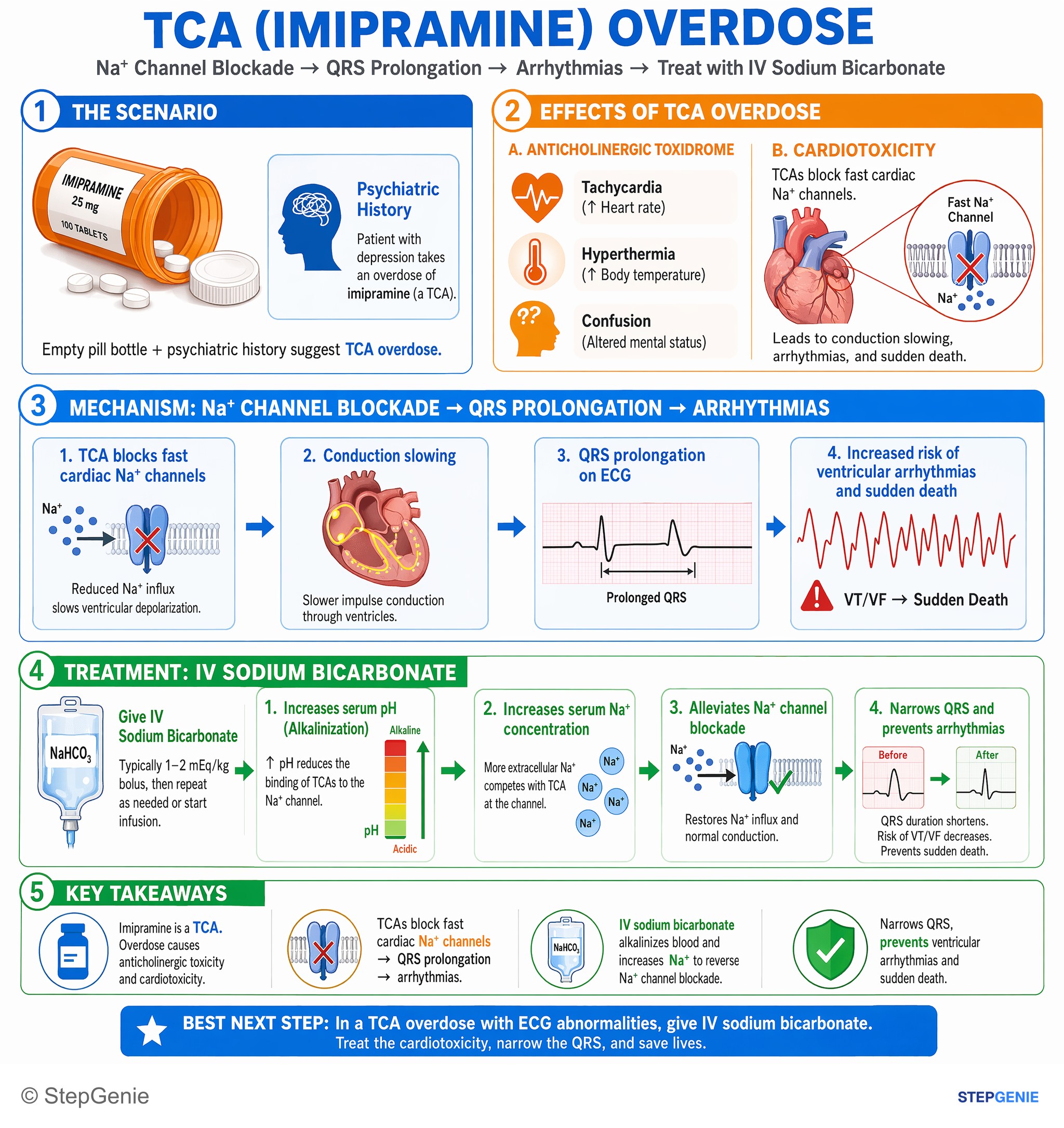
TCA overdose causes Na⁺ channel blockade with QRS prolongation; treat cardiotoxicity with IV sodium bicarbonate to narrow QRS and prevent…
USMLE Step 2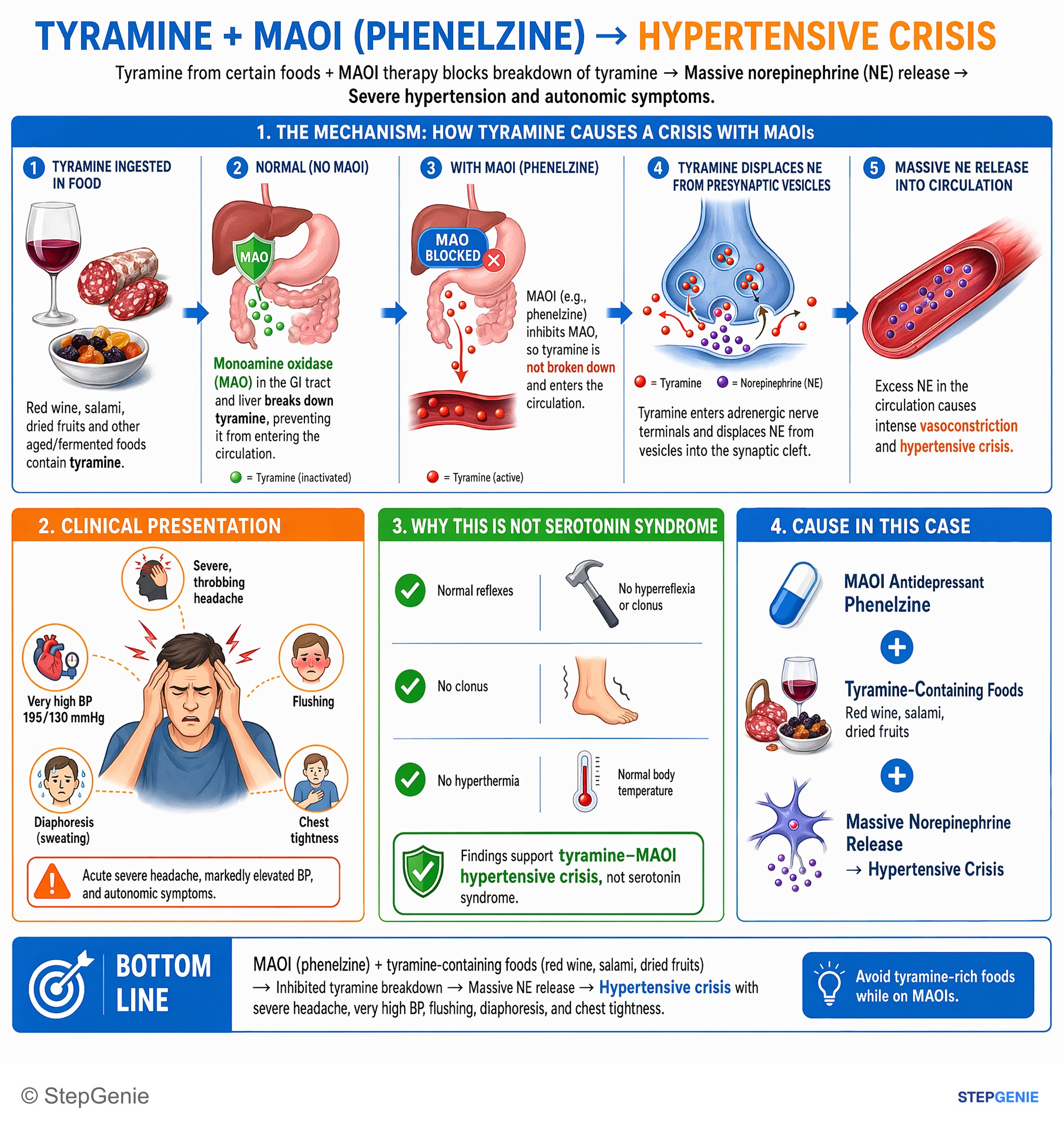
**Hypertensive crisis from MAOI (phenelzine) + tyramine-containing foods (wine, salami, dried fruits) causing acute severe headache…
USMLE Step 1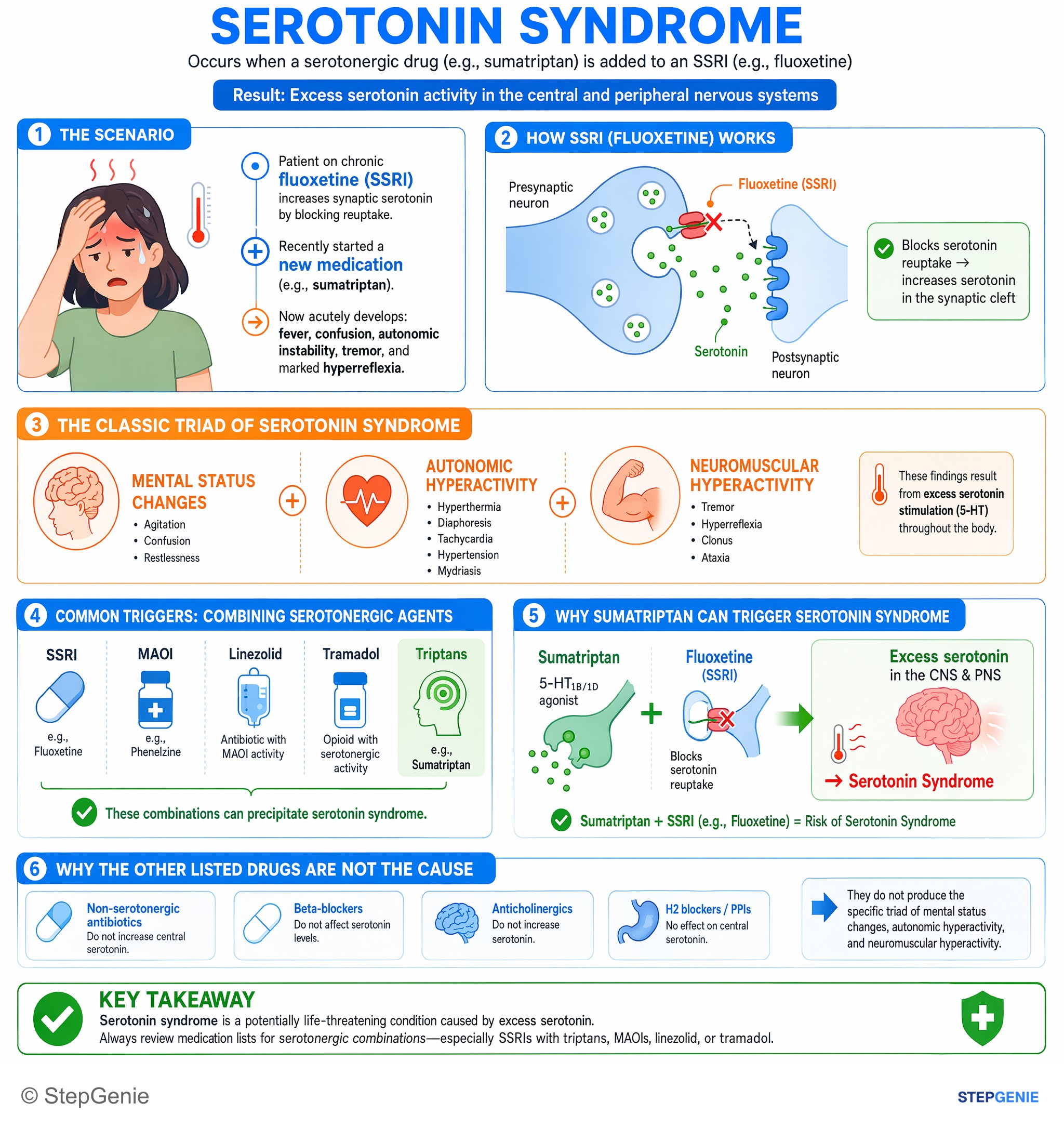
Serotonin syndrome: serotonergic drug (triptan) added to SSRI (fluoxetine) → hyperthermia, agitation, hyperreflexia, clonus, autonomic…
USMLE Step 1Frequently Asked Questions
What is the difference between SSRIs, SNRIs, TCAs and MAOIs?
SSRIs block serotonin reuptake. SNRIs block serotonin and norepinephrine reuptake. TCAs also block both, but they additionally block muscarinic, histamine H1 and alpha-1 receptors, which causes anticholinergic effects, sedation and orthostatic hypotension, and they block cardiac sodium channels in overdose. MAOIs inhibit monoamine oxidase, so norepinephrine, serotonin and dopamine are not broken down, which creates the risk of tyramine-induced hypertensive crisis.
Why are SSRIs usually chosen before TCAs and MAOIs?
SSRIs have a wide therapeutic margin, need little dose adjustment and have minimal cardiac and anticholinergic effects, so they are often the initial drugs of choice. TCAs are effective but now rarely used because overdose is toxic and they cause more adverse effects. MAOIs are mainly reserved for refractory or atypical depression because of dietary restrictions and dangerous drug interactions.
How is TCA overdose treated?
Give IV sodium bicarbonate for a QRS longer than 100 ms, seizures or hemodynamic instability, aiming to narrow the QRS and keep the serum pH around 7.5 to 7.55. Treat seizures with benzodiazepines and hypotension with fluids, then norepinephrine if needed; activated charcoal can help within 2 hours. Avoid physostigmine, flumazenil and class IA, IC and III antiarrhythmics.
What foods should be avoided with MAOIs?
Patients on MAOIs such as phenelzine should avoid tyramine-rich foods, including aged cheeses, cured meats like salami and pepperoni, pickled herring, sauerkraut, yeast extract, beer and wine. Gut MAO normally breaks down dietary tyramine; when it is inhibited, tyramine releases norepinephrine and can cause a hypertensive crisis with a severe occipital headache, palpitations and neck stiffness. The phenelzine label recommends IV phentolamine for treatment.
How long should you wait between stopping an MAOI and starting an SSRI?
At least 2 weeks should pass between stopping an MAOI and starting an SSRI or another serotonergic antidepressant, and vice versa. The exception is fluoxetine: because it and its active metabolite have a very long half-life, at least 5 weeks should pass after stopping fluoxetine before an MAOI is started. The washout prevents serotonin syndrome.
How do you tell serotonin syndrome from neuroleptic malignant syndrome?
Serotonin syndrome follows serotonergic drugs, starts within 24 hours in most cases, and causes tremor, hyperreflexia and clonus with agitation, sweating, diarrhea and hyperthermia; treat it with drug withdrawal, benzodiazepines and cyproheptadine. Neuroleptic malignant syndrome follows antipsychotics or other dopamine blockers, develops over days, and causes severe rigidity with decreased reflexes, high fever and a raised CK; dantrolene and bromocriptine are used.