Obsessive-compulsive disorder (OCD) questions are deceptively simple: the stem feels “obvious,” and then the answer choices bait you with conditions that share anxiety, rituals, or intrusive thoughts. The trick is to treat the vignette like a DSM-to-management algorithm—then use each distractor to sharpen the edges of the diagnosis.
Tag: Psychiatry > Anxiety, Trauma & Personality
The Vignette (Q-Bank Style)
A 26-year-old woman comes to clinic because she is “losing hours” every day. For the past 8 months, she has had recurrent intrusive thoughts that she might contaminate her younger sibling with germs and cause serious illness. She recognizes these thoughts are excessive but cannot stop them. To reduce anxiety, she showers repeatedly and cleans her phone and door handles in a strict sequence that takes 2–3 hours daily. She is often late to work and avoids visiting family. She denies hallucinations. No history of manic episodes. She does not use substances. Mental status exam shows an anxious mood and intact reality testing. She says, “I know it doesn’t make sense, but I feel like I have to do it.”
Question: What is the best next step in management?
Answer choices
A. Start sertraline and begin exposure and response prevention (ERP)
B. Start alprazolam as needed for acute anxiety
C. Start risperidone monotherapy
D. Reassure the patient that these fears are normal and will resolve
E. Diagnose obsessive-compulsive personality disorder (OCPD) and recommend psychotherapy focused on perfectionism
F. Diagnose generalized anxiety disorder (GAD) and start buspirone
G. Diagnose PTSD and start prazosin
Step 1: Identify the Diagnosis (Don’t Skip This)
This stem gives you classic OCD:
OCD = Obsessions + Compulsions + distress/impairment
- Obsessions: intrusive, unwanted thoughts/urges/images (eg, contamination) that cause anxiety
- Compulsions: repetitive behaviors or mental acts (eg, excessive washing/cleaning) done to reduce anxiety
- Insight preserved (often): “I know it’s irrational,” aka ego-dystonic
- Time-consuming or impairing: typically >1 hour/day and/or functional impairment
She has intact reality testing (not psychosis), and the compulsions are clearly aimed at neutralizing obsession-related anxiety.
Correct Answer: A. Start sertraline and begin exposure and response prevention (ERP)
Why this is best
First-line treatment for OCD is:
- CBT with exposure and response prevention (ERP)
- SSRI (often at higher doses than depression)
Many vignettes are set up so the “best next step” is combined therapy if symptoms are causing significant impairment—which they are (2–3 hours/day, late to work, avoiding family).
High-yield OCD treatment facts (USMLE)
- ERP = expose to trigger (eg, “contaminated” doorknob) without allowing the compulsion (no washing) → habituation/extinction
- SSRIs commonly tested: fluoxetine, sertraline, fluvoxamine, paroxetine
- Clomipramine (TCA, strong serotonergic) is effective but has more side effects (anticholinergic, orthostasis, arrhythmia risk)
- OCD often requires:
- Higher SSRI doses
- Longer trial (often 8–12 weeks) than depression before declaring failure
- If refractory: augment with an antipsychotic (eg, risperidone) in addition to SSRI/ERP
Now the Real Learning: Why Every Distractor Is Wrong
B. Start alprazolam as needed for acute anxiety
Benzodiazepines can reduce acute anxiety, but they do not treat the core pathology of OCD (obsessions + compulsions) and are not first-line.
Why it’s tempting: patient is anxious and distressed.
Why it’s wrong/high-yield:
- Benzos are best for acute panic, severe short-term anxiety, alcohol withdrawal, procedural sedation
- Risks: dependence, tolerance, sedation, falls (and dangerous with other CNS depressants)
- In OCD, they can become a “safety behavior,” undermining ERP principles
C. Start risperidone monotherapy
Antipsychotics are not first-line monotherapy for OCD.
When risperidone is relevant:
- SSRI + ERP partial response → consider augmentation with low-dose antipsychotic (especially if tic-related OCD)
Board-style anchor:
- Augment, don’t replace, unless you’re treating comorbid psychosis/mania (not here).
D. Reassure the patient that these fears are normal and will resolve
This is not normal worry. It’s time-consuming, impairing, and the patient is performing compulsions for hours daily.
High-yield: “Reassurance only” is inappropriate when symptoms cause functional impairment or meet diagnostic criteria. OCD rarely “just goes away” without treatment, and delaying care can entrench compulsive cycles.
E. Diagnose obsessive-compulsive personality disorder (OCPD) and recommend psychotherapy focused on perfectionism
OCPD and OCD are commonly confused but very testable.
OCD vs OCPD (must-know table)
| Feature | OCD | OCPD |
|---|---|---|
| Core issue | Obsessions + compulsions to reduce anxiety | Perfectionism, control, orderliness |
| Ego-syntonic vs ego-dystonic | Ego-dystonic (“I hate these thoughts/rituals”) | Ego-syntonic (“This is the right way”) |
| Intrusive thoughts/rituals | Yes | No true obsessions/compulsions |
| Time-consuming behaviors | Yes (rituals) | Yes (but due to rigidity) |
| Treatment | ERP + SSRI | Psychotherapy (often CBT/psychodynamic); meds less central |
This patient has classic ego-dystonic obsessions and compulsive washing—this is OCD, not a personality disorder.
F. Diagnose generalized anxiety disorder (GAD) and start buspirone
GAD is characterized by excessive worry about multiple domains (work/school/health/finances), difficult to control, with symptoms like restlessness, fatigue, poor concentration, irritability, muscle tension, sleep disturbance—typically for ≥6 months.
Why it’s tempting: chronic anxiety, functional impairment.
Why it’s wrong:
- OCD worries are intrusive, unwanted, and linked to rituals
- GAD lacks compulsions and typically isn’t centered on a specific obsessional theme with neutralizing behaviors
- Buspirone is for GAD (non-sedating, delayed onset), not first-line for OCD
G. Diagnose PTSD and start prazosin
PTSD requires:
- Exposure to actual/threatened death, serious injury, or sexual violence
- Symptoms in clusters: intrusion, avoidance, negative mood/cognition, hyperarousal
- Duration >1 month
Why it’s tempting: anxiety + avoidance.
Why it’s wrong:
- Avoidance in OCD is typically avoidance of triggers for obsessions/compulsions (eg, avoiding family to avoid “contamination”), not trauma-related avoidance
- No trauma exposure described
- Prazosin targets PTSD-related nightmares, not OCD
High-Yield OCD Pearls That Show Up Everywhere
1) Insight matters (and helps you rule out psychosis)
- OCD: patient usually recognizes thoughts are unreasonable (insight varies)
- Delusional disorder/psychosis: fixed false beliefs, no insight
- Test writers love: “I know it’s irrational, but…” = OCD vibe
2) OCD is not the same as “obsessive thoughts”
Intrusive thoughts can occur in depression, PTSD, and psychotic disorders. OCD requires:
- Recurrent obsessions
- Compulsions aimed at reducing anxiety
- Impairment/time cost
3) Tic-related clue (Step 1/2 crossover)
OCD can be associated with tic disorders/Tourette syndrome. If you see:
- Childhood onset tics + OCD symptoms → think tic-related OCD, potentially more likely to need antipsychotic augmentation.
4) Postpartum twist (classic)
Intrusive thoughts of harming the baby can be postpartum OCD (ego-dystonic, terrifying to the patient).
Key differentiator from postpartum psychosis:
- OCD: insight preserved, distressed by thoughts, seeks help
- Psychosis: bizarre delusions, hallucinations, impaired reality testing → emergency
A Quick “Exam Day” Algorithm
- Obsessions + compulsions + impairment? → OCD
- First-line: ERP + SSRI (or either depending on severity/access)
- No response: optimize dose/duration → consider clomipramine or antipsychotic augmentation
- Always screen: suicidality, comorbid depression, substance use, tics
Takeaway: How to Beat the Answer Choices
When the vignette screams OCD, don’t stop at recognition—prove why each alternative fails:
- Anxiety + rituals ≠ GAD
- Intrusive thoughts with insight ≠ psychosis
- Rigidity/perfectionism ≠ OCD (that’s OCPD)
- Impairing symptoms ≠ reassurance-only
- Benzos can calm, but they don’t treat the OCD cycle
- Antipsychotics can help—but usually as augmentation, not monotherapy
Visual explanations from the StepGenie QBank
Infographics StepGenie drew to explain questions in its own QBank, matched to this article's topic. Each caption is the takeaway of the question it explains.
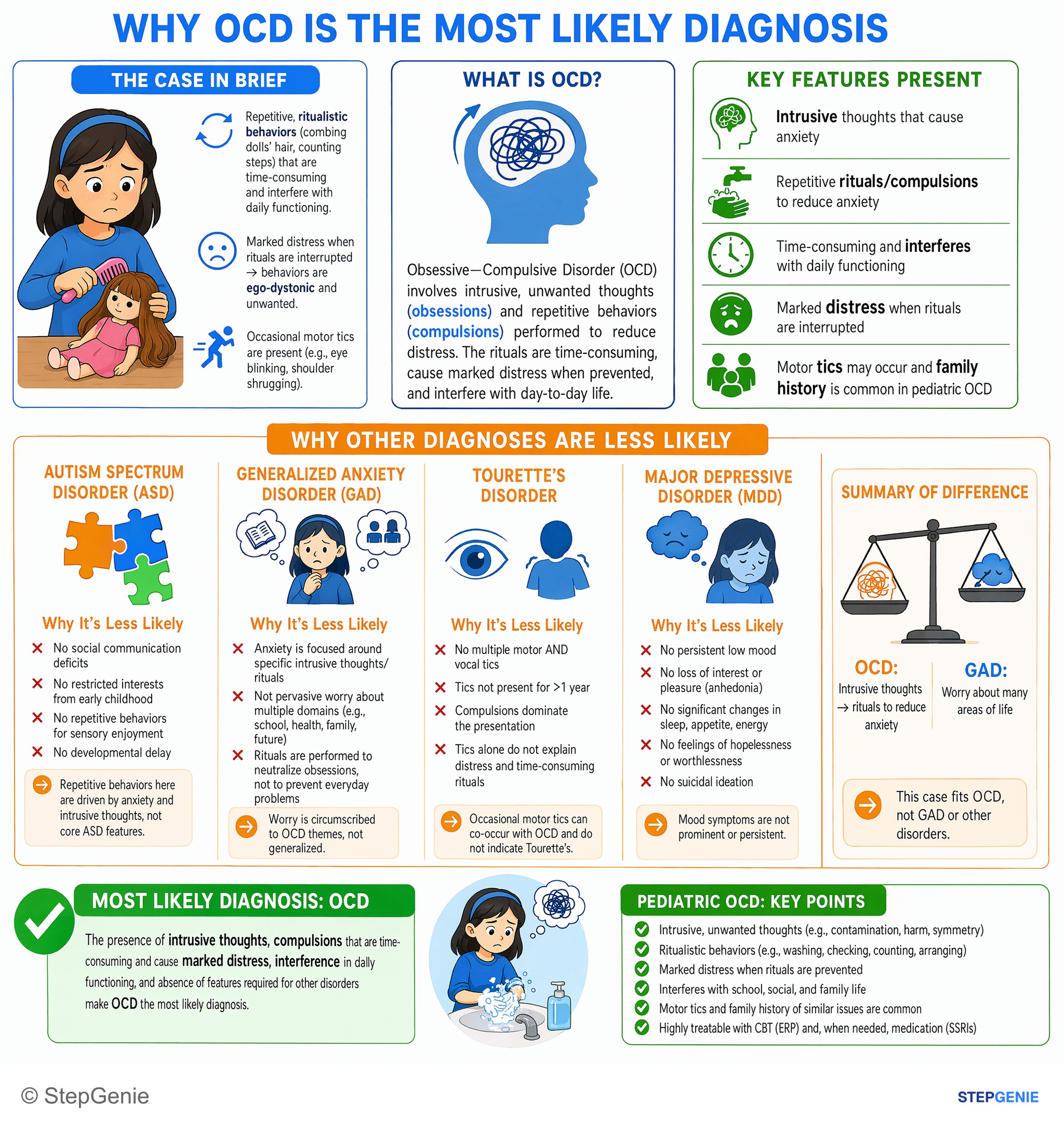
Pediatric OCD presents with intrusive thoughts and ritualistic behaviors causing marked distress; motor tics and family history of similar…
USMLE Step 2Frequently Asked Questions
What is the first-line treatment for OCD when symptoms are causing major impairment?
The best next step is combined treatment with an SSRI and exposure and response prevention. In a patient with OCD who is losing hours each day, arriving late to work, and avoiding family, the symptoms are clearly impairing. First-line treatment is CBT with exposure and response prevention plus an SSRI, and combined therapy is especially appropriate when the disorder is significantly affecting function.
How do you recognize OCD in a vignette instead of just general anxiety?
OCD is identified by obsessions, compulsions, and meaningful distress or impairment. Obsessions are intrusive, unwanted thoughts, urges, or images that cause anxiety, while compulsions are repetitive behaviors or mental acts performed to reduce that anxiety. A classic clue is preserved insight, such as a patient saying the thoughts feel irrational but still feeling driven to do the rituals, especially when they take more than an hour a day.
How do you tell OCD from obsessive-compulsive personality disorder on a psychiatry question?
The key distinction is that OCD is ego-dystonic, while OCPD is ego-syntonic. In OCD, patients experience intrusive thoughts and compulsive rituals that they recognize as excessive or irrational and often dislike. In OCPD, the problem is perfectionism, control, and orderliness that feels appropriate to the person, without true obsessions or compulsions. Compulsive washing to neutralize contamination fears points to OCD, not OCPD.
Why isn’t alprazolam the right answer for OCD even if the patient is very anxious?
Alprazolam is not the right treatment because benzodiazepines do not treat the core pathology of OCD. OCD is driven by obsessions and compulsions, not just nonspecific anxiety, so first-line care targets those symptoms with exposure and response prevention and an SSRI. Benzodiazepines may reduce acute anxiety, but in OCD they can act as a safety behavior and undermine exposure-based treatment principles.
When is risperidone used for OCD, and why is risperidone alone wrong here?
Risperidone is used as augmentation, not first-line monotherapy, in OCD. The usual role is after a partial response to an SSRI plus exposure and response prevention, when adding a low-dose antipsychotic may help. Risperidone alone is wrong in a classic OCD vignette with intact reality testing and no evidence of psychosis or mania, because standard initial treatment remains ERP combined with an SSRI.