Lithium is one of those Step 1 “classic” drugs that keeps showing up because it’s clinically important and testable in a million ways: mechanism, narrow therapeutic index, kidney handling, thyroid effects, EKG changes, pregnancy, drug interactions—the whole package. If you master lithium, you’ll pick up points across psychiatry, renal physiology, endocrine, and pharmacology.
Where Lithium Fits (and Why Step Loves It)
Lithium is a mood stabilizer used primarily for bipolar disorder, especially for acute mania and maintenance therapy to prevent mood episodes. It’s also associated with a unique high-yield benefit:
- Decreases suicide risk in bipolar disorder (classic association)
First Aid cross-reference: Psychiatry (Bipolar disorder), Pharmacology (Mood stabilizers), Renal (ADH resistance), Endocrine (thyroid), Repro (Ebstein anomaly)
What Lithium Is (Definition + Clinical Role)
Lithium is a monovalent cation that behaves like sodium in the body and affects intracellular signaling pathways in neurons.
Core indications (Step-style)
- Bipolar I disorder
- Acute mania (often combined with an antipsychotic for faster control)
- Maintenance to prevent manic and depressive relapse
- Bipolar depression (maintenance benefit; acute bipolar depression often needs additional agents)
- Sometimes: augmentation for refractory depression (Step 2/clinical nuance)
Mechanism of Action (High-Yield, Don’t Overcomplicate)
Lithium’s mechanism is classically tested as second messenger modulation:
Key MOA points
- Inhibits inositol monophosphatase
- ↓ recycling of inositol → ↓ PIP2 → ↓ IP3/DAG signaling
- Also affects GSK-3 (glycogen synthase kinase-3) and downstream gene transcription (conceptual, less commonly asked)
Step takeaway: Lithium = “second messenger inhibitor (IP3/DAG)”.
Pathophysiology Tie-In (Why It Stabilizes Mood)
Bipolar disorder involves dysregulation of:
- Monoaminergic signaling (NE, DA, 5-HT)
- Intracellular signaling cascades
- Circadian rhythm / sleep architecture
Lithium’s “stabilizing” effect is thought to come from dampening overactive intracellular signaling and modulating neuronal excitability over time. This explains why:
- It works well for preventing relapse
- It may take time to see full stabilization (more “maintenance” than immediate sedation)
Clinical Presentation: When You Think “Lithium” on a Question Stem
The patient who needs lithium
- Bipolar I with:
- Recurrent manic episodes
- Classic mania symptoms: DIG FAST
- Distractibility
- Indiscretion/impulsivity
- Grandiosity
- Flight of ideas
- Activity/agitation
- Sleep decreased
- Talkative/pressured speech
The patient with lithium toxicity
Think:
- Mood stabilizer + dehydration/diuretics/NSAIDs + neurologic/GI symptoms
Diagnosis & Monitoring: What You Must Know for USMLE
Lithium requires close monitoring because of its narrow therapeutic index.
Baseline tests before starting lithium (common Step checklist)
- BMP/CMP (renal function: BUN/Cr, electrolytes)
- TSH (± free T4)
- Pregnancy test (teratogenic risk)
- EKG (especially older patients or cardiac history)
Ongoing monitoring
- Lithium level
- Renal function
- Thyroid function
Therapeutic levels (high-yield ranges)
| Setting | Typical target lithium level |
|---|---|
| Maintenance | ~0.6–1.0 mEq/L (often cited) |
| Acute mania | ~0.8–1.2 mEq/L |
| Toxicity risk | increases >1.5 mEq/L (classic) |
(Exact cutoffs vary slightly by source; Step questions usually want the concept of narrow index + toxicity with small increases.)
Pharmacokinetics: The Renal Physiology Connection
Lithium is:
- Not metabolized
- Excreted by the kidney
- Handled similarly to sodium in the proximal tubule
Key concept: sodium/water depletion increases lithium reabsorption
If the body senses low volume/low sodium, the kidney reabsorbs more sodium—and lithium tags along → higher lithium levels.
Translation for test day: Dehydration, vomiting/diarrhea, low-salt diet, diuretics → toxicity.
Drug Interactions (Ultra High-Yield: “AIN”)
The classic Step mnemonic is “AIN”: drugs that increase lithium levels.
- ACE inhibitors (and ARBs)
- Ibuprofen / NSAIDs (most)
- Na⁺-wasting diuretics (thiazides > loops)
Why this matters
These decrease renal clearance of lithium (via hemodynamics and/or sodium handling), causing toxicity.
Adverse Effects: The Big 6 You Need Cold
1) Tremor
- Fine tremor is common even at therapeutic levels
- Can treat with a beta blocker (propranolol) (commonly tested)
2) Hypothyroidism
- Lithium can cause hypothyroidism (and goiter)
- Monitor TSH
3) Nephrogenic diabetes insipidus (NDI)
- Lithium causes ADH resistance in collecting ducts → inability to concentrate urine
- Symptoms: polyuria, polydipsia, dilute urine
- Labs: ↓ urine osmolality, ↑ serum osmolality, hypernatremia possible
Treatment of lithium-induced NDI (high yield):
- Amiloride (preferred association because it blocks ENaC, reducing lithium entry into principal cells)
- Thiazides can also help NDI in general (but remember thiazides can raise lithium levels—Step may test the nuance)
4) Teratogenicity
- Ebstein anomaly (tricuspid valve malformation → atrialization of RV) with first-trimester exposure
- Step association: lithium in pregnancy = Ebstein anomaly
5) Weight gain
- Common, contributes to nonadherence
6) Cardiac effects
- Can cause T-wave flattening/inversion and other conduction changes
- Also associated with sick sinus syndrome (more clinical, but fair game)
Lithium Toxicity: Recognize It Fast
Classic toxicity presentation
- GI: nausea, vomiting, diarrhea
- Neuro: confusion, ataxia, coarse tremor, seizures
- Severe: coma, life-threatening dysrhythmias
What triggers toxicity in stems
- Starting NSAID for pain
- Thiazide for hypertension
- ACE inhibitor for diabetic nephropathy
- Dehydration (e.g., gastroenteritis, marathon, poor oral intake)
Treatment (Step-level)
- Stop lithium
- IV normal saline (volume expansion increases lithium excretion)
- Hemodialysis for severe toxicity, high levels, or significant neurologic symptoms/renal failure
Lithium vs Other Mood Stabilizers (How Questions Try to Trick You)
| Drug | Best-known Step association | Notable high-yield toxicity |
|---|---|---|
| Lithium | Bipolar maintenance, anti-suicide benefit | NDI, hypothyroid, Ebstein anomaly, tremor |
| Valproate | Acute mania, epilepsy | Hepatotoxicity, pancreatitis, neural tube defects |
| Carbamazepine | Bipolar + seizures, trigeminal neuralgia | Agranulocytosis/aplastic anemia, SJS/TEN (HLA-B*1502), CYP induction |
| Lamotrigine | Bipolar depression maintenance | SJS/TEN risk (titrate slowly) |
Test writer move: If the stem emphasizes recurrent classic mania + suicide prevention, lithium is the giveaway. If pregnancy is involved, lithium and valproate both raise flags, but they point to different congenital issues.
High-Yield Step 1 “If You See X, Think Lithium” Associations
- Thiazide/NSAID/ACE inhibitor added → lithium toxicity
- Polyuria + polydipsia + dilute urine → lithium-induced nephrogenic DI
- Elevated TSH after starting mood stabilizer → lithium hypothyroidism
- Pregnant patient with Ebstein anomaly history → lithium exposure
- Bipolar patient doing well but develops tremor → lithium side effect (propranolol helps)
- Dehydration (vomiting/diarrhea) → increased lithium reabsorption
Rapid Review (Exam-Day Bullets)
- MOA: inhibits inositol monophosphatase → ↓ IP3/DAG signaling
- Excretion: renal; follows sodium handling
- Interactions that increase levels: ACEi, Ibuprofen/NSAIDs, Na-wasting diuretics (thiazides)
- Toxicity: GI + neuro (ataxia, confusion, seizures); treat with IV NS, dialysis if severe
- AEs: tremor, hypothyroid, nephrogenic DI, weight gain, T-wave changes
- Teratogen: Ebstein anomaly
Visual explanations from the StepGenie QBank
Infographics StepGenie drew to explain questions in its own QBank, matched to this article's topic. Each caption is the takeaway of the question it explains.
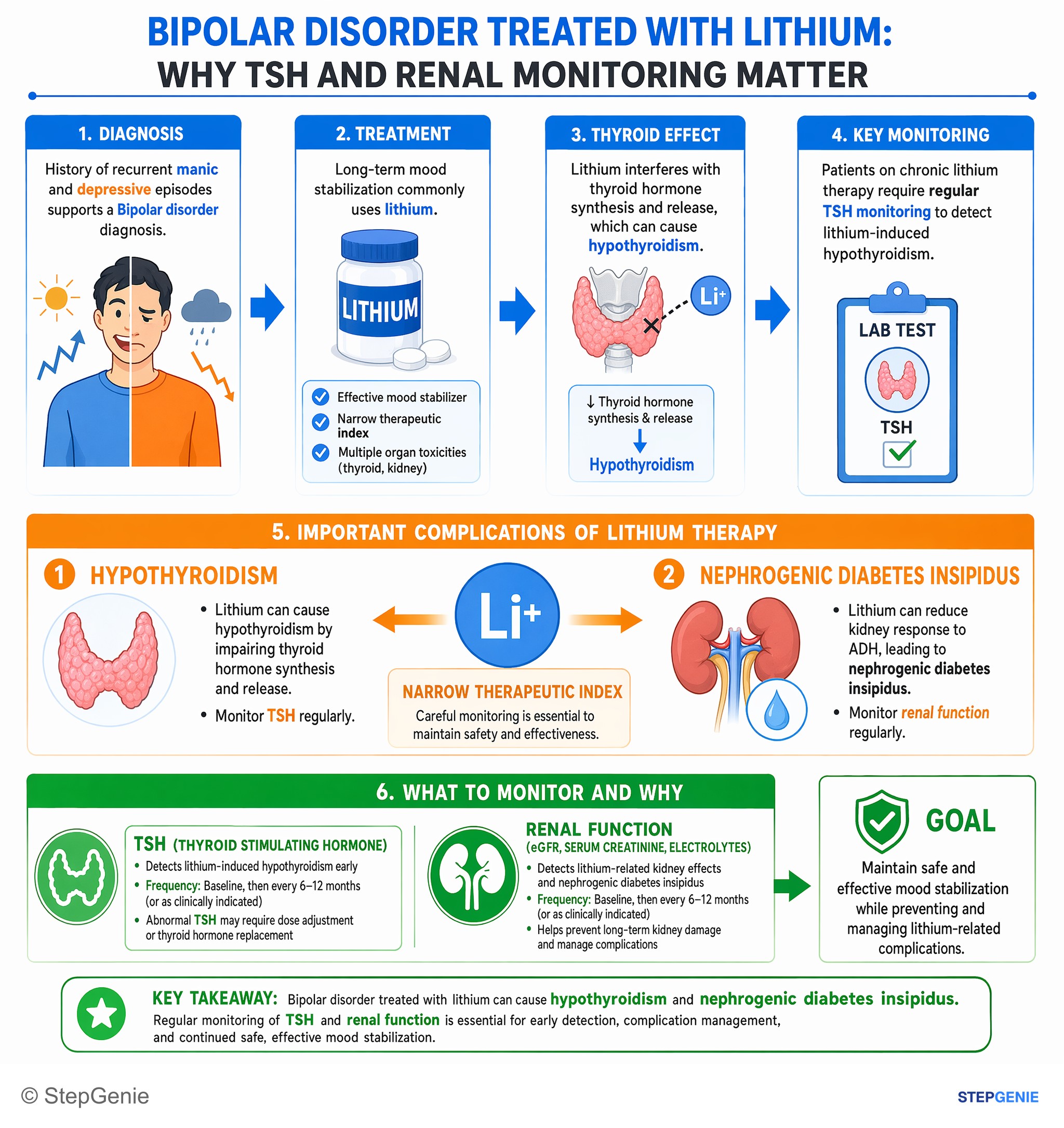
Bipolar disorder treated with lithium can cause hypothyroidism and nephrogenic diabetes insipidus; monitor TSH and renal function regularly.
USMLE Step 1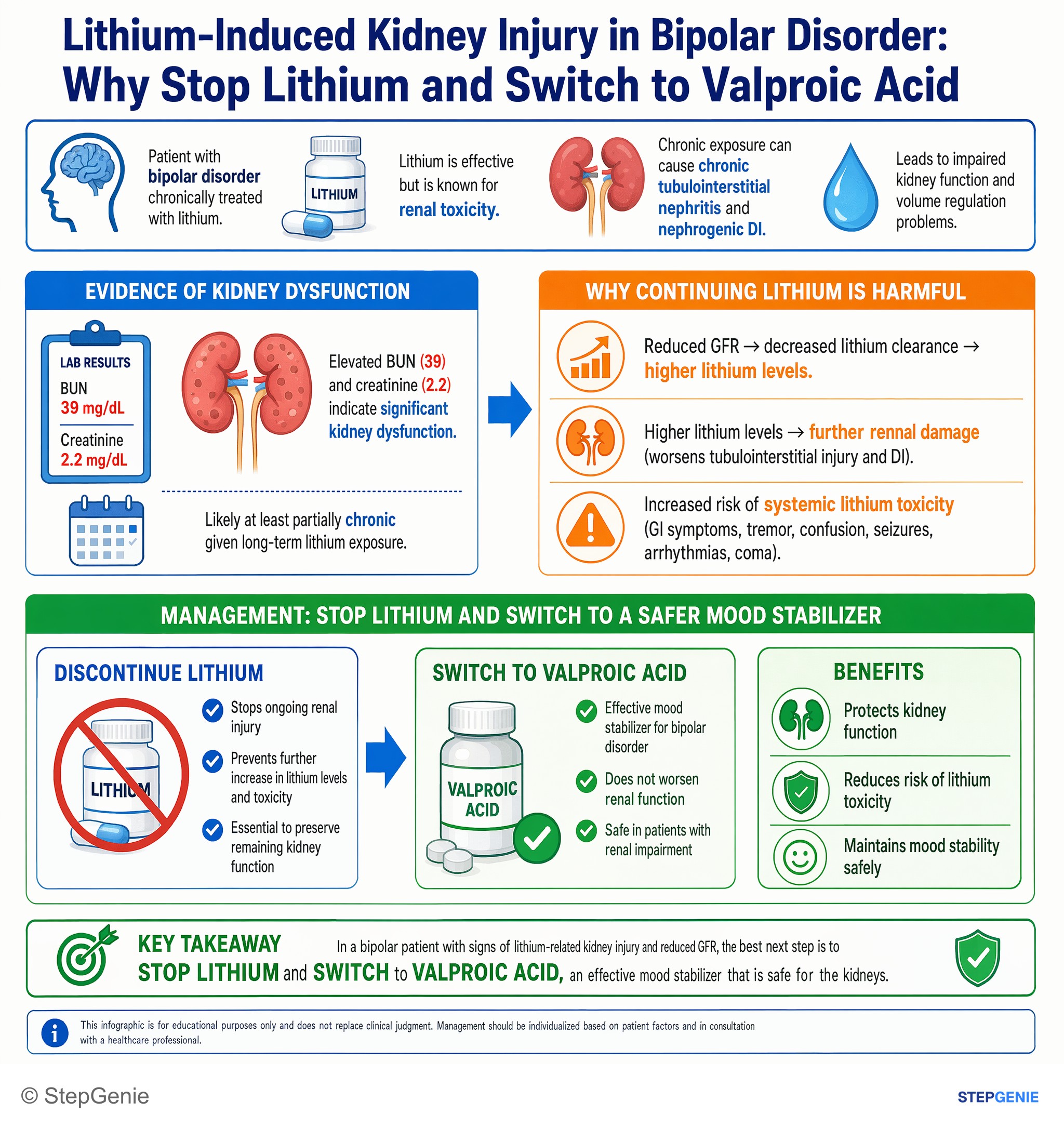
Chronic lithium toxicity causing kidney injury and nephrogenic-like volume issues in a bipolar patient requires stopping lithium and…
USMLE Step 2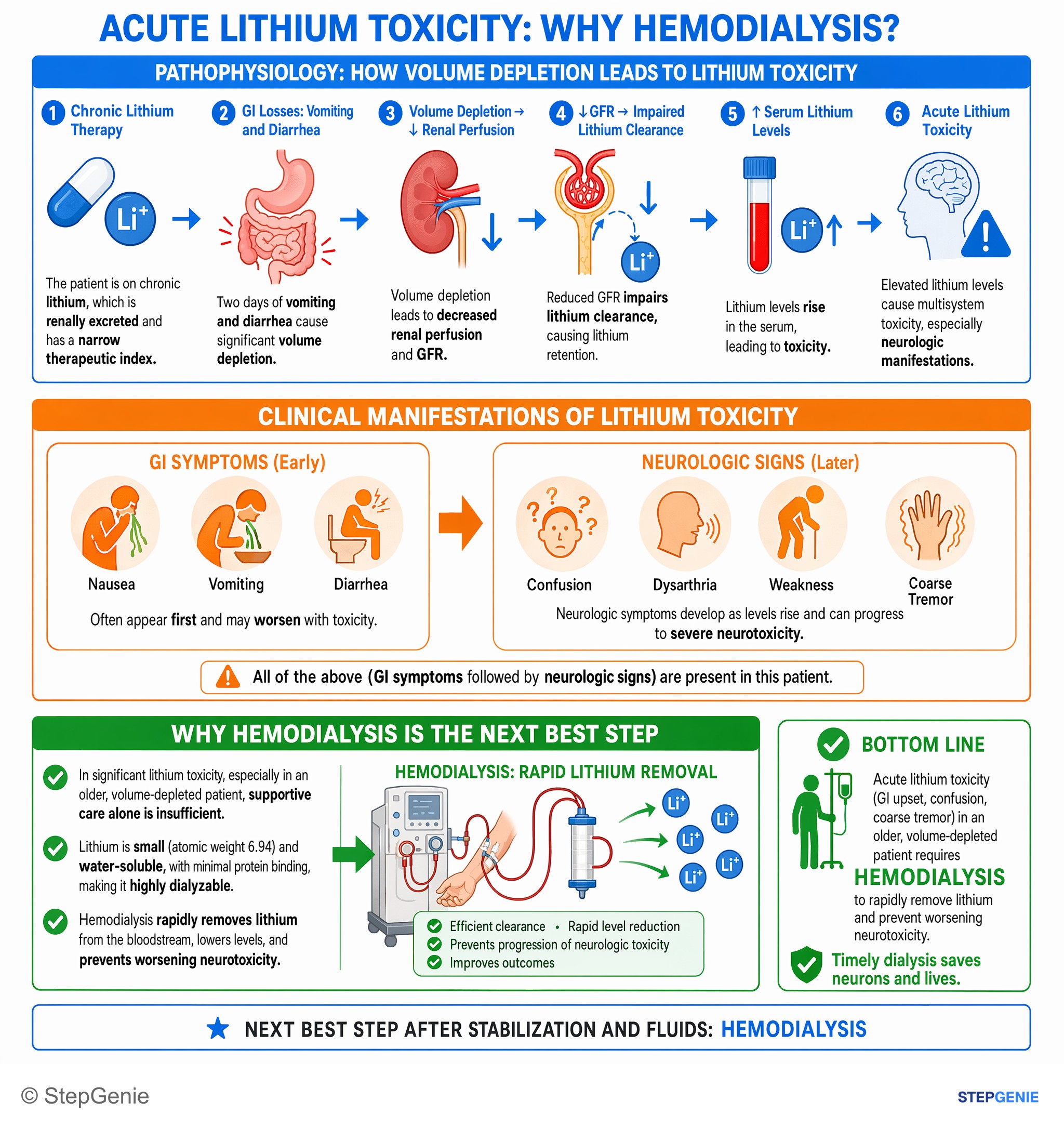
Acute lithium toxicity (GI upset, confusion, coarse tremor) in an older patient with volume depletion requires hemodialysis to rapidly…
USMLE Step 2Frequently Asked Questions
What is lithium used for in bipolar disorder?
Lithium is a mood stabilizer used mainly for bipolar disorder, especially acute mania and maintenance therapy to prevent future mood episodes. It is particularly associated with Bipolar I disorder and recurrent manic episodes, and it also has the classic high-yield association of decreasing suicide risk in bipolar disorder. For acute mania, it is often combined with an antipsychotic for faster symptom control.
How does lithium work for Step 1?
Lithium is classically tested as a second messenger inhibitor. It inhibits inositol monophosphatase, which decreases inositol recycling and lowers PIP2, leading to reduced IP3/DAG signaling. It also affects GSK-3 and downstream gene transcription. The key exam takeaway is that lithium dampens overactive intracellular signaling, which helps explain its mood-stabilizing effect over time.
Why do dehydration, NSAIDs, and diuretics cause lithium toxicity?
They cause lithium toxicity by increasing lithium levels through reduced renal clearance and increased reabsorption. Lithium is excreted by the kidney and is handled similarly to sodium in the proximal tubule. When the body is volume depleted or sodium depleted, the kidney reabsorbs more sodium, and lithium comes along with it. High-yield triggers include dehydration, vomiting, diarrhea, low-salt diet, NSAIDs, ACE inhibitors, ARBs, and sodium-wasting diuretics.
How do you recognize lithium toxicity on a question stem?
Lithium toxicity is recognized by a mood stabilizer user who develops gastrointestinal and neurologic symptoms, often after dehydration or a drug interaction. The classic presentation includes nausea, vomiting, and diarrhea along with confusion, ataxia, coarse tremor, and seizures. A common test pattern is lithium use plus dehydration, diuretics, or NSAIDs followed by these GI and neuro findings.
What are the classic adverse effects of lithium that are high-yield for Step 1?
The major high-yield adverse effects are fine tremor, hypothyroidism, nephrogenic diabetes insipidus, teratogenicity, weight gain, and cardiac conduction changes. Lithium can cause ADH resistance in the collecting ducts, leading to polyuria, polydipsia, dilute urine, and possible hypernatremia. It is also associated with first-trimester Ebstein anomaly and can cause T-wave flattening or inversion and sick sinus syndrome.