The CYP450 enzyme inducer mnemonic is GRAB PCS: griseofulvin, rifampin, alcohol (chronic), barbiturates, phenytoin, carbamazepine, St. John's wort and smoking, which speed metabolism and lower other drugs' levels. The inhibitor mnemonic is A MAGIC VCR: amiodarone, macrolides, azoles, grapefruit juice, isoniazid, cimetidine, valproate, ciprofloxacin and ritonavir, which slow metabolism and raise levels toward toxicity.
Add + SOS for three more inhibitors: sulfonamides (TMP-SMX), omeprazole and SSRIs (fluoxetine, paroxetine, fluvoxamine). Inhibition shows up within days; induction takes a week or more to build and weeks to fade. Prodrugs flip the result: clopidogrel (CYP2C19) and codeine (CYP2D6) need their enzyme to work, so blocking it causes treatment failure.
CYP450 inducers mnemonic: GRAB PCS
Inducers GRAB more enzyme, so the other drug (the substrate) is cleared faster and its level falls. Ratings are FDA's: a strong inducer cuts a sensitive substrate's exposure (AUC) by at least 80%, a moderate one by 50-80%, a weak one by 20-50%.
| Letter | Inducer | What it induces | Classic consequence |
|---|---|---|---|
| G | Griseofulvin | CYP3A4 per StatPearls (not FDA-rated); its label reports a weaker warfarin effect and possible pill interactions | The Yaz label lists it among drugs that can make the pill less effective |
| R | Rifampin (rifabutin and rifapentine also induce) | Strong CYP3A and 2C19; moderate 1A2, 2B6, 2C8 and 2C9; also UGT and P-glycoprotein | Pill failure (its label advises a non-hormonal method), tacrolimus rejection, falling INR |
| A | Alcohol, chronic | CYP2E1 (mainly by stabilizing the enzyme) | More NAPQI, acetaminophen's toxic metabolite, with repeated supratherapeutic doses |
| B | Barbiturates (phenobarbital, primidone) | Moderate CYP3A | Theophylline falls about 25% after 2 weeks of phenobarbital |
| P | Phenytoin | Strong CYP3A; moderate 1A2 and 2C19 | Pill failure, low tacrolimus; phenytoin itself is a 2C9 and 2C19 substrate |
| C | Carbamazepine | Strong CYP3A and 2B6; weak 2C9 (its label adds 1A2 and 2C8/9/19) | Induces its own metabolism: half-life falls from 25-65 h to 12-17 h, complete after 3-5 weeks |
| S | St. John's wort and smoking | St. John's wort: strong CYP3A (preparation-dependent). Tobacco smoke: moderate CYP1A2 | St. John's wort weakens the pill, cyclosporine, warfarin, simvastatin and some HIV drugs; young adult smokers clear theophylline about 50% faster |
Other strong CYP3A inducers on FDA's list that GRAB PCS misses: apalutamide, enzalutamide, mitotane, ivosidenib and lumacaftor-ivacaftor; efavirenz and bosentan are moderate. Rifampin is the broadest: FDA's index inducer for CYP3A, 2C19, 2C9, 2C8 and 2B6.
CYP450 inhibitors mnemonic: A MAGIC VCR + SOS
An inhibitor hits pause, like a VCR: the enzyme already there works less, so the substrate accumulates. On FDA's scale a strong inhibitor raises a sensitive substrate's AUC at least 5-fold, a moderate one 2- to 5-fold, a weak one 1.25- to 2-fold.
| Letter | Inhibitor | Main targets (FDA rating) | Classic consequence |
|---|---|---|---|
| A | Amiodarone | Moderate 2C9; weak 2D6 and 3A; also P-glycoprotein | Prothrombin time doubles 3-4 days after it is added to warfarin; simvastatin capped at 20 mg |
| M | Macrolides: clarithromycin (strong 3A), erythromycin (moderate 3A) | CYP3A and P-glycoprotein | Clarithromycin is contraindicated with simvastatin and lovastatin; tacrolimus spikes. Azithromycin is the least likely to interact |
| A | Azoles: ketoconazole, itraconazole, posaconazole, voriconazole (strong 3A); fluconazole | Fluconazole: strong 2C19, moderate 2C9 and 3A | Simvastatin is contraindicated with the strong ones; fluconazole raised phenytoin AUC by 88% and raises the INR |
| G | Grapefruit juice | Moderate 3A (strong with double-strength juice), in the gut wall, cutting first-pass metabolism | High-dose juice raised simvastatin AUC 16-fold; an 8-oz glass of regular juice daily for 3 days, 1.9-fold |
| I | Isoniazid | Not FDA-rated; inhibits CYP2C19 and 3A4 (also 1A2) | Raises phenytoin, carbamazepine, theophylline and valproate levels; yet it induces 2E1 |
| C | Cimetidine | Weak 3A, 1A2 and 2D6 | Theophylline about 70% higher |
| V | Valproate | Not FDA-rated; weak CYP2C9 inhibitor, plus UGT (glucuronidation) and epoxide hydrolase | Lamotrigine levels more than double (half-life 26 to 70 h), with a higher risk of serious rash; phenobarbital clearance falls 30% |
| C | Ciprofloxacin | Moderate 1A2 (can act strong) and moderate 3A | Theophylline about 40% higher; contraindicated with tizanidine; clozapine dose cut to one-third |
| R | Ritonavir (and cobicistat) | Strong CYP3A, mechanism-based | Boosts HIV protease inhibitors on purpose; nirmatrelvir-ritonavir (Paxlovid) has a boxed warning for interactions |
+ SOS:
- Sulfonamides: sulfamethoxazole inhibits CYP2C9 (trimethoprim inhibits 2C8). TMP-SMX can prolong the prothrombin time on warfarin, and it lengthened phenytoin's half-life by 39%.
- Omeprazole and esomeprazole: FDA rates omeprazole only a weak 2C19 inhibitor, yet both cut clopidogrel's antiplatelet effect, omeprazole even when the doses were 12 hours apart. Pantoprazole, lansoprazole and dexlansoprazole had less effect.
- SSRIs: fluoxetine (strong 2D6 and 2C19) and paroxetine (strong 2D6). Fluvoxamine (strong 1A2 and 2C19) cut theophylline clearance about 3-fold and raised tizanidine AUC 33-fold. Sertraline and escitalopram are only weak 2D6 inhibitors.
Also worth knowing: diltiazem and verapamil (moderate 3A) and bupropion, quinidine and terbinafine (strong 2D6). Antidepressant interactions are covered in SSRIs vs SNRIs vs TCAs vs MAOIs, and boosting in HIV antiretroviral drugs.
Inducers vs inhibitors: mechanism and time course
| Inducer | Inhibitor | |
|---|---|---|
| Mechanism | Activates nuclear receptors that switch on CYP genes: PXR (rifampin; hyperforin in St. John's wort), CAR/PXR (carbamazepine, phenytoin, phenobarbital), AHR (tobacco smoke, charbroiled meat) | Competitive and reversible (ketoconazole, itraconazole, fluconazole, quinidine, fluvoxamine), or mechanism-based, inactivating the enzyme (clarithromycin, erythromycin, diltiazem, verapamil, ritonavir, grapefruit furanocoumarins) |
| Onset | Slow: days to weeks; effects may take a week or more to appear | Fast: tacrolimus can rise sharply, so troughs are checked within 1-3 days of adding a strong inhibitor |
| Offset | Slow: back-up contraception for 28 days after an inducer is stopped; rifampin is stopped 4 weeks before praziquantel | Once the inhibitor clears and, for mechanism-based ones, new enzyme is made: fluconazole 4-5 days, amiodarone weeks to months |
| Substrate level | ↓ | ↑ |
| Active drug | Treatment failure: pregnancy on the pill, transplant rejection, low INR | Toxicity: bleeding, rhabdomyolysis, nephrotoxicity, seizures |
| Prodrug | More activation: rifampin raised clopidogrel's active metabolite 3.8-fold | Less activation: failure |
Why induction is slow. The cell has to build new enzyme, and after the inducer stops the extra enzyme has to be degraded; with long half-life substrates the shift is slower still (see the 4-5 half-life rule). That is why nirmatrelvir-ritonavir cannot be started right after a strong CYP3A inducer is stopped.
Stopping an inducer acts like adding an inhibitor. The theophylline label lists stopping carbamazepine or rifampin alongside adding cimetidine or erythromycin as causes of reduced clearance and toxicity, and one week without cigarettes cuts theophylline clearance by about 40%.
CYP inhibitors and inducers by isoenzyme
CYP enzymes are heme-containing monooxygenases, most abundant in the liver and also active in the gut. Six isoforms (1A2, 2C9, 2C19, 2D6, 2E1, 3A4) account for most drug metabolism (an estimated 80-90% of reactions); CYP3A4 has the largest share (estimates run from about 30% to 50% of drugs), CYP2D6 about 20%. S, M, W = FDA's strong, moderate, weak.
| Enzyme | Substrates to know | Inhibitors | Inducers | Memory hook |
|---|---|---|---|---|
| CYP3A4/5 | Tacrolimus, cyclosporine, simvastatin, lovastatin, midazolam, triazolam, the pill's hormones, carbamazepine | Clarithromycin, itraconazole, ketoconazole, posaconazole, voriconazole, ritonavir, cobicistat (S); erythromycin, fluconazole, diltiazem, verapamil, grapefruit, ciprofloxacin (M) | Rifampin, carbamazepine, phenytoin, St. John's wort, apalutamide, enzalutamide (S); phenobarbital, primidone, efavirenz, bosentan (M) | The workhorse, in liver and gut |
| CYP2C9 | S-warfarin, phenytoin, celecoxib, tolbutamide, glimepiride | Amiodarone, fluconazole, miconazole (M); TMP-SMX and metronidazole per the warfarin label | Rifampin, enzalutamide (M); carbamazepine (W); phenobarbital per the warfarin label | "FAMS raise the INR": fluconazole, amiodarone, metronidazole, sulfamethoxazole |
| CYP2C19 | Clopidogrel (activation), omeprazole, diazepam | Fluconazole, fluoxetine, fluvoxamine, ticlopidine (S); voriconazole (M); omeprazole (W) | Rifampin (S); phenytoin, efavirenz, apalutamide, enzalutamide (M) | "Flu-flu-flu": fluconazole, fluoxetine, fluvoxamine |
| CYP2D6 | Codeine, tramadol and tamoxifen (activation); metoprolol, TCAs, dextromethorphan | Bupropion, fluoxetine, paroxetine, quinidine, terbinafine (S); duloxetine (M); sertraline, amiodarone, cimetidine (W) | None on FDA's table | Think genotype and inhibitors, not inducers |
| CYP1A2 | Theophylline, clozapine, tizanidine, caffeine | Fluvoxamine (S); ciprofloxacin, oral contraceptives, mexiletine (M); cimetidine (W) | Smoking, phenytoin, rifampin (M); charbroiled meat | Smoke speeds it up; cipro and fluvoxamine slow it down |
| CYP2E1 | Ethanol, acetaminophen (to NAPQI) | Disulfiram | Chronic alcohol, isoniazid | The alcohol enzyme |
Two warfarin facts explain most INR questions: the S-enantiomer is 2-5 times more potent and is cleared by CYP2C9, while R-warfarin goes through 1A2 and 3A4. Inhibit 2C9 and the INR climbs; induce it and the INR falls. Monitoring is in the anticoagulants guide.
Narrow-window substrates: the pairs USMLE tests
The dangerous pairs involve narrow therapeutic index drugs such as warfarin, theophylline and phenytoin, where a modest change in level causes harm, and level-guided drugs such as tacrolimus and cyclosporine; see the therapeutic index guide.
| Patient stable on | Then starts | What happens | What the labels say |
|---|---|---|---|
| Warfarin (2C9) | Amiodarone, fluconazole, TMP-SMX or metronidazole | INR up, bleeding | With amiodarone, cut warfarin by one-third to one-half |
| Warfarin | Rifampin, carbamazepine, phenobarbital or St. John's wort | INR down, clots | Check the INR more often when any drug is started or stopped |
| Theophylline (1A2) | Ciprofloxacin, fluvoxamine, cimetidine or erythromycin, or quits smoking | Nausea, arrhythmias, seizures | With fluvoxamine, give one-third of the theophylline dose |
| Tacrolimus or cyclosporine (3A4, P-glycoprotein) | Clarithromycin, an azole, ritonavir (including Paxlovid), diltiazem, verapamil or grapefruit | Nephrotoxicity, tremor, PRES | Troughs within 1-3 days; one-third of the tacrolimus dose with voriconazole or posaconazole |
| Tacrolimus or cyclosporine | Rifampin, phenytoin, carbamazepine, phenobarbital or St. John's wort | Low levels, rejection | St. John's wort has caused graft loss with cyclosporine |
| Simvastatin (3A4) | Clarithromycin, erythromycin, strong azoles, HIV protease inhibitors, cobicistat, cyclosporine or gemfibrozil | Myopathy, rhabdomyolysis | Contraindicated; simvastatin at most 10 mg with verapamil or diltiazem, 20 mg with amiodarone or amlodipine |
| Combined pill (3A4) | Rifampin, carbamazepine, phenytoin, barbiturates, topiramate, oxcarbazepine or St. John's wort | Breakthrough bleeding, pregnancy | Back-up or another method, continued for 28 days after the inducer stops |
| Clozapine (1A2) | Fluvoxamine or ciprofloxacin, or quits smoking | Orthostatic hypotension, seizures | One-third of the clozapine dose with strong 1A2 inhibitors |
Statins with a way out: itraconazole raised pravastatin AUC by only 11%, and rosuvastatin clearance does not depend on CYP3A4 to a clinically significant extent. Pill interactions are also covered in the contraception methods guide.
Prodrugs and pharmacogenomics: clopidogrel, codeine and more
Metabolizer phenotypes run from poor through intermediate and normal (extensive) to rapid and ultrarapid. For a prodrug, low activity means failure and high activity means more active drug.
- Clopidogrel (CYP2C19). Esterases turn most of a dose into an inactive acid (85% of circulating metabolites); CYPs, with 2C19 in both steps, make the active thiol. The boxed warning covers poor metabolizers (two no-function alleles such as *2 and *3), about 2% of White, 4% of Black and 14% of Chinese patients. CPIC (2022) goes beyond the label and strengthened its advice for intermediate metabolizers too: after ACS or PCI, avoid standard-dose clopidogrel and use prasugrel or ticagrelor if there is no contraindication. Because rifampin raised the active metabolite 3.8-fold, the label says to avoid strong 2C19 inducers. Compare the antiplatelets in this aspirin vs clopidogrel question.
- Codeine (CYP2D6). Only 5-10% becomes morphine through 2D6; 70-80% is glucuronidated and about 10% becomes norcodeine through 3A4. Ultrarapid metabolizers (gene duplications: 1-10% of White, 3-4% of Black and 1-2% of East Asian people, more than 10% in some groups) make dangerous amounts of morphine, while poor metabolizers get little pain relief. Codeine is contraindicated under age 12 and after tonsillectomy or adenoidectomy under 18, and breastfeeding is not recommended. CPIC advises avoiding codeine and tramadol in both groups. A 3A4 inhibitor pushes more codeine down the 2D6 pathway and raises morphine.
- Phenoconversion. A strong 2D6 inhibitor makes a genetic normal metabolizer behave like a poor one; CPIC scores 2D6 activity as 0 in patients taking one. The same logic covers tamoxifen: 2D6 forms endoxifen, which is lower in poor metabolizers and with strong 2D6 inhibitors.
- Warfarin and phenytoin (CYP2C9). The *2 and *3 variants (plus VKORC1 for warfarin) lower dose needs, and the warfarin label gives genotype-based dose ranges. Phenytoin's saturable metabolism (zero-order kinetics) makes it "particularly susceptible" to inhibitors such as fluconazole and isoniazid.
USMLE traps: classic mnemonic lists vs current evidence
| Classic teaching | Current evidence |
|---|---|
| Every mnemonic letter is a major CYP player | FDA's table grades examples by clinical interaction studies and is not comprehensive; exam lists also keep drugs with label-documented interactions: isoniazid (2C19 and 3A4 inhibitor), valproate (weak 2C9 inhibitor) and griseofulvin (CYP inducer). Valproate raises lamotrigine through glucuronidation (UGT), not CYP |
| Cimetidine and omeprazole are big inhibitors | FDA rates both weak; cimetidine's 70% theophylline rise still matters because theophylline's window is narrow, and omeprazole still blunts clopidogrel |
| Ketoconazole is the azole to know | Still a strong 3A inhibitor, but oral ketoconazole has a boxed warning (liver injury, QT prolongation) and is used only when other antifungals are not available or tolerated |
| Nicotine induces CYP1A2 | It is the smoke: nicotine gum did not change theophylline clearance, so a smoker who quits needs closer theophylline or clozapine monitoring and often a lower dose |
| Chronic drinkers get acetaminophen toxicity at normal doses | StatPearls finds minimal evidence at therapeutic doses; the risk is with repeated supratherapeutic doses. A single large dose of alcohol acts like an inhibitor: about 3 mL/kg of whiskey lowered theophylline clearance for up to 24 hours |
| Space grapefruit and the drug apart | Furanocoumarins inactivate gut CYP3A4 until new enzyme is made; juice taken 24 hours earlier still gave about 25% of the peak effect, and one grapefruit or 200-250 mL is enough. Seville oranges, limes and pomelos act the same; navel and valencia oranges do not |
| Rifampin and other inducers work on CYP2D6 too | CPIC finds no clinically relevant drug induction of 2D6; FDA and StatPearls list none, Merck a few |
| Inhibitors always cause toxicity | Prodrugs fail instead: clopidogrel, codeine, tramadol, tamoxifen |
| Ciprofloxacin is a strong 1A2 inhibitor | FDA calls it moderate overall, though it can behave like a strong one with highly sensitive substrates such as tizanidine; the clozapine and tizanidine labels treat it as strong |
Absorption, transporter and pharmacodynamic interactions are in the drug-drug interactions guide, lamotrigine and the enzyme-inducing antiepileptics in antiepileptic drug classes, and more walkthroughs on the Pharmacology hub.
Worked USMLE-style vignettes
Vignette 1: the transplant patient. A 52-year-old man with a kidney transplant has had stable tacrolimus troughs for years. Five days after a new drug is started, he has a fine hand tremor, his creatinine has risen from 1.2 to 1.9 mg/dL and his tacrolimus trough is well above range. Which drug was started?
A. Azithromycin. B. Clarithromycin. C. Rifampin. D. St. John's wort. E. Phenytoin.
Answer: B. Tacrolimus is a sensitive CYP3A substrate and clarithromycin a strong, mechanism-based CYP3A inhibitor, so the level climbs within days and causes nephrotoxicity and tremor. A: azithromycin is the macrolide least likely to interact. C, D, E: strong CYP3A inducers, which would lower tacrolimus and risk rejection.
Vignette 2: the pill and tuberculosis. A 26-year-old woman taking a combined oral contraceptive starts rifampin, isoniazid, pyrazinamide and ethambutol for pulmonary tuberculosis. Which contraceptive advice is correct?
A. No change: isoniazid's inhibition cancels rifampin's induction. B. Back-up for 7 days. C. Take the pill 12 hours apart from rifampin. D. A non-hormonal method during rifampin and for 28 days after. E. No change: induction takes months.
Answer: D. Rifampin is a strong CYP3A inducer; its label advises non-hormonal contraception, and pill labels advise back-up for 28 days after an inducer stops. A: isoniazid inhibits 2C19 and 3A4 but does not cancel rifampin: in TB patients on both, phenytoin clearance still rose about 70%. B: 7 days is the missed-pill rule. C: spacing doses does not help; the extra enzyme is there all day. E: induction builds over days to weeks.
Vignette 3: the stent. A 61-year-old man with no history of stroke or bleeding has a drug-eluting stent placed for an NSTEMI and is discharged on aspirin and clopidogrel. Genotyping shows CYP2C19 *2/*2. What is the best change?
A. Continue clopidogrel 75 mg daily. B. Switch clopidogrel to prasugrel or ticagrelor. C. Add omeprazole to protect the stomach. D. Order CYP2D6 genotyping.
Answer: B. *2/*2 makes him a CYP2C19 poor metabolizer who forms little active metabolite; the boxed warning and CPIC (a strong recommendation) point to another P2Y12 inhibitor. A: leaves platelet inhibition weak. C: omeprazole further inhibits 2C19; the label says to avoid it. D: clopidogrel is activated by 2C19, not 2D6.
Vignette 4: the tonsillectomy. A 5-year-old boy is given codeine after a tonsillectomy. On the second night he is hard to rouse, with a respiratory rate of 6/min and pinpoint pupils; naloxone reverses it. Testing later shows a CYP2D6 gene duplication. Which mechanism explains this?
A. CYP2D6 poor metabolism. B. CYP2D6 ultrarapid metabolism. C. CYP3A4 induction. D. CYP2C19 poor metabolism.
Answer: B. Extra 2D6 copies convert codeine to morphine faster and more completely, so a usual dose acts like an overdose; hence the contraindications under 12 and after tonsillectomy under 18. A: poor metabolizers make little morphine and get poor pain relief. C: 3A4 induction shifts codeine toward norcodeine and lowers morphine. D: codeine is activated by 2D6, not 2C19.
Key takeaways
- Inducers (GRAB PCS): griseofulvin, rifampin, chronic alcohol, barbiturates, phenytoin, carbamazepine, St. John's wort and smoking. Substrate levels fall: failure.
- Inhibitors (A MAGIC VCR + SOS): amiodarone, macrolides (not azithromycin), azoles, grapefruit, isoniazid, cimetidine, valproate, ciprofloxacin and ritonavir, plus sulfonamides, omeprazole and SSRIs. Levels rise: toxicity.
- Timing: inhibition acts within days; induction builds over a week or more and fades over weeks (back-up contraception for 28 days after an inducer stops). Stopping an inducer behaves like adding an inhibitor.
- Prodrugs flip it: clopidogrel (2C19) and codeine, tramadol and tamoxifen (2D6) fail with inhibitors or poor-metabolizer genes; ultrarapid 2D6 metabolizers overdose on codeine.
- Anchor substrates: warfarin (2C9), theophylline and clozapine (1A2), tacrolimus, cyclosporine, simvastatin and the pill (3A4), acetaminophen (2E1).
- Current evidence: FDA rates cimetidine and omeprazole weak and lists no CYP2D6 inducers; its table is not comprehensive, so isoniazid, valproate and griseofulvin still count.
Sources
- For Healthcare Professionals: FDA's Examples of Drugs that Interact with CYP Enzymes and Transporter Systems — U.S. Food and Drug Administration (2026)
- Drug Development and Drug Interactions: Table of Substrates, Inhibitors and Inducers — U.S. Food and Drug Administration (2023)
- Biochemistry, Cytochrome P450 — StatPearls, NCBI Bookshelf (2026)
- Acetaminophen Toxicity — StatPearls, NCBI Bookshelf (2026)
- Valproic Acid — StatPearls, NCBI Bookshelf (2024)
- Hakkola J, et al. Inhibition and Induction of CYP Enzymes in Humans: An Update — Arch Toxicol (2020)
- Bailey DG, et al. Grapefruit-Medication Interactions: Forbidden Fruit or Avoidable Consequences? — CMAJ (2013)
- Kay L, et al. Influence of Rifampicin and Isoniazid on the Kinetics of Phenytoin — Br J Clin Pharmacol (1985)
- Lee CR, et al. CPIC Guideline for CYP2C19 Genotype and Clopidogrel Therapy: 2022 Update — Clin Pharmacol Ther (2022)
- Crews KR, et al. CPIC Guideline for CYP2D6, OPRM1, and COMT Genotypes and Select Opioid Therapy — Clin Pharmacol Ther (2021)
- Goetz MP, et al. CPIC Guideline for CYP2D6 and Tamoxifen Therapy — Clin Pharmacol Ther (2018)
- Scodellaro S, et al. Factors Influencing Phenoconversion in CYP-Mediated Drug Metabolism: A Scoping Review — Pharmacy (2026)
- Drug Metabolism — Merck Manual Professional Edition (2026)
- Drug Interactions — Merck Manual Professional Edition (2025)
- Macrolides — Merck Manual Professional Edition (2024)
- Grapefruit Juice and Some Drugs Don't Mix — U.S. Food and Drug Administration (2021)
- St. John's Wort: Usefulness and Safety — NCCIH (2025)
- Plavix (clopidogrel) Label — DailyMed, NLM (2025)
- Codeine Sulfate Tablets Label — DailyMed, NLM (2026)
- Jantoven (warfarin) Label — DailyMed, NLM (2025)
- Pacerone (amiodarone) Label — DailyMed, NLM (2025)
- Tegretol (carbamazepine) Label — DailyMed, NLM (2026)
- Theophylline Extended-Release Tablets Label — DailyMed, NLM (2025)
- Yaz (drospirenone and ethinyl estradiol) Label — DailyMed, NLM (2025)
- Rifampin Capsules Label — DailyMed, NLM (2026)
- Zocor (simvastatin) Label — DailyMed, NLM (2025)
- Crestor (rosuvastatin) Label — DailyMed, NLM (2026)
- Pravastatin Sodium Tablets Label — DailyMed, NLM (2026)
- Prograf (tacrolimus) Label — DailyMed, NLM (2025)
- Neoral (cyclosporine) Label — DailyMed, NLM (2026)
- Paxlovid (nirmatrelvir and ritonavir) Label — DailyMed, NLM (2026)
- Isoniazid Tablets Label — DailyMed, NLM (2026)
- Depakote (divalproex sodium) Label — DailyMed, NLM (2026)
- Lamictal (lamotrigine) Label — DailyMed, NLM (2026)
- Clarithromycin Tablets Label — DailyMed, NLM (2026)
- Diflucan (fluconazole) Label — DailyMed, NLM (2026)
- Bactrim (sulfamethoxazole and trimethoprim) Label — DailyMed, NLM (2025)
- Fluvoxamine Maleate Tablets Label — DailyMed, NLM (2026)
- Clozaril (clozapine) Label — DailyMed, NLM (2025)
- Zanaflex (tizanidine) Label — DailyMed, NLM (2026)
- Dilantin (phenytoin) Label — DailyMed, NLM (2025)
- Ultramicrosize Griseofulvin Tablets Label — DailyMed, NLM (2026)
- Ketoconazole Tablets Label — DailyMed, NLM (2026)
Visual explanations from the StepGenie QBank
Infographics StepGenie drew to explain questions in its own QBank, matched to this article's topic. Each caption is the takeaway of the question it explains.
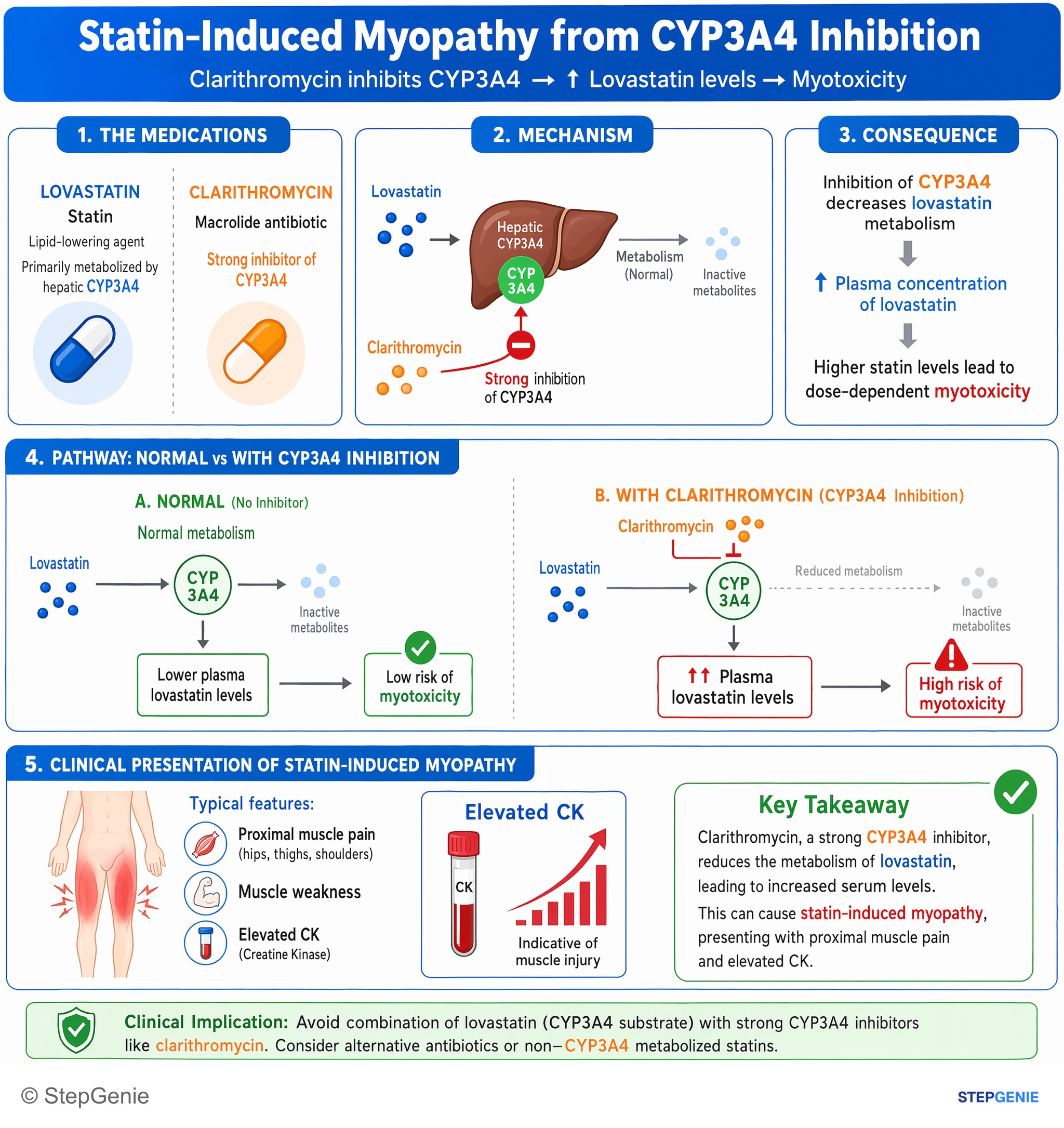
Statin-induced myopathy due to clarithromycin inhibition of CYP3A4, increasing serum lovastatin and causing proximal muscle pain and…
USMLE Step 1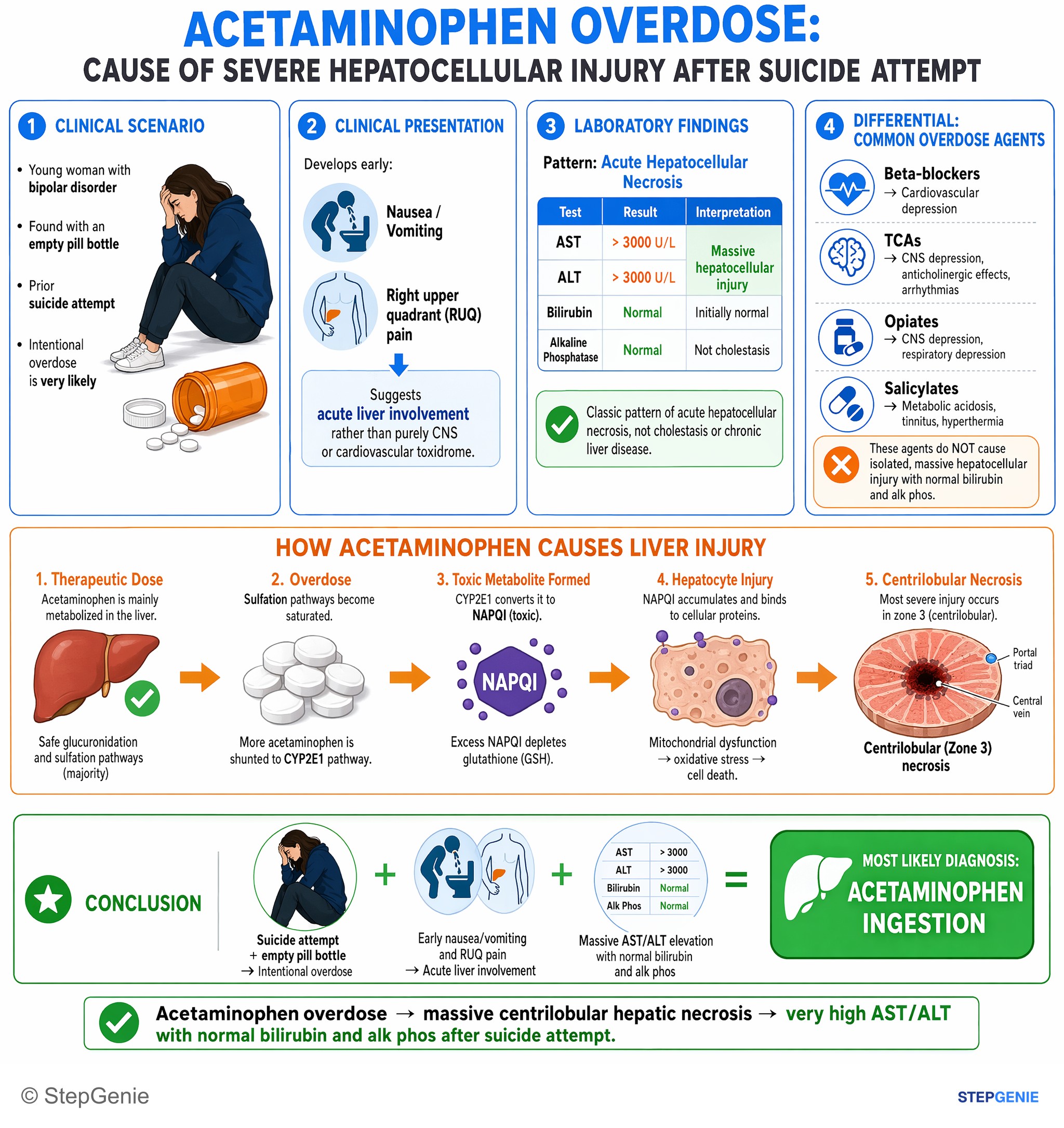
Acetaminophen overdose → massive centrilobular hepatic necrosis → very high AST/ALT with normal bilirubin and alk phos after suicide…
USMLE Step 2Frequently Asked Questions
What is the mnemonic for CYP450 inducers?
GRAB PCS: griseofulvin, rifampin, alcohol (chronic use), barbiturates such as phenobarbital, phenytoin, carbamazepine, St. John's wort and smoking. Inducers make cells produce more CYP enzyme, so drugs cleared by that enzyme fall to subtherapeutic levels, causing oral contraceptive failure, transplant rejection on tacrolimus or a falling INR on warfarin. Rifampin is the broadest inducer, and newer strong CYP3A inducers include apalutamide and enzalutamide.
What is the mnemonic for CYP450 inhibitors?
A MAGIC VCR: amiodarone, macrolides (clarithromycin and erythromycin, not azithromycin), azoles, grapefruit juice, isoniazid, cimetidine, valproate, ciprofloxacin and ritonavir, plus SOS for sulfonamides, omeprazole and SSRIs such as fluoxetine, paroxetine and fluvoxamine. Inhibitors slow the metabolism of other drugs, so levels rise and toxicity follows, for example bleeding on warfarin, rhabdomyolysis on simvastatin or high tacrolimus levels. FDA rates cimetidine and omeprazole as only weak inhibitors.
Why do CYP450 inducers take longer to act than inhibitors?
Inducers activate nuclear receptors such as PXR, CAR and AHR, which switch on CYP genes, and new enzyme takes days to weeks to build up. After the inducer stops, the extra enzyme has to be degraded, so the effect also fades slowly; combined pill labels advise back-up contraception for 28 days after an inducer is stopped. Inhibitors block enzyme that is already there, so levels of the affected drug rise within days.
Which drugs are strong CYP3A4 inhibitors and inducers?
On FDA's list, strong CYP3A inhibitors include clarithromycin, itraconazole, ketoconazole, posaconazole, voriconazole, ritonavir, cobicistat and nefazodone, while erythromycin, fluconazole, diltiazem, verapamil and grapefruit juice are moderate. Strong CYP3A inducers include rifampin, carbamazepine, phenytoin, St. John's wort, apalutamide and enzalutamide; phenobarbital is moderate. Sensitive CYP3A4 substrates include tacrolimus, simvastatin and midazolam. Azithromycin is the macrolide least likely to interact.
Which CYP450 enzyme metabolizes warfarin?
CYP2C9 metabolizes S-warfarin, the enantiomer with 2 to 5 times more anticoagulant activity; R-warfarin is metabolized mainly by CYP1A2 and CYP3A4. CYP2C9 inhibitors such as amiodarone, fluconazole, trimethoprim-sulfamethoxazole and metronidazole raise the INR and bleeding risk, and amiodarone can double the prothrombin time within 3 to 4 days. Inducers such as rifampin, carbamazepine and phenobarbital lower the INR. CYP2C9 and VKORC1 variants also lower warfarin dose needs.
How do CYP2C19 and CYP2D6 genes affect clopidogrel and codeine?
Both are prodrugs. Clopidogrel needs CYP2C19 to form its active metabolite, so poor metabolizers with two no-function alleles get weaker platelet inhibition; after ACS or PCI, CPIC advises prasugrel or ticagrelor, if not contraindicated, for poor and intermediate metabolizers, and omeprazole should be avoided. Codeine needs CYP2D6 to become morphine: poor metabolizers get little pain relief, while ultrarapid metabolizers can develop life-threatening respiratory depression, so CPIC advises avoiding codeine in both.