Drug–drug interactions (DDIs) are one of those “easy points if you’re prepared, brutal if you’re not” Step topics—because the exam loves pairing a classic medication with a second agent that quietly flips its metabolism, binding, or physiologic effect. The good news: DDIs are highly pattern-based. If you learn a small set of mechanisms and a short list of culprit drugs, you can predict most testable interactions on Step 1 (and a surprising number on Step 2).
What exactly is a drug–drug interaction?
A drug–drug interaction occurs when one drug alters the effect of another drug, causing:
- Increased toxicity
- Decreased efficacy
- Unexpected clinical effects (e.g., serotonin syndrome, QT prolongation, bleeding)
Big classification: PK vs PD
| Type | What changes? | Key question | Step-style clue |
|---|---|---|---|
| Pharmacokinetic (PK) | ADME: absorption, distribution, metabolism, excretion | “What changed the concentration of the drug?” | ↑/↓ levels, INR change, toxicity after starting/stopping another drug |
| Pharmacodynamic (PD) | Receptor/physiologic effect | “What changed the effect at same concentration?” | Additive/synergistic effects: hypotension, bleeding, CNS depression |
First Aid cross-reference: General Principles of Pharmacology (drug metabolism, enzyme induction/inhibition, therapeutic index), plus drug-specific sections (CYP450 table, anticoagulants, autonomics, psych, antimicrobials).
Pathophysiology (the mechanisms Step loves)
1) CYP450 enzyme inhibition (fast → toxicity risk)
Inhibition decreases metabolism of substrate drugs → increased levels → toxicity.
- Time course: often rapid (hours to days)
- Classic “giveaway” vignette: “Patient stable on warfarin, starts antibiotic, now bleeding + INR high.”
High-yield CYP inhibitors to memorize
A classic mnemonic is SICKFACES.COM, but on exams the most common culprits include:
- Macrolides (especially erythromycin, clarithromycin)
- Azole antifungals (ketoconazole, itraconazole, fluconazole; variable strength)
- Protease inhibitors (ritonavir is a big one)
- Amiodarone
- Cimetidine
- Grapefruit juice (intestinal CYP3A4 inhibition)
- Isoniazid (can inhibit CYP enzymes)
What Step asks: “Which medication caused toxicity by inhibiting CYP?” or “What happens to the level of drug X?”
2) CYP450 enzyme induction (slow → therapeutic failure risk)
Induction increases metabolism of substrate drugs → decreased levels → treatment failure.
- Time course: slow onset (days to weeks) because it requires increased enzyme transcription/translation
- Classic vignette: “Breakthrough seizures / pregnancy / clot / transplant rejection after starting rifampin.”
High-yield CYP inducers (Step favorites)
- Rifampin
- Carbamazepine
- Phenytoin
- Phenobarbital
- St. John’s wort
- Griseofulvin (shows up with OCP failure)
Clinical consequences to recognize:
- Oral contraceptive failure (spotting, unexpected pregnancy)
- Warfarin failure (↓ INR → thrombosis)
- Calcineurin inhibitor failure (↓ tacrolimus/cyclosporine → transplant rejection)
- Antiretroviral failure (depending on regimen)
3) P-glycoprotein (P-gp) transport interactions
P-gp is an ATP-dependent efflux pump (e.g., in gut, BBB, kidney) that reduces intracellular drug levels.
- Inhibiting P-gp can increase drug absorption/levels
- Inducing P-gp can decrease levels
Board-relevant example:
- Digoxin levels can rise with P-gp inhibitors (clinically important; Step sometimes frames this as “inhibits renal secretion/transport”).
4) Protein binding displacement (less common than students think)
Highly protein-bound drugs (e.g., warfarin) can be displaced, transiently increasing free drug.
But: the body often re-equilibrates via metabolism/clearance, so Step more often tests CYP effects than pure displacement.
Still, know the concept:
- Warfarin is highly albumin-bound → displacement can increase bleeding risk (often paired with metabolism inhibition in real life).
5) Altered absorption (chelators, pH changes, gut flora)
These are often “mechanism straightforward → free points.”
Chelation (big Step 1 favorite)
Divalent/trivalent cations bind drugs → reduced absorption:
- Tetracyclines + Ca²⁺/Mg²⁺/Fe²⁺ (milk, antacids, iron) → ↓ absorption
- Fluoroquinolones + cations → ↓ absorption
- Levothyroxine + iron/calcium → ↓ absorption (common clinically)
Gastric pH changes
- PPIs/H2 blockers can reduce absorption of drugs needing acid (classically discussed with antifungals like ketoconazole; real-world varies)
Gut flora effects (classic warfarin tie-in)
- Broad-spectrum antibiotics ↓ vitamin K–producing gut flora → ↑ warfarin effect → bleeding, ↑ INR
6) Altered excretion (renal tubular secretion; urine pH)
Competition for secretion
- Probenecid decreases tubular secretion of weak acids (e.g., penicillin) → increases levels
- NSAIDs can reduce renal perfusion → raise levels of renally cleared drugs (e.g., lithium)
Urine alkalinization/acidification (weak acids/bases)
- Weak acids (e.g., aspirin) are “trapped” in basic urine → increased excretion
- Weak bases (e.g., amphetamines) are “trapped” in acidic urine → increased excretion
This is more “general principles” than common DDI vignettes, but it’s fair game on Step 1.
Clinical presentation: how DDIs show up in vignettes
Think in patterns—toxicity vs failure vs syndrome.
A) Toxicity from increased levels (PK)
Common “target” drugs with narrow therapeutic index (NTI):
- Warfarin → bleeding, ↑ INR
- Digoxin → nausea, yellow vision, arrhythmias
- Lithium → tremor, ataxia, nephrogenic diabetes insipidus
- Theophylline → seizures, arrhythmias
- Phenytoin → nystagmus, ataxia, gingival hyperplasia (toxicity adds CNS findings)
B) Therapeutic failure from decreased levels (PK)
- Breakthrough seizures (antiepileptics affected by inducers/inhibitors)
- Pregnancy on OCPs (enzyme inducers)
- Transplant rejection (tacrolimus/cyclosporine levels drop)
- Clotting while “on warfarin” (inducers lower INR)
C) Additive/synergistic physiologic effects (PD)
- Bleeding: anticoagulants + antiplatelets + NSAIDs
- Hypotension/bradycardia: nitrates + PDE-5 inhibitors; beta-blockers + non-DHP CCBs
- CNS/respiratory depression: opioids + benzodiazepines + alcohol
- Hyperkalemia: ACEi/ARB + K⁺-sparing diuretics + K⁺ supplements
- Serotonin syndrome: serotonergic combinations (see below)
- QT prolongation: multiple QT-prolongers together
Diagnosis: a Step-friendly approach
1) Identify a “trigger” change
DDIs are often tested as: “A stable patient started medication X and now has symptom Y.”
Ask:
- What drug was added (or stopped)?
- Is it a CYP inhibitor/inducer?
- Is there a PD synergy (same physiologic direction)?
2) Check for an NTI drug
If the patient is on warfarin, digoxin, lithium, theophylline, phenytoin—your DDI radar should immediately go up.
3) Use key labs/monitoring clues
- Warfarin: ↑ INR (bleeding risk) or ↓ INR (clot risk)
- Digoxin: arrhythmia + GI symptoms; level may be provided
- Lithium: neurologic symptoms; kidney issues; level may be provided
- Serotonin syndrome: hyperreflexia/clonus is a major clue (see below)
Treatment (and prevention): what to do about DDIs
General management principles
- Stop or replace the offending interacting drug when possible
- Adjust dose of the affected drug (especially if must continue both)
- Monitor levels or physiologic endpoints:
- INR for warfarin
- Drug levels for digoxin, lithium, phenytoin (context-dependent)
- EKG for QT risk or arrhythmias
- Provide antidotes/supportive care for acute toxicity (high yield below)
High-yield specific “what to do” scenarios
- Warfarin toxicity/bleeding: hold warfarin; give vitamin K ± PCC/FFP depending on severity (Step 2 leans into this)
- Opioid overdose (PD synergy common): naloxone
- Benzodiazepine overdose (careful): flumazenil (rarely used clinically due to seizure risk; Step may ask mechanism)
- Serotonin syndrome: stop serotonergic agents, supportive care, cyproheptadine (5-HT antagonist)
- Torsades from QT prolongation: IV magnesium
HY “association list” you should know cold
1) Warfarin: the Step 1 interaction magnet
Warfarin effect increases (↑ INR, bleeding) with:
- CYP inhibitors (macrolides, azoles, amiodarone, cimetidine, etc.)
- Broad-spectrum antibiotics (↓ gut flora → ↓ vitamin K)
- Aspirin/NSAIDs (PD: platelet inhibition + GI bleeding risk)
Warfarin effect decreases (↓ INR, clot risk) with:
- CYP inducers (rifampin, carbamazepine, phenytoin, phenobarbital, St. John’s wort)
- Increased vitamin K intake (not a drug-drug interaction, but commonly paired as a distractor)
First Aid cross-reference: Anticoagulants (warfarin), CYP450 inducers/inhibitors tables.
2) Nitrates + PDE-5 inhibitors = dangerous hypotension
- Nitroglycerin/isosorbide + sildenafil/tadalafil/vardenafil
- Mechanism: excessive cGMP-mediated vasodilation → severe hypotension, syncope
First Aid cross-reference: Autonomics/vasodilators; erectile dysfunction drugs.
3) Serotonin syndrome combos (PD)
Common triggers:
- SSRI/SNRI + MAOI
- SSRI + linezolid (MAOI activity)
- SSRI + tramadol
- SSRI + triptans (classically taught; real-world risk variable, but Step-likely)
- Multiple serotonergic agents together
Clinical triad (think: “hot + altered + hyperreflexic”):
- Mental status changes (agitation, confusion)
- Autonomic instability (hyperthermia, diaphoresis, diarrhea)
- Neuromuscular hyperactivity (clonus, hyperreflexia)
Treatment: stop drugs, supportive care, cyproheptadine
First Aid cross-reference: Antidepressants (SSRIs, SNRIs, MAOIs), antimicrobials (linezolid), analgesics (tramadol).
4) QT prolongation stacking (PD)
QT risk increases when combining multiple QT-prolongers. Big categories:
- Class Ia and Class III antiarrhythmics (quinidine, procainamide, sotalol, amiodarone*)
- Macrolides
- Fluoroquinolones
- Antipsychotics (especially typicals, some atypicals)
- Methadone
- Ondansetron (commonly taught)
*Amiodarone prolongs QT but less torsades than expected; Step may still treat it as QT-prolonging.
Presentation: syncope, palpitations; polymorphic VT (torsades)
Treatment: IV magnesium
First Aid cross-reference: Antiarrhythmics; antimicrobial sections; psych pharm.
5) Lithium toxicity: dehydration + NSAIDs/ACEi/diuretics
Lithium levels rise with:
- Thiazide diuretics (↑ lithium reabsorption in proximal tubule)
- NSAIDs (↓ renal perfusion → ↓ clearance)
- ACE inhibitors/ARBs (can reduce GFR/alter handling)
Presentation: coarse tremor, ataxia, confusion, GI upset, nephrogenic DI
Management: stop offending agent; hydration; severe cases may need dialysis
First Aid cross-reference: Mood stabilizers (lithium); renal physiology tie-ins.
6) Digoxin toxicity: beware transport/clearance changes + hypokalemia
Digoxin toxicity risk increases with:
- Hypokalemia (often from loop/thiazide diuretics): less K⁺ competition at Na⁺/K⁺-ATPase → more digoxin effect
- Drugs that raise digoxin levels (classically amiodarone, some macrolides; transport interactions may be referenced)
Presentation: nausea/vomiting, confusion, yellow vision, arrhythmias
Treatment: digoxin immune Fab (Digibind) for serious toxicity
First Aid cross-reference: Cardiac glycosides (digoxin); diuretics; antiarrhythmics.
7) Chelation: “don’t take with milk/antacids/iron”
- Tetracyclines: doxycycline + dairy/antacids/iron → ↓ absorption
- Fluoroquinolones: ciprofloxacin + cations → ↓ absorption
First Aid cross-reference: Antibiotics—tetracyclines, fluoroquinolones.
8) Beta-blocker + non-DHP calcium channel blocker = bradycardia/heart block
- Metoprolol/atenolol/etc. + verapamil/diltiazem
- PD synergy: ↓ AV node conduction + negative inotropy
Presentation: bradycardia, hypotension, dizziness, possible AV block
First Aid cross-reference: Cardiovascular pharm (beta-blockers, CCBs).
A quick “DDI algorithm” for Step questions
-
Is the adverse effect from too much drug or too little drug?
- Toxicity → think inhibitor, reduced clearance, transport effects
- Failure → think inducer, reduced absorption
-
Is there an NTI drug involved?
Warfarin, digoxin, lithium, theophylline, phenytoin are classic. -
Does this look like PD synergy?
- Bleeding (anticoagulant + antiplatelet/NSAID)
- Hypotension (nitrates + PDE-5)
- CNS depression (opioid + benzo)
- Serotonin syndrome (stack serotonergic drugs)
-
Pick the most “board-famous” interacting agent in the list.
Rifampin, macrolides, azoles, amiodarone, cimetidine, grapefruit juice, St. John’s wort show up constantly.
High-yield tables (memorize-friendly)
CYP450 inducers vs inhibitors (Step essentials)
| Inducers (↓ substrate levels) | Inhibitors (↑ substrate levels) |
|---|---|
| Rifampin | Macrolides (erythro/clarithro) |
| Carbamazepine | Azoles (ketoconazole, etc.) |
| Phenytoin | Protease inhibitors (ritonavir) |
| Phenobarbital | Amiodarone |
| St. John’s wort | Cimetidine |
| Griseofulvin | Grapefruit juice |
| Isoniazid (notable) |
Classic “pairings” the exam likes
| Interaction | Mechanism | Outcome |
|---|---|---|
| Warfarin + TMP-SMX / macrolide / azole | CYP inhibition ± ↓ gut vitamin K | ↑ INR, bleeding |
| Warfarin + rifampin | CYP induction | ↓ INR, thrombosis |
| OCPs + rifampin / enzyme-inducing antiepileptics | CYP induction | Contraceptive failure |
| Nitrates + sildenafil | PD (vasodilation) | Severe hypotension |
| SSRI + MAOI/linezolid/tramadol | PD (↑ serotonin) | Serotonin syndrome |
| Tetracycline + milk/antacids | ↓ absorption (chelation) | Treatment failure |
| Beta-blocker + verapamil/diltiazem | PD (↓ AV conduction) | Bradycardia, heart block |
| Lithium + NSAID/thiazide/ACEi | ↓ clearance | Lithium toxicity |
First Aid cross-references (where to anchor this)
Use these as “home bases” while you annotate UWorld/NBME patterns:
- General Principles: CYP450 induction/inhibition, first-pass metabolism, therapeutic index
- Autonomics/Cardio: nitrates, PDE-5 inhibitors, beta-blockers, CCBs, antiarrhythmics (QT)
- Antimicrobials: macrolides, azoles, rifampin, tetracyclines, fluoroquinolones, linezolid
- Psych: SSRIs/SNRIs/MAOIs, lithium
- Heme: warfarin and monitoring (INR)
Final rapid-fire high-yield facts
- Inhibitors act fast → toxicity soon after starting the new drug.
- Inducers act slow → failure after days to weeks.
- Warfarin interactions are disproportionately tested; always ask “INR up or down?”
- QT prolongation is additive; torsades treatment = IV magnesium.
- Serotonin syndrome clue is clonus/hyperreflexia (not just “fever + confusion”).
- Chelation (tetracyclines/fluoroquinolones) is a common “missed freebie.”
Visual explanations from the StepGenie QBank
Infographics StepGenie drew to explain questions in its own QBank, matched to this article's topic. Each caption is the takeaway of the question it explains.
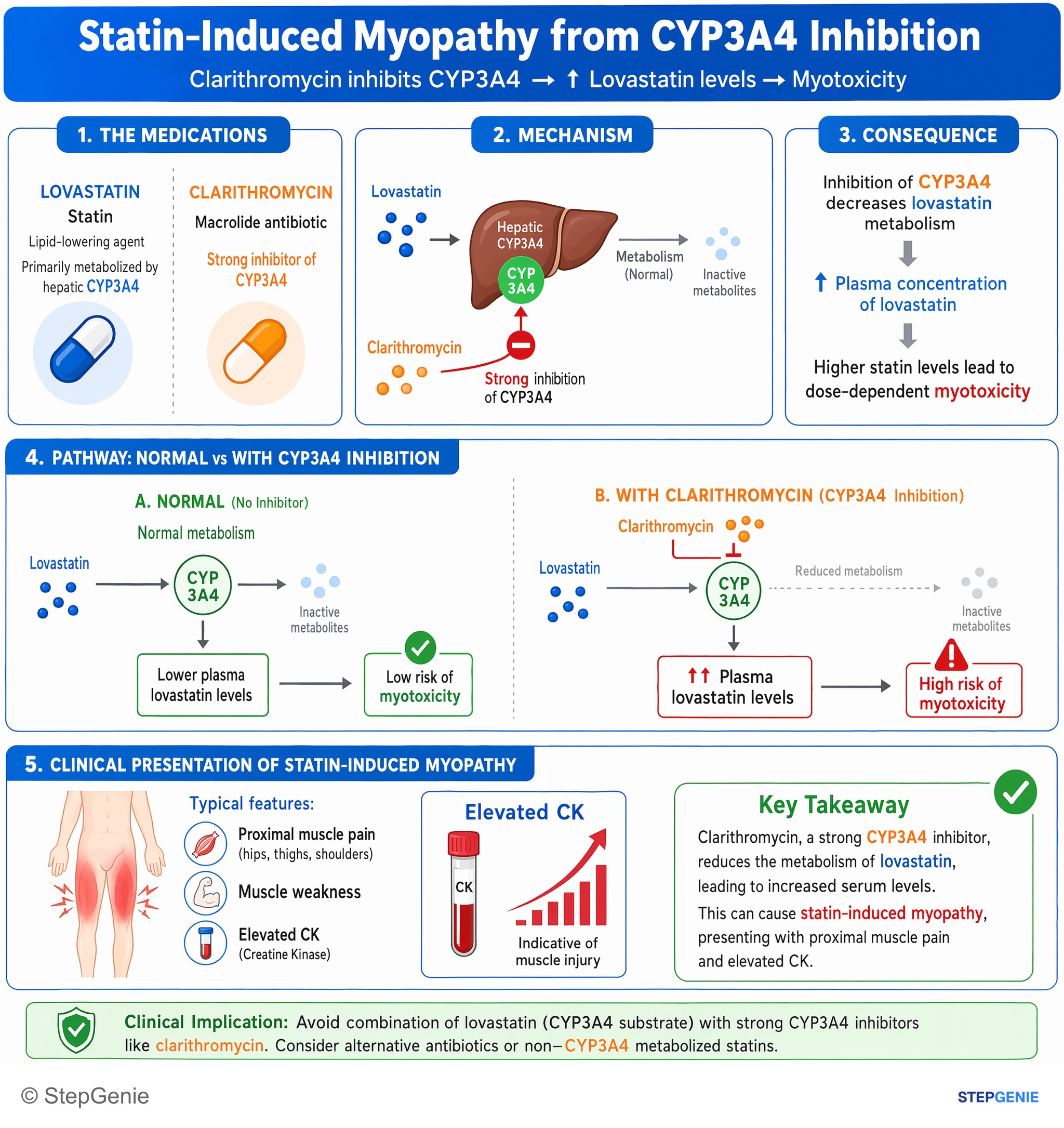
Statin-induced myopathy due to clarithromycin inhibition of CYP3A4, increasing serum lovastatin and causing proximal muscle pain and…
USMLE Step 1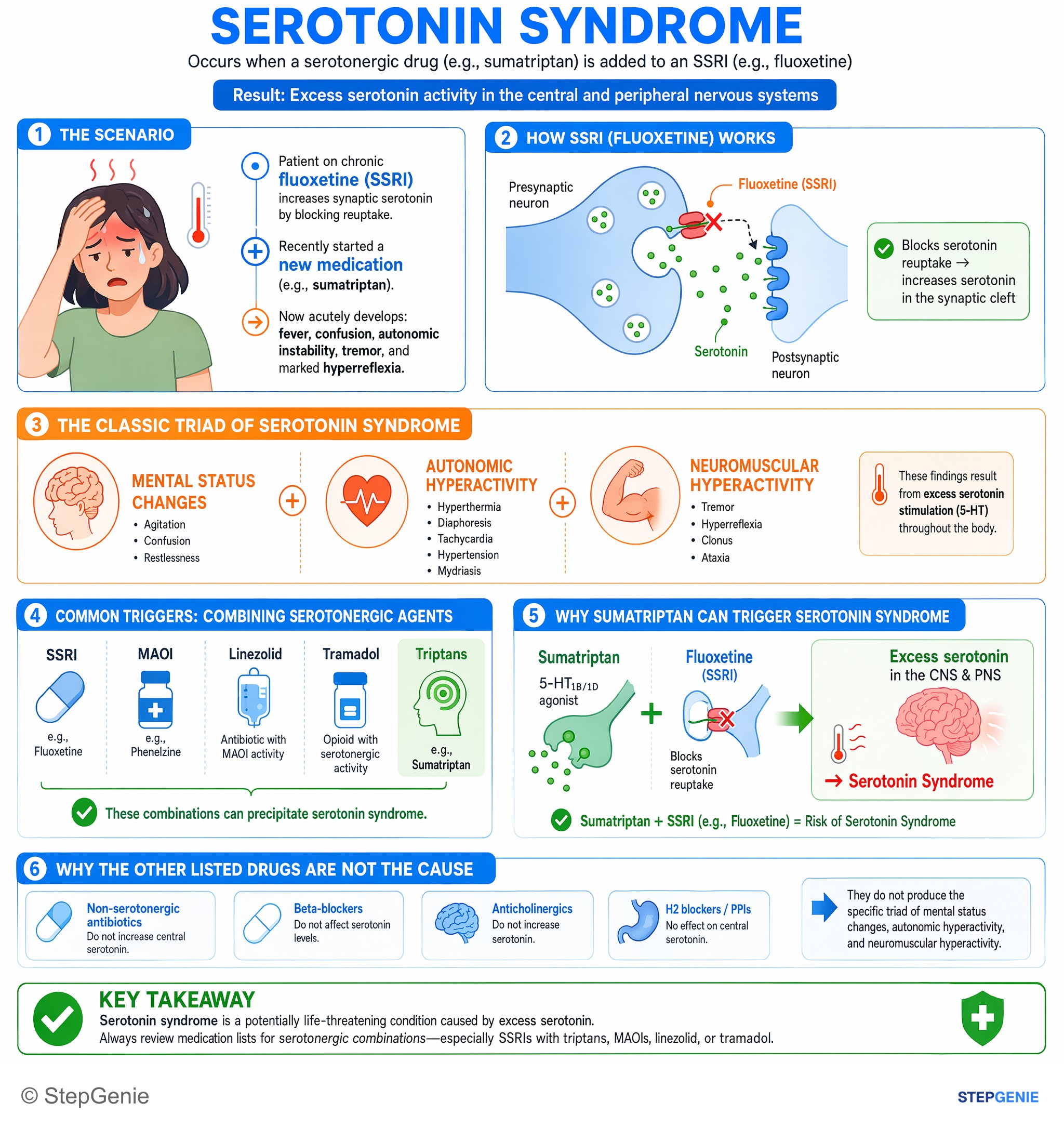
Serotonin syndrome: serotonergic drug (triptan) added to SSRI (fluoxetine) → hyperthermia, agitation, hyperreflexia, clonus, autonomic…
USMLE Step 1Frequently Asked Questions
How do you tell a pharmacokinetic drug interaction from a pharmacodynamic one?
A pharmacokinetic interaction changes the drug concentration, while a pharmacodynamic interaction changes the drug effect at the same concentration. Pharmacokinetic interactions involve absorption, distribution, metabolism, or excretion and often show up as changed drug levels, INR shifts, or toxicity after starting or stopping another drug. Pharmacodynamic interactions instead produce additive or synergistic physiologic effects such as hypotension, bleeding, or CNS depression without requiring a concentration change.
Why do CYP450 inhibitors cause toxicity so quickly?
CYP450 inhibitors cause toxicity because they decrease metabolism of substrate drugs, which raises drug levels and increases toxicity risk. This usually happens rapidly, within hours to days. A classic exam clue is a patient stable on warfarin who starts another medication and then develops bleeding with a high INR. High-yield inhibitors include macrolides, azole antifungals, protease inhibitors, amiodarone, cimetidine, grapefruit juice, and isoniazid.
Why do CYP450 inducers cause treatment failure instead of toxicity?
CYP450 inducers usually cause treatment failure because they increase metabolism of substrate drugs, which lowers drug levels. Their onset is slower, over days to weeks, because induction requires increased enzyme transcription and translation. Common clues include breakthrough seizures, unexpected pregnancy, thrombosis, or transplant rejection after starting an inducer such as rifampin, carbamazepine, phenytoin, phenobarbital, St. John’s wort, or griseofulvin.
Why do antacids, iron, and milk reduce tetracycline or fluoroquinolone absorption?
They reduce absorption by chelation. Divalent or trivalent cations such as calcium, magnesium, and iron bind certain drugs in the gut and prevent effective absorption. This is a high-yield mechanism for tetracyclines and fluoroquinolones. The same principle also applies to levothyroxine with iron or calcium. It is a straightforward altered-absorption interaction that commonly appears in drug interaction questions.
What drug interactions make warfarin more likely to cause bleeding?
Warfarin is more likely to cause bleeding when another interaction increases its effect or level. High-yield examples include CYP inhibition, which decreases warfarin metabolism and can lead to bleeding with an elevated INR, and broad-spectrum antibiotics, which reduce vitamin K–producing gut flora and increase warfarin effect. Protein-binding displacement can transiently increase free warfarin, but CYP-related mechanisms are tested more often than pure displacement.