The therapeutic index (TI) is TD50/ED50, the median toxic dose divided by the median effective dose (LD50/ED50 in animal studies), so the higher the TI, the safer the drug. A narrow therapeutic index means the toxic and effective doses, or the blood levels they produce, are close together, so a small change in dose, metabolism or kidney function can cause toxicity or treatment failure.
That is why narrow therapeutic index (NTI) drugs such as warfarin, digoxin, lithium, phenytoin, carbamazepine, theophylline, levothyroxine, tacrolimus and cyclosporine are titrated in small steps, checked with drug levels or effect markers such as the INR and TSH, and their generics must meet tighter FDA standards.
TI is not potency (how much drug you need) and not efficacy (the biggest effect the drug can produce); it measures the gap between help and harm.
Therapeutic index formula and definitions
| Term | Meaning | Exam point |
|---|---|---|
| ED50 | Dose that produces the desired effect in 50% of a population | Lower ED50 = more potent |
| TD50 | Dose that produces a defined toxic effect in 50% of a population | Read off the toxicity curve |
| LD50 | Dose lethal to 50% of test animals | Preclinical (animal) number; TD50 replaces it in people |
| Therapeutic index | TD50/ED50 (LD50/ED50 in animals) | A ratio without units; higher = safer |
| Therapeutic window | Concentrations between the minimum effective (MEC) and minimum toxic (MTC) concentration | The clinical version, used with drug levels |
| Margin of safety | Usually TD1/ED99 (NLM ToxTutor); some books call it the certain safety factor | Stricter: toxic in 1% vs effective in 99% |
| NTI drug (FDA) | Small differences in dose or blood concentration may lead to serious therapeutic failure or life-threatening or disabling adverse reactions | Needs monitoring and careful titration |
Four wordings you may meet:
- MeSH (National Library of Medicine): "The ratio of the dose that produces toxicity to the dose that produces a clinically desired or effective response."
- Merck Manual: the "ratio of the minimum toxic concentration to the median effective concentration"; raising the dose of a small-TI drug raises the chance of toxicity.
- In clinical use (Tamargo 2015): LD50/ED50 is the "academic" definition; in practice TI means the range of doses that work without unacceptable adverse effects.
- 21 CFR 320.33(c): its example of a "narrow therapeutic ratio" is less than a 2-fold difference between LD50 and ED50, or between the minimum toxic and minimum effective blood concentrations, when safe use needs careful titration and monitoring.
Rules of thumb: a TI above 10 is generally considered a good safety profile (Tamargo 2015), and a TI below 2 is called narrow (Chen 2024), matching the regulation's 2-fold example.
What does a narrow therapeutic index mean?
It means the dose or blood level that harms is not much higher than the one that helps. In Tamargo's words, there is "only a very small range of doses at which the drug produces a beneficial effect without causing severe and potentially fatal complications". "Low TI" and "narrow TI" mean the same thing.
The FDA's five features of NTI drugs (CDER, 2024) show what that means in practice:
- Little separation between therapeutic and toxic doses or blood levels, so a small dose change can be toxic.
- Too little is dangerous too: levels that are too low can cause serious therapeutic failure (FDA's examples: epilepsy, immunosuppression).
- Therapeutic monitoring: drug levels for digoxin, lithium, phenytoin or tacrolimus; effect markers for warfarin (INR) and levothyroxine (TSH), as FDA's product-specific guidances (PSGs) specify.
- Low within-subject variability: one patient's exposure to the same dose changes little over time.
- Very small dose steps: under 20% for digoxin and phenytoin, 10-25% for warfarin and theophylline (PSGs).
So anything that shifts exposure, such as a new interacting drug, falling kidney function, dehydration or a switch between formulations, can push a stable patient out of range.
Therapeutic window, margin of safety and certain safety factor
The therapeutic window is a range, not a ratio: the blood concentrations from the minimum effective concentration (MEC) to the minimum toxic concentration (MTC). FDA's plain-language version calls it the dose range that gives effective therapy and avoids serious adverse effects: above it, serious side effects; below it, likely failure. Most drugs have a wide window, while NTI drugs have "a much tighter" one (FDA).
There is no official "therapeutic window formula." A 2024 review gives the window's width as a ratio, noting that it lacks a formal definition:
The margin of safety is stricter than TI. NLM's ToxTutor and a 2024 review (Chen, who also calls it the certain safety factor) give it as:
It compares the dose that harms the most sensitive 1% with the dose that helps 99%. TI uses only the 50% points, so it can look reassuring when the curves overlap at their tails; a margin of safety below 1 means some patients are harmed at a dose others still need. Names vary: the Saunders veterinary dictionary uses "certain safety factor" for LD50/ED50, the TI itself. So read the subscripts: 50/50 is TI, 1/99 is the margin of safety.
How to read quantal dose-response curves
A quantal curve tracks an all-or-none effect, one that is either "occurring" or "not occurring" (IUPAC), such as seizure control or an arrhythmia, and plots the percentage of a population showing it at each dose: it answers "Yes or no?" where a graded curve answers "How much?" (StatPearls). Dose goes on the x-axis, often as log dose (Merck). To read TI off a pair of curves:
- Check the y-axis. "% of subjects" means quantal. A graded curve plots the size of the response in one patient or tissue; it shows potency, maximal efficacy and slope (Merck) but cannot give TI.
- Find the 50% crossings: the ED50 on the efficacy curve, the TD50 on the toxicity curve to its right.
- Divide, toxic on top: TI = TD50/ED50. The gap between the curves, not their position on the dose axis, is the safety.
- Check the tails: where toxicity starts (TD1) vs where efficacy becomes nearly universal (ED99). Shallow, overlapping curves can hide a poor margin of safety behind a decent TI.
Here is a hypothetical population study:
| Dose (mg) | % with the desired effect | % with toxicity |
|---|---|---|
| 1 | 10 | 0 |
| 2 | 50 | 0 |
| 5 | 90 | 2 |
| 20 | 99 | 20 |
| 40 | 100 | 50 |
| 80 | 100 | 85 |
ED50 = 2 mg and TD50 = 40 mg, so TI = 40/2 = 20. Now the tails: the 20-mg dose that helps 99% (ED99) is toxic in 20%, and 2% already have toxicity at 5 mg, so TD1 is at most 5 mg and the margin of safety is at most 5/20 = 0.25. A TI of 20 hides that overlap. More on curve shapes in the dose-response curve tips.
Worked calculations
The first uses illustrative numbers; the rest use published ones.
1. Potency vs safety. Drug A: ED50 = 10 mg, TD50 = 1,000 mg, so TI = 100. Drug B: ED50 = 0.5 mg, TD50 = 1.5 mg, so TI = 3. Drug B is 20 times more potent (0.5 mg vs 10 mg) but far less safe. Potency tells you the dose, not the margin.
2. A window from a label. Lithium's label targets 0.8-1.2 mEq/L in acute mania and calls 1.5 mEq/L or more toxic. Taking the bottom of the target range as the effective level, MTC/MEC = 1.5/0.8 ≈ 1.9, under the regulation's 2-fold mark.
3. Phenytoin. The label gives a clinically effective total level of 10-20 mcg/mL. Nystagmus on lateral gaze usually appears at about 20 mcg/mL and ataxia at 30. Because its metabolism saturates, a dose increase of 10% or more can raise the steady-state level out of proportion (see zero-order elimination).
4. Real estimates. In a 2022 talk (her own views, not formal FDA policy), FDA generic-drug scientist Wenlei Jiang estimated toxic-to-effective ratios of about 2 for tacrolimus, 2-2.7 for valproic acid, 2.5 for carbamazepine and 2.7 for phenytoin, all NTI in FDA's PSGs, but 10 for lamotrigine, which is not.
Potency vs efficacy vs therapeutic index
| Concept | Question it answers | Where to look | Trap |
|---|---|---|---|
| Potency | How much drug for a given effect? | Position along the dose axis (ED50 or EC50); left = more potent | More potent does not mean safer or better |
| Efficacy | How big can the effect get? | Height of the plateau (maximal response) | A partial agonist has lower efficacy than a full agonist, whatever its potency |
| Therapeutic index | How far apart are help and harm? | Distance between the efficacy and toxicity curves | Needs both an effective and a toxic dose |
Agonist types and their curves are in the agonist vs antagonist mnemonic; more general principles are on the pharmacology topic page.
Narrow therapeutic index drugs: whose list?
There is no single list. FDA's general materials give examples (CDER names warfarin and levothyroxine), and its PSGs state drug by drug that FDA "has concluded" a drug is NTI; the table shows exam-relevant ones, not every PSG. Health Canada calls them critical dose drugs, in a list "not limited to" nine drugs. The European Medicines Agency's guideline says no set of criteria can define NTI drugs, so it decides "case by case".
| Drug | FDA (PSG says NTI) | Health Canada (critical dose) |
|---|---|---|
| Warfarin | Yes | Yes |
| Digoxin | Yes | Yes |
| Lithium | Yes | Yes |
| Phenytoin | Yes | Yes |
| Theophylline | Yes | Yes |
| Tacrolimus, cyclosporine, sirolimus | Yes | Yes |
| Carbamazepine, valproic acid | Yes | Not listed |
| Levothyroxine, liothyronine | Yes | Not listed |
| Everolimus | Transplant tablets (Zortress) only | Not listed |
| Flecainide | No (standard PSG) | Yes |
| Aminoglycosides, vancomycin | No NTI PSG | Not listed |
A 2026 review comparing national lists has neither aminoglycosides nor vancomycin in its FDA, EMA or Health Canada columns.
The study mnemonic is "Warning! These Drugs Are Lethal!": Warfarin, Theophylline, Digoxin, Antiepileptics (phenytoin, carbamazepine, valproic acid), Lithium. It is an unofficial memory aid, not an FDA list, and it leaves out levothyroxine and the transplant drugs.
At the other end, drugs with a very high TI, such as penicillin and other beta-lactams, are generally safe and do not need precise drug monitoring (StatPearls; Chen 2024).
How narrow-TI drugs are monitored
Numbers come from the FDA labels on DailyMed unless marked otherwise. Levels are drawn at set times, once concentrations are stable (half-life and steady state). The last two rows are level-guided antibiotics that are not on the NTI lists.
| Drug | Monitor and label targets | Toxicity clues | What shifts levels or raises risk |
|---|---|---|---|
| Warfarin | INR daily until stable, then every 1-4 weeks; target 2.5 (2.0-3.0) for venous thromboembolism and non-valvular atrial fibrillation, 3.0 (2.5-3.5) for mechanical mitral valves | Bleeding, sometimes major or fatal | CYP2C9, 1A2 or 3A4 inhibitors, antibiotics, vitamin K changes, CYP2C9 and VKORC1 variants (CYP450 inducers and inhibitors) |
| Digoxin | Level just before the next dose or 6 or more hours after the last; electrolytes, renal function. Under 0.5 ng/mL: less effective; over 2: more toxicity, no added benefit | Nausea, vomiting, anorexia, visual changes; AV block, atrial tachycardia with block, bidirectional VT | Renal impairment, low potassium or magnesium, high calcium, old age, low weight; amiodarone (cut digoxin 30-50%) |
| Lithium | Level 12 hours after the last dose: 0.8-1.2 mEq/L acute, 0.8-1.0 maintenance, toxic at 1.5 or more; renal, thyroid and calcium checks | Tremor, ataxia, hyperreflexia, slurred speech; then confusion, seizures, coma | Diuretics, NSAIDs, renin-angiotensin blockers (ACE inhibitors, ARBs), metronidazole; dehydration, sodium loss, fever |
| Phenytoin | Total level 10-20 mcg/mL; unbound level (1-2 mcg/mL) if albumin is low or with renal or liver disease | Nystagmus, ataxia, slurred speech, confusion; gingival hyperplasia | Saturable CYP2C9 metabolism; CYP2C9 inhibitors or poor-metabolizer variants (antiepileptic drugs) |
| Carbamazepine | Levels (usual adult range 4-12 mcg/mL); baseline blood counts; HLA-B*1502 test before starting in at-risk ancestry | Dizziness, drowsiness, unsteadiness, nausea; hyponatremia; boxed aplastic anemia, SJS/TEN | Autoinduction (half-life falls from 25-65 to 12-17 hours); CYP3A4 inhibitors such as macrolides and azoles; it also induces CYP3A4, lowering other drugs' levels |
| Theophylline | Peak level, rechecked with fever, new illness or interacting drugs; 10-15 mcg/mL gives most of the benefit (Theo-24 label) | Nausea, vomiting, headache, insomnia; above 20: persistent vomiting, arrhythmias, seizures | Cimetidine, ciprofloxacin, erythromycin, clarithromycin; fever, liver disease, heart failure; stopping smoking |
| Levothyroxine | TSH 6-8 weeks after any dose change (free T4 in secondary hypothyroidism); steps of 12.5-25 mcg | Overtreatment: atrial fibrillation and other cardiac effects, bone loss | Older age or heart disease: start low (thyroid function tests) |
| Tacrolimus | Whole-blood trough levels in all patients; creatinine, potassium, glucose | Nephrotoxicity, tremor, PRES, new-onset diabetes, hyperkalemia, hypertension | Strong CYP3A4 inhibitors (azoles, clarithromycin, ritonavir) or inducers (rifampin); grapefruit |
| Cyclosporine | Blood levels in transplant patients; creatinine, BUN, liver tests, lipids, magnesium, potassium | Nephrotoxicity, hypertension, tremor, hirsutism, gum hyperplasia | CYP3A4 and P-glycoprotein inhibitors; grapefruit |
| Gentamicin | Peaks and troughs; renal and eighth-nerve function; avoid prolonged peaks over 12 mcg/mL and troughs over 2 | Nephrotoxicity; vestibular and hearing damage, usually irreversible; neuromuscular blockade | Renal impairment, high doses, long courses; furosemide, ethacrynic acid, other nephrotoxins |
| Vancomycin | AUC 400-600 mg·h/L for invasive MRSA, assuming an MIC of 1 mg/L (2020 consensus guideline) | Nephrotoxicity | Older 15-20 mg/L trough targets were linked to more nephrotoxicity |
The table comes down to a few mechanisms: the wanted effect is the danger (more anticoagulation, more bleeding), kidney function falls, an interacting drug changes metabolism (drug-drug interactions), metabolism saturates, or albumin and electrolytes shift. Lithium monitoring in depth is in the lithium guide, and warfarin among the anticoagulants in the anticoagulant guide.
Generics and bioequivalence: why NTI status matters
A generic must match the brand's rate and extent of absorption. For most drugs, the 90% confidence interval of the generic-to-brand ratio for AUC and Cmax must fall within 80.00-125.00% (FDA). That does not mean generics differ by 20%: across 2,070 FDA studies from 1996 to 2007, the average difference was 3.56% for AUC and 4.35% for Cmax (Davit 2009). More on absorption in the bioavailability breakdown.
For NTI drugs, FDA asks for more (2026 guidances unless marked):
- A four-way, fully replicated crossover study, so each subject takes the generic twice and the brand twice.
- Reference-scaled limits that tighten as the brand's own within-subject variability falls: about 90-111% when that variability is 10% (from the 2026 statistical guidance's constants; Yu 2015).
- The usual 80.00-125.00% limits as well.
- A generic not much more variable than the brand: the upper 90% confidence bound of the ratio of their within-subject standard deviations, generic to brand, must be 2.5 or less.
- Tighter quality standards (CDER), such as drug-content assay limits of 95.0-105.0% instead of 90.0-110.0% (per FDA scientist Wenlei Jiang, 2022).
Other regulators narrow the interval instead: Health Canada requires 90.0-112.0% for AUC of critical dose drugs, and the EMA 90.00-111.11% for AUC, and for Cmax when it matters for safety, efficacy or drug-level monitoring. That EMA rule comes from its 2010 guideline, which still governs NTI drugs because ICH M13A, in force since January 2025, leaves them to a later M13C.
FDA says generic NTI drugs, like all generics, are approved as clinically substitutable for the brand. Large US cohort studies agree: generic and brand levothyroxine brought TSH into the normal range equally often (17,598 new users; Brito 2020), and generic and brand warfarin starters aged 65 or older had similar rates of stroke or venous thromboembolism, major bleeding and death (Desai 2020). Labels still urge care when products change: extra INR tests when warfarin products are interchanged; Neoral and Sandimmune (both cyclosporine) are not bioequivalent; Prograf is not interchangeable with extended-release tacrolimus.
How USMLE tests it: the traps
- Upside-down ratio. TI = TD50/ED50: toxic on top. ED50/TD50 is a distractor.
- "Low TI" = "narrow TI" = less safe. The higher number is the safer drug.
- Potency is not safety. The most potent drug in a table can have the narrowest TI.
- Ratio vs range. TI is a ratio of doses; the therapeutic window is a range of concentrations.
- 50% points vs tails. A decent TI can hide overlapping curves; TD1/ED99 exposes them.
- The stable patient who becomes toxic. Lithium plus a thiazide or NSAID; theophylline plus ciprofloxacin or erythromycin; digoxin plus amiodarone, or a diuretic that lowers potassium. The question is really about a narrow TI.
- Phenytoin: a small dose increase causes a disproportionate rise; with low albumin, the total level can mislead, so check unbound phenytoin.
- Digoxin toxicity at a "normal" level: symptoms can occur below 2 ng/mL, especially with low potassium or magnesium.
- TI says nothing about rare idiosyncratic reactions (Chen 2024), such as carbamazepine's skin reactions, which HLA-B*1502 testing screens for.
Practice question
A population study compares four investigational drugs for the same indication. The median effective dose (ED50) and median toxic dose (TD50) of each are shown:
| Drug | ED50 (mg) | TD50 (mg) |
|---|---|---|
| W | 2 | 8 |
| X | 20 | 400 |
| Y | 0.5 | 1 |
| Z | 50 | 250 |
Which drug has the highest therapeutic index?
A. Drug W B. Drug X C. Drug Y D. Drug Z E. It cannot be determined without each drug's maximal efficacy
Answer: B. TI = TD50/ED50 = 400/20 = 20, the largest gap between the toxic and effective doses.
- A: 8/2 = 4.
- C: 1/0.5 = 2. Drug Y is the most potent (lowest ED50) but has the narrowest TI, the classic trap. It is the one most likely to need therapeutic drug monitoring.
- D: 250/50 = 5. It is the least potent, but potency does not decide safety.
- E: TI needs only TD50 and ED50. Maximal efficacy is a separate property, read from the plateau of a graded dose-response curve.
Key takeaways
- TI = TD50/ED50 (LD50/ED50 in animals); a higher TI is safer.
- A narrow TI means the doses or levels that help and harm are close, so small changes cause toxicity or failure.
- The therapeutic window runs from the MEC to the MTC; the margin of safety is usually TD1/ED99 (names vary, so read the subscripts).
- FDA's PSGs classify warfarin, digoxin, lithium, phenytoin, carbamazepine, valproic acid, theophylline, levothyroxine, tacrolimus, cyclosporine and sirolimus, among others, as NTI; other agencies' lists differ.
- NTI drugs need monitoring and small dose steps; levels shift with kidney function, CYP interactions, saturable kinetics, albumin, electrolytes and formulation changes.
- Generic NTI drugs must meet scaled, tighter bioequivalence limits.
Sources
- Therapeutic Index, Drug (MeSH descriptor D000074389) — National Library of Medicine (2018)
- Dose-Response Relationships — Merck Manual Professional Edition (2026)
- ED50 — StatPearls, NCBI Bookshelf (2024)
- Quantal effect — IUPAC Gold Book, Glossary of Terms Used in Ecotoxicology (2009)
- Drug–Receptor Interactions — Merck Manual Professional Edition (2025)
- Tamargo J, et al. Narrow therapeutic index drugs: a clinical pharmacological consideration to flecainide — European Journal of Clinical Pharmacology (2015)
- Chen YS, et al. Use of Drug Sensitisers to Improve Therapeutic Index in Cancer — Pharmaceutics (2024)
- Determining the Safety of a Drug — ToxTutor, National Library of Medicine
- Certain safety factor (entry) — Saunders Comprehensive Veterinary Dictionary, Elsevier (2020)
- Liu M, et al. Narrow Therapeutic Index Drugs: Regulatory Frameworks, Bioequivalence, and Model-Informed Precision Dosing — Pharmaceutics (2026)
- 21 CFR 320.33: Criteria and Evidence to Assess Actual or Potential Bioequivalence Problems — eCFR (2026)
- Setting and Implementing Standards for Narrow Therapeutic Index Drugs — U.S. Food and Drug Administration (2024)
- Jiang W. FDA Drug Topics: Understanding Generic Narrow Therapeutic Index Drugs (presentation; the speaker's views) — U.S. Food and Drug Administration (2022)
- Bioequivalence Studies With Pharmacokinetic Endpoints for Drugs Submitted Under an ANDA — U.S. Food and Drug Administration (2026)
- Statistical Approaches to Establishing Bioequivalence — U.S. Food and Drug Administration (2026)
- Product-specific guidances, U.S. Food and Drug Administration (database). NTI: warfarin (2026), digoxin (2017), lithium (2023), phenytoin (2014), carbamazepine (2015), valproic acid (2017), theophylline (2022), levothyroxine tablets (2014), levothyroxine capsules (2026), liothyronine (2022), tacrolimus (2026), cyclosporine (2016), sirolimus (2015), everolimus, Zortress (2020). Not NTI: everolimus, Afinitor (2018), flecainide (2024).
- Comparative Bioavailability Standards: Formulations Used for Systemic Effects — Health Canada (2018)
- Guideline on the Investigation of Bioequivalence — European Medicines Agency (2010)
- Considerations Regarding the Implementation of ICH M13A on Bioequivalence — European Medicines Agency (2025)
- Yu LX, et al. Novel bioequivalence approach for narrow therapeutic index drugs — Clinical Pharmacology & Therapeutics (2015)
- Davit BM, et al. Comparing generic and innovator drugs: a review of 12 years of bioequivalence data from the United States Food and Drug Administration — Annals of Pharmacotherapy (2009)
- Brito JP, et al. Comparative Effectiveness of Generic vs Brand-Name Levothyroxine in Achieving Normal Thyrotropin Levels — JAMA Network Open (2020)
- Desai RJ, et al. Comparative Outcomes of Treatment Initiation With Brand vs. Generic Warfarin in Older Patients — Clinical Pharmacology & Therapeutics (2020)
- Warfarin Sodium Tablets Prescribing Information (Sun Pharmaceutical) — DailyMed, NLM (2026)
- Lanoxin (Digoxin) Tablets Prescribing Information — DailyMed, NLM (2024)
- Lithium Carbonate Tablets and Capsules Prescribing Information (Hikma) — DailyMed, NLM (2026)
- Dilantin (Extended Phenytoin Sodium Capsules) Prescribing Information — DailyMed, NLM (2023)
- Tegretol (Carbamazepine) Prescribing Information — DailyMed, NLM (2026)
- Theo-24 (Theophylline Extended-Release Capsules) Prescribing Information — DailyMed, NLM (2024)
- Synthroid (Levothyroxine Sodium) Prescribing Information — DailyMed, NLM (2024)
- Prograf (Tacrolimus) Prescribing Information — DailyMed, NLM (2023)
- Neoral (Cyclosporine) Prescribing Information — DailyMed, NLM (2026)
- Gentamicin Sulfate Injection Prescribing Information (Hospira) — DailyMed, NLM (2026)
- Vancomycin Therapeutic Monitoring: ASHP/PIDS/SIDP/IDSA Revised Consensus Guideline — Infectious Diseases Society of America (2020)
Visual explanations from the StepGenie QBank
Infographics StepGenie drew to explain questions in its own QBank, matched to this article's topic. Each caption is the takeaway of the question it explains.
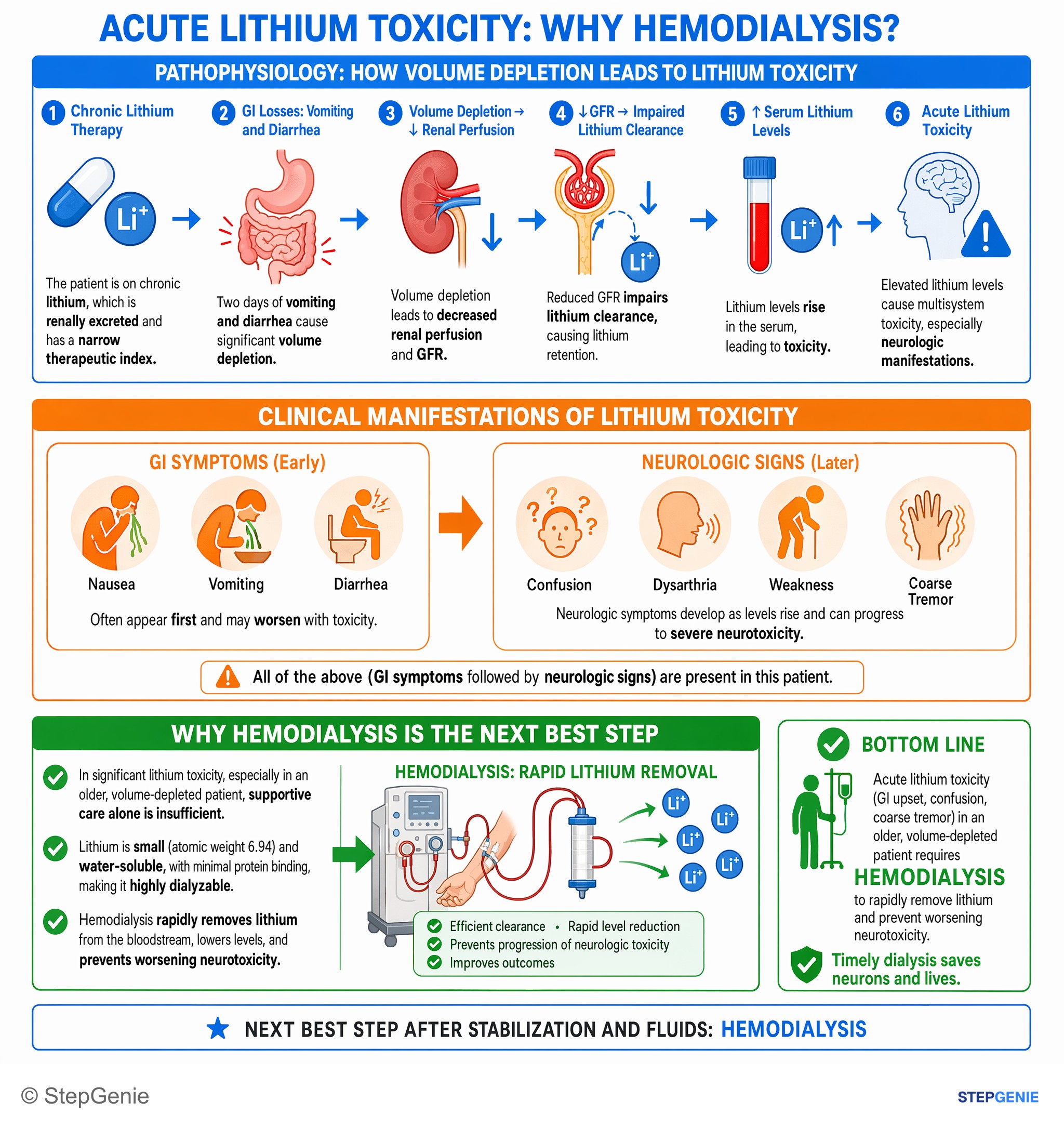
Acute lithium toxicity (GI upset, confusion, coarse tremor) in an older patient with volume depletion requires hemodialysis to rapidly…
USMLE Step 2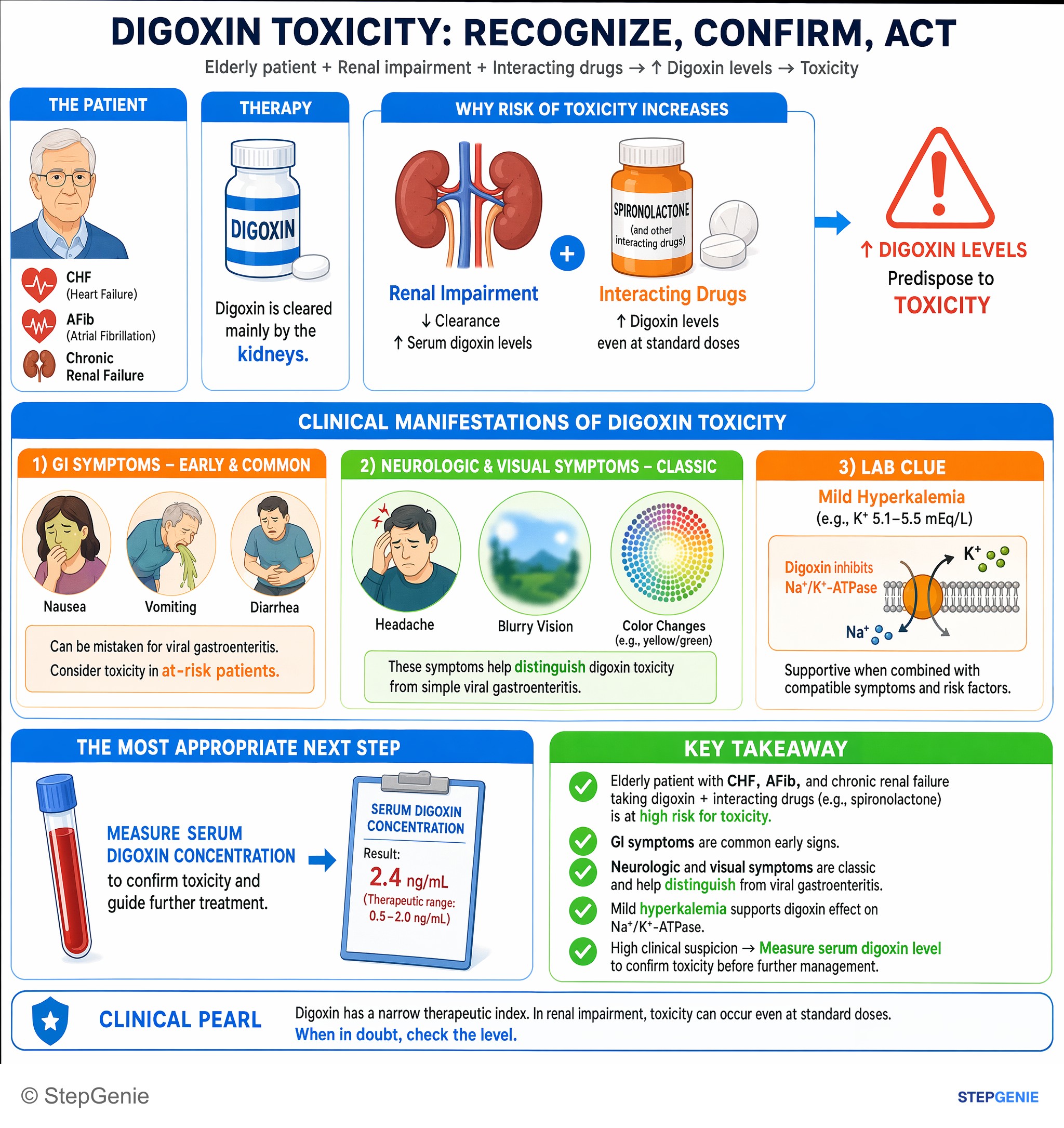
Digoxin toxicity in an elderly patient with renal impairment and GI/visual symptoms → confirm with serum digoxin level before further…
USMLE Step 2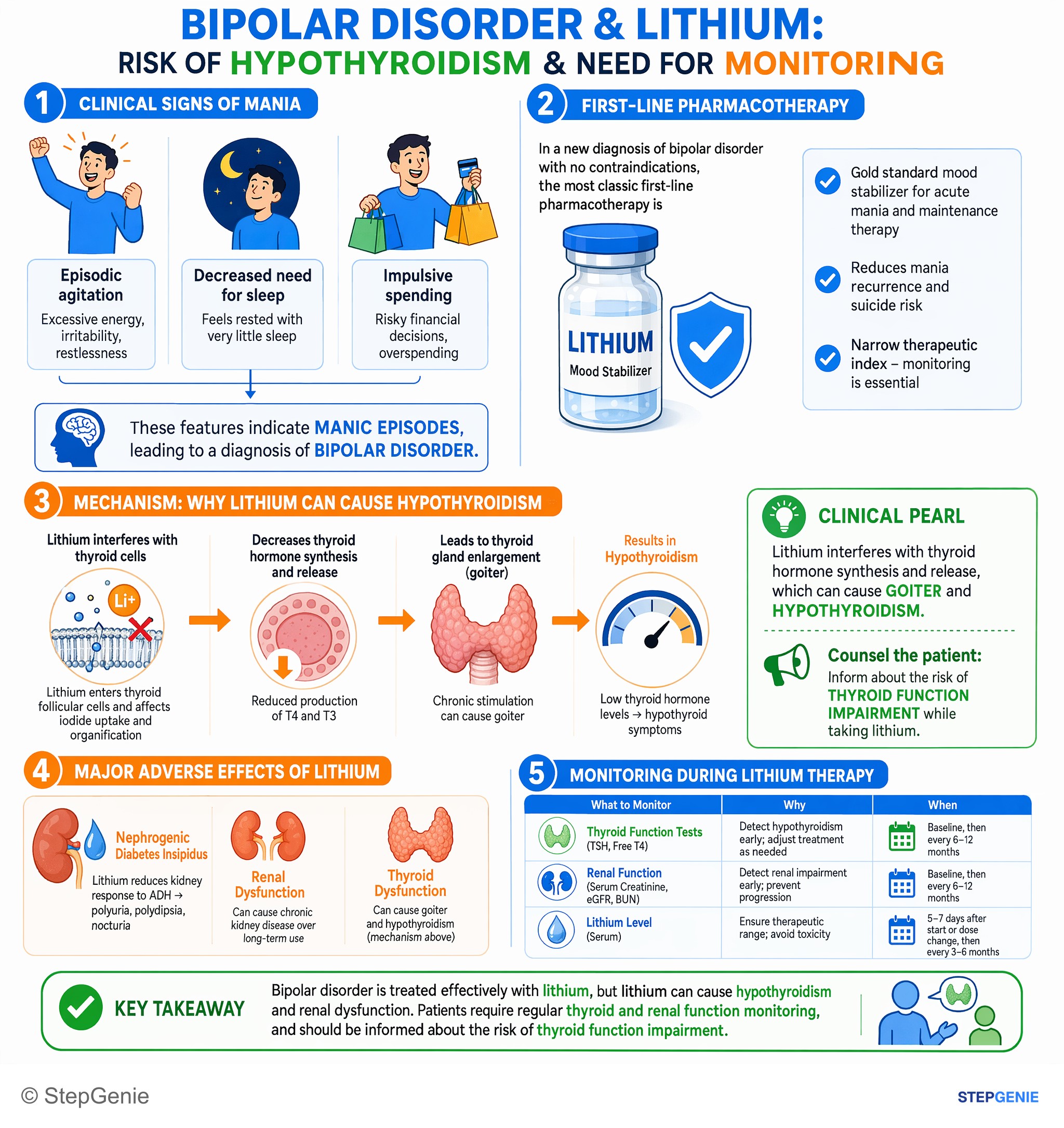
Bipolar disorder treated with lithium, which can cause hypothyroidism and requires thyroid and renal function monitoring during therapy.
USMLE Step 1Frequently Asked Questions
What is the therapeutic index formula?
The therapeutic index (TI) is TD50 divided by ED50: the dose that causes a defined toxic effect in 50% of a population divided by the dose that produces the desired effect in 50%. In animal studies, LD50, the dose lethal to 50% of animals, replaces TD50. As a ratio of two doses, TI has no units. A TD50 of 40 mg and an ED50 of 2 mg give a TI of 20; the higher the TI, the safer the drug.
What does a narrow therapeutic index mean?
A narrow therapeutic index means the dose or blood level that causes toxicity is not much higher than the one that works, so small changes in dose, absorption, metabolism or kidney function can cause serious toxicity or treatment failure. The FDA says these drugs need careful dosing, therapeutic monitoring and very small dose adjustments, and US regulations give a less than 2-fold toxic-to-effective gap as an example. Low TI and narrow TI mean the same.
What is the difference between therapeutic index, therapeutic window and margin of safety?
The therapeutic index is a ratio of doses, TD50 divided by ED50, taken from population studies. The therapeutic window is a range of blood concentrations, from the minimum effective to the minimum toxic concentration, which clinicians use when they check drug levels; its width is sometimes given as MTC divided by MEC. The margin of safety, usually TD1 divided by ED99, is a stricter test that exposes overlapping curves. Some books call it the certain safety factor; others use that name differently.
Which drugs have a narrow therapeutic index?
FDA product-specific guidances classify warfarin, digoxin, lithium, phenytoin, carbamazepine, valproic acid, theophylline, levothyroxine, tacrolimus, cyclosporine and sirolimus, among others, as narrow therapeutic index drugs. Health Canada's critical dose list adds flecainide but omits carbamazepine, valproic acid and levothyroxine, and the EMA decides case by case. A study mnemonic is Warning! These Drugs Are Lethal! (warfarin, theophylline, digoxin, antiepileptics, lithium). Aminoglycosides and vancomycin are dosed by blood levels in hospital but are not on these lists.
How are narrow therapeutic index drugs monitored?
Most are monitored with drug levels: digoxin between about 0.5 and 2 ng/mL, lithium 0.8 to 1.2 mEq/L in acute mania, total phenytoin 10 to 20 mcg/mL, and trough blood levels for tacrolimus and cyclosporine. Warfarin is monitored with the INR, usually aiming for 2.0 to 3.0, and levothyroxine with the TSH 6 to 8 weeks after a dose change. Recheck when an interacting drug is started or stopped, or when kidney function or hydration changes.
Why do generic narrow therapeutic index drugs have stricter rules?
A small difference in exposure matters more for these drugs. Most generics must show that the 90% confidence interval of their AUC and Cmax ratio to the brand falls within 80 to 125%. For NTI drugs, FDA adds a fully replicated study, limits scaled to the brand's variability (about 90 to 111% when that variability is 10%), a check that the generic is not much more variable than the brand, and tighter quality standards. FDA approves these generics as substitutable.