Contraception is one of those Step 1 topics that feels “obvious”… until a question asks which method increases thrombosis risk, which is safe postpartum, or why rifampin makes pills fail. The trick is to organize contraception by mechanism + estrogen exposure + timing—then layer in the high-yield adverse effects, contraindications, and classic USMLE associations.
Big-Picture Definition (What “Contraception” Is Actually Doing)
Contraception prevents pregnancy by interfering with one (or more) of the following:
- Ovulation (suppress LH surge)
- Fertilization (block sperm transport or function)
- Implantation (alter endometrium; primarily via progestin effects)
Key physiology anchor: The LH surge triggers ovulation. Many hormonal methods work by preventing that surge.
Core Pathophysiology & Mechanisms (Step 1-Friendly)
Estrogen + Progestin: what each component does
| Component | Primary actions | High-yield consequence |
|---|---|---|
| Estrogen | ↓ FSH → ↓ follicular development; stabilizes endometrium | ↑ hepatic clotting factors → thrombotic risk |
| Progestin | Thickens cervical mucus; thins endometrium; ↓ GnRH pulse frequency → ↓ LH surge | Irregular bleeding, less endometrial proliferation, “hostile” cervix |
Why progestin-only works even without fully blocking ovulation: cervical mucus thickening is a powerful barrier.
The Step 1 Classification System (Learn It Once)
1) Combined Hormonal Contraceptives (CHCs): estrogen + progestin
Includes:
- Combined oral contraceptive pills (OCPs)
- Transdermal patch
- Vaginal ring
Mechanism
- Estrogen suppresses FSH
- Progestin suppresses LH surge + thickens cervical mucus
High-yield benefits
- ↓ risk of endometrial cancer and ovarian cancer
- Improves dysmenorrhea, menorrhagia, acne
- Helpful in PCOS (cycle control, lower androgens)
High-yield adverse effects / risks
- Thrombosis (DVT/PE), especially with additional risk factors
- Hypertension
- Cholestasis
- Hepatic adenoma (rare but classic)
- Nausea, breast tenderness, headache
- Can worsen migraine with aura risk profile (contraindication)
Contraindications (USMLE loves these) Remember: avoid estrogen when clot/stroke risk is high.
- Age > 35 + smoking
- History of DVT/PE or known thrombophilia
- Migraine with aura
- Uncontrolled HTN
- Breast cancer (hormone-sensitive)
- Active liver disease (e.g., severe cirrhosis, hepatic tumors)
- Postpartum early period (hypercoagulable state; more below)
Drug interactions
- Enzyme inducers ↓ effectiveness:
- Rifampin/rifabutin
- Many anti-seizure meds (e.g., carbamazepine, phenytoin, phenobarbital, topiramate in higher doses)
- St. John’s wort (less tested but commonly referenced)
Clinical vignette tip
- “Woman on OCPs treated with rifampin becomes pregnant” → classic.
First Aid cross-reference
- First Aid (Repro/Endocrine sections): Combined OCP adverse effects (thromboembolism, hepatic adenoma) and contraindications (smoker >35, migraine with aura).
2) Progestin-Only Methods (no estrogen)
Includes:
- Progestin-only pill (“mini-pill”)
- Depot medroxyprogesterone acetate (DMPA) injection
- Etonogestrel implant
- Levonorgestrel (LNG) IUD
Shared mechanism
- Thickens cervical mucus
- Thins endometrium
- Variable ovulation suppression (stronger with DMPA/implant)
Progestin-only pill
- Must be taken same time daily (short window); otherwise higher failure than long-acting methods.
- Great when estrogen is contraindicated.
DMPA (Depo shot)
High-yield associations
- ↓ bone mineral density (reversible)
- Weight gain
- Delayed return to fertility after stopping (can take months)
- Can reduce seizure frequency in some (less commonly tested)
Implant (etonogestrel)
- Long-acting, very effective
- Common AE: irregular bleeding
LNG IUD
- Progestin locally → markedly decreases menstrual bleeding
- Great for heavy menstrual bleeding
- Can cause amenorrhea over time
Why progestin-only is high-yield postpartum
- Safe in breastfeeding and when avoiding estrogen-related thrombosis risk.
First Aid cross-reference
- First Aid: DMPA → decreased bone density, progestin IUD → decreased bleeding/amenorrhea.
3) Intrauterine Devices (IUDs): Copper vs Levonorgestrel
| IUD | Mechanism | Key clinical associations | Common Step pitfalls |
|---|---|---|---|
| Copper IUD | Copper is spermicidal; sterile inflammatory reaction impairs sperm motility/viability | Can be used as emergency contraception (most effective) | Heavier bleeding + cramps |
| Levonorgestrel IUD | Thick cervical mucus; endometrial atrophy | Decreased bleeding, may cause amenorrhea | Irregular bleeding early |
IUD complications (testable)
- Uterine perforation (rare)
- Expulsion (esp. soon after insertion)
- Pelvic inflammatory disease (PID) risk is mainly in the first ~20 days after insertion if an STI is present at insertion
- If pregnancy occurs with an IUD in place → higher risk ectopic pregnancy proportionally (overall pregnancy risk is still very low)
Who should not get an IUD?
- Active PID or untreated cervicitis (e.g., gonorrhea/chlamydia)
- Distorted uterine cavity (relative, depends on scenario)
First Aid cross-reference
- First Aid: Copper IUD: emergency contraception; increased bleeding, LNG IUD: decreased bleeding, and PID risk near insertion if infected.
4) Barrier Methods (mechanical + behavior)
Includes:
- Male condoms
- Female condoms
- Diaphragm + spermicide
- Cervical cap
- Sponge
High-yield points
- Condoms reduce STI transmission (biggest exam point)
- Diaphragm + spermicide: increased risk of UTIs (often due to urinary retention + altered flora)
- Think: “recurrent UTIs after new diaphragm use.”
- Latex allergy scenarios: consider non-latex alternatives.
5) Fertility Awareness + Withdrawal (less reliable)
- Requires predictable cycles and strong adherence.
- Step-wise, more likely to be tested as “least effective typical use.”
6) Permanent Sterilization
- Tubal ligation (female)
- Vasectomy (male)
High-yield
- Vasectomy: sperm may persist for weeks → need semen analysis confirmation.
- “Failure after tubal ligation” raises concern for ectopic pregnancy.
Emergency Contraception (Must-Know Table)
| Method | Time window | Mechanism | Key notes |
|---|---|---|---|
| Levonorgestrel (Plan B) | Best < 72 h (some efficacy up to 5 days) | Delays ovulation | Less effective with higher BMI (testable nuance) |
| Ulipristal acetate | Up to 5 days | Selective progesterone receptor modulator (delays ovulation) | More effective than levonorgestrel later in window |
| Copper IUD | Up to 5 days | Spermicidal + inflammatory | Most effective EC and provides ongoing contraception |
Common USMLE trap
- Emergency contraception does not disrupt an implanted pregnancy (it prevents/delays ovulation or fertilization).
Clinical Presentation (How It Shows Up on Exams)
Most contraception questions are not “patient has contraception side effects, diagnose contraception.” They’re more like:
- Picking the best method given comorbidities (e.g., smoker >35, migraines with aura, postpartum)
- Identifying adverse effect (e.g., DMPA → bone loss; copper IUD → heavier menses)
- Identifying drug interaction (rifampin → OCP failure)
- Choosing emergency contraception option and timing
Classic side-effect patterns
- CHC: nausea, breast tenderness, breakthrough bleeding, VTE risk
- Progestin-only: irregular bleeding, mood changes
- DMPA: weight gain, delayed fertility return, ↓ bone density
- Copper IUD: heavier/longer periods, cramps
- LNG IUD: decreased bleeding/amenorrhea
Diagnosis (What Are You “Diagnosing,” Exactly?)
Usually you’re not diagnosing the contraception method; you’re diagnosing:
-
A contraindication to estrogen:
- Migraine with aura
- Smoking + age > 35
- Prior VTE / thrombophilia
- Uncontrolled HTN
-
A complication:
- Concern for ectopic pregnancy (esp. pelvic pain + bleeding + pregnancy risk factors)
- PID after insertion with fever, pelvic pain, cervical motion tenderness
- Hepatic adenoma with RUQ pain + estrogen exposure history
-
Pregnancy when missed periods / symptoms occur:
- Always check a pregnancy test first in relevant vignettes.
Treatment & Counseling (What Step 1/2 Wants You to Choose)
Choosing a method: quick high-yield algorithm
If estrogen is contraindicated → choose progestin-only or non-hormonal:
- LNG IUD, copper IUD, implant, DMPA, mini-pill, condoms
If patient has heavy menstrual bleeding:
- Levonorgestrel IUD (often best)
- CHCs can also help
If patient wants best efficacy with minimal user error:
- LARC methods:
- Implant
- IUDs (copper or LNG)
If patient needs STI protection:
- Condoms (alone or dual-method with another contraceptive)
Postpartum & breastfeeding (frequent NBME-style)
- Immediate postpartum is hypercoagulable; avoid estrogen early postpartum.
- Progestin-only methods and IUDs are commonly used options postpartum; condoms always OK.
- Step framing: “Breastfeeding mother wants contraception” → pick progestin-only or IUD.
High-Yield Associations & Buzzwords (Rapid Review)
Estrogen-related
- ↑ clotting factors → DVT/PE risk
- Migraines with aura → avoid estrogen
- Smoker >35 → avoid estrogen
- Hepatic adenoma association
Progestin-related
- Irregular bleeding
- Thick cervical mucus
- DMPA → ↓ bone density, weight gain, delayed fertility return
IUD-related
- Copper: heavier menses; emergency contraception
- LNG: lighter menses/amenorrhea
- PID risk highest shortly after insertion if STI present
- Pregnancy with IUD → consider ectopic (relative risk)
Enzyme-inducer interactions
- Rifampin (classic)
- Some anti-epileptics
Mini Table: “Which One Is It?” (Fast Exam Discriminators)
| Vignette clue | Best match |
|---|---|
| Wants EC 4 days after unprotected sex | Ulipristal or copper IUD |
| Very heavy periods + wants contraception | Levonorgestrel IUD |
| Crampy heavier periods after contraception started | Copper IUD |
| Smoker, 38 years old, wants pill | Progestin-only (avoid CHC) |
| Migraine with aura | Avoid estrogen → progestin-only/IUD |
| On rifampin for TB | Avoid reliance on OCPs → IUD/implant |
| Recurrent UTIs after new method | Diaphragm + spermicide |
| Wants “set it and forget it” | Implant or IUD |
First Aid Cross-References (Where This Lives Conceptually)
While page numbers vary by edition, these topics are consistently covered in First Aid under:
- Reproductive Endocrinology: hypothalamic-pituitary-ovarian axis (LH surge/ovulation)
- Pharmacology—Reproductive: OCPs (combined vs progestin-only), AEs/contraindications
- Obstetrics/Gynecology high-yield facts: IUD types and effects, emergency contraception
Use First Aid to lock in:
- Combined OCP contraindications (smoker >35, migraine with aura, VTE)
- DMPA → decreased bone density
- Copper vs LNG IUD bleeding patterns
- Rifampin → decreased OCP efficacy
USMLE-Style Checkpoints (If You Can Answer These, You’re Solid)
-
Why do CHCs increase thrombosis risk?
- Estrogen increases hepatic production of clotting factors → hypercoagulability.
-
Which method is most effective emergency contraception?
- Copper IUD.
-
Which method commonly decreases bleeding/causes amenorrhea?
- Levonorgestrel IUD (also CHCs can decrease bleeding, but LNG IUD is the standout).
-
Which method decreases bone mineral density?
- DMPA.
-
Which medication classically reduces OCP efficacy?
- Rifampin (CYP induction).
Visual explanations from the StepGenie QBank
Infographics StepGenie drew to explain questions in its own QBank, matched to this article's topic. Each caption is the takeaway of the question it explains.
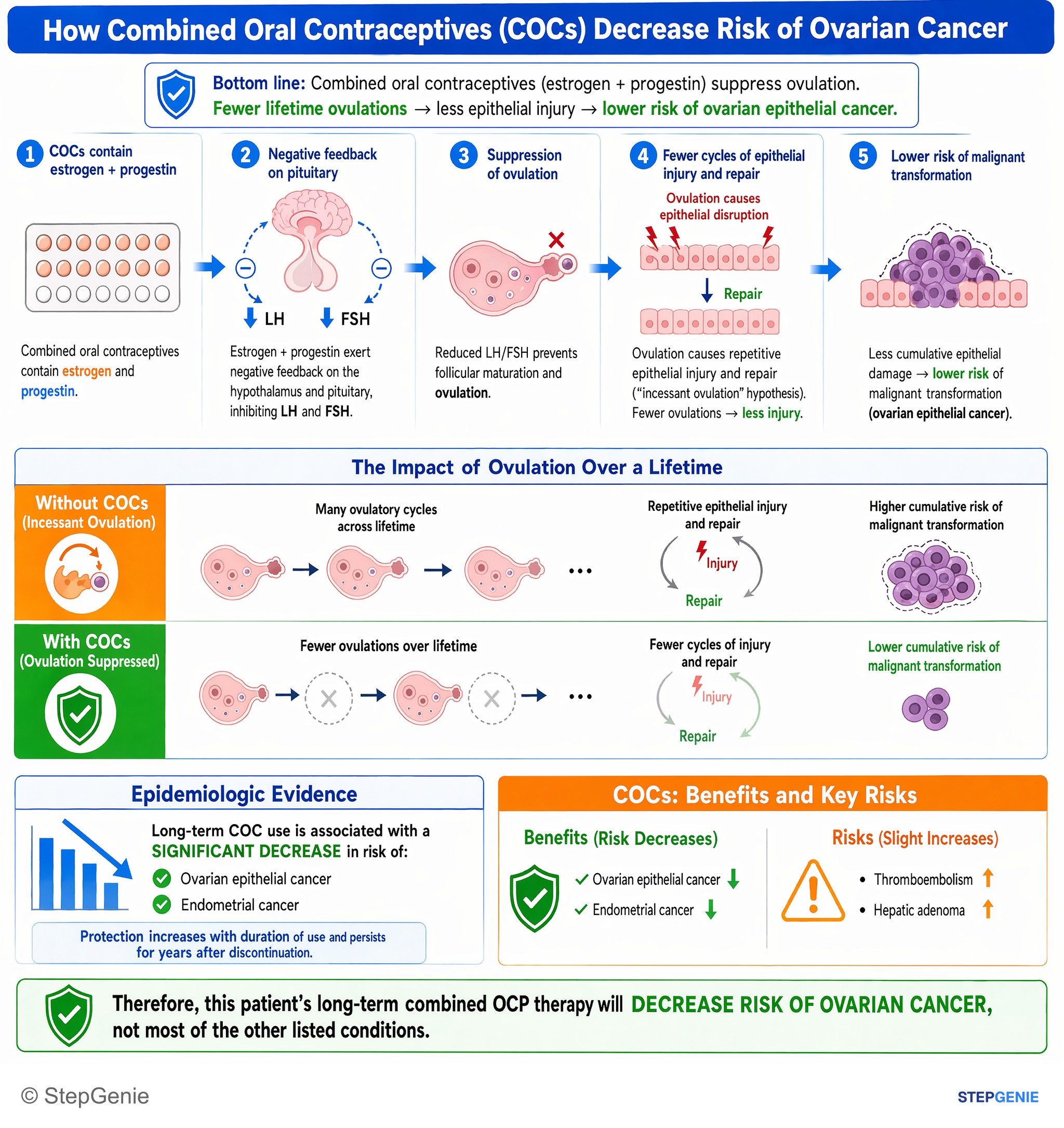
Combined oral contraceptives suppress ovulation; fewer lifetime ovulations lowers risk of ovarian epithelial cancer but slightly increase…
USMLE Step 2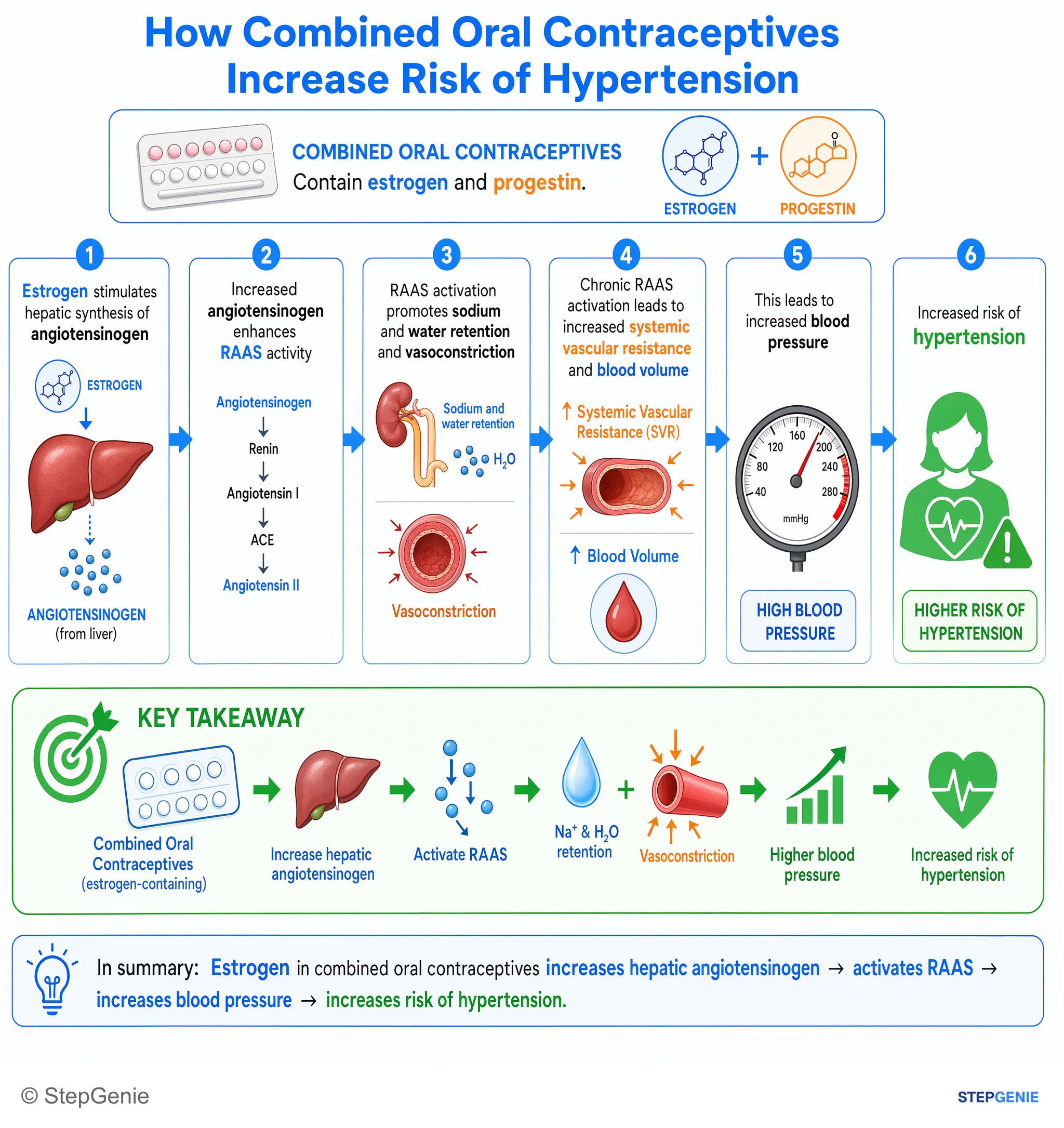
Combined oral contraceptives (estrogen-containing) increase hepatic angiotensinogen → higher blood pressure → increased risk of…
USMLE Step 2Frequently Asked Questions
Why do combined hormonal contraceptives increase thrombosis risk?
Combined hormonal contraceptives increase thrombosis risk because the estrogen component increases hepatic clotting factors. Although estrogen also suppresses FSH and stabilizes the endometrium, the classic high-yield adverse effect is venous thromboembolism such as DVT or PE, especially when other risk factors are present. That is why estrogen-containing methods are avoided when clot or stroke risk is already elevated.
Why can rifampin make oral contraceptive pills fail?
Rifampin can make oral contraceptive pills fail because it is an enzyme inducer that decreases contraceptive effectiveness. A classic vignette is a patient taking OCPs who becomes pregnant after treatment with rifampin. Other listed enzyme inducers that can reduce effectiveness include rifabutin, several anti-seizure medications such as carbamazepine and phenytoin, and St. John’s wort.
How do you tell a copper IUD from a levonorgestrel IUD on a Step 1 question?
A copper IUD is linked to heavier bleeding, cramps, and use as the most effective emergency contraception, while a levonorgestrel IUD decreases bleeding and may cause amenorrhea over time. Mechanistically, copper is spermicidal and creates a sterile inflammatory reaction that impairs sperm, whereas the levonorgestrel IUD thickens cervical mucus and causes endometrial atrophy. Early irregular bleeding is a common clue for the levonorgestrel IUD.
Which contraceptive methods are best when estrogen is contraindicated or postpartum?
Progestin-only methods are preferred when estrogen is contraindicated or during the postpartum period. These include the progestin-only pill, depot medroxyprogesterone acetate injection, the etonogestrel implant, and the levonorgestrel IUD. They avoid estrogen-related thrombosis risk and are safe in breastfeeding. Their shared mechanism is mainly thickening cervical mucus and thinning the endometrium, with variable suppression of ovulation.
What are the classic contraindications to combined hormonal contraceptives for Step 1?
The classic contraindications to combined hormonal contraceptives are conditions where estrogen raises clot or stroke risk. High-yield examples include age over 35 with smoking, prior DVT or PE or known thrombophilia, migraine with aura, uncontrolled hypertension, breast cancer, active liver disease such as severe cirrhosis or hepatic tumors, and the early postpartum period because of a hypercoagulable state.