Ectopic pregnancy is implantation outside the uterine cavity, in the fallopian tube in more than 90% of cases, and it must be ruled out in any reproductive-age patient with pain or bleeding and a positive pregnancy test. The workup pairs transvaginal ultrasound (TVUS) with a quantitative hCG, repeated serially when the first scan is nondiagnostic. A patient who is unstable or shows signs of rupture goes to surgery; a stable patient with an unruptured mass and no absolute contraindications can receive methotrexate, followed by hCG checks until it is undetectable.
The ECTOPIC acronym, letter by letter
| Letter | Stands for | What to know |
|---|---|---|
| E | Early pregnancy with pain, bleeding or both | Pelvic pain (dull, sharp or crampy), vaginal bleeding or both. Suspect ectopic pregnancy in any reproductive-age patient with pelvic pain, bleeding, or unexplained syncope or shock, whatever her contraceptive history. |
| C | Cervical motion and adnexal tenderness | Exam may show cervical motion tenderness, adnexal tenderness or an adnexal mass. Rupture brings sudden severe pain, syncope or hemorrhagic shock, and sometimes shoulder pain. |
| T | Tube is the usual site | More than 90% are tubal, most often in the ampulla (about 70%). The interstitial (cornual) segment comes next; cervical, cesarean scar, ovarian and abdominal sites are rare. |
| O | hCG Out of step with the ultrasound | No intrauterine pregnancy despite an hCG above the discriminatory level, or an hCG that rises too slowly or plateaus. |
| P | Predisposing risks | Prior ectopic pregnancy, tubal damage from pelvic infection, prior tubal surgery, infertility or assisted reproduction, smoking, age over 35. |
| I | Imaging first: transvaginal ultrasound | TVUS with a quantitative hCG. A patient who is unstable or shows signs of rupture goes to surgery without waiting. |
| C | Care: methotrexate, surgery or watchful waiting | Methotrexate if stable, unruptured and eligible; surgery if unstable, ruptured, ineligible or failing; expectant management only when asymptomatic with a low and falling hCG. |
Two letters in the usual version of this acronym mislead. Pain is often dull or crampy rather than "exquisite," and a closed cervical os does not separate ectopic pregnancy from threatened or missed abortion, which also have a closed os. That is why E and C here use findings that actually help.
Risk factors in more detail
- Prior ectopic pregnancy: recurrence risk is about 10% after one and more than 25% after two or more.
- Tubal damage from ascending pelvic infection such as Chlamydia trachomatis, or prior pelvic or tubal surgery.
- Infertility and assisted reproduction such as IVF.
- Smoking and age over 35.
- IUD: lowers the overall risk of ectopic pregnancy because it prevents pregnancy so well, but up to 53% of pregnancies that occur with an IUD in place are ectopic.
- Half of patients diagnosed with an ectopic pregnancy have no known risk factor.
Diagnosis: hCG and transvaginal ultrasound
- Definitive finding: a yolk sac or embryo seen outside the uterus confirms ectopic pregnancy. A complex adnexal mass or echogenic free fluid in the cul-de-sac is suggestive. A definite intrauterine pregnancy (gestational sac with a yolk sac or embryo) makes a coexisting ectopic pregnancy extremely unlikely except after assisted reproduction: heterotopic pregnancy occurs in about 1 in 10,000 to 30,000 pregnancies but in as many as 1 in 100 women undergoing IVF.
- Discriminatory level: the hCG above which a normal intrauterine pregnancy should be visible on TVUS. It was historically set at 1,000–2,000 mIU/mL, a cutoff that can miss some normal pregnancies, so ACOG now suggests a value as high as 3,500 mIU/mL to avoid misdiagnosing and interrupting a wanted pregnancy. An empty uterus above that level should raise concern for an early pregnancy loss or an ectopic pregnancy.
- Serial hCG, 2 days apart: the minimum expected 48-hour rise for a potentially viable intrauterine pregnancy depends on the starting level: 49% if under 1,500 mIU/mL, 40% at 1,500–3,000 and 33% above 3,000. About 99% of viable intrauterine pregnancies rise at least this much, so a slower rise suggests an abnormal pregnancy. A fall of at least 21% in 48 hours suggests a failing intrauterine pregnancy, whereas a smaller fall should raise concern for ectopic pregnancy.
- hCG never locates the pregnancy by itself. Interpret every value together with TVUS and the clinical picture.
Pregnancy of unknown location (PUL) means a positive test with neither an intrauterine nor an ectopic pregnancy seen on ultrasound. A stable patient is followed with serial hCG and repeat TVUS. Once a viable intrauterine pregnancy has been excluded, uterine aspiration can look for chorionic villi: villi confirm a failed intrauterine pregnancy, so no further workup or methotrexate is needed, whereas their absence keeps ectopic pregnancy on the list.
Management: methotrexate vs surgery vs expectant
| Option | Who qualifies | Key details |
|---|---|---|
| Surgery | Hemodynamic instability or signs of rupture (such as peritoneal signs); contraindications to methotrexate; failed methotrexate; inability to return for follow-up | Usually laparoscopic salpingectomy; an unstable patient needs immediate laparotomy |
| Methotrexate | Hemodynamically stable, unruptured mass, no absolute contraindications, able to return for follow-up | Single dose 50 mg/m² IM; hCG on days 4 and 7; success about 90% |
| Expectant | Asymptomatic with a low and falling hCG, and accepts the risk of rupture or hemorrhage | 88% resolve spontaneously when the initial hCG is below 200 mIU/mL |
Salpingectomy vs salpingostomy: both give similar rates of later intrauterine pregnancy. Salpingectomy is the usual operation and is preferred when the tube is badly damaged or ruptured; salpingostomy, which conserves the tube, is reserved for cases where preserving it is a priority.
Rh status: Rh(D)-negative patients are given Rho(D) immune globulin whether they receive methotrexate or surgery. A 2026 ASRM position statement no longer recommends routine anti-D for bleeding, miscarriage or abortion before 12 weeks, but it does not address ectopic pregnancy.
Methotrexate: the testable details
- Mechanism: a folate antagonist that inhibits dihydrofolate reductase, suppressing purine and thymidylate synthesis and therefore DNA synthesis in rapidly dividing cells, including trophoblast. It is also a first-line drug for low-risk gestational trophoblastic neoplasia, the malignant end of gestational trophoblastic disease.
- Absolute contraindications: intrauterine pregnancy, immunodeficiency, moderate to severe anemia, leukopenia or thrombocytopenia, methotrexate sensitivity, active pulmonary disease, active peptic ulcer disease, clinically important liver or kidney dysfunction, breastfeeding, ruptured ectopic pregnancy, hemodynamic instability and inability to follow up.
- Relative contraindications: embryonic cardiac activity on TVUS, a high initial hCG (above about 5,000 mIU/mL), an ectopic mass larger than 4 cm, and refusal of blood transfusion. Single-dose success is about 94–98% when hCG is under 5,000 mIU/mL but 85% at 5,000–9,999 and 81% at 10,000 or more.
- Monitoring: hCG commonly rises between days 1 and 4. A fall of at least 15% from day 4 to day 7 is the response; a smaller fall means a second dose or surgery. After that, check hCG weekly until it is undetectable, which can take up to 8 weeks.
- Side effects: abdominal pain 2–3 days after the injection is common, as are nausea, vomiting and vaginal spotting.
- Counseling: avoid folic acid supplements and NSAIDs; avoid alcohol and narcotic painkillers, which can mask rupture symptoms; avoid sunlight (methotrexate dermatitis), vigorous exercise and intercourse; and avoid pregnancy until at least one ovulatory cycle after hCG becomes undetectable.
Differential: bleeding in early pregnancy
| Diagnosis | Cervical os | Key finding |
|---|---|---|
| Ectopic pregnancy | Not a reliable discriminator | No intrauterine pregnancy; adnexal mass; free fluid if ruptured |
| Threatened abortion | Closed | Bleeding with no evidence of fetal demise |
| Inevitable abortion | Dilated | Bleeding or rupture of membranes before 20 weeks with advanced dilation |
| Incomplete abortion | Dilated | Some products of conception have passed |
| Complete abortion | Closed | All products of conception expelled |
| Missed abortion | Closed | Embryonic or fetal demise with products retained |
Exam traps
- Unstable with a positive pregnancy test: go to surgery urgently rather than waiting for serial hCG or repeat imaging.
- hCG alone never diagnoses ectopic pregnancy. Interpret it with TVUS, history and symptoms.
- A rising hCG on day 4 after methotrexate is expected. The decision point is the day 4 to day 7 fall of at least 15%.
- Cardiac activity, hCG above 5,000 and a mass over 4 cm are relative contraindications, not absolute ones; breastfeeding and an intrauterine pregnancy are absolute.
- IUD in place: pregnancy is rare, but when it happens it is ectopic up to half the time.
- Follow hCG to undetectable. After methotrexate, weekly checks continue until the hCG is gone, which can take up to 8 weeks.
Worked example
Vignette. A 29-year-old woman has 2 days of left lower quadrant pain and spotting 6 weeks after her last menstrual period. Her vital signs are normal and there are no peritoneal signs. Serum hCG is 2,100 mIU/mL. TVUS shows an empty uterus and a 2.5-cm left adnexal gestational sac containing a yolk sac, with no embryonic cardiac activity and no free fluid. Her blood counts, creatinine and liver enzymes are normal, she is not breastfeeding, and she can return for follow-up. What is the most appropriate management?
Answer: Intramuscular methotrexate (single dose, 50 mg/m²), with hCG measured on days 4 and 7.
Reasoning: A yolk sac in the adnexa makes the diagnosis definitive, so the discriminatory level no longer matters. She is stable with an unruptured tubal pregnancy, has no absolute contraindications and none of the relative ones (hCG under 5,000, mass under 4 cm, no cardiac activity). Laparoscopic surgery would also be acceptable, but surgery is not required. Check her Rh status and counsel her to avoid folic acid and NSAIDs during treatment.
Key takeaways
- ECTOPIC: Early pain or bleeding, Cervical motion and adnexal tenderness, Tube (ampulla), hCG Out of step with TVUS, Predisposing risks, Imaging first, Care by stability.
- Workup: TVUS with a quantitative hCG; repeat both when the first scan is nondiagnostic.
- Discriminatory level: as high as 3,500 mIU/mL; never diagnose from hCG alone.
- Surgery for instability, rupture or intraperitoneal bleeding; methotrexate for stable, unruptured, eligible patients who can follow up.
- Methotrexate response: hCG must fall at least 15% from day 4 to day 7, then be followed until undetectable.
- Relative contraindications: cardiac activity, high hCG (over 5,000), mass over 4 cm, refusal of transfusion.
Sources
- Hendriks E, Rosenberg R, Prine L. Ectopic Pregnancy: Diagnosis and Management — American Family Physician, 2020
- Ectopic Pregnancy — StatPearls, NCBI Bookshelf
- Ectopic Pregnancy — Merck Manual Professional Edition
- Spontaneous Abortion — Merck Manual Professional Edition
- Position Statement on Rho(D) Immune Globulin Administration in the First Trimester (2026) — American Society for Reproductive Medicine
Visual explanations from the StepGenie QBank
Infographics StepGenie drew to explain questions in its own QBank, matched to this article's topic. Each caption is the takeaway of the question it explains.
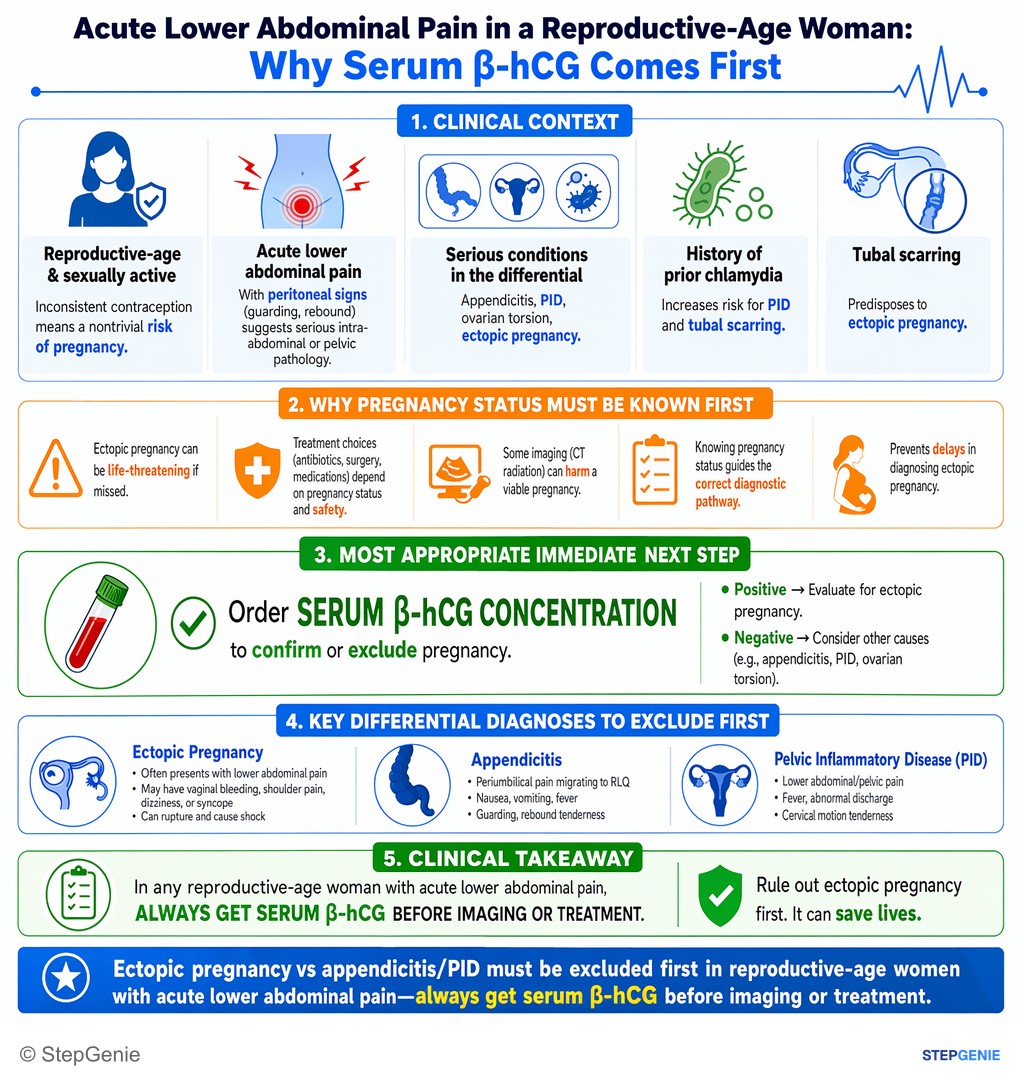
Ectopic pregnancy vs appendicitis/PID must be excluded first in reproductive-age women with acute lower abdominal pain—always get serum…
USMLE Step 2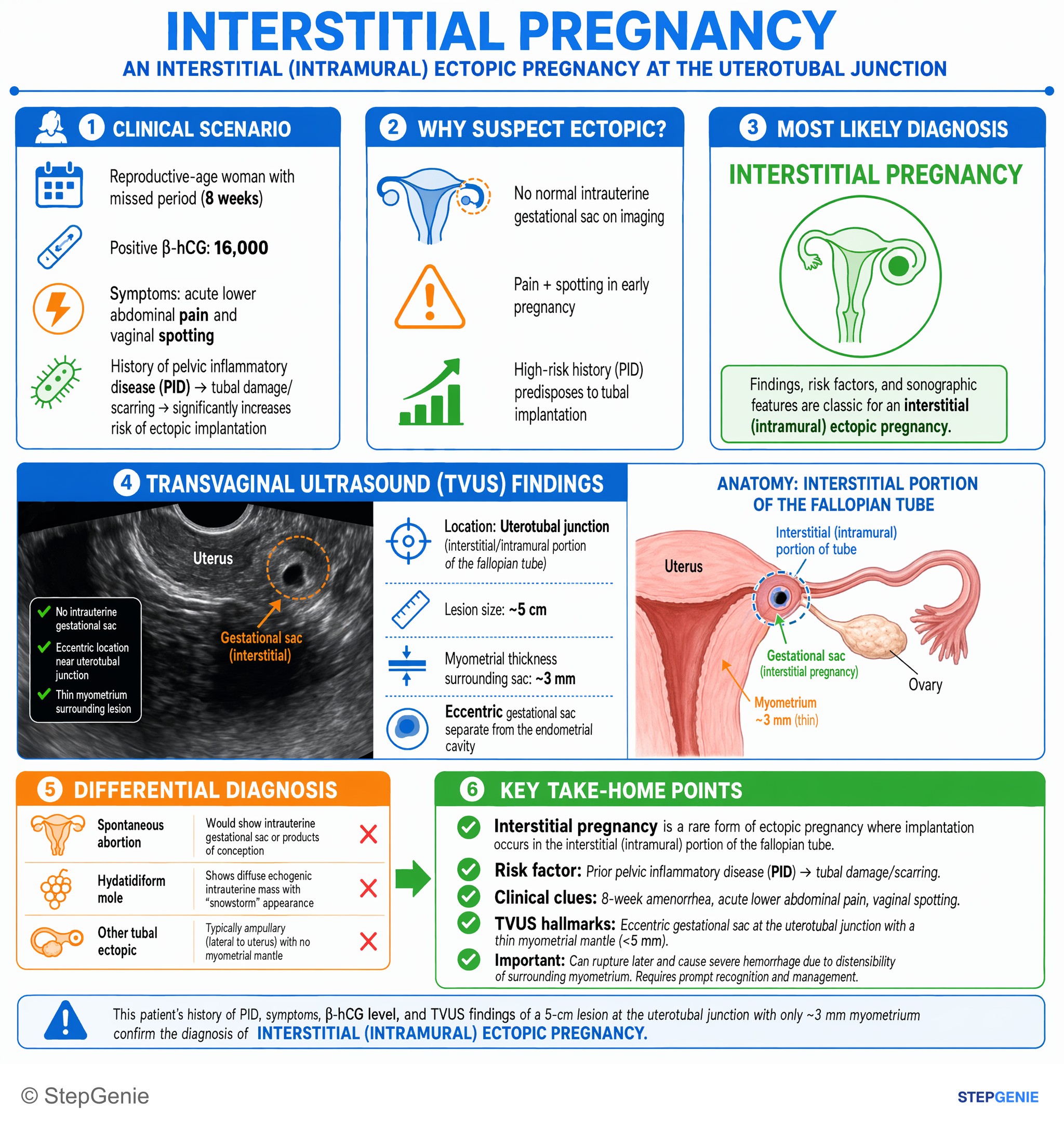
Interstitial ectopic pregnancy at uterotubal junction: prior PID + 8-week amenorrhea + pain/spotting + adnexal mass with thin myometrium…
USMLE Step 2Frequently Asked Questions
What is the discriminatory zone for ectopic pregnancy?
The discriminatory level is the hCG value above which a normal intrauterine pregnancy should be visible on transvaginal ultrasound. It was historically set at 1,000 to 2,000 mIU/mL, but that cutoff can miss normal pregnancies, so ACOG suggests a value as high as 3,500 mIU/mL to avoid misdiagnosing and interrupting a wanted pregnancy. An empty uterus above that level should raise concern for an early pregnancy loss or an ectopic pregnancy, and hCG alone should never be used to make the diagnosis.
Who can be treated with methotrexate for ectopic pregnancy?
Methotrexate can be used for an ectopic pregnancy when the patient is hemodynamically stable, the mass is unruptured, there are no absolute contraindications and she can return for follow-up. Absolute contraindications include an intrauterine pregnancy, breastfeeding, immunodeficiency, significant anemia or other cytopenias, active lung or peptic ulcer disease, and significant liver or kidney dysfunction. Embryonic cardiac activity, an hCG above about 5,000 mIU/mL, a mass larger than 4 cm and refusal of blood transfusion are relative contraindications.
How is hCG monitored after methotrexate for ectopic pregnancy?
With the single-dose regimen, hCG is measured on days 4 and 7 after the injection. It can rise during the first few days, so the key test is a fall of at least 15% between day 4 and day 7; a smaller fall calls for another dose or surgery. After an adequate fall, hCG is checked weekly until it is undetectable, which can take up to 8 weeks.
What is the most common site of an ectopic pregnancy?
The fallopian tube is the site of more than 90% of ectopic pregnancies, and about 70% of tubal pregnancies are in the ampulla. The interstitial (cornual) portion of the tube is the next most common site, while implantation in the cervix, a cesarean scar, an ovary or the abdomen is rare.
When is surgery required for an ectopic pregnancy?
Surgery is needed when the patient is hemodynamically unstable or rupture is suspected, for example because of peritoneal signs. It is also needed when methotrexate is contraindicated or has failed, or when the patient cannot return for follow-up. Laparoscopic salpingectomy is the usual operation, salpingostomy is reserved for cases where conserving the tube is a priority, and an unstable patient needs immediate laparotomy.