Uterine fibroids (leiomyomas) are classic USMLE fodder because they’re common, symptomatic in multiple ways, and easy to confuse with other causes of abnormal uterine bleeding (AUB) and pelvic masses. The trick isn’t just recognizing fibroids—it’s knowing why every alternative answer choice is wrong in this vignette.
The Vignette (USMLE-Style)
A 38-year-old G2P2 presents with progressively heavier menstrual bleeding for 8 months. She reports passage of clots, fatigue, and increasing pelvic “pressure.” Cycles are regular. She denies postcoital bleeding. Exam shows conjunctival pallor and a firm, irregularly enlarged uterus equivalent to a 12-week pregnancy. Urine pregnancy test is negative. Labs show Hb 9.2 g/dL and low ferritin. Transvaginal ultrasound reveals multiple well-circumscribed, hypoechoic masses in the myometrium.
Question: What is the most likely diagnosis?
Correct answer: Uterine leiomyomas (fibroids).
Why the Correct Answer Is Correct: Uterine Leiomyomas
Leiomyomas are benign smooth muscle tumors of the myometrium and are the most common pelvic tumor in women. In question stems, think fibroids when you see:
Key clinical clues
- Heavy menstrual bleeding (HMB) with regular cycles
- Often due to increased endometrial surface area and impaired uterine contractility
- Bulk symptoms
- Pelvic pressure/fullness
- Urinary frequency/urgency (bladder compression)
- Constipation (rectal compression)
- Exam
- Firm, irregularly enlarged uterus
- Imaging
- TVUS: well-defined, hypoechoic myometrial masses
- May show shadowing or calcifications in older fibroids
High-yield pathology facts (Step 1 + Step 2)
- Benign; malignant transformation to leiomyosarcoma is rare and not thought to arise from typical fibroids
- Estrogen-sensitive → grow during pregnancy; regress after menopause
- Can cause:
- Iron deficiency anemia from chronic blood loss
- Infertility or recurrent pregnancy loss (especially submucosal fibroids)
- Pregnancy complications (malpresentation, postpartum hemorrhage)
Subtype = symptom pattern (high-yield)
| Location | Classic association | Why it matters |
|---|---|---|
| Submucosal | Heavy bleeding, infertility | Distorts uterine cavity |
| Intramural | Heavy bleeding + bulk | Most common location |
| Subserosal | Bulk symptoms > bleeding | Can become pedunculated |
Next-Step Management (Quick USMLE Framework)
If the question pivots to management, think hemodynamic status, pregnancy desire, and size/location:
- Initial workup of AUB: pregnancy test, CBC ± TSH; consider endometrial sampling if indicated
- First-line symptom control:
- NSAIDs (decrease prostaglandins → less bleeding/pain)
- Combined OCPs or progestins
- Levonorgestrel IUD (excellent for bleeding control)
- Tranexamic acid (antifibrinolytic for HMB)
- Shrink fibroids temporarily:
- GnRH agonists (e.g., leuprolide) → hypoestrogenic state (bridge to surgery)
- Definitive / procedural:
- Myomectomy (preserves fertility)
- Uterine artery embolization (not ideal if future pregnancy strongly desired)
- Hysterectomy (definitive if no fertility desired)
Now the Money Part: Why Each Distractor Is Wrong
Below are the usual suspects that show up as answer choices in fibroid vignettes.
Distractor 1: Adenomyosis
Why it’s tempting: Also causes heavy menstrual bleeding and dysmenorrhea.
Why it’s wrong here:
- Adenomyosis classically causes a uniformly enlarged, boggy, tender uterus, not firm and irregular.
- Symptoms often include severe dysmenorrhea and chronic pelvic pain.
- Imaging: may show heterogeneous myometrium or “venetian blind” shadowing; MRI shows thickened junctional zone.
High-yield differentiator
- Fibroids: firm, irregular uterus
- Adenomyosis: boggy, uniformly enlarged uterus
Distractor 2: Endometrial polyp
Why it’s tempting: Can cause abnormal bleeding.
Why it’s wrong here:
- Polyps usually cause intermenstrual bleeding or postcoital spotting, not classically progressive heavy regular menses with bulk symptoms.
- Uterus size is typically normal; you don’t get a “12-week” uterus from a polyp.
- Diagnosis is best with sonohysterography or hysteroscopy (focal intracavitary lesion).
High-yield clue: Think polyp when bleeding is between periods and imaging shows a focal endometrial mass.
Distractor 3: Endometrial carcinoma (or hyperplasia)
Why it’s tempting: AUB in women >35 can raise concern.
Why it’s wrong here:
- Typical presentation: postmenopausal bleeding or irregular/heavy bleeding with strong risk factors.
- Risk factors: unopposed estrogen (obesity, PCOS, chronic anovulation), tamoxifen, early menarche/late menopause.
- The stem gives regular cycles and classic fibroid exam + ultrasound findings.
USMLE safety point:
Even if fibroids look likely, endometrial sampling is indicated in:
- Age ≥45 with AUB, or
- <45 with AUB plus unopposed estrogen, persistent bleeding, or failed medical management
Distractor 4: Uterine leiomyosarcoma
Why it’s tempting: “Mass in uterus” + worry about malignancy.
Why it’s wrong here:
- Leiomyosarcoma is rare, often in older patients, and may present with rapidly enlarging uterine mass and systemic symptoms.
- USMLE classic teaching: benign fibroids do not ‘turn into’ leiomyosarcoma in the usual pathway.
- The vignette screams benign: multiple well-circumscribed myometrial masses and chronic menorrhagia.
High-yield trap: “Rapid growth” is not a perfect discriminator, but cancer becomes more concerning with postmenopausal status, atypical imaging, or systemic signs.
Distractor 5: Endometriosis
Why it’s tempting: Common and causes pelvic pain.
Why it’s wrong here:
- Hallmark: cyclic pelvic pain, dysmenorrhea, dyspareunia, dyschezia.
- Exam may show tender nodules (uterosacral ligaments) or fixed retroverted uterus—not a firm irregularly enlarged uterus.
- Endometriosis doesn’t usually cause a markedly enlarged uterus on bimanual exam.
High-yield association: “Chocolate cyst” (endometrioma) on ovary, not intramyometrial well-circumscribed masses.
Distractor 6: Ectopic pregnancy
Why it’s tempting: Reproductive-age bleeding + pelvic symptoms.
Why it’s wrong here:
- Pregnancy test is negative.
- Ectopic typically presents with amenorrhea, pelvic pain, and vaginal bleeding; can have adnexal tenderness/mass.
- Doesn’t explain a firm, irregular 12-week-size uterus with chronic heavy menses.
High-yield: Always check β-hCG first in AUB—USMLE loves that step.
Distractor 7: Ovarian torsion (or ovarian neoplasm)
Why it’s tempting: Pelvic pain + mass concepts.
Why it’s wrong here:
- Torsion presents with sudden severe unilateral pain, nausea/vomiting, adnexal tenderness—an acute abdomen vibe.
- This stem is chronic bleeding + pressure with a uterine (not adnexal) mass.
Rapid-Fire High-Yield Pearls (What You Want in Your Head on Test Day)
- Leiomyoma = benign smooth muscle tumor → firm, irregular uterus
- Heavy menstrual bleeding + regular cycles fits structural causes like fibroids (PALM-COEIN: Polyp, Adenomyosis, Leiomyoma, Malignancy)
- Submucosal fibroids are the biggest culprits for bleeding and infertility
- Estrogen-sensitive: grow in pregnancy, shrink after menopause
- Most common complication tested: iron deficiency anemia
- Workup of AUB: pregnancy test first, then CBC; endometrial biopsy when indicated by age/risk
Mini Self-Check (1-minute)
If the uterus is…
- Firm + irregular → fibroids
- Boggy + uniformly enlarged → adenomyosis
- Normal size + intermenstrual spotting → polyp
- Postmenopausal bleeding (esp. obese/anovulatory) → endometrial cancer until proven otherwise
Visual explanations from the StepGenie QBank
Infographics StepGenie drew to explain questions in its own QBank, matched to this article's topic. Each caption is the takeaway of the question it explains.
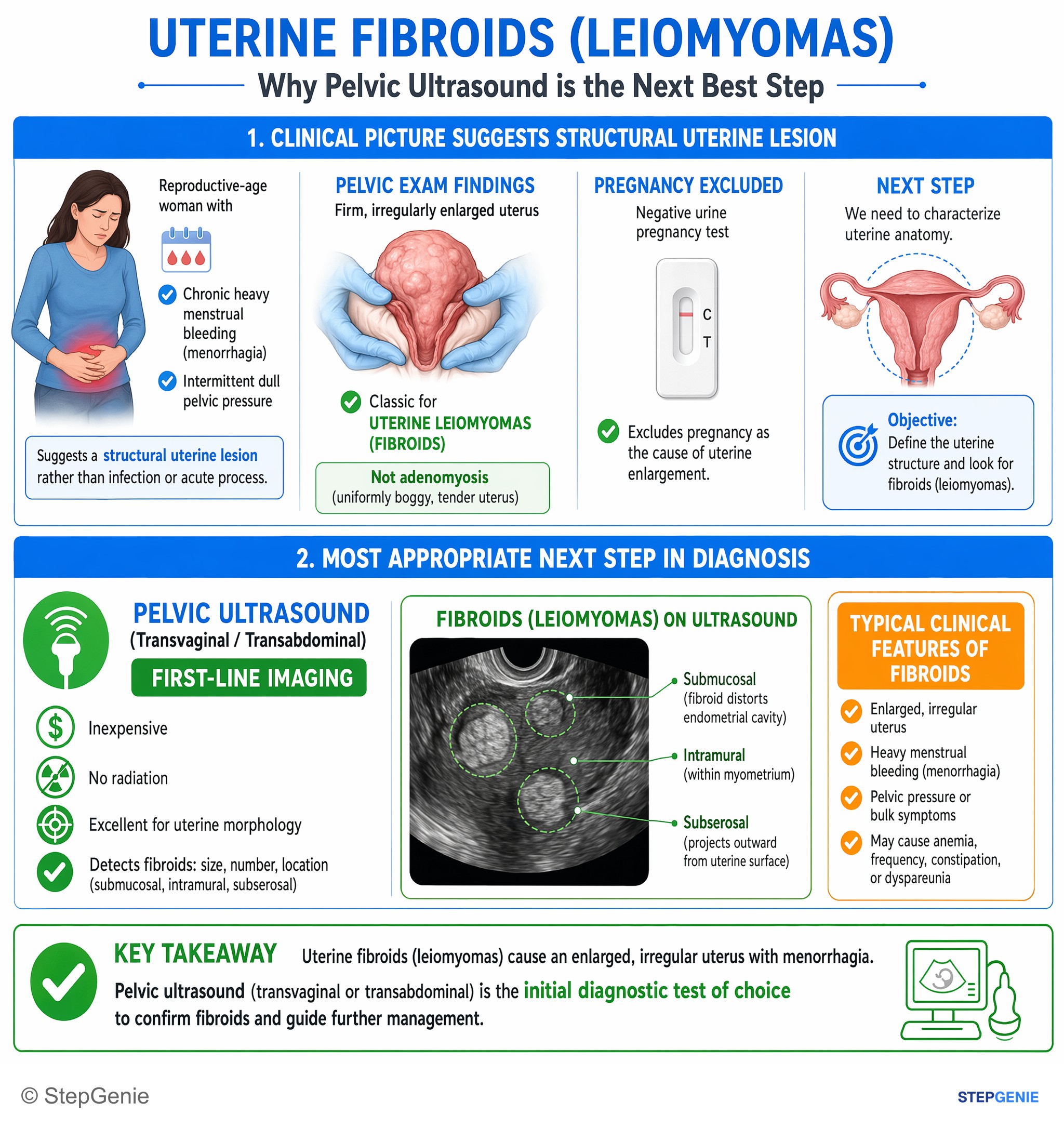
Uterine fibroids (leiomyomas) cause enlarged, irregular uterus with menorrhagia; pelvic ultrasound is the initial diagnostic test of choice.
USMLE Step 2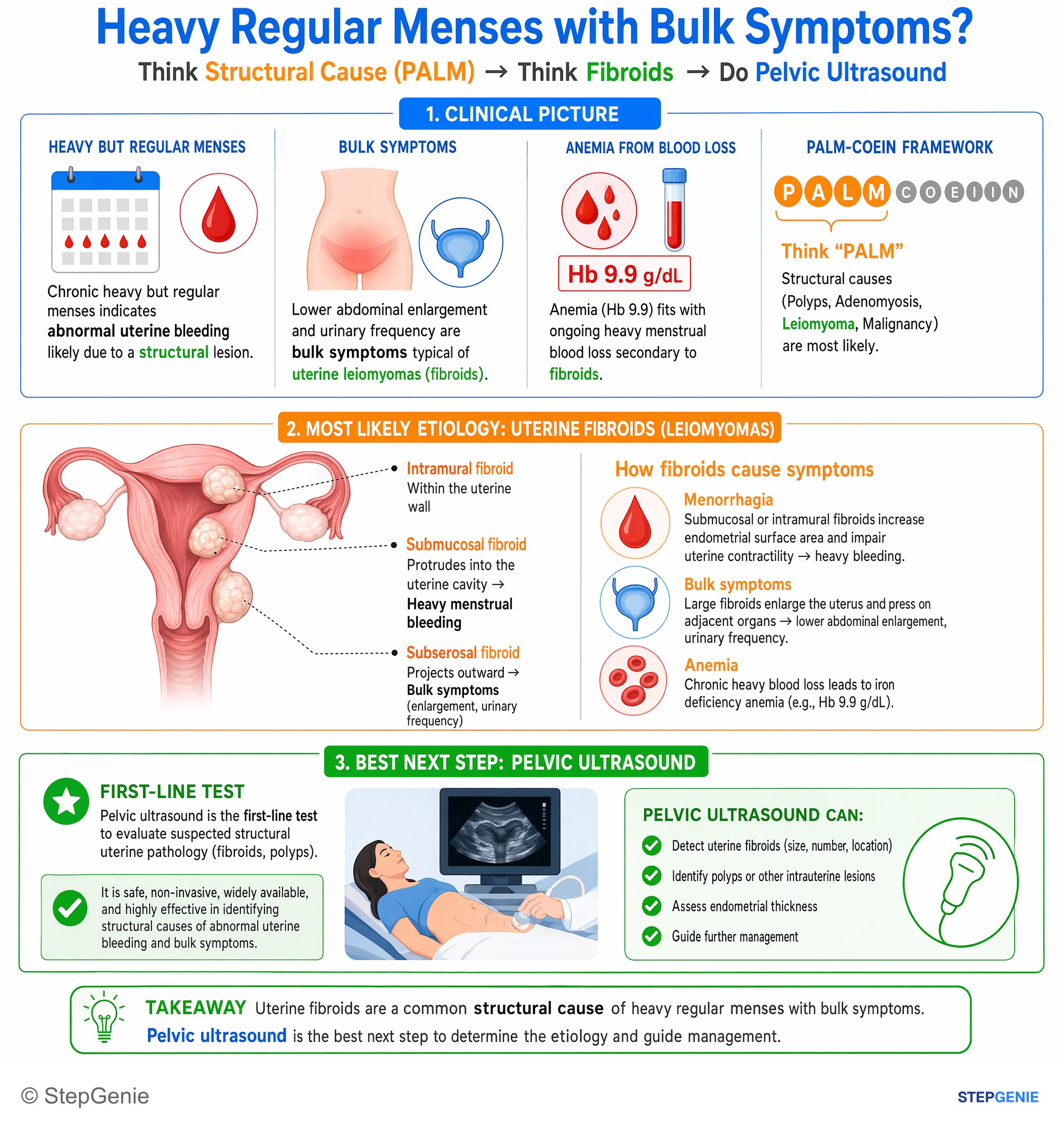
Uterine fibroids causing menorrhagia and bulk symptoms → first-line evaluation is pelvic ultrasound to identify structural uterine…
USMLE Step 2Frequently Asked Questions
How do you tell uterine fibroids from adenomyosis on a USMLE vignette?
The key distinction is that fibroids cause a firm, irregularly enlarged uterus, while adenomyosis causes a uniformly enlarged, boggy, tender uterus. Fibroids also fit heavy menstrual bleeding with regular cycles, bulk symptoms like pelvic pressure, and ultrasound showing well-circumscribed hypoechoic myometrial masses. Adenomyosis more often presents with severe dysmenorrhea, chronic pelvic pain, and imaging showing a heterogeneous myometrium or venetian blind shadowing.
Why do uterine fibroids cause heavy menstrual bleeding and iron deficiency anemia?
Fibroids can cause heavy menstrual bleeding because they increase endometrial surface area and impair uterine contractility. Over time, that chronic blood loss can lead to iron deficiency anemia, which explains findings like fatigue, low hemoglobin, low ferritin, and conjunctival pallor. This pattern is especially classic when the patient also has regular cycles and a firm, irregularly enlarged uterus.
What ultrasound findings point to uterine leiomyomas?
Transvaginal ultrasound suggesting leiomyomas typically shows multiple well-defined, hypoechoic masses within the myometrium. Older fibroids may also show shadowing or calcifications. When these imaging findings appear alongside heavy regular menstrual bleeding and a firm, irregularly enlarged uterus, they strongly support the diagnosis of benign uterine fibroids rather than other causes of abnormal uterine bleeding.
What is the first-line treatment for symptomatic uterine fibroids?
First-line symptom control for uterine fibroids includes NSAIDs, combined oral contraceptives or progestins, a levonorgestrel IUD, and tranexamic acid. These options are used to reduce bleeding and pain rather than remove the fibroids themselves. If the question shifts toward shrinking fibroids temporarily, GnRH agonists such as leuprolide can create a hypoestrogenic state as a bridge to surgery.
When should you think about endometrial sampling even if fibroids seem likely?
Endometrial sampling is indicated in abnormal uterine bleeding when the patient is age 45 or older, or younger than 45 with unopposed estrogen exposure, persistent bleeding, or failed medical management. This matters because fibroids can explain bleeding, but endometrial carcinoma or hyperplasia still has to be considered in the right clinical setting, especially when risk factors are present.