Polycystic ovary syndrome (PCOS) is one of those “everyone’s heard of it” diagnoses that still traps people on test day—usually because the vignette is straightforward, but the answer choices are designed to exploit tiny misunderstandings about hormones, bleeding patterns, and what actually causes ovarian cysts. Let’s walk through a classic Q-bank-style case, pick the correct answer, and then ruthlessly dissect every distractor the way the exam writers intended.
Clinical Vignette (USMLE-Style)
A 24-year-old woman presents with irregular menstrual cycles occurring every 2–4 months for the past year. She also reports increased facial hair growth and worsening acne. She is sexually active and not using contraception. BMI is 33 kg/m². Blood pressure is 138/86 mm Hg. Physical exam shows coarse hair on the upper lip and chin and acanthosis nigricans on the posterior neck. Urine pregnancy test is negative.
Labs:
- Total testosterone: mildly elevated
- LH: elevated
- FSH: normal-low
- Prolactin: normal
- TSH: normal
Pelvic ultrasound shows enlarged ovaries with multiple small follicles.
Question: What is the most likely underlying mechanism of her condition?
Correct Answer: Insulin resistance → increased ovarian androgen production (theca cells) + decreased SHBG
Why this is PCOS
This vignette hits the “PCOS triad” hard:
- Ovulatory dysfunction: oligomenorrhea/amenorrhea
- Hyperandrogenism: hirsutism, acne, elevated testosterone
- Polycystic ovaries: “string of pearls” follicles on ultrasound (supportive, not required)
Add obesity + acanthosis nigricans and you should hear “insulin resistance” in your head.
Mechanism (the part USMLE loves)
PCOS is driven by a neuroendocrine + metabolic feedback loop:
- Insulin resistance → hyperinsulinemia
- Insulin stimulates theca cells (synergizes with LH) → ↑ androgen production (testosterone, androstenedione)
- Insulin decreases hepatic sex hormone–binding globulin (SHBG) → ↑ free testosterone
- Increased androgens → impaired follicular maturation → chronic anovulation
- Anovulation → low progesterone (no corpus luteum) → unopposed estrogen → endometrial proliferation → irregular/heavy bleeding and risk of endometrial hyperplasia/cancer
High-yield lab pattern
| Finding | PCOS tendency | Why it happens |
|---|---|---|
| LH:FSH ratio | Increased (often >2:1) | Increased GnRH pulse frequency favors LH |
| Testosterone | Mildly elevated | Theca cell androgen excess |
| Estrone | Increased | Peripheral aromatization in adipose tissue |
| SHBG | Decreased | Hyperinsulinemia suppresses hepatic SHBG |
| Progesterone | Low | Chronic anovulation |
How to “Prove” PCOS on a Question Stem
Rotterdam criteria (you need 2 of 3)
- Oligo/anovulation
- Clinical or biochemical hyperandrogenism
- Polycystic ovaries on ultrasound
Important nuance: PCOS is a diagnosis of exclusion. If they give you abnormal prolactin, abnormal TSH, severe virilization, or Cushingoid features, the question may be steering away from PCOS.
Now the Real Game: Why Every Distractor Is Wrong (and how to spot it fast)
Below are common answer choices that show up with PCOS vignettes—and the exact mental move to eliminate each one.
Distractor 1: 21-hydroxylase deficiency (nonclassic congenital adrenal hyperplasia)
Why it tempts you: hirsutism + acne + irregular menses overlap heavily with PCOS.
Why it’s wrong here:
- CAH (especially nonclassic) is adrenal-driven, not ovarian-driven.
- Typical clue is elevated 17-hydroxyprogesterone (baseline or after ACTH stimulation).
- Often presents earlier with premature pubarche or longstanding hyperandrogen symptoms.
How USMLE distinguishes it
- If they mention: high 17-OHP, family history, or ambiguous genitalia (classic form) → think CAH.
- PCOS more often comes with obesity/insulin resistance clues (acanthosis) and LH elevation.
Distractor 2: Androgen-secreting tumor (ovarian or adrenal)
Why it tempts you: “Elevated testosterone” + hair growth.
Why it’s wrong here:
- Tumors cause rapid onset and severe hyperandrogenism:
- Virilization: deep voice, clitoromegaly, increased muscle mass, male-pattern balding
- Testosterone often markedly elevated, not mildly.
Exam tip
- Time course matters: gradual over months/years → PCOS; rapid over weeks/months → tumor.
- DHEA-S markedly elevated suggests adrenal source.
Distractor 3: Cushing syndrome (excess cortisol)
Why it tempts you: obesity + hypertension + menstrual irregularities.
Why it’s wrong here:
- Cushing’s has classic stigmata:
- proximal muscle weakness, wide purple striae, easy bruising, facial plethora, supraclavicular fat pads
- Hyperandrogenism can happen, but it’s not usually the main story unless the stem pushes it.
Quick elimination
- If the stem screams catabolic skin changes (bruising/striae) and muscle weakness, pivot toward Cushing’s.
- PCOS: metabolic (insulin resistance) + reproductive (anovulation) without cortisol stigmata.
Distractor 4: Hyperprolactinemia
Why it tempts you: amenorrhea/oligomenorrhea.
Why it’s wrong here:
- Hyperprolactinemia classically causes:
- galactorrhea
- decreased libido
- sometimes headaches/visual field defects (pituitary adenoma)
- Mechanism: prolactin suppresses GnRH → ↓ LH/FSH → anovulation
- In this stem, prolactin is normal, and we have hyperandrogenic features.
USMLE pearl
- Hyperprolactinemia causes hypogonadism; it does not classically cause elevated androgens/hirsutism.
Distractor 5: Hypothyroidism
Why it tempts you: irregular menses can occur, and hypothyroidism is common.
Why it’s wrong here:
- Hypothyroidism often shows:
- fatigue, weight gain, cold intolerance, constipation, bradycardia
- can elevate prolactin via ↑ TRH
- Here: TSH is normal, prolactin is normal, and hyperandrogenism is prominent.
Test-day move
- If TSH is provided and normal, it’s there to help you exclude thyroid disease.
Distractor 6: Premature ovarian insufficiency (POI)
Why it tempts you: irregular menses in a young woman.
Why it’s wrong here:
- POI is ovarian follicle depletion/dysfunction → low estrogen
- Labs: high FSH, low estradiol
- Symptoms: hot flashes, vaginal dryness, dyspareunia
- PCOS is often a high-estrogen (unopposed) state via estrone.
Key distinction
- POI = hypergonadotropic hypogonadism (↑ FSH).
- PCOS = often normal/low FSH with relatively ↑ LH.
Distractor 7: Functional hypothalamic amenorrhea (FHA)
Why it tempts you: amenorrhea in a young woman.
Why it’s wrong here:
- FHA is due to stress, weight loss, excessive exercise → ↓ GnRH → ↓ LH/FSH → low estrogen
- Patient here is obese with insulin resistance stigmata and hyperandrogenism (opposite phenotype).
Rule of thumb
- FHA = underfueling/overtraining phenotype.
- PCOS = metabolic syndrome phenotype.
Distractor 8: Endometriosis
Why it tempts you: common reproductive diagnosis; some students default to it.
Why it’s wrong here:
- Endometriosis presents with:
- cyclic pelvic pain, dysmenorrhea, dyspareunia, infertility
- It does not cause hyperandrogenism or insulin resistance signs.
- Menses are typically regular (painful, not absent).
High-Yield PCOS Complications (Commonly Tested)
Reproductive
- Infertility from chronic anovulation
- Endometrial hyperplasia/carcinoma from unopposed estrogen
Metabolic/Cardiovascular
- Type 2 diabetes mellitus
- Dyslipidemia
- Hypertension
- Nonalcoholic fatty liver disease
- Increased cardiovascular risk over time
Management: What USMLE Expects You to Know
Step 1 mindset: address hormones + mechanism
- Weight loss improves insulin sensitivity → can restore ovulation
- Combined oral contraceptives (COCs):
- ↓ LH → ↓ theca cell androgen production
- ↑ SHBG → ↓ free testosterone
- provides endometrial protection (progestin)
Step 2 mindset: match treatment to the patient’s goal
| Goal | First-line | Add-ons / notes |
|---|---|---|
| Not trying to get pregnant; wants cycle control + acne/hirsutism help | COCs | Add spironolactone for hirsutism (must use contraception; teratogenic) |
| Trying to conceive | Letrozole (often first-line) | Clomiphene is also used; consider metformin especially with insulin resistance |
| Prediabetes/insulin resistance features | Lifestyle ± metformin | Metformin can improve ovulatory function, but primary benefit is metabolic |
Endometrial protection matters: If not on COCs, use cyclic progestins or a progestin IUD to prevent hyperplasia in chronic anovulation.
Rapid-Fire Exam Pearls (Memorize These)
- PCOS = anovulation + hyperandrogenism + insulin resistance
- Acanthosis nigricans = insulin resistance until proven otherwise
- Unopposed estrogen (estrone from adipose) → endometrial hyperplasia
- LH:FSH ratio increased (supportive, not diagnostic)
- Severe virilization or rapid onset → think androgen-secreting tumor
- Always exclude: pregnancy, thyroid disease, hyperprolactinemia, and consider CAH/Cushing/tumor based on clues
One-Liner Takeaway
When the stem gives you oligomenorrhea + hyperandrogenism + insulin resistance clues, the mechanism you’re looking for is hyperinsulinemia amplifying theca cell androgen production and lowering SHBG, driving chronic anovulation and unopposed estrogen.
Visual explanations from the StepGenie QBank
Infographics StepGenie drew to explain questions in its own QBank, matched to this article's topic. Each caption is the takeaway of the question it explains.
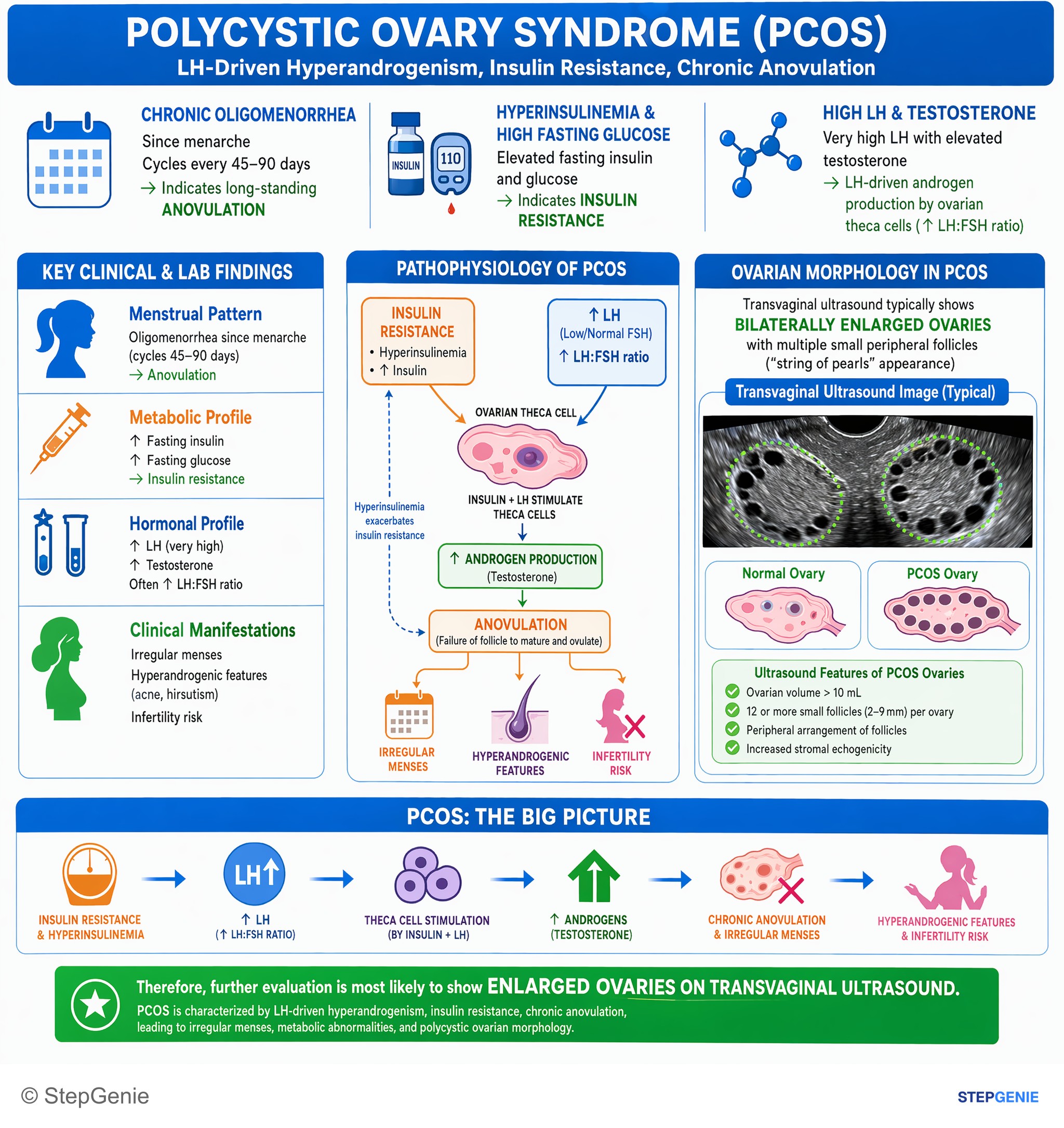
Polycystic ovary syndrome (PCOS): LH-driven hyperandrogenism, insulin resistance, chronic anovulation → irregular menses…
USMLE Step 1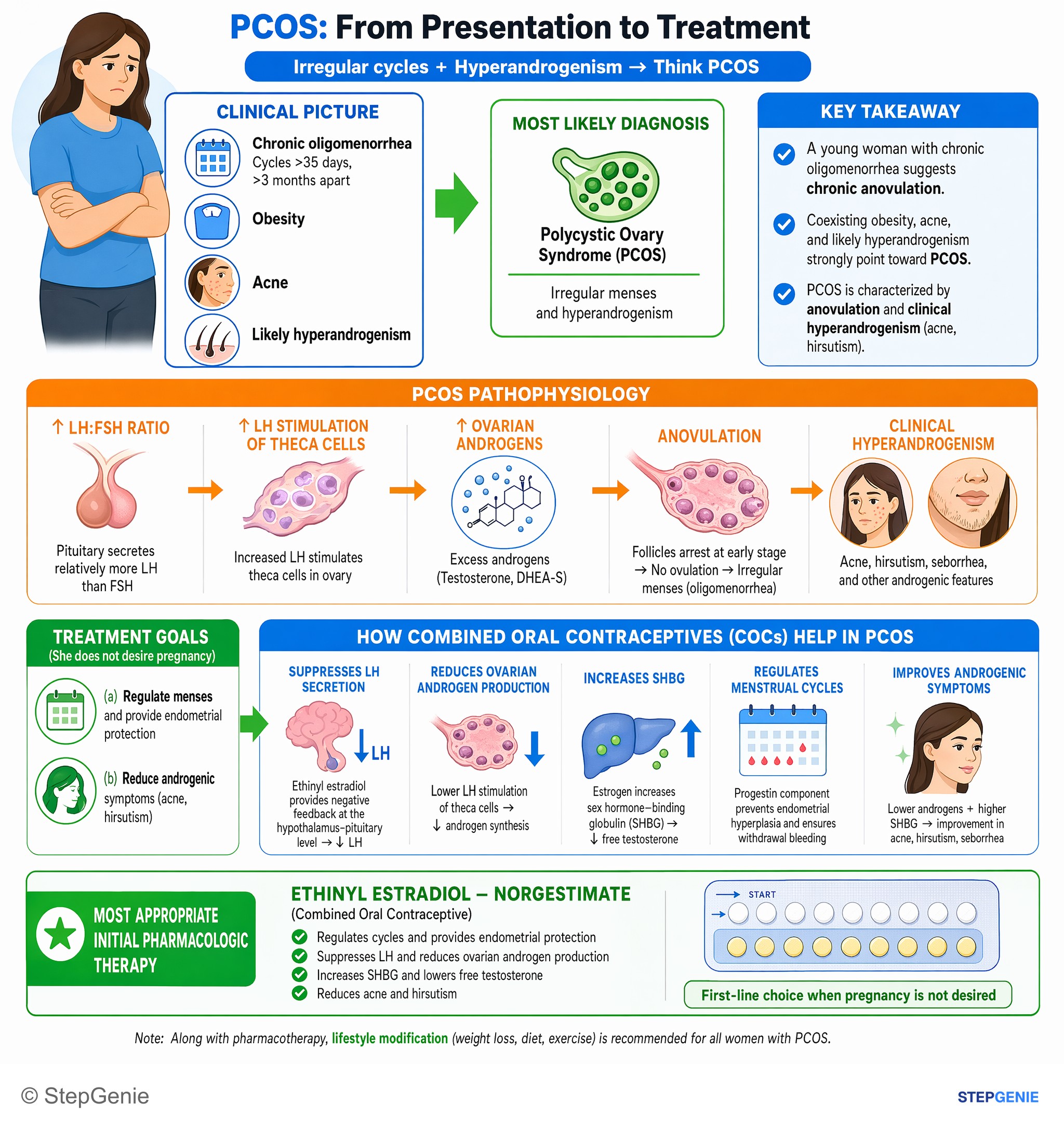
Polycystic ovary syndrome (PCOS) with irregular menses and hyperandrogenism; first-line if pregnancy not desired is combined oral…
USMLE Step 2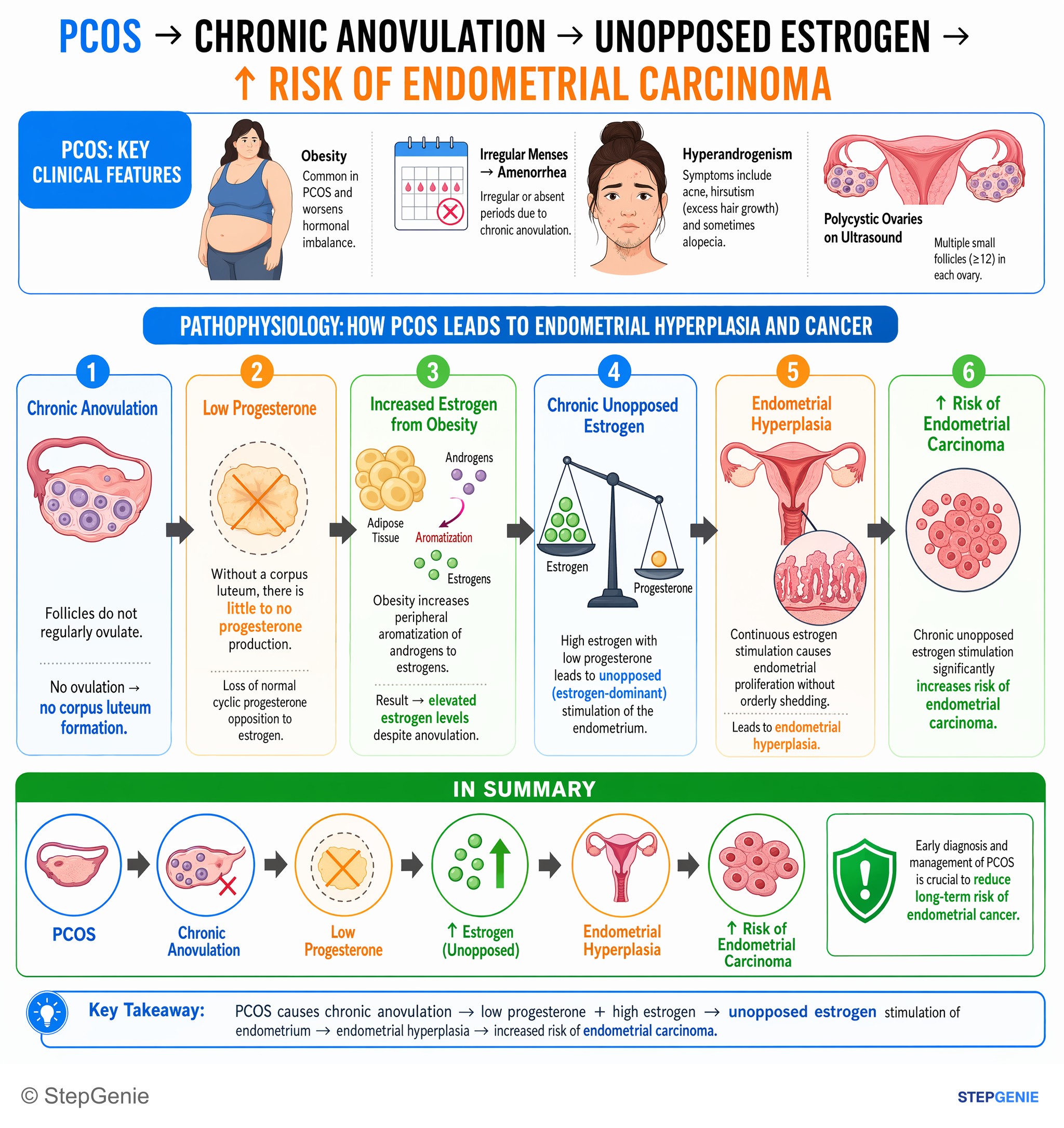
PCOS causes chronic anovulation → unopposed estrogen stimulation of endometrium → ↑ risk of endometrial carcinoma.
USMLE Step 2Frequently Asked Questions
What causes PCOS in a patient with obesity, acanthosis nigricans, hirsutism, and irregular periods?
The core mechanism is insulin resistance causing hyperinsulinemia. High insulin stimulates ovarian theca cells, working with LH to increase androgen production, and it also decreases hepatic sex hormone–binding globulin, which raises free testosterone. The androgen excess causes hirsutism and acne and impairs follicular maturation, leading to chronic anovulation, low progesterone, and irregular or heavy bleeding.
How do you diagnose PCOS on a question stem?
PCOS is diagnosed by the Rotterdam criteria, which require 2 of 3 findings: oligo- or anovulation, clinical or biochemical hyperandrogenism, and polycystic ovaries on ultrasound. Common supporting clues include obesity, acanthosis nigricans, mildly elevated testosterone, elevated LH with normal-low FSH, and multiple small follicles on ultrasound. It is also a diagnosis of exclusion.
How do you tell PCOS from nonclassic 21-hydroxylase deficiency?
PCOS is more likely when the stem shows insulin resistance clues such as obesity and acanthosis nigricans along with LH elevation. Nonclassic 21-hydroxylase deficiency is adrenal-driven rather than ovarian-driven, and the classic clue is elevated 17-hydroxyprogesterone, either at baseline or after ACTH stimulation. It may also present earlier with premature pubarche or longstanding hyperandrogen symptoms.
How do you distinguish PCOS from an androgen-secreting tumor on an exam question?
The biggest clue is the time course and severity of androgen excess. PCOS usually causes gradual symptoms over months to years with mildly elevated testosterone, while an androgen-secreting tumor causes rapid onset severe hyperandrogenism with virilization, such as deep voice, clitoromegaly, increased muscle mass, or male-pattern balding. Markedly elevated DHEA-S suggests an adrenal source.
Why does PCOS increase the risk of endometrial hyperplasia and irregular heavy bleeding?
PCOS increases this risk because chronic anovulation means there is no corpus luteum, so progesterone stays low. Without progesterone, estrogen is unopposed and continues to stimulate endometrial proliferation. That leads to irregular or heavy bleeding and raises the risk of endometrial hyperplasia and cancer. The anovulation itself comes from androgen-mediated impaired follicular maturation.