Erectile dysfunction (ED) shows up everywhere on USMLE because it’s a “simple symptom” with high-yield physiology, pharmacology, vascular disease, endocrine ties, and medication side effects. This post is built to be shareable: a fast comparison table plus a memorable visual mnemonic and one-liners that help you pick the right mechanism and next step.
The 10‑second physiology you must know (USMLE core)
An erection is parasympathetic + nitric oxide (NO) driven:
- Sexual stimulation → parasympathetic (S2–S4) activation
- NO release → ↑ cGMP in cavernosal smooth muscle
- Smooth muscle relaxation → ↑ arterial inflow + venous trapping → erection
- PDE‑5 breaks down cGMP (so inhibiting PDE‑5 helps maintain erection)
High-yield distinction:
- Erection = parasympathetic (point)
- Ejaculation = sympathetic (shoot)
- Emission = sympathetic; expulsion = somatic (pudendal)
Visual mnemonic: “N.O. = Needs Open vessels”
Picture a road sign:
N.O. → Open the pipes
- N = Nitric oxide starts it
- O = cGMP opens cavernosal smooth muscle (relaxation)
PDE‑5 inhibitors (sildenafil, tadalafil, vardenafil, avanafil) are like “closing the drain” so cGMP stays high.
One-liner: ED is often a vascular disease clue—think endothelial dysfunction until proven otherwise.
Comparison table: Erectile dysfunction (quick-hit)
| Category | Classic clues / risk factors | Key pathophysiology | High-yield meds & associations | One-liner (exam-ready) |
|---|---|---|---|---|
| Vasculogenic (arterial insufficiency) | Older age, DM, HTN, smoking, hyperlipidemia, CAD/PAD; diminished pulses | Endothelial dysfunction → ↓ NO + impaired inflow | Improves with lifestyle + PDE‑5 inhibitors if safe | ED can be an early marker of atherosclerosis—screen CV risk. |
| Veno-occlusive dysfunction (“venous leak”) | Can’t maintain erection; may have normal onset | Failure of venous trapping in corpora cavernosa | Often needs devices/surgery if refractory | If erection starts but won’t stay, think leak (poor trapping). |
| Neurogenic | Spinal cord injury, MS, diabetic neuropathy, pelvic surgery | Impaired autonomic/somatic pathways | Depends on lesion level; consider devices/injections | Neural wiring matters—damage the signal, lose the response. |
| Medication-induced | Temporal relation to new drug; very testable | Drug effect on hormones, SNS/PSNS tone, or mood | SSRIs, antipsychotics, beta-blockers (esp nonselective), thiazides, spironolactone, opioids, 5‑ARIs | If timing fits, blame the med first—then switch/adjust. |
| Endocrine (hypogonadism) | Low libido, fatigue, ↓ morning erections; small testes; infertility | ↓ Testosterone → ↓ libido + impaired NO signaling | Primary vs secondary hypogonadism workup; treat cause/testosterone when indicated | Low libido + ED = check testosterone (AM total). |
| Hyperprolactinemia | Galactorrhea, headaches/visual field defects | ↑ Prolactin → ↓ GnRH → ↓ LH/FSH → ↓ testosterone | Pituitary adenoma; dopamine agonists (cabergoline) | High prolactin suppresses the axis → low T → ED. |
| Psychogenic | Younger, abrupt onset, situational; normal nocturnal/morning erections | Performance anxiety, depression, relationship factors | Treat underlying psych issue; PDE‑5 may help | If nocturnal erections are intact, think psychogenic. |
| Post-prostatectomy/pelvic surgery | After radical prostatectomy, pelvic radiation | Cavernous nerve injury, vascular damage | Penile rehab strategies; PDE‑5 response variable | Pelvic surgery can disrupt nerves → neurogenic ED. |
| Peyronie disease | Penile curvature, painful erection, palpable plaque | Fibrous plaque in tunica albuginea | Can cause ED via deformity/pain | Curvature + plaque = Peyronie → sexual dysfunction. |
| PDE‑5 inhibitor contraindication scenario | Chest pain/angina treatment | Dangerous hypotension if combined | Contraindicated with nitrates (nitroglycerin, isosorbide) | Nitrates + PDE‑5 inhibitors = profound hypotension. |
High-yield meds: who causes ED and who treats it?
Common culprits (Step-friendly list)
- SSRIs: decreased libido, delayed ejaculation, anorgasmia
- Antipsychotics: hyperprolactinemia + sexual dysfunction
- Beta-blockers (especially older/nonselective) and thiazides
- Spironolactone: antiandrogen effects (gynecomastia, ↓ libido, ED)
- Opioids: suppress GnRH → hypogonadism
- 5‑alpha reductase inhibitors (finasteride/dutasteride): sexual side effects
Treatments you should recognize
- PDE‑5 inhibitors: increase cGMP → smooth muscle relaxation
- Adverse effects: headache, flushing, dyspepsia, nasal congestion
- Blue vision (sildenafil—PDE‑6 inhibition)
- Back pain/myalgias (tadalafil—PDE‑11)
- Absolute contraindication: concurrent nitrates
- Alprostadil (PGE1) (intracavernosal/intraurethral): ↑ cAMP → erection
- Risks: penile pain, priapism
- Mechanical/support options: vacuum devices, penile prosthesis (often for refractory cases)
Fast clinical sorting: 4 questions that narrow the diagnosis
Use these as a mental checklist on vignettes:
- Is libido low?
- Yes → endocrine (check testosterone, prolactin, thyroid as indicated)
- Are morning/nocturnal erections present?
- Present → suggests psychogenic
- Absent → organic (vascular/neuro/endocrine/medication)
- Can he initiate vs maintain erection?
- Initiate difficulty → arterial/neuro/endocrine
- Maintain difficulty → venous leak (often)
- Any new meds or vascular risk factors?
- If yes, they’re often the answer
USMLE “gotcha” facts (high-yield)
- Diabetes causes ED via both vascular disease and autonomic neuropathy (double hit).
- ED can precede symptomatic CAD—think endothelial dysfunction as a systemic process.
- Erection = parasympathetic (S2–S4); ejaculation = sympathetic (L1–L2); expulsion = pudendal nerve.
- PDE‑5 inhibitors are contraindicated with nitrates due to severe hypotension.
- Normal nocturnal erections strongly point to psychogenic ED.
Ultra-compact summary (shareable)
- NO → cGMP → smooth muscle relaxation → erection
- PDE‑5 inhibitors keep cGMP high (but never with nitrates)
- Most common big-picture causes: vascular disease, meds, diabetes, psychogenic, low testosterone
Visual explanations from the StepGenie QBank
Infographics StepGenie drew to explain questions in its own QBank, matched to this article's topic. Each caption is the takeaway of the question it explains.
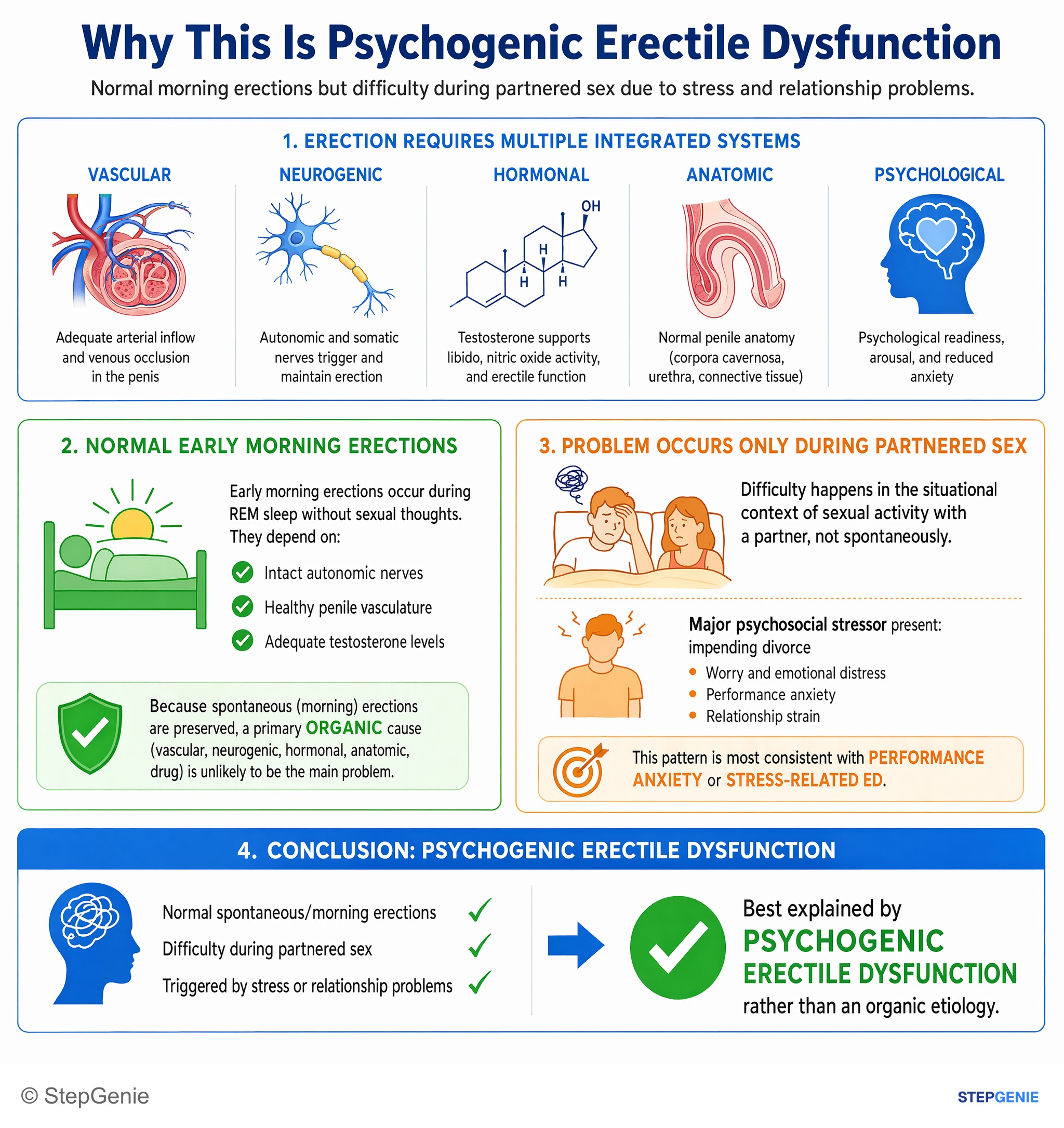
Psychogenic erectile dysfunction: normal spontaneous/morning erections but difficulty during partnered sex, often triggered by stress or…
USMLE Step 2Frequently Asked Questions
Why can diabetes cause erectile dysfunction?
Diabetes can cause erectile dysfunction through both vascular disease and autonomic neuropathy. The vascular component leads to endothelial dysfunction with reduced nitric oxide signaling and impaired arterial inflow, while the neuropathic component damages the autonomic pathways needed to trigger erection. This makes diabetes a classic double-hit cause of erectile dysfunction on exams.
How do you tell psychogenic erectile dysfunction from organic erectile dysfunction?
Psychogenic erectile dysfunction is suggested when normal morning or nocturnal erections are still present. Organic causes are more likely when those erections are absent, especially if there are vascular risk factors, neurologic disease, endocrine symptoms, or a medication trigger. Psychogenic cases also tend to occur in younger patients and may have abrupt, situational onset.
What is the first-line drug treatment for erectile dysfunction, and how does it work?
PDE-5 inhibitors are the main drug treatment for erectile dysfunction, and they work by increasing cGMP. Erection depends on parasympathetic stimulation and nitric oxide release, which raises cGMP in cavernosal smooth muscle to produce relaxation, increased arterial inflow, and venous trapping. By blocking PDE-5, these drugs prevent cGMP breakdown and help maintain the erection.
Why are PDE-5 inhibitors contraindicated with nitrates?
PDE-5 inhibitors are contraindicated with nitrates because the combination can cause dangerous, profound hypotension. PDE-5 inhibitors keep cGMP levels elevated, and nitrates also increase nitric oxide signaling, so using them together can produce an excessive vasodilatory effect. This is a classic safety question when erectile dysfunction treatment is tested.
How do you tell arterial erectile dysfunction from venous leak on a vignette?
Arterial erectile dysfunction more often causes trouble initiating an erection, especially in patients with diabetes, hypertension, smoking, hyperlipidemia, or other vascular disease. Venous leak is suggested when the erection begins normally but cannot be maintained, reflecting failure of venous trapping in the corpora cavernosa. That initiate-versus-maintain distinction is a key clue on questions.