You’ve probably missed (or second-guessed) a bipolar question not because you don’t “know bipolar,” but because you didn’t slow down to classify the episode type. USMLE-style vignettes love to blur mood, psychosis, sleep, and functioning—then punish you for ignoring a single phrase like “hospitalized” or “no marked impairment.” Let’s do a Q-bank-style breakdown that trains your eye to separate Bipolar I from Bipolar II, then walk through the most tempting distractors one by one.
Tag: Psychiatry > Psychotic & Mood Disorders
The Clinical Vignette (Q-bank style)
A 26-year-old woman is brought to the ED by her roommate because she has been “acting bizarre” for the past week. She has slept 2 hours total over the last 3 nights and says she feels “better than ever.” She has been talking rapidly, jumping between topics, and spent $6,000 on clothes she can’t afford. Today, she tried to “pitch a revolutionary app idea” to strangers in a coffee shop and became agitated when asked to leave. She insists she has a “special connection to the CEO of Apple,” who is sending her “secret messages” through the radio. She has no history of substance use. Vitals are normal; urine toxicology screen is negative.
Question: What is the most likely diagnosis?
Answer choices:
A. Bipolar I disorder
B. Bipolar II disorder
C. Cyclothymic disorder
D. Schizoaffective disorder
E. Major depressive disorder with psychotic features
Step 1/2 Snapshot: The One-Liner You Must Know
Bipolar I = at least one MANIC episode
- Mania = elevated/irritable mood + increased energy week (or any duration if hospitalized) AND marked impairment / hospitalization / psychosis.
Bipolar II = hypomania + major depression
- Hypomania = same symptom cluster as mania but days, NO marked impairment, NO hospitalization, NO psychosis.
- Must have major depressive episode (often what brings them to care).
Shortcut:
- Psychosis or hospitalization → mania → Bipolar I (not Bipolar II).
Why the Correct Answer Is A. Bipolar I Disorder
This vignette is screaming mania:
She meets manic episode criteria
- Duration: about a week
- Symptoms: decreased need for sleep, pressured speech, flight of ideas, increased goal-directed activity, risky spending, agitation
- Severity: marked impairment (ED presentation, disruptive behavior)
- Psychotic features: grandiose delusion (“special connection… secret messages”)
✅ Psychosis during mood elevation = manic episode = Bipolar I (even if she also has depression at other times; Bipolar I doesn’t require a depressive episode).
Now, Why Each Distractor Is Wrong (and How USMLE Tries to Trick You)
B. Bipolar II Disorder
Why it’s tempting: She has classic “bipolar” symptoms—sleep, spending, energy.
Why it’s wrong:
Bipolar II requires hypomania, which cannot include psychosis and cannot cause marked impairment/hospitalization.
- In Bipolar II, if psychosis appears, it is typically during major depression, not during hypomania.
- Here, psychosis is occurring with the elevated mood/energy → that’s mania.
Exam rule:
Hypomania + psychosis = not hypomania anymore. It’s mania.
C. Cyclothymic Disorder
What it is: A chronic “mini bipolar” pattern:
- years (1 year in children/adolescents)
- Numerous periods of hypomanic symptoms and depressive symptoms that do not meet full episode criteria
- Symptoms present at least half the time, with < 2 months symptom-free
Why it’s wrong here:
This is an acute severe episode with psychosis and functional collapse—well beyond cyclothymia.
High-yield distinction:
- Cyclothymia = subthreshold symptoms, chronic course.
- Bipolar I/II = episodic syndromes meeting full criteria.
D. Schizoaffective Disorder
What USMLE is really testing: whether the psychosis is independent of mood episodes.
Diagnostic key for schizoaffective:
- Meets criteria for schizophrenia (delusions/hallucinations + other psychotic symptoms)
- Plus a major mood episode (mania or depression)
- AND at least 2 weeks of psychosis WITHOUT mood symptoms at some point in the illness
Why it’s wrong here:
All psychotic content shown is mood-congruent (grandiosity) and occurs during a manic episode. There’s no evidence of a 2-week period of psychosis in the absence of mood symptoms.
Quick exam anchor:
- Bipolar w/ psychosis: psychosis only during mood episodes
- Schizoaffective: psychosis sometimes persists when mood symptoms are absent
E. Major Depressive Disorder with Psychotic Features
What it is: Psychotic symptoms that occur exclusively during major depressive episodes (often mood-congruent: guilt, worthlessness, nihilism; can be mood-incongruent too).
Why it’s wrong here:
This patient is not depressed—she’s manic (sleep ↓, energy ↑, grandiosity, impulsivity). Psychosis is appearing alongside mood elevation, not depression.
High-yield trap:
If the vignette includes psychosis, don’t reflexively label it “schizophrenia spectrum.” First ask: What’s the mood state right now? Then ask: Does psychosis occur outside mood episodes?
High-Yield Table: Bipolar I vs Bipolar II (USMLE-friendly)
| Feature | Bipolar I | Bipolar II |
|---|---|---|
| Required episodes | ≥ 1 manic episode | ≥ 1 hypomanic + ≥ 1 major depressive |
| Mania vs hypomania | Mania: ≥ 1 week or any duration if hospitalized | Hypomania: ≥ 4 days |
| Functional impairment | Marked impairment common | No marked impairment |
| Hospitalization | Can occur (and makes it mania) | By definition, no hospitalization for hypomania |
| Psychosis | May occur during mania | Not during hypomania |
| What patients often present with | Mania/psychosis/ER visit | Depression (often misdiagnosed as MDD) |
The “Answer Choice Matters” Checklist (How to Classify in 10 Seconds)
When you see elevated mood/energy:
- Any psychosis?
- Yes → Mania → Bipolar I (or schizoaffective only if psychosis occurs without mood symptoms later)
- Any hospitalization or marked impairment?
- Yes → Mania → Bipolar I
- Duration ≥ 1 week?
- Yes → likely mania (context matters)
- If none of the above:
- Duration ≥ 4 days + clear change in functioning but not severe → Hypomania → Bipolar II (if also major depression history)
Extra USMLE High-Yield Pearls (Test writers love these)
1) Antidepressants can unmask bipolar disorder
If a stem hints at:
- prior “depression” treated with SSRI → then new agitation, insomnia, impulsivity
Think: bipolar spectrum (especially Bipolar II) rather than “SSRI side effect” in isolation.
2) Mood-congruent vs mood-incongruent psychosis
- Mania: grandiosity, special powers, invincibility
- Depression: guilt, deserved punishment, nihilism, somatic delusions
Not required for diagnosis, but helps you track whether psychosis is occurring inside the mood episode.
3) Bipolar II is often missed
Because hypomania can feel “productive,” many patients don’t report it as pathology—USMLE may show:
- multiple “depression” episodes
- brief “high” periods (4–6 days) with less sleep and increased goal-directed activity
Diagnosis hinges on actively eliciting hypomanic history.
4) If psychosis persists when mood normal → think schizoaffective (or schizophrenia)
The 2-week rule is a favorite. If they explicitly tell you:
- “He continued hearing voices for 3 weeks after mood symptoms resolved”
→ schizoaffective/schizophrenia-spectrum, not bipolar w/ psychosis.
Final Takeaway
In USMLE vignettes, Bipolar I vs Bipolar II is rarely about “does this sound like bipolar?” It’s about episode severity:
- Psychosis or hospitalization = mania = Bipolar I
- Hypomania is never psychotic and never severely impairing
- Schizoaffective requires psychosis outside mood episodes
Train yourself to read every distractor as a diagnostic rule, not just a label—and your accuracy on mood/psychosis questions will jump.
Visual explanations from the StepGenie QBank
Infographics StepGenie drew to explain questions in its own QBank, matched to this article's topic. Each caption is the takeaway of the question it explains.
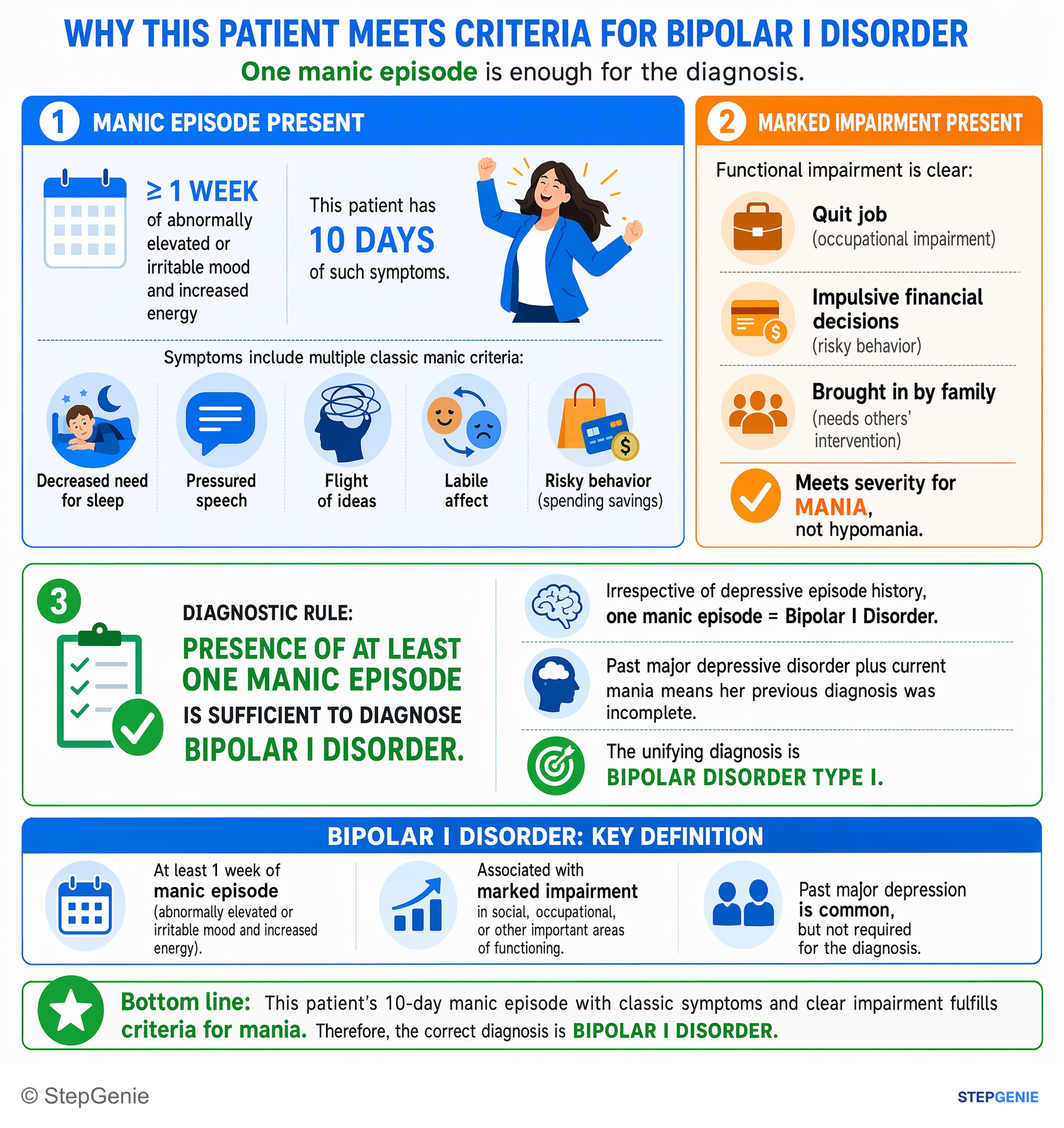
Bipolar I disorder: at least 1 week of manic episode with marked impairment; past major depression common but not required for diagnosis.
USMLE Step 2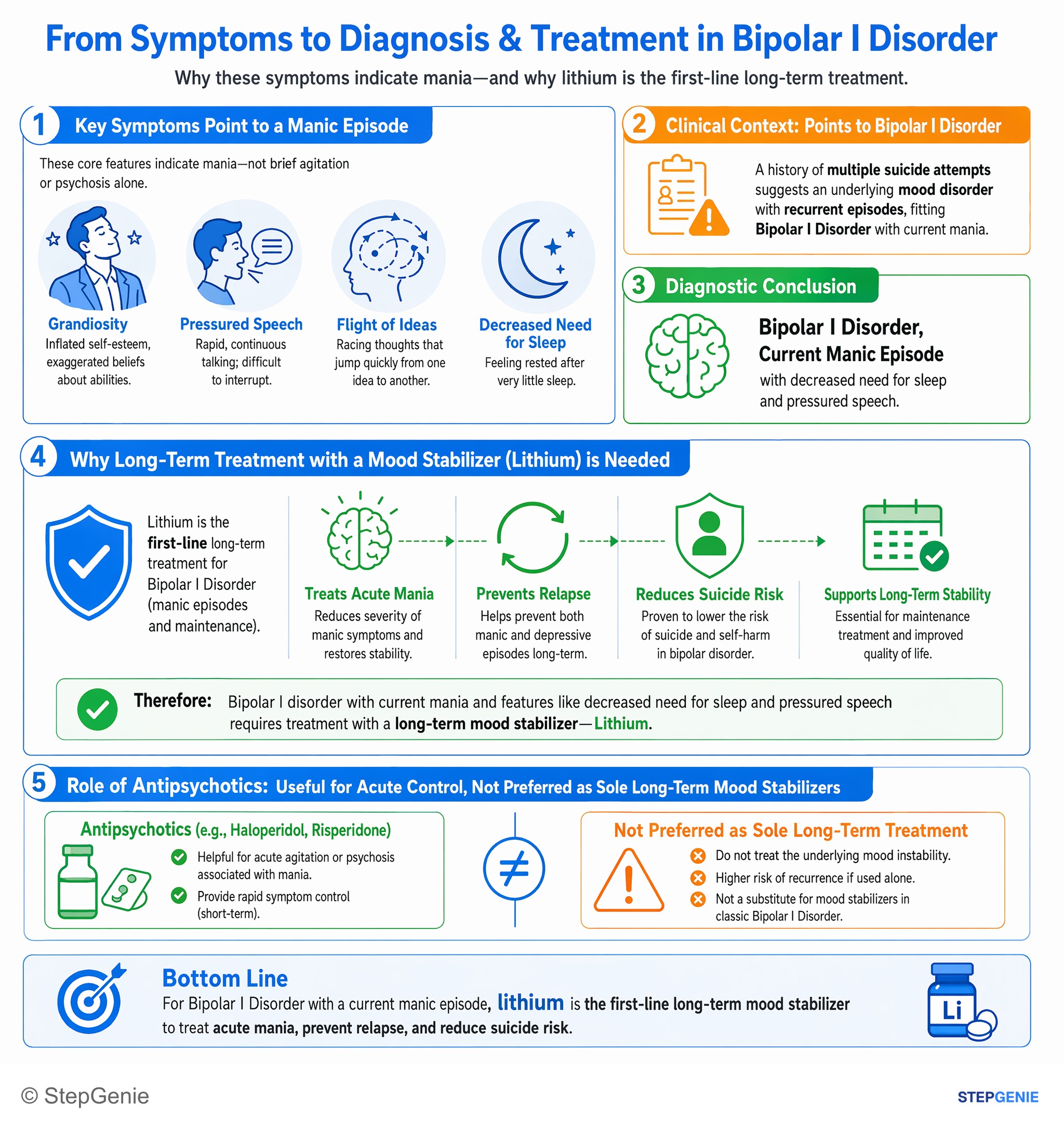
Bipolar I disorder, current manic episode with decreased need for sleep and pressured speech → treat with long-term mood stabilizer…
USMLE Step 2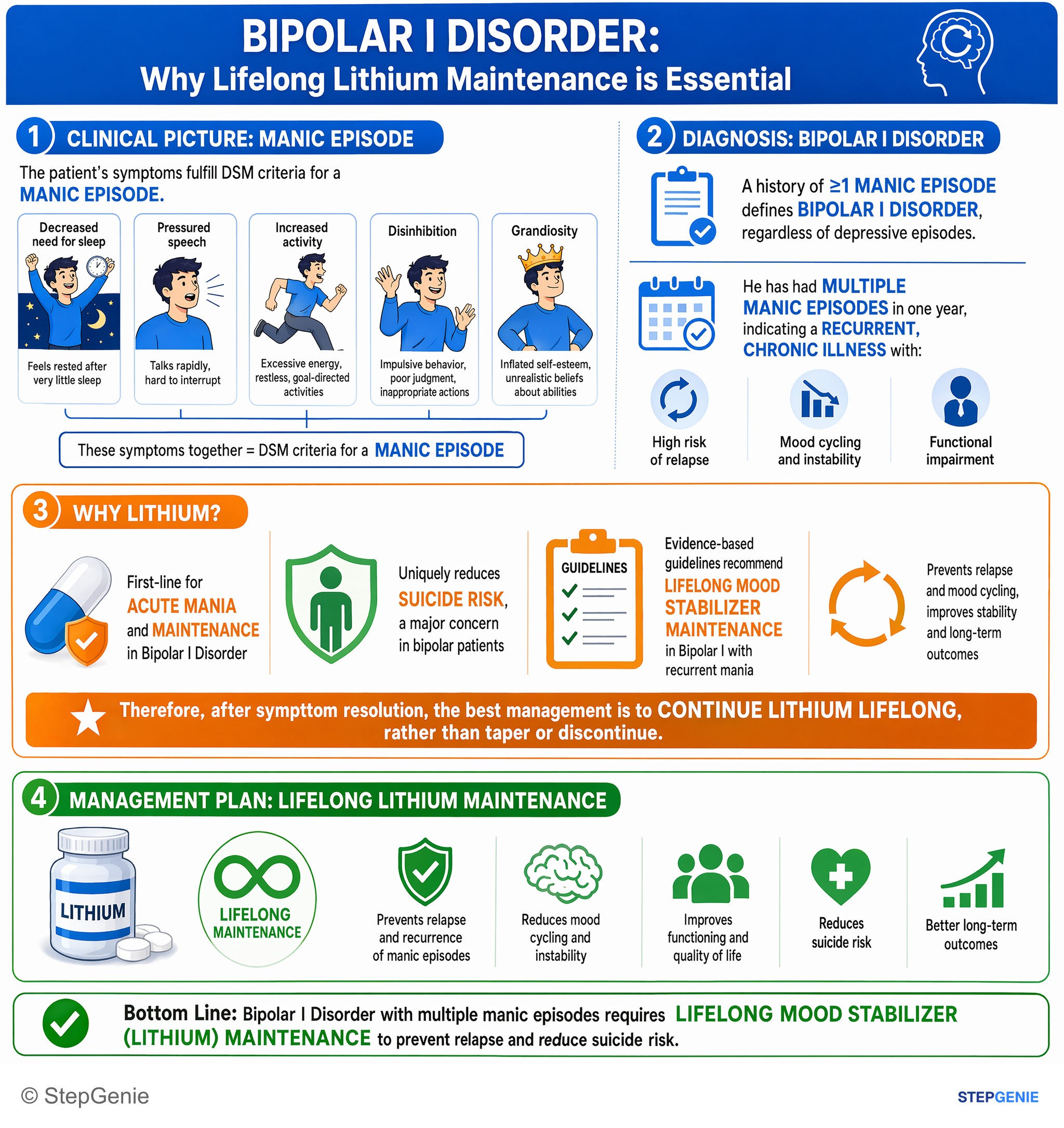
Bipolar I disorder with multiple manic episodes requires lifelong mood stabilizer (lithium) maintenance to prevent relapse and suicide risk.
USMLE Step 2Frequently Asked Questions
How do you tell Bipolar I from Bipolar II on a vignette?
The key difference is mania versus hypomania. Bipolar I requires at least one manic episode, which involves elevated or irritable mood with increased energy for at least 1 week, or any duration if hospitalized, plus marked impairment, hospitalization, or psychosis. Bipolar II requires hypomania and at least one major depressive episode, and hypomania cannot include psychosis, hospitalization, or marked impairment.
Does psychosis during an elevated mood mean Bipolar I or Bipolar II?
Psychosis during mood elevation points to Bipolar I because psychosis during an elevated or irritable mood makes the episode manic, not hypomanic. Bipolar II is defined by hypomania, and hypomania cannot include psychosis. In the vignette, the grandiose delusion occurs alongside decreased need for sleep, rapid speech, and risky behavior, which fits mania and therefore Bipolar I disorder.
Why does hospitalization or marked impairment make it mania instead of hypomania?
Hospitalization or marked impairment makes the episode mania because hypomania, by definition, does not cause marked functional impairment and does not require hospitalization. Mania is the more severe form and is associated with serious disruption in functioning, psychosis, or the need for inpatient care. That is why phrases like ED presentation, bizarre behavior, or inability to function are major clues for Bipolar I.
How do you tell bipolar disorder with psychosis from schizoaffective disorder?
The distinction is whether psychosis occurs only during mood episodes or also persists independently. In bipolar disorder with psychosis, the psychotic symptoms occur during manic or depressive episodes. Schizoaffective disorder requires at least 2 weeks of psychosis without mood symptoms at some point in the illness. In the vignette, the psychosis is mood-congruent and appears during mania, so schizoaffective disorder is not supported.
Why isn’t this cyclothymic disorder?
It is not cyclothymic disorder because cyclothymia is a chronic pattern of numerous hypomanic and depressive symptoms that stay below full episode criteria for at least 2 years. The vignette shows an acute, severe episode with psychosis and major functional collapse, which is far beyond subthreshold chronic symptoms. Cyclothymia is a chronic mini-bipolar pattern, not a full manic syndrome.