Major depressive disorder (MDD) shows up everywhere on USMLE—often disguised as “fatigue” or “can’t sleep” or “just stressed.” The trick isn’t only recognizing the diagnosis; it’s knowing why the other tempting answers are wrong in that specific vignette. Let’s walk through a classic Q-bank-style stem and then dissect every answer choice like you would during review.
Clinical Vignette (Q-bank style)
A 28-year-old woman comes to clinic because she has felt “empty and exhausted” for the past month. She has trouble falling asleep, wakes up early, and has lost interest in seeing friends or going to the gym. She reports poor concentration at work and feels “like a failure.” Her appetite is decreased and she has unintentionally lost 8 lb (3.6 kg). She denies alcohol or illicit drug use. She has no history of manic episodes. On exam, she has slowed speech and psychomotor retardation. She denies hallucinations or delusions. When asked about safety, she says, “Sometimes I think it would be easier if I didn’t wake up,” but denies a plan.
Which diagnosis best explains her symptoms?
A. Adjustment disorder with depressed mood
B. Major depressive disorder
C. Persistent depressive disorder (dysthymia)
D. Bipolar II disorder
E. Bereavement (normal grief)
F. Schizoaffective disorder
Step 1/2 First Pass: What’s the diagnosis?
She has depressed mood/anhedonia plus multiple neurovegetative/cognitive symptoms:
- Sleep disturbance (early morning awakening)
- Decreased interest (anhedonia)
- Poor concentration
- Appetite/weight loss
- Psychomotor retardation
- Feelings of worthlessness
- Passive suicidal ideation (“easier if I didn’t wake up”)
Duration: ~1 month (≥ 2 weeks).
This fits Major depressive disorder.
Correct Answer: B. Major depressive disorder
Why it’s correct (USMLE framing)
MDD criteria (high yield):
- ≥ 5 symptoms for ≥ 2 weeks
- Must include depressed mood and/or anhedonia
- Causes clinically significant distress/impairment
- Not attributable to substances/medical conditions
- No history of manic or hypomanic episode (otherwise think bipolar spectrum)
SIGECAPS symptoms to count:
- Sleep changes
- Interest decreased
- Guilt/worthlessness
- Energy decreased
- Concentration decreased
- Appetite/weight changes
- Psychomotor agitation/retardation
- Suicidality
Extra USMLE-high-yield: Suicide assessment
Passive SI still matters. In questions, escalation is:
- Passive SI → active SI → plan → intent → means/access
Always assess safety and consider urgent intervention if risk is high (plan, intent, prior attempts, intoxication, limited supports).
Why Every Other Answer Choice Is Wrong (and what would make it right)
A. Adjustment disorder with depressed mood
Why it’s wrong here:
- Adjustment disorder is a maladaptive response to an identifiable stressor occurring within 3 months of the stressor.
- Symptoms are out of proportion but typically do not meet full criteria for MDD.
What would make it right:
- Clear precipitating stressor (e.g., divorce, job loss) + depressive symptoms that don’t reach 5 SIGECAPS or don’t have the full syndrome.
- Time course: resolves within 6 months after stressor ends.
Board tip: If the vignette clearly meets MDD criteria, pick MDD—even if there’s a stressor. Stressors can precipitate MDD; they don’t exclude it.
C. Persistent depressive disorder (dysthymia)
Why it’s wrong here:
- PDD requires chronic depressed mood for ≥ 2 years (≥ 1 year in children/adolescents).
- Symptoms can be “less severe” but long-lasting; patients often say “I’ve always felt this way.”
What would make it right:
- Depressed mood most days for 2+ years plus ≥ 2 of:
- Poor appetite/overeating
- Insomnia/hypersomnia
- Low energy
- Low self-esteem
- Poor concentration
- Hopelessness
High-yield nuance: You can have double depression (PDD baseline + superimposed MDD episode). USMLE may describe years of low mood, then a recent worsening meeting MDD criteria.
D. Bipolar II disorder
Why it’s wrong here:
- Bipolar II = hypomanic episode(s) + major depressive episode(s).
- She explicitly has no history of mania/hypomania.
What would make it right:
- A past period of ≥ 4 days of elevated/irritable mood + increased energy with ≥ 3 symptoms (DIG FAST) and observable change in functioning, but no marked impairment, no psychosis, no hospitalization.
USMLE trap: Patients may not label hypomania as a problem (“best week of my life,” “super productive”). Always ask:
- Decreased need for sleep?
- Racing thoughts?
- Increased goal-directed activity?
- Risky behavior?
Clinical pearl: Starting antidepressant monotherapy in undiagnosed bipolar can precipitate mania/hypomania.
E. Bereavement (normal grief)
Why it’s wrong here:
- Grief is a normal response to loss; mood tends to come in waves, often tied to reminders, with preserved self-esteem.
- This vignette has a syndromic depressive episode with worthlessness, functional impairment, and multiple SIGECAPS features—without any stated loss.
What would make it right:
- Recent death/loss with:
- Sadness that fluctuates
- Ability to experience positive emotions intermittently
- Thoughts focused on the deceased
- No pervasive worthlessness
- No persistent suicidal ideation (may have “wish to join” the deceased, but not typically self-loathing-driven SI)
High-yield: Major depression can occur after a loss; “it’s grief” doesn’t protect against MDD if criteria are met.
F. Schizoaffective disorder
Why it’s wrong here:
- Requires psychotic symptoms (delusions/hallucinations) plus mood episodes.
- Key criterion: ≥ 2 weeks of psychosis without mood symptoms at some point.
- This patient denies hallucinations/delusions; the stem emphasizes depressive symptoms only.
What would make it right:
- A patient with major mood episodes (depression or mania) and schizophrenia-like symptoms, with a period of psychosis alone.
Quick differentiator table (high yield):
| Condition | Psychosis outside mood episode? | Mood episodes present? |
|---|---|---|
| MDD with psychotic features | No | Yes (depression) |
| Bipolar with psychotic features | No | Yes (mania/depression) |
| Schizoaffective disorder | Yes (≥ 2 weeks) | Yes |
| Schizophrenia | Yes | Mood symptoms can occur but aren’t predominant |
High-Yield Add-ons USMLE Loves About MDD
Melancholic vs atypical clues (pattern recognition)
- Melancholic features: early morning awakening, worse in AM, anhedonia, psychomotor changes, guilt, weight loss
- Atypical features: mood reactivity, hypersomnia, hyperphagia, leaden paralysis, rejection sensitivity
This vignette leans melancholic (early morning awakening, psychomotor retardation, weight loss).
Screening and first-line treatments (Step 2 emphasis)
First-line:
- SSRIs/SNRIs, bupropion, mirtazapine
- Psychotherapy (CBT, interpersonal therapy) for mild–moderate; combined therapy often best for moderate–severe
When urgent escalation matters:
- Active SI with plan/intent, psychosis, catatonia, severe functional impairment → consider inpatient, ECT, and safety planning.
Medication side-effect mini-map (rapid recall)
- SSRIs: sexual dysfunction, GI upset; serotonin syndrome risk with MAOIs/linezolid/triptans
- SNRIs: like SSRIs + possible HTN
- Bupropion: activating, no sexual side effects, helps smoking cessation; contraindicated in seizures/eating disorders
- Mirtazapine: sedation + weight gain (useful if insomnia/low appetite)
Rapid-Fire Takeaway: How to Win These Questions
- If you see ≥ 5 SIGECAPS for ≥ 2 weeks with impairment → MDD.
- Don’t let a possible stressor trick you into adjustment disorder if full MDD criteria are met.
- Always rule out bipolar by asking about hypomania.
- Psychosis timing is the key to schizoaffective vs mood disorder with psychotic features.
- Passive SI is still SI—acknowledge and assess.
Tag
Psychiatry > Psychotic & Mood Disorders
Visual explanations from the StepGenie QBank
Infographics StepGenie drew to explain questions in its own QBank, matched to this article's topic. Each caption is the takeaway of the question it explains.
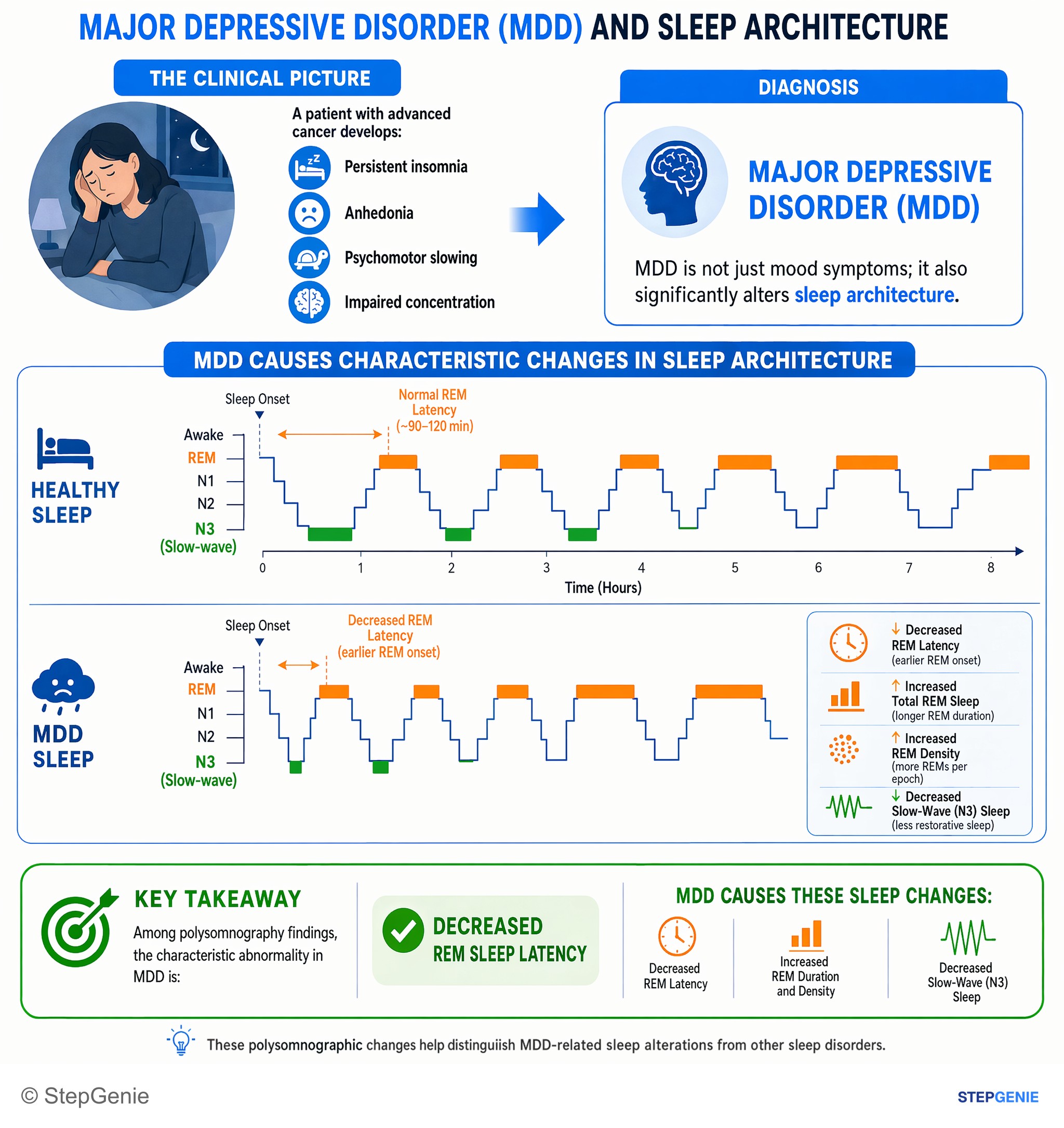
Major depressive disorder causes sleep changes: decreased REM latency, increased REM duration and density, and decreased slow-wave (N3)…
USMLE Step 1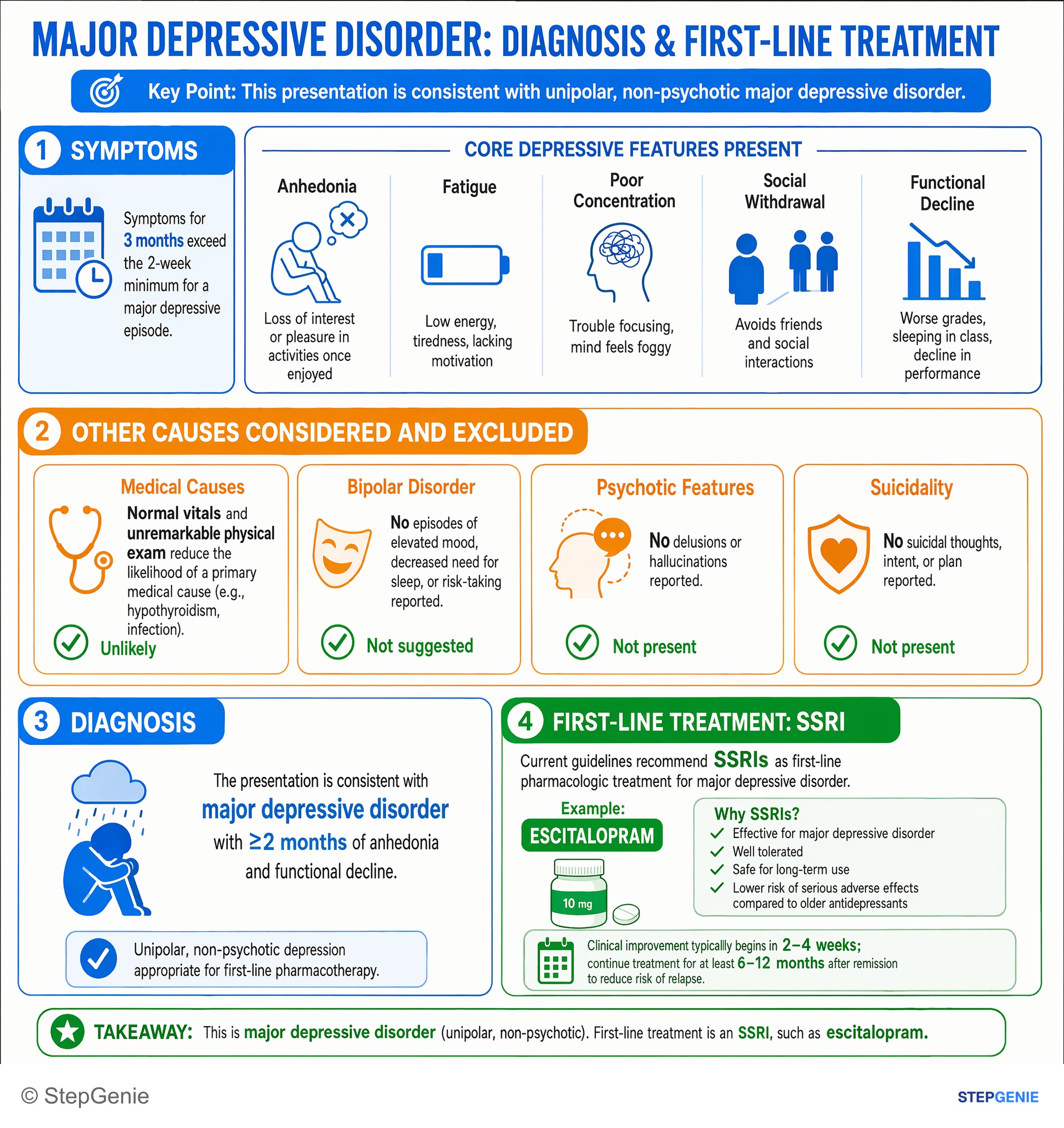
Major depressive disorder with ≥2 months of anhedonia and functional decline; first-line treatment is an SSRI such as escitalopram.
USMLE Step 2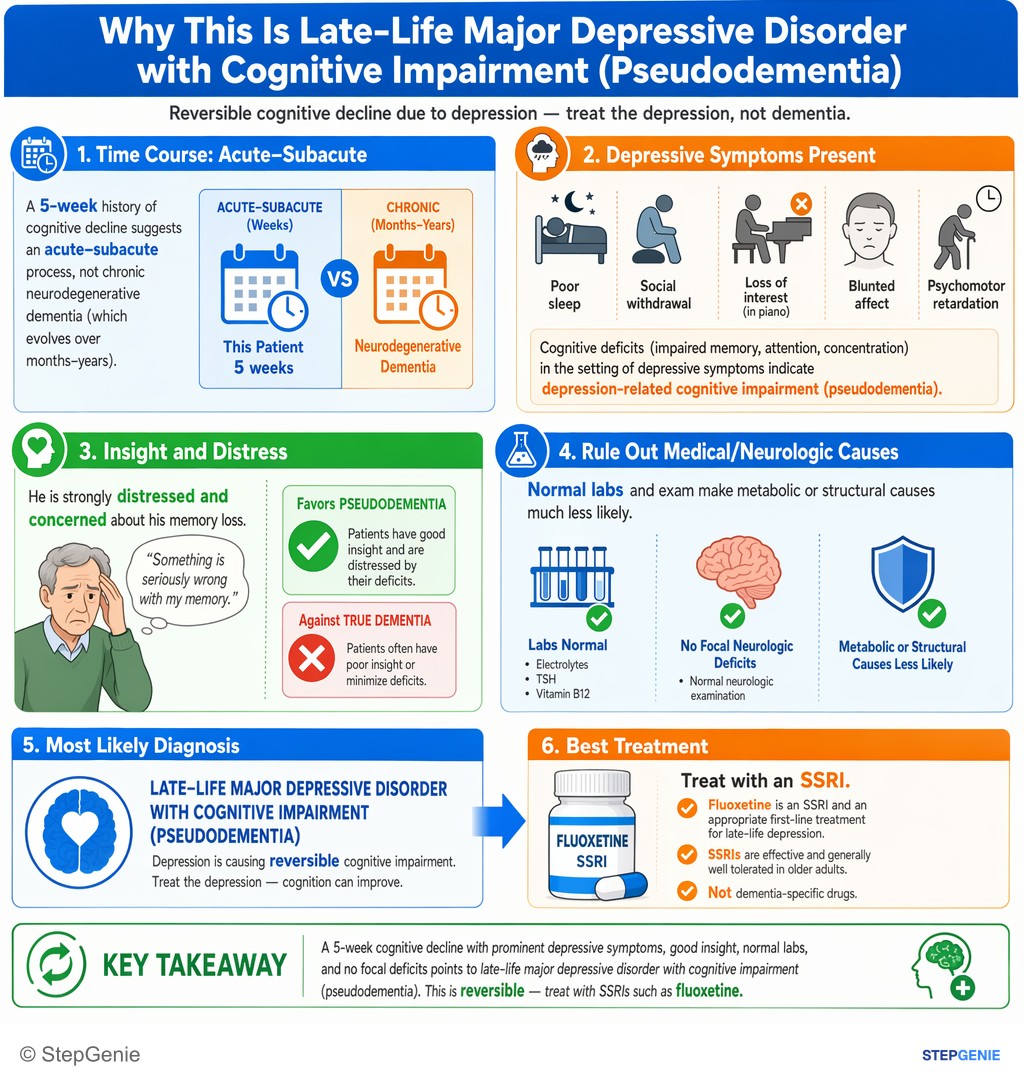
Late-life major depressive disorder (pseudodementia) causes reversible cognitive impairment; treat with SSRIs such as fluoxetine, not…
USMLE Step 2Frequently Asked Questions
How do you know a vignette is major depressive disorder instead of just stress or feeling down?
Major depressive disorder is identified by at least 5 depressive symptoms lasting at least 2 weeks, with depressed mood and/or anhedonia included. Typical clues are sleep change, decreased interest, poor concentration, appetite or weight loss, psychomotor retardation, worthlessness, and suicidality. The symptoms must cause clinically significant distress or impairment and not be better explained by substances, medical conditions, or a history of mania or hypomania.
How do you tell major depressive disorder from adjustment disorder with depressed mood?
Major depressive disorder is favored when the patient meets the full syndrome, while adjustment disorder is a maladaptive response to an identifiable stressor that usually does not meet full MDD criteria. Adjustment disorder begins within 3 months of the stressor and resolves within 6 months after the stressor ends. Even if a stressor is present, you should still choose MDD if the vignette clearly meets MDD criteria.
How do you distinguish major depressive disorder from persistent depressive disorder on exam questions?
The key difference is duration. Major depressive disorder requires a depressive episode lasting at least 2 weeks, whereas persistent depressive disorder is chronic depressed mood for at least 2 years in adults. Persistent depressive disorder is often described as long-standing, with patients saying they have always felt this way, and it is associated with symptoms like low energy, poor concentration, low self-esteem, poor appetite or overeating, sleep problems, and hopelessness.
How do you tell major depressive disorder from bipolar II disorder in a psychiatry vignette?
Bipolar II disorder requires both a major depressive episode and a history of hypomania, so the absence of manic or hypomanic episodes points away from bipolar II. A hypomanic episode involves at least 4 days of elevated or irritable mood with increased energy plus additional symptoms such as decreased need for sleep, racing thoughts, increased goal-directed activity, or risky behavior. Patients may describe hypomania as a very productive or unusually good period rather than a problem.
Why is passive suicidal ideation still important in major depressive disorder questions?
Passive suicidal ideation still matters because it is part of suicide assessment and can signal meaningful risk even without a specific plan. A statement like "it would be easier if I didn’t wake up" should prompt further safety evaluation. In exam questions, risk generally escalates from passive suicidal ideation to active ideation, then plan, intent, and access to means, with urgent intervention considered when risk is high.