Polycythemia vera (PV) is one of those “blink-and-you-miss-it” USMLE diagnoses: a ruddy patient with headaches and itching after a hot shower—plus labs that scream myeloproliferative neoplasm. Here’s a fast, shareable 5-second rule to lock it in and avoid common traps.
The 5‑Second Rule (PV)
“JAK2 + high Hct/Hgb + low EPO = Polycythemia vera.”
If you can say that in one breath, you can answer most PV questions.
The Visual/Mnemonic Device: “PV = Pile of blood in a Hot Shower”
Picture a cartoon patient:
- Pile of blood (thick, sludgy blood) → hyperviscosity + thrombosis
- Very itchy in a hot shower → aquagenic pruritus
- Holding a sign that says “JAK2”
- With a speech bubble: “EPO? Nah, I’m good.” → low EPO
One-liner explanation:
PV is a JAK2-driven myeloproliferative neoplasm with autonomous RBC production → high Hct/Hgb and suppressed EPO.
How PV Presents (High-Yield Symptoms)
Think: “too many RBCs → thick blood + histamine/basophils + uric acid.”
Classic clues
- Aquagenic pruritus (itching after warm shower/bath)
- Ruddy plethoric complexion
- Headache, dizziness, visual disturbances (hyperviscosity)
- Thrombosis (DVT, stroke, MI); Budd–Chiari syndrome can show up
- Splenomegaly (extramedullary hematopoiesis)
Extra Step-friendly associations
- Erythromelalgia: burning pain/redness in hands/feet (microvascular thrombosis)
- Hyperuricemia/gout (increased cell turnover)
Key Labs & What They Mean
| Finding | PV Pattern | Why it happens |
|---|---|---|
| Hemoglobin/hematocrit | High | Increased RBC mass |
| EPO level | Low | Negative feedback from increased oxygen-carrying capacity |
| JAK2 mutation | Positive (usually V617F) | Constitutive signaling → growth without normal regulation |
| WBC/platelets | Often high too | It’s a myeloproliferative neoplasm (panmyelosis) |
| O saturation | Normal | Not driven by hypoxia |
| Uric acid | High | High turnover |
Bone marrow (if asked): hypercellular marrow with panmyelosis.
PV vs Secondary Polycythemia (The Most Common Test Trap)
Use this micro-algorithm
- High Hct/Hgb
- Ask: EPO high or low?
- Low EPO → PV (autonomous RBC production)
- High EPO → secondary polycythemia (appropriately or inappropriately driven)
| Condition | EPO | O sat | Classic hint |
|---|---|---|---|
| Polycythemia vera | Low | Normal | Aquagenic pruritus, splenomegaly, thrombosis; JAK2+ |
| COPD, OSA, high altitude | High | Low | Chronic hypoxia |
| EPO-secreting tumors (e.g., RCC, HCC) | High | Normal | Renal/hepatic mass clues |
Complications You Should Be Ready to Name
- Thrombosis is the big one (arterial and venous)
- Bleeding can occur too (platelet dysfunction despite high platelets)
- Progression to myelofibrosis (“spent phase”)
- Transformation to acute leukemia (less common, but classic for MPNs)
Treatment (USMLE-Style)
Goal: reduce thrombosis risk by lowering hematocrit and platelet activation.
- Phlebotomy = first-line to lower hematocrit
- Low-dose aspirin (unless contraindicated) to reduce thrombosis symptoms/risk
- Hydroxyurea for high-risk patients (e.g., older age, prior thrombosis) to cytoreduce
- JAK inhibitors (e.g., ruxolitinib) may be used in select cases (more common in myelofibrosis, but can appear for PV)
Rapid-Fire PV “5-Second” Recall Box
- Mutation: JAK2
- EPO: Low
- Symptoms: aquagenic pruritus, ruddy face, headaches, splenomegaly
- Complication: thrombosis (think Budd–Chiari)
- Treatment: phlebotomy + aspirin (± hydroxyurea)
Visual explanations from the StepGenie QBank
Infographics StepGenie drew to explain questions in its own QBank, matched to this article's topic. Each caption is the takeaway of the question it explains.
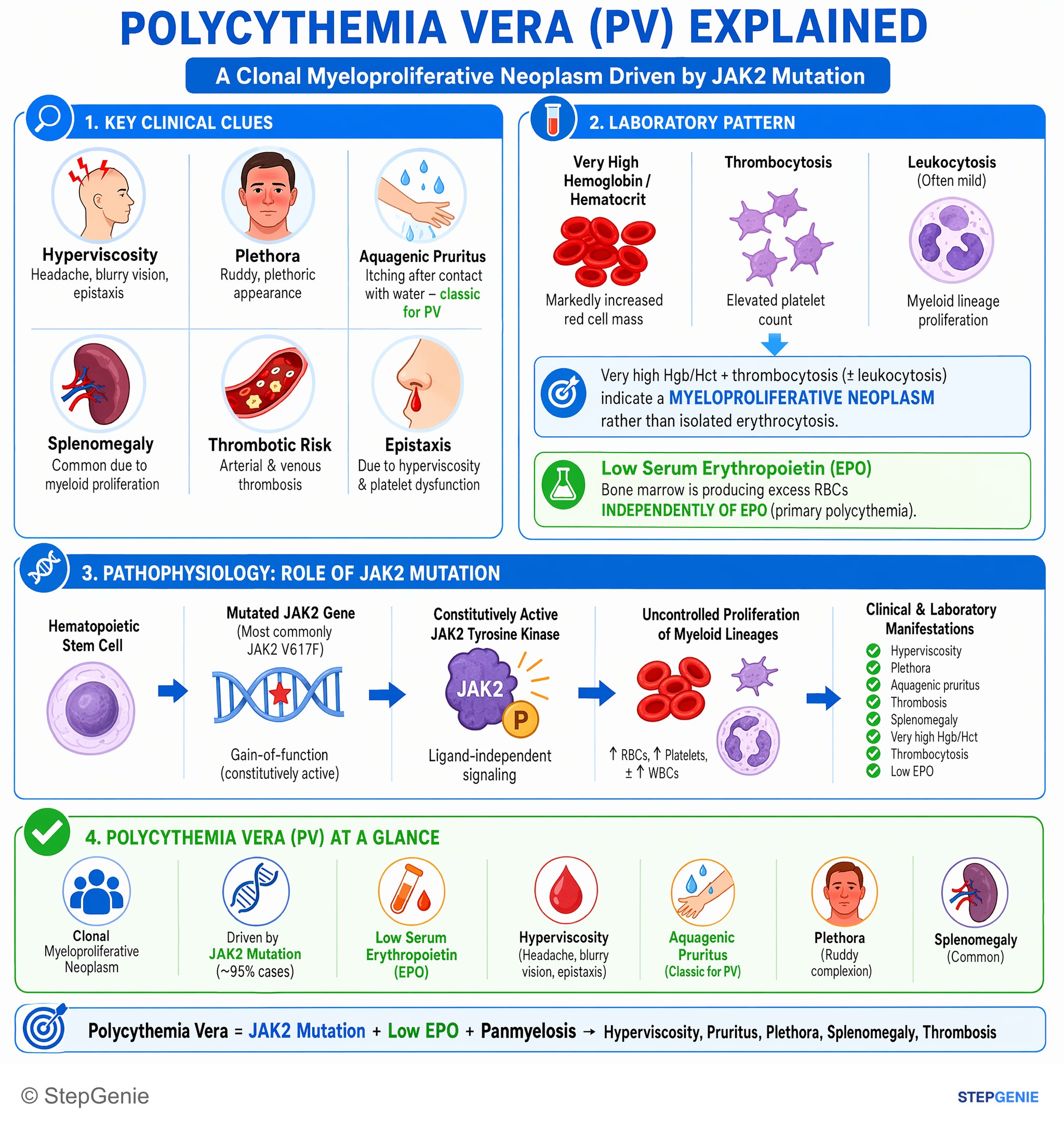
Polycythemia vera: clonal myeloproliferative neoplasm with JAK2 mutation, low EPO, hyperviscosity, aquagenic pruritus, plethora, and…
USMLE Step 1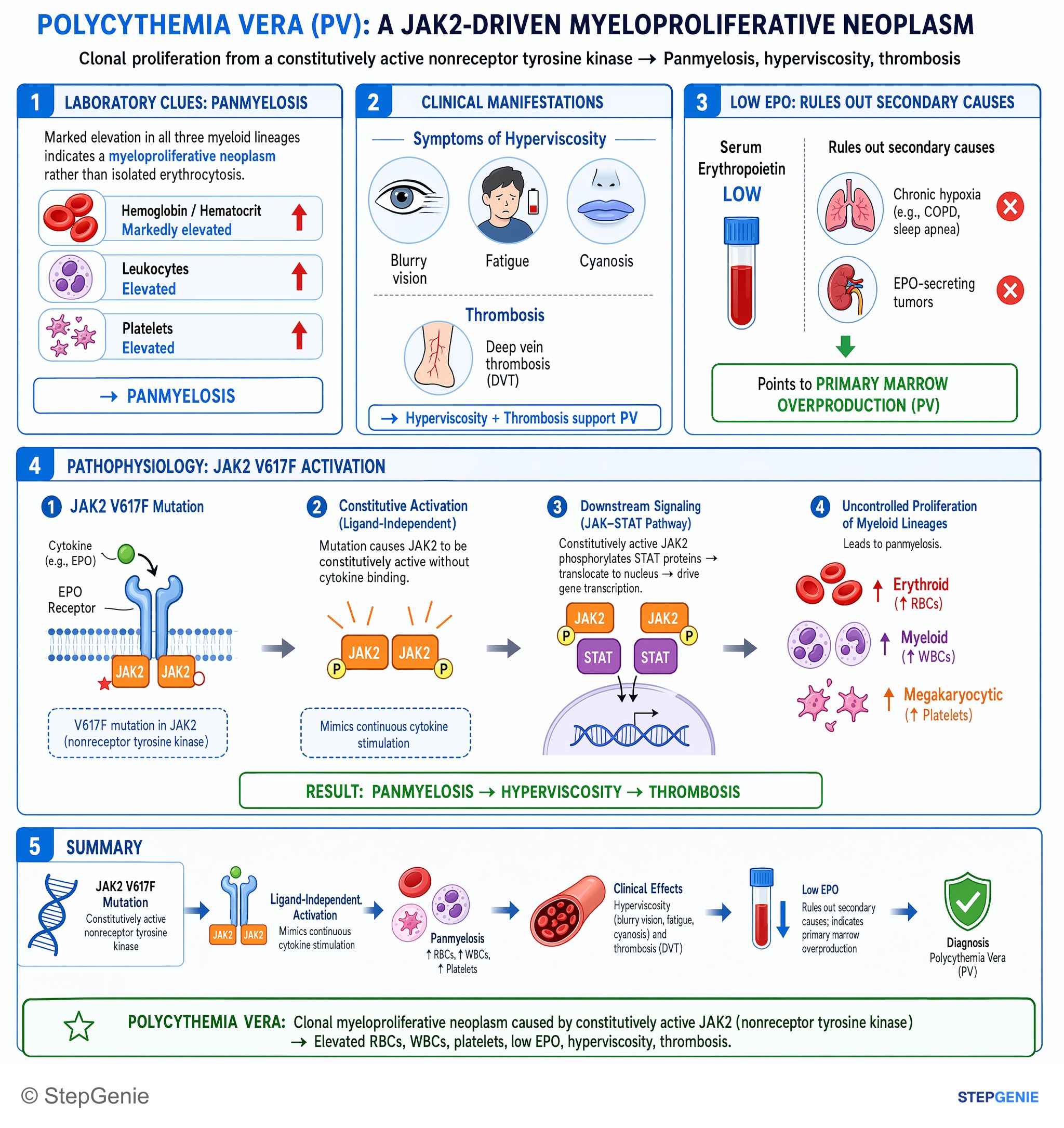
Polycythemia vera: clonal myeloproliferative neoplasm from constitutively active JAK2 nonreceptor tyrosine kinase → elevated RBCs, WBCs…
USMLE Step 1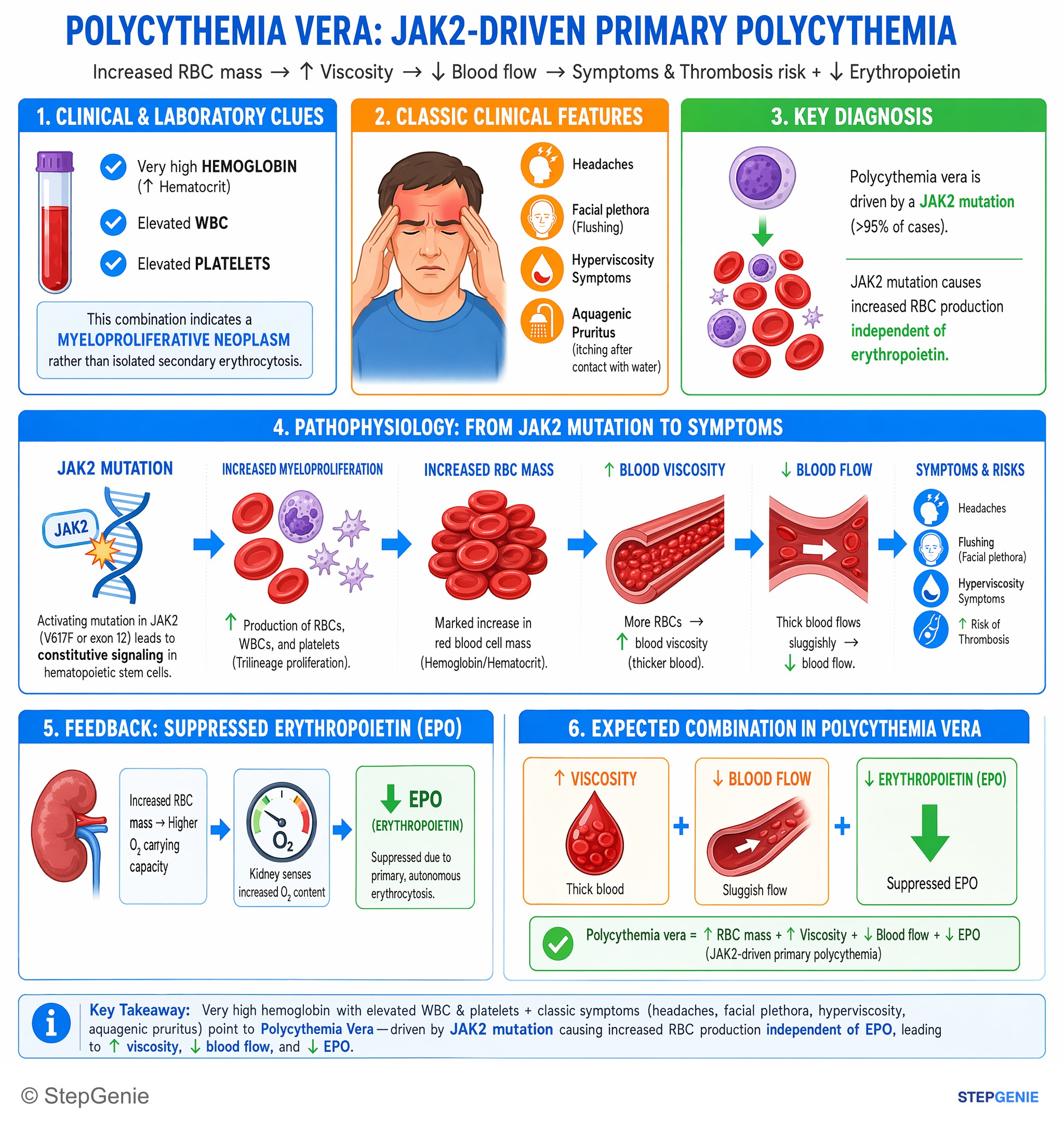
Polycythemia vera causes increased RBC mass, hyperviscosity with sluggish blood flow, and suppressed erythropoietin due to JAK2-driven…
USMLE Step 1Frequently Asked Questions
How do you tell polycythemia vera from secondary polycythemia on labs?
The key distinction is the EPO level. Polycythemia vera shows high hemoglobin or hematocrit with low EPO because autonomous RBC production suppresses erythropoietin through negative feedback. Secondary polycythemia has high EPO instead, and oxygen saturation helps narrow the cause: it is low in chronic hypoxia states like COPD, OSA, or high altitude, but normal in EPO-secreting tumors.
Why does polycythemia vera cause itching after a hot shower?
Polycythemia vera classically causes aquagenic pruritus, which means itching after a warm shower or bath. This is one of the high-yield presentation clues that points toward PV along with ruddy complexion, headaches, and thrombosis. The symptom appears as part of the classic clinical picture of excessive blood cell production and is a strong exam clue when paired with JAK2 positivity and low EPO.
Why is EPO low in polycythemia vera?
EPO is low in polycythemia vera because RBC production is autonomous and driven by a JAK2-mutated myeloproliferative neoplasm. The increased RBC mass raises oxygen-carrying capacity, which suppresses erythropoietin through negative feedback. That is why the classic PV pattern is JAK2 positivity, high hemoglobin or hematocrit, and low EPO rather than a hypoxia-driven increase in EPO.
What is the first-line treatment for polycythemia vera?
First-line treatment for polycythemia vera is phlebotomy. The treatment goal is to reduce thrombosis risk by lowering hematocrit and decreasing platelet activation. Low-dose aspirin is also used unless contraindicated to reduce thrombotic symptoms and risk. For high-risk patients, such as older age or prior thrombosis, hydroxyurea may be added for cytoreduction.
What are the classic Step-style clues that point to polycythemia vera?
Classic clues for polycythemia vera are aquagenic pruritus, a ruddy plethoric complexion, headaches, dizziness, visual disturbances, splenomegaly, and thrombosis. The diagnosis is strengthened by labs showing high hemoglobin or hematocrit, low EPO, and a positive JAK2 mutation. Normal oxygen saturation also supports PV because the erythrocytosis is not being driven by hypoxia.