Autoimmune hemolytic anemia (AIHA) is hemolysis caused by autoantibodies against the patient's own red cells, and a positive direct antiglobulin test (DAT, direct Coombs) is what proves it is immune. Warm AIHA, the most common form, is driven by IgG that binds at body temperature: coated cells are cleared mainly in the spleen, the smear shows spherocytes, the DAT shows IgG (with or without C3), and glucocorticoids are first-line. Cold agglutinin disease is driven by clonal IgM that binds below 37°C and fixes complement: the DAT shows C3 only, red cells clump on the smear, cold brings acrocyanosis, and steroids do not work. In August 2026 the FDA approved the FcRn blocker nipocalimab for warm AIHA; sutimlimab, an anti-C1s antibody, treats hemolysis in cold agglutinin disease.
Warm vs cold AIHA at a glance
| Warm AIHA | Cold agglutinin disease (CAD) | Paroxysmal cold hemoglobinuria (PCH) | |
|---|---|---|---|
| Antibody | IgG, usually a polyclonal panagglutinin against common red cell antigens | Clonal IgM, usually anti-I | IgG (Donath-Landsteiner antibody) against the P antigen |
| Reacts at | 37°C and above | Below 37°C | Binds in the cold, lyses on rewarming |
| DAT | IgG alone, or IgG + C3 (common in SLE) | C3 only | C3 only |
| Where cells die | Mainly the spleen (extravascular) | Liver and spleen; intravascular when complement is amplified (e.g., infection) | Intravascular: hemoglobinuria |
| Smear and clues | Microspherocytes, high reticulocytes, mild splenomegaly | Clumping; acrocyanosis and Raynaud phenomenon in the cold | Back and leg pain, dark brown urine after cold exposure |
| Typical setting | Idiopathic, SLE, CLL, lymphoma, drugs; slightly more common in females | Older adult with a clonal B-cell disorder (chronic); after Mycoplasma or mononucleosis (acute) | Child after a viral illness; congenital or acquired syphilis |
| Treatment | Glucocorticoids first; rituximab next; nipocalimab, splenectomy | Avoid cold; rituximab (± bendamustine); sutimlimab | Avoid cold; often self-limited in children |
| Doesn't help | — | Glucocorticoids, splenectomy | Splenectomy |
Mechanism: a type II hypersensitivity
Coombs-positive hemolytic anemias are type II (antibody-dependent cytotoxic) hypersensitivity: antibody binds an antigen on the cell surface and marks the cell for destruction. Compare the other antibody-mediated patterns in the type II hypersensitivity breakdown.
- Warm (IgG): IgG coats red cells at body temperature. Macrophages, chiefly in the spleen, remove small pieces of membrane again and again, so the cells become spherocytes, and the spleen destroys them. Hemolysis is extravascular, not direct lysis.
- Cold (IgM): IgM binds red cells in cooler parts of the body, agglutinates them (acrocyanosis, Raynaud phenomenon) and activates complement. Cells coated with C3 are cleared by phagocytes in the liver and spleen; an infection that amplifies complement can tip this into intravascular hemolysis. The antibody's thermal amplitude (how warm it still binds) matters more than its titer.
- PCH (biphasic IgG): the Donath-Landsteiner antibody binds the P antigen in the cold, and complement lyses the cells on rewarming, so hemolysis is intravascular with hemoglobinuria. Exposure can be local, such as drinking cold water.
Drug-induced immune hemolysis (Merck's three patterns)
| Pattern | Mechanism | Examples |
|---|---|---|
| Autoantibody (methyldopa type) | The drug induces true autoantibodies against Rh antigens | Methyldopa, levodopa, some cephalosporins |
| Stable hapten | The drug binds firmly to red cells; antibody targets the drug–membrane complex | High-dose penicillin, cephalosporins |
| Unstable hapten | The drug associates with red cells only transiently | Quinidine, sulfonamides |
Stopping the drug slows hemolysis; with the methyldopa type, hemolysis usually stops within 3 weeks.
Diagnosis: prove hemolysis, prove it's immune, then type it
- Hemolysis labs: anemia with high reticulocytes, high LDH, high indirect (unconjugated) bilirubin and low haptoglobin. Hemoglobinuria and hemosiderinuria point to intravascular hemolysis.
- DAT: detects IgG or complement (C3) already on the patient's red cells. The indirect antiglobulin test mixes the patient's serum with normal red cells to look for free antibody.
- Smear and temperature clues: spherocytes with few or no schistocytes suggest warm AIHA; clumping suggests CAD. A cold agglutinin titer of 1:64 or more at 4°C is typically part of the CAD diagnosis; the Donath-Landsteiner test is specific for PCH.
- Find the cause: look for SLE, CLL or lymphoma, an offending drug, a recent Mycoplasma pneumonia or infectious mononucleosis, or a clonal B-cell population in CAD.
| DAT result | Interpretation |
|---|---|
| IgG positive, C3 negative | Warm AIHA: idiopathic or drug-induced (methyldopa type) |
| IgG positive, C3 positive | Warm AIHA, common in SLE |
| IgG negative, C3 positive | Cold agglutinin disease or PCH |
| Negative | Look for a non-immune cause, such as hereditary spherocytosis or PNH |
Lab artifact trap: in CAD, red cells clump in an unwarmed sample, so automated counters report a falsely high MCV; warming the tube and recounting brings the values much closer to normal.
Treatment
Warm AIHA
- Glucocorticoids first (for example, prednisone 1 mg/kg/day): roughly two-thirds to 80% respond, but relapse and steroid dependence are common.
- Rituximab (anti-CD20) is the usual second-line drug. AIHA is not among its FDA-labeled indications, so this is off-label use; the label carries boxed warnings including hepatitis B reactivation and PML.
- Nipocalimab (Imaavy): FDA-approved in August 2026 for wAIHA in patients 12 years and older who are currently or were previously treated with corticosteroids. This IgG1 antibody binds the neonatal Fc receptor (FcRn) and lowers circulating IgG, including the IgG autoantibodies. In the pivotal trial described in its label, about 24% of patients on nipocalimab vs 8% on placebo had a durable hemoglobin response. AABB's news report called it the first therapy approved specifically for wAIHA. It is also approved for generalized myasthenia gravis; the label warns of infections, hypersensitivity and infusion-related reactions.
- Splenectomy gives a sustained response in about one-third to one-half; other immunosuppressants (cyclophosphamide, mycophenolate, azathioprine, cyclosporine, sirolimus) are options for refractory disease.
- Transfusion is the most important treatment for rapidly developing, life-threatening anemia and should not be withheld for lack of "compatible" units.
- Drug-induced: stop the drug.
- Venous thromboembolism is common in warm AIHA.
Cold agglutinin disease and PCH
- Avoid cold: for mild CAD this may be all that is needed; transfuse blood and fluids through an in-line warmer.
- Rituximab, sometimes with bendamustine, targets the clonal B cells.
- Sutimlimab (Enjaymo) binds C1s and blocks the classical complement pathway, preventing complement deposition on red cells. It is FDA-approved for hemolysis in adults with CAD, raised hemoglobin and cut transfusions in about half of patients, and does not relieve Raynaud phenomenon or acrocyanosis. Patients are vaccinated against encapsulated bacteria, including pneumococcus and meningococcus (serogroups A, C, W, Y and B), at least 2 weeks before the first dose, or as soon as possible if treatment is urgent.
- Glucocorticoids have limited effectiveness and should not be used, and splenectomy is usually of no value; C3-coated cells are cleared in the liver as well as the spleen.
- PCH: strict cold avoidance; in children it often resolves on its own; treating syphilis, when present, may cure it.
How USMLE tests it
- Spherocytes + positive DAT = warm AIHA; spherocytes + negative DAT (high MCHC, family history, increased osmotic fragility) = hereditary spherocytosis.
- Older adult with lymphocytosis and spherocytic anemia: warm AIHA secondary to CLL.
- Atypical pneumonia, then anemia and blue fingertips in the cold: CAD with anti-I antibodies after Mycoplasma pneumoniae; infectious mononucleosis gives anti-i.
- Child with dark urine after cold exposure following a viral illness: PCH.
- Methyldopa causes a true warm autoantibody; high-dose penicillin acts as a hapten.
- DAT-negative intravascular hemolysis with thrombosis at odd sites and cytopenias: PNH, complement attack after loss of CD55 and CD59, diagnosed by flow cytometry.
- Hemolysis after fava beans, infection or an oxidant drug, with bite cells and Heinz bodies: G6PD deficiency.
Practice question
A 71-year-old woman has 6 months of fatigue. In cold weather her fingertips and ears turn blue and painful, then recover when warmed. She has had no recent illness and takes no medications. Hemoglobin is 9.0 g/dL, automated MCV 118 fL and reticulocytes 6%; LDH and indirect bilirubin are raised and haptoglobin is undetectable. The smear shows clumps of red cells. The direct antiglobulin test is positive for C3 and negative for IgG. Which of the following best explains her anemia?
A. IgG autoantibody that binds red cells at body temperature, with splenic clearance of coated cells B. Clonal IgM autoantibody against the I antigen that fixes complement C. IgG antibody against the P antigen that lyses cells after rewarming D. Defective spectrin or ankyrin in the red cell membrane E. Loss of the GPI-anchored complement regulators CD55 and CD59 F. Oxidant injury in glucose-6-phosphate dehydrogenase deficiency
Answer: B. Chronic hemolysis in an older adult with cold-induced acrocyanosis, red cell clumping, a falsely high MCV and a C3-only DAT is cold agglutinin disease, usually a clonal IgM anti-I from a low-grade B-cell disorder. Management is cold avoidance and warmed transfusions, then rituximab (with or without bendamustine) or sutimlimab for significant hemolysis; glucocorticoids and splenectomy don't help.
- A: warm AIHA gives an IgG-positive DAT and spherocytes, without cold symptoms.
- C: PCH also has a C3-only DAT, but it is an acute intravascular hemolysis with dark urine, usually in a child after a viral illness, confirmed by the Donath-Landsteiner test.
- D: hereditary spherocytosis is DAT-negative, with spherocytes rather than clumps.
- E: PNH is DAT-negative complement hemolysis, diagnosed by flow cytometry.
- F: G6PD deficiency causes episodic, DAT-negative hemolysis after an oxidant trigger, with bite cells and Heinz bodies.
Key takeaways
- AIHA = autoantibody hemolysis, proven by a positive DAT; it is a type II hypersensitivity.
- Warm: IgG at 37°C, spleen, spherocytes, DAT IgG ± C3; idiopathic, SLE, CLL, lymphoma, drugs; glucocorticoids first, then rituximab, nipocalimab (FDA 2026) or splenectomy.
- Cold agglutinin disease: clonal IgM (anti-I) below 37°C, complement, DAT C3 only, clumping and a falsely high MCV, acrocyanosis; avoid cold, rituximab or sutimlimab; steroids and splenectomy don't work.
- PCH: biphasic IgG anti-P (Donath-Landsteiner) in children after viral illness; intravascular hemolysis and hemoglobinuria.
- Drug patterns: methyldopa type (true autoantibody), hapten type (high-dose penicillin, cephalosporins); stop the drug.
- Spherocytes with a negative DAT = hereditary spherocytosis; DAT-negative complement hemolysis = PNH.
Sources
- Autoimmune Hemolytic Anemia — Merck Manual Professional Edition (2026)
- Overview of Hemolytic Anemia — Merck Manual Professional Edition (2026)
- Hereditary Spherocytosis and Hereditary Elliptocytosis — Merck Manual Professional Edition (2026)
- Paroxysmal Nocturnal Hemoglobinuria (PNH) — Merck Manual Professional Edition (2026)
- Glucose-6-Phosphate Dehydrogenase (G6PD) Deficiency — Merck Manual Professional Edition (2026)
- Overview of Allergic and Atopic Disorders — Merck Manual Professional Edition (2026)
- Hemolytic Anemia: Evaluation and Differential Diagnosis — American Family Physician (2018)
- IMAAVY (nipocalimab-aahu): Prescribing Information — DailyMed (2026)
- Drugs@FDA: IMAAVY (BLA 761430) Approval History — U.S. Food and Drug Administration (2026)
- FDA Approves First Treatment for Warm Autoimmune Hemolytic Anemia — AABB (2026)
- ENJAYMO (sutimlimab-jome): Prescribing Information — DailyMed (2024)
- RITUXAN (rituximab): Prescribing Information — DailyMed
Visual explanations from the StepGenie QBank
Infographics StepGenie drew to explain questions in its own QBank, matched to this article's topic. Each caption is the takeaway of the question it explains.
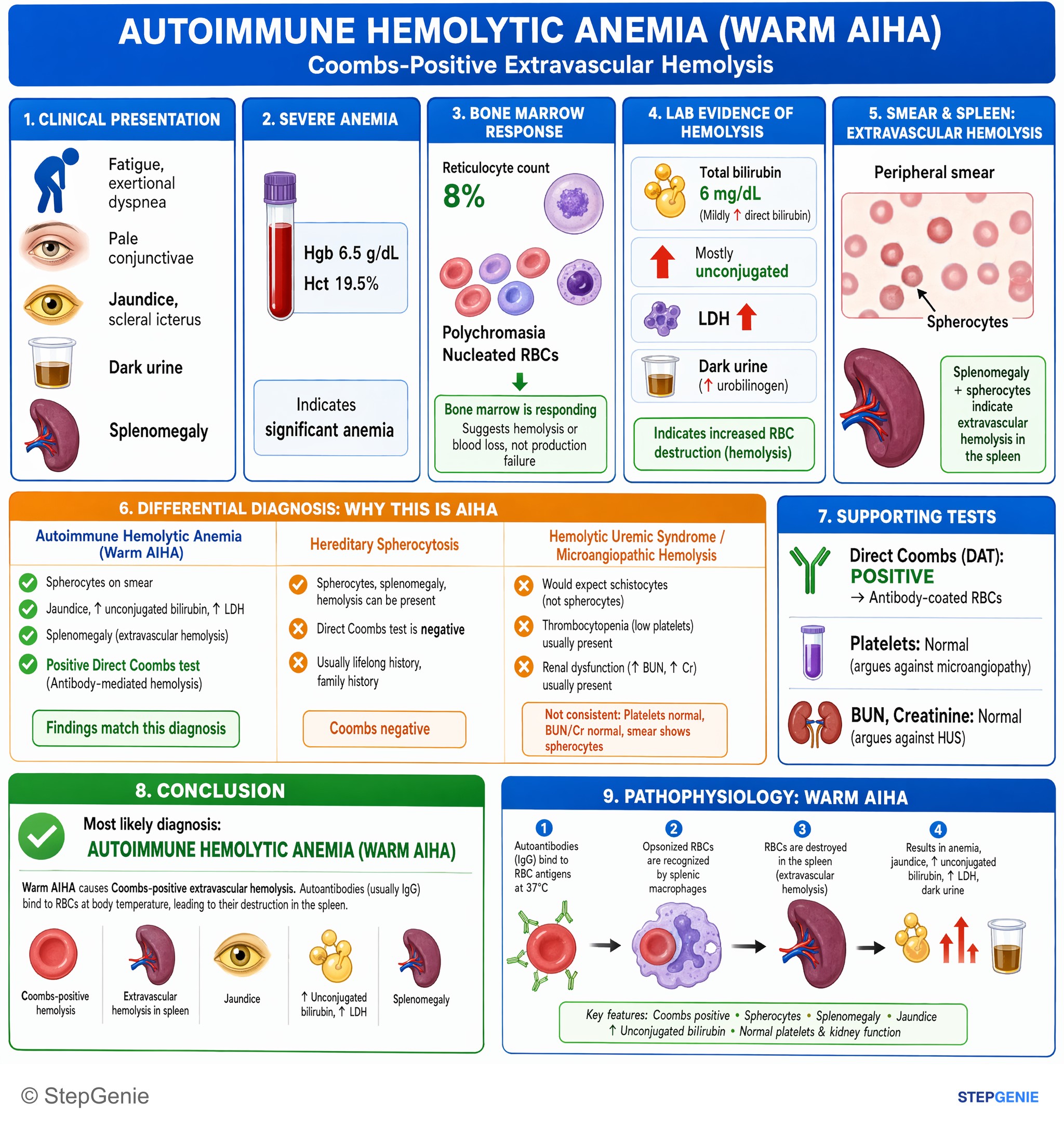
Warm autoimmune hemolytic anemia causes Coombs-positive extravascular hemolysis with spherocytes, splenomegaly, jaundice, and elevated…
USMLE Step 2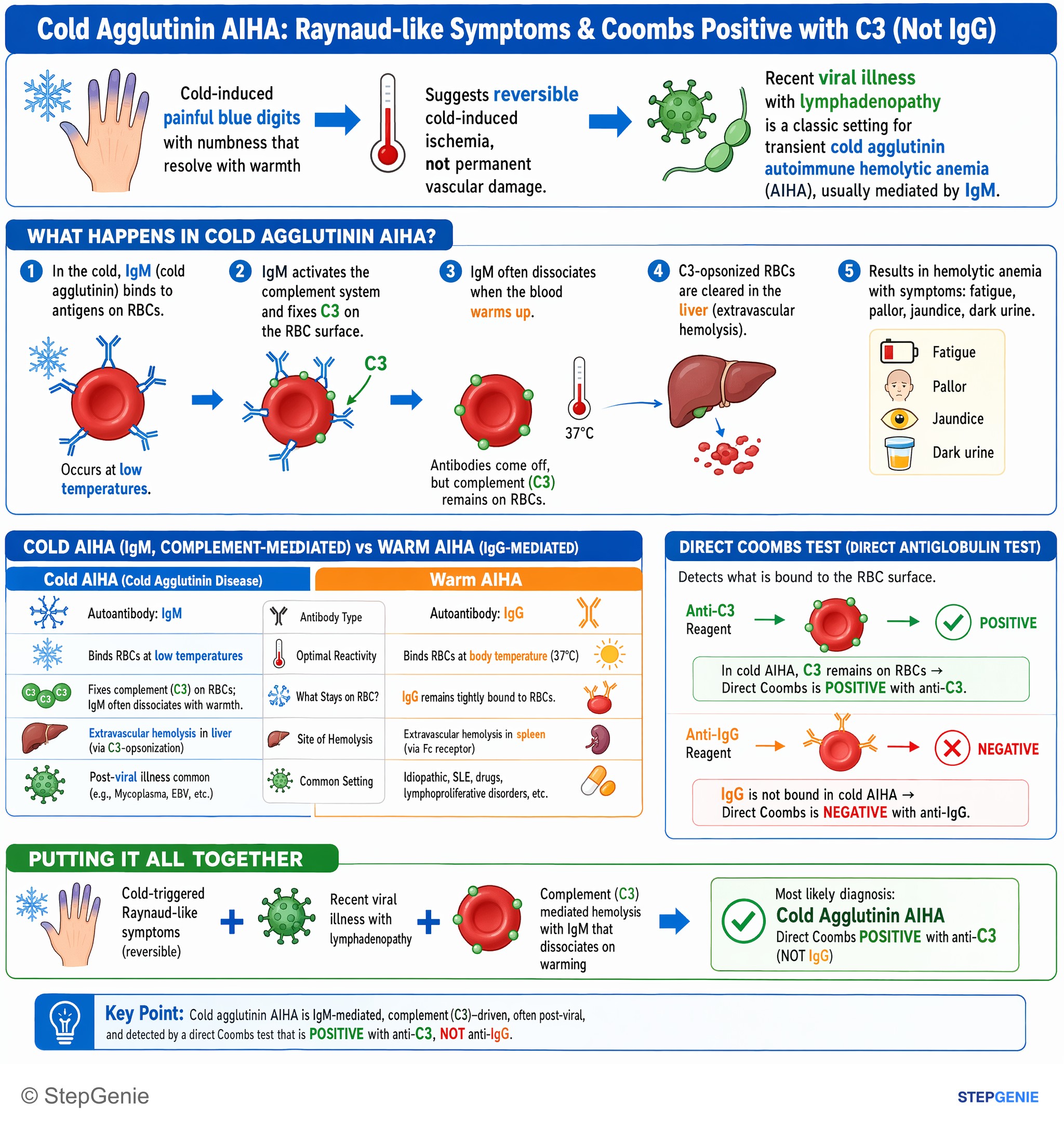
Cold agglutinin autoimmune hemolytic anemia from recent viral infection causes Raynaud-like acral symptoms; Coombs positive with C3 (not…
USMLE Step 1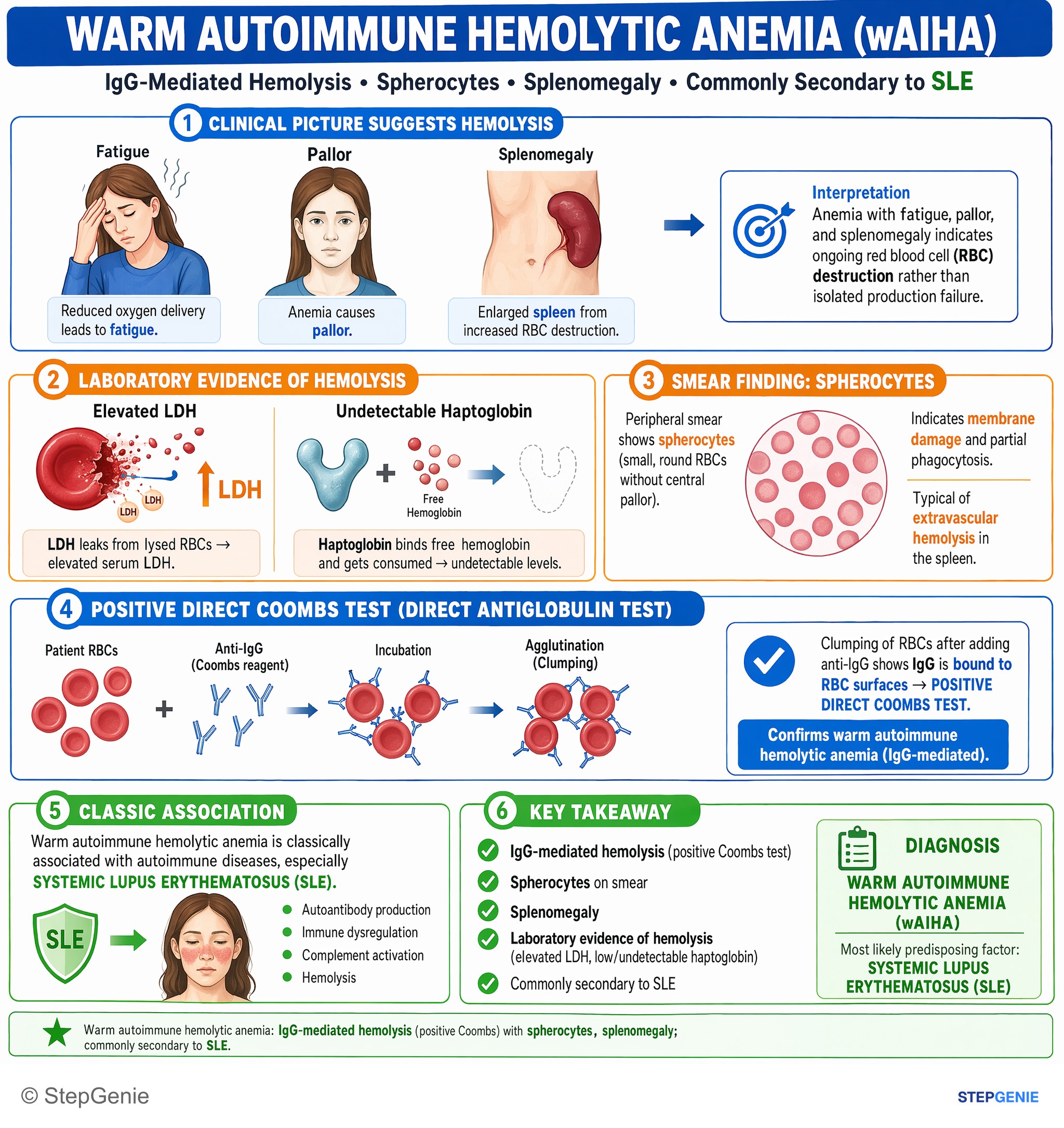
Warm autoimmune hemolytic anemia: IgG-mediated hemolysis (positive Coombs) with spherocytes, splenomegaly; commonly secondary to SLE.
USMLE Step 1Frequently Asked Questions
What is the difference between warm and cold autoimmune hemolytic anemia?
Warm AIHA is caused by IgG autoantibodies that bind red cells at body temperature; the coated cells are removed mainly in the spleen, the smear shows spherocytes and the direct antiglobulin test detects IgG, sometimes with C3. Cold agglutinin disease is caused by clonal IgM that binds below 37°C and fixes complement, so the test detects C3 only, red cells clump, and symptoms such as acrocyanosis worsen in the cold.
What does the direct Coombs test show in autoimmune hemolytic anemia?
The direct antiglobulin (Coombs) test detects IgG or complement C3 already bound to the patient's red cells, which shows the hemolysis is immune. IgG alone suggests idiopathic or drug-induced warm AIHA; IgG plus C3 is common in warm AIHA with lupus; C3 alone suggests cold agglutinin disease or paroxysmal cold hemoglobinuria. A negative test points to a non-immune cause such as hereditary spherocytosis or PNH.
What is the first-line treatment for warm autoimmune hemolytic anemia?
Glucocorticoids, such as prednisone 1 mg/kg per day, are first-line; roughly two-thirds to 80 percent of patients respond, though relapse and steroid dependence are common. Rituximab is the usual second-line drug, an off-label use. In August 2026 the FDA approved nipocalimab (Imaavy), an FcRn blocker that lowers IgG, for patients 12 and older currently or previously treated with corticosteroids. Splenectomy and other immunosuppressants are further options.
How is cold agglutinin disease treated?
The first step is avoiding cold, and any blood or fluids are given through an in-line warmer. Rituximab, sometimes with bendamustine, targets the clonal B cells that make the IgM. Sutimlimab (Enjaymo), which blocks C1s in the classical complement pathway, is FDA-approved for hemolysis in adults with cold agglutinin disease, but it does not relieve Raynaud phenomenon or acrocyanosis. Glucocorticoids and splenectomy usually do not help.
Which infections and drugs cause autoimmune hemolytic anemia?
Mycoplasma pneumoniae can trigger cold agglutinins against the I antigen, and infectious mononucleosis can trigger anti-i antibodies. Paroxysmal cold hemoglobinuria usually follows a viral illness in children, and some cases occur with congenital or acquired syphilis. Drug causes include methyldopa and levodopa, which induce true autoantibodies against Rh antigens, and high-dose penicillin or cephalosporins, which act as haptens on the red cell. Stopping the drug slows the hemolysis.
How do you tell warm AIHA from hereditary spherocytosis?
Both show spherocytes and extravascular hemolysis, but warm AIHA has a positive direct antiglobulin test and hereditary spherocytosis has a negative one. Hereditary spherocytosis is usually autosomal dominant, caused by defects in spectrin, ankyrin, band 3 or protein 4.2, with a high MCHC and increased osmotic fragility; splenectomy is reserved for symptomatic or complicated cases. Warm AIHA often has an associated disease, such as lupus or CLL, or a causative drug.