Reactive arthritis is a sterile, inflammatory spondyloarthropathy triggered by an infection elsewhere in the body, usually genitourinary (Chlamydia trachomatis) or enteric (Shigella, Salmonella, Yersinia, Campylobacter, Clostridioides difficile). It typically begins 1 to 6 weeks after the infection as an asymmetric oligoarthritis of the knees, ankles and toes, often with enthesitis, dactylitis, conjunctivitis and urethritis, and it is strongly associated with HLA-B27. The classic triad ("can't see, can't pee, can't climb a tree") is often incomplete. Diagnosis is clinical, with arthrocentesis to exclude septic arthritis; treatment starts with NSAIDs, adds intra-articular corticosteroids for persistent joints, treats any active chlamydial infection, and uses DMARDs (sulfasalazine, methotrexate) for chronic disease.
Triggers and timing
| Form | Organisms | Who | Timing |
|---|---|---|---|
| Sexually acquired | Chlamydia trachomatis | Mainly men aged 20-40 | Urethritis 7-14 days after sexual contact; fever, conjunctivitis and arthritis over the next few weeks |
| Enteric (dysenteric) | Shigella, Salmonella, Yersinia, Campylobacter, C. difficile | Men and women equally (NIAMS) | Symptoms typically 1-6 weeks after the infection (NIAMS) |
| No trigger found | About 40% of cases have no identifiable pathogen (Merck) | — | — |
Timing varies by source: NIAMS says symptoms typically start 1 to 6 weeks after an infection, ACR says arthritis may appear several weeks later, and Merck describes urethritis 7 to 14 days after sexual contact with fever, conjunctivitis and arthritis over the next few weeks. A stem that puts the diarrhea or dysuria days to a few weeks before the joint symptoms fits. Because no pathogen is found in many cases, ask directly about diarrhea, dysuria and new sexual partners. Revisit the organisms in the Chlamydia trachomatis flowchart.
Why the joint is inflamed but sterile
- Post-infectious, not infected: microbial antigens can sometimes be detected in the synovium by PCR, but organisms cannot be cultured from joint fluid (Merck). The bacteria set off an immune response; they do not live in the joint.
- HLA-B27: present in up to about 80% of patients (Merck). HLA-B27-positive patients have more severe arthritis, more extra-articular disease, more chronic axial involvement and more prolonged courses. See the HLA associations breakdown.
- Seronegative: rheumatoid factor is usually negative, as in all spondyloarthropathies.
- HIV: consider HIV infection in severe reactive arthritis (Merck).
- Name: formerly called Reiter syndrome; "reactive arthritis" is the current term.
Clinical features
Joints and entheses ("can't climb a tree")
- Asymmetric oligoarthritis, mainly of the toes and large joints of the lower extremities; knee effusions can be large.
- Enthesitis is common and characteristic: Achilles tendinitis, plantar fasciitis, digital periostitis. Heel pain in a young adult is a strong clue.
- Dactylitis: sausage-shaped fingers or toes.
- Back pain with severe disease; chronic axial involvement (sacroiliitis, bulky syndesmophytes) is more common in HLA-B27-positive patients. ACR describes low back pain that is worse at night or in the morning.
- Constitutional symptoms: low-grade fever, fatigue, weight loss.
Eyes and genitourinary tract ("can't see, can't pee")
- Conjunctivitis is the most common eye lesion (mild redness). Anterior uveitis (a painful red eye with photophobia) and keratitis are less common but threaten vision and need prompt ophthalmology care.
- Noninfectious urethritis or cervicitis: in men it is less painful, with less purulent discharge, than gonococcal urethritis and may come with prostatitis or hemorrhagic cystitis; in women it may be mild or asymptomatic.
Skin and mucosa
- Keratoderma blennorrhagicum: vesicles on the palms and soles and around the nails that become hyperkeratotic and crusted; they can look identical to pustular psoriasis.
- Circinate balanitis: small, transient, relatively painless superficial ulcers on the glans penis; similar lesions occur on the oral mucosa and tongue.
- Nail dystrophy.
Heart (rare)
- Aortitis, aortic insufficiency and cardiac conduction defects.
The triad caveat
The triad of arthritis, conjunctivitis and urethritis is a memory aid, not a requirement. NIAMS notes that not everyone has all three and that they may not occur at the same time, and Merck says incomplete forms must be considered. A young adult with post-diarrheal knee swelling and Achilles pain fits the diagnosis even with normal eyes and no urethritis.
Diagnosis
- Clinical diagnosis (Merck): typical peripheral arthritis plus symptoms of a recent GU or GI infection, or one other extra-articular feature. Because features appear in sequence, a definitive diagnosis can take months.
- Arthrocentesis for any acute monoarticular effusion (Merck): synovial fluid analysis is the most accurate way to exclude infection and diagnose crystal disease. Reactive arthritis gives inflammatory fluid with no crystals and a negative Gram stain and culture.
- Find the trigger: NAAT for chlamydia (first-void urine in men; vaginal or cervical swab or first-void urine in women), plus testing for gonorrhea, HIV and other STIs.
- HLA-B27 testing can support the diagnosis, but a negative result does not exclude it.
- Rule out disseminated gonococcal infection (DGI): DGI tends to involve the upper and lower limbs equally, is more migratory, does not cause back pain, and its skin vesicles tend not to become hyperkeratotic (Merck).
- Psoriatic arthritis can mimic reactive arthritis with similar skin lesions, uveitis and asymmetric arthritis.
| Feature | Reactive arthritis | DGI | Septic arthritis (nongonococcal) |
|---|---|---|---|
| Joint fluid | Inflammatory, culture negative | Gram stain often negative; NAAT of mucosal sites is key | Usually >50,000 WBC/µL; Gram stain and culture often positive |
| Pattern | Asymmetric, lower-limb oligoarthritis; enthesitis, dactylitis | Migratory polyarthralgia, tenosynovitis, pustules; upper and lower limbs | One hot joint, often the knee |
| Skin | Keratoderma blennorrhagicum (hyperkeratotic), circinate balanitis | Small pustules, papules or hemorrhagic vesicles on the limbs | None |
| Treatment | NSAIDs | Ceftriaxone (CDC: at least 7 days) | IV antibiotics plus drainage |
The full septic workup is in the septic arthritis guide.
Treatment
- NSAIDs first for arthritis and enthesitis (Merck's example: indomethacin 25-50 mg orally 3 times a day).
- Depot corticosteroid injections for persistent oligoarthritis or enthesitis, once infection is excluded.
- Treat an active chlamydial infection and the partners: CDC recommends doxycycline 100 mg twice daily for 7 days (alternatives: azithromycin 1 g once, levofloxacin for 7 days). Prolonged doxycycline (up to 3 months) for chlamydia-induced reactive arthritis may speed recovery, but Merck calls this controversial.
- Chronic or severe disease: sulfasalazine, methotrexate for severe disease, and TNF inhibitors (e.g., etanercept, adalimumab) when NSAIDs and DMARDs fail.
- Anterior uveitis: topical corticosteroid and mydriatic drops, with ophthalmology follow-up.
- Physical therapy to maintain mobility.
Prognosis. It often resolves in 3 to 4 months, but up to 50% have recurrent or prolonged symptoms over several years, especially after chlamydial infection and in HLA-B27-positive patients (Merck). Some develop joint or spinal deformity.
Seronegative spondyloarthropathies (PAIR)
PAIR = Psoriatic arthritis, Ankylosing spondylitis, IBD-associated (enteropathic) arthritis, Reactive arthritis. They share HLA-B27, inflammatory back pain, enthesitis, uveitis and a negative rheumatoid factor (Merck also lists undifferentiated and juvenile-onset forms).
| Feature | Ankylosing spondylitis | Psoriatic arthritis | IBD-associated arthritis | Reactive arthritis |
|---|---|---|---|---|
| Who | Men about 3 times more than women; onset usually 20-40 | About 20% of people with psoriasis | Crohn disease or ulcerative colitis | Young adults after a GU or GI infection |
| Spine | Inflammatory back pain (morning stiffness relieved by activity), sacroiliitis, bamboo spine | Axial disease in a subset, linked to HLA-B27 | Spondylitis and sacroiliitis independent of bowel activity | Back pain if severe; chronic axial disease mostly in HLA-B27-positive patients |
| Peripheral joints | Achilles and patellar enthesitis | DIP joints, dactylitis, arthritis mutilans | Large joints, migratory, transient; parallels bowel flares | Asymmetric lower-limb oligoarthritis, toes, dactylitis |
| Extra-articular | Recurrent anterior uveitis, aortic insufficiency, reduced chest expansion | Nail pitting, onycholysis; pencil-in-cup on x-ray | Erythema nodosum, episcleritis, uveitis | Conjunctivitis, urethritis, keratoderma blennorrhagicum, circinate balanitis |
| HLA-B27 | About 90% of White patients | Raises risk, mainly of axial disease | Ankylosing spondylitis in IBD is more common with HLA-B27 | Up to about 80% |
Go deeper with the ankylosing spondylitis memory palace and the psoriatic arthritis guide.
How USMLE tests it
- Diarrhea or dysuria a few weeks ago, now a swollen knee or ankle, heel pain and red eyes: reactive arthritis; the association is HLA-B27.
- Hyperkeratotic, crusted lesions on the soles in a young man with arthritis: keratoderma blennorrhagicum, not plantar warts or tinea.
- Sausage digit: reactive or psoriatic arthritis, not rheumatoid arthritis.
- Tenosynovitis plus pustules plus migratory polyarthralgia: DGI, which needs ceftriaxone, not NSAIDs alone.
- Next best step for a hot, swollen joint: arthrocentesis, even when reactive arthritis seems likely.
- Most appropriate initial treatment: an NSAID; antibiotics only for a current chlamydial infection.
Practice question
A 24-year-old man has had painful swelling of the right knee and left ankle for 5 days. Three weeks ago he had a few days of bloody diarrhea after eating undercooked chicken at a barbecue; it resolved without treatment. Temperature is 37.9°C (100.2°F). Both eyes are red without discharge. There is a right knee effusion, tenderness at the left Achilles tendon insertion, and diffuse swelling of the left second toe. Arthrocentesis of the knee shows cloudy fluid with a WBC count of 18,000/µL, no crystals and a negative Gram stain; culture is later negative.
Which best explains this patient's joint findings?
- A. Bacterial invasion of the synovium during bacteremia
- B. Deposition of monosodium urate crystals
- C. Sterile, immune-mediated inflammation triggered by a distant infection in a genetically susceptible host
- D. Antibodies to group A streptococcal antigens that cross-react with host tissue
- E. Hematogenous gonococcal seeding of joints and tendon sheaths
Answer: C, reactive arthritis after an enteric infection (likely Campylobacter). The timing (3 weeks after dysentery), asymmetric lower-limb oligoarthritis, Achilles enthesitis, dactylitis and conjunctivitis are classic, and the inflammatory but culture-negative fluid fits a sterile, post-infectious process. The strongest genetic association is HLA-B27; treat with an NSAID.
- A: septic arthritis produces a positive Gram stain or culture in most cases and is usually a single, very hot joint; a negative culture and multiple joints with enthesitis argue against it.
- B: gout shows needle-shaped, negatively birefringent crystals and classically affects the first MTP; there are no crystals here.
- D: acute rheumatic fever follows streptococcal pharyngitis and causes migratory polyarthritis with carditis, chorea or erythema marginatum (see molecular mimicry); the trigger here was dysentery.
- E: DGI follows a gonococcal infection and brings tenosynovitis and pustular skin lesions; it is treated with ceftriaxone.
Key takeaways
- Reactive arthritis = sterile arthritis after a remote infection: Chlamydia (GU) or Shigella, Salmonella, Yersinia, Campylobacter, C. difficile (GI); no trigger is found in about 40%.
- Onset 1-6 weeks after infection (NIAMS), mainly in young adults; the STI form affects mostly men.
- Asymmetric lower-limb oligoarthritis + enthesitis (Achilles, plantar fascia) + dactylitis; conjunctivitis, urethritis, keratoderma blennorrhagicum, circinate balanitis.
- The triad is often incomplete; don't wait for all three.
- HLA-B27 in up to about 80%; RF negative; part of PAIR.
- Arthrocentesis excludes septic arthritis; reactive fluid is inflammatory and culture negative.
- Treatment: NSAIDs, then local corticosteroid injections; doxycycline for active chlamydia; sulfasalazine, methotrexate or TNF inhibitors for chronic disease. Up to 50% have prolonged or recurrent symptoms.
Sources
- Reactive Arthritis — Merck Manual Professional Edition (2026)
- Overview of Seronegative Spondyloarthropathies — Merck Manual Professional Edition (2026)
- Ankylosing Spondylitis — Merck Manual Professional Edition (2026)
- Psoriatic Arthritis — Merck Manual Professional Edition (2026)
- Overview of Inflammatory Bowel Disease — Merck Manual Professional Edition (2026)
- Reactive Arthritis — American College of Rheumatology (2025)
- Reactive Arthritis — National Institute of Arthritis and Musculoskeletal and Skin Diseases (NIAMS)
- Chlamydial Infections — CDC STI Treatment Guidelines (2021)
- Gonococcal Infections Among Adolescents and Adults — CDC STI Treatment Guidelines (2021)
- Evaluation of the Patient With Joint Symptoms — Merck Manual Professional Edition (2025)
- Acute Infectious Arthritis — Merck Manual Professional Edition (2024)
Visual explanations from the StepGenie QBank
Infographics StepGenie drew to explain questions in its own QBank, matched to this article's topic. Each caption is the takeaway of the question it explains.
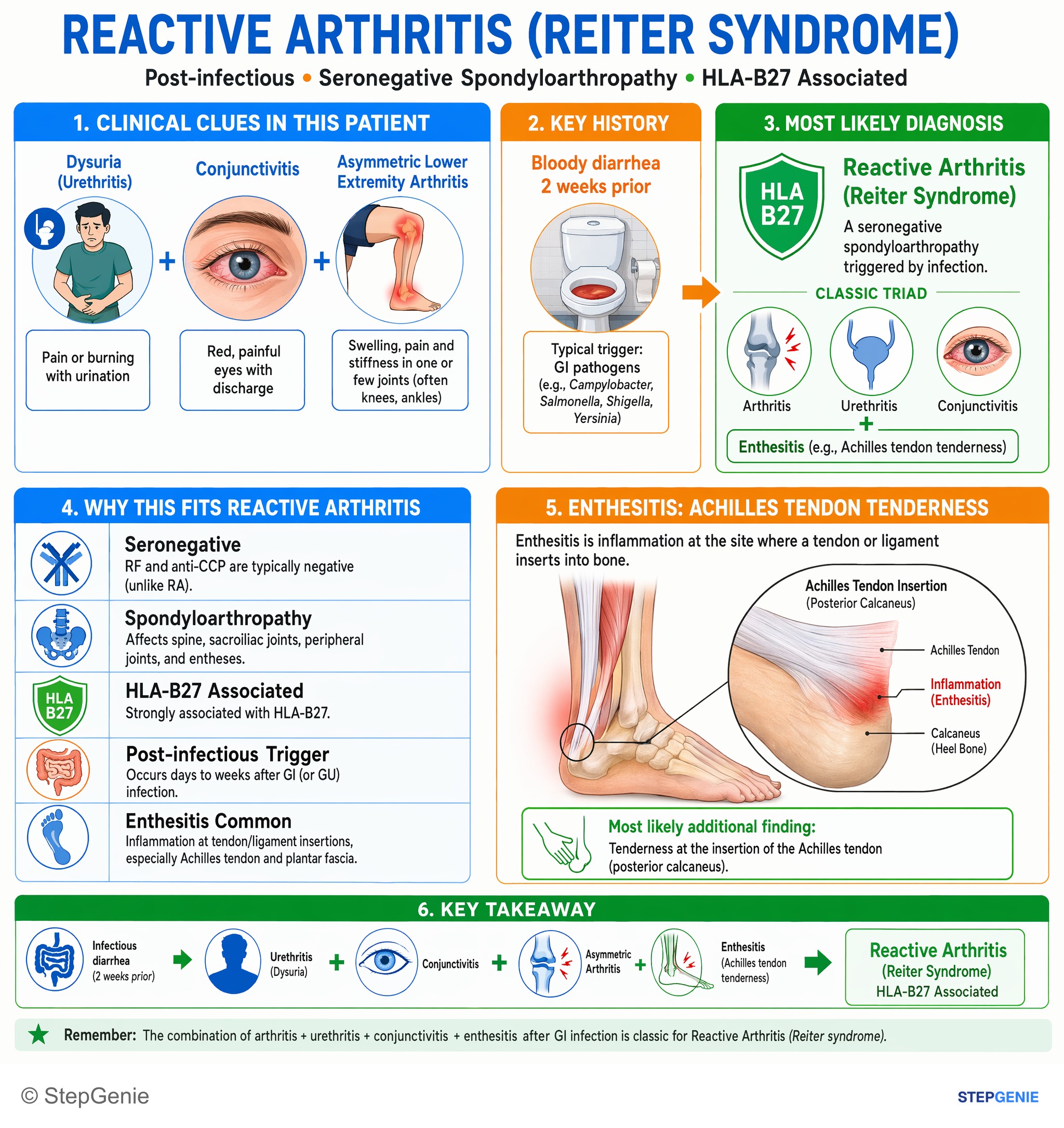
Reactive arthritis (Reiter syndrome) after infectious diarrhea: triad of arthritis, urethritis, conjunctivitis and enthesitis (Achilles…
USMLE Step 1Frequently Asked Questions
What causes reactive arthritis?
Reactive arthritis is triggered by an infection outside the joint, most often Chlamydia trachomatis in the genitourinary tract or enteric bacteria such as Shigella, Salmonella, Yersinia, Campylobacter and Clostridioides difficile. The joint itself is sterile: bacterial antigens may be detected, but organisms cannot be cultured from joint fluid. Genetic susceptibility matters, since up to about 80% of patients carry HLA-B27. Symptoms usually begin 1 to 6 weeks after the infection, and in about 40% of cases no trigger is identified.
What is the classic triad of reactive arthritis?
The classic triad is arthritis, conjunctivitis and urethritis, remembered as 'can't see, can't pee, can't climb a tree.' Not every patient has all three, and the features may appear at different times, so incomplete forms must be considered. The arthritis is usually an asymmetric oligoarthritis of the knees, ankles and toes, often with Achilles tendinitis, plantar fasciitis or sausage digits. Skin and mucosal clues include keratoderma blennorrhagicum on the palms and soles and circinate balanitis on the glans penis.
How do you tell reactive arthritis from septic arthritis?
Septic arthritis is an infected joint: usually a single hot joint with a synovial white count above 50,000 per microliter and organisms on Gram stain or culture in most cases. Reactive arthritis is sterile: the fluid is inflammatory but culture negative, several lower-limb joints are often involved, and enthesitis, dactylitis, conjunctivitis or urethritis may follow a recent genitourinary or gastrointestinal infection. Because the two can look alike, any acute hot joint needs arthrocentesis before you settle on reactive arthritis.
What is keratoderma blennorrhagicum?
Keratoderma blennorrhagicum is the characteristic skin lesion of reactive arthritis. It starts as vesicles on the palms and soles and around the nails that become hyperkeratotic and crusted, and it can look identical to pustular psoriasis. A related finding is circinate balanitis: small, transient, relatively painless superficial ulcers on the glans penis, with similar lesions on the oral mucosa and tongue. These lesions help separate reactive arthritis from disseminated gonococcal infection, whose skin vesicles tend not to become hyperkeratotic.
How is reactive arthritis treated?
NSAIDs are first-line for arthritis and enthesitis. Persistent oligoarthritis or enthesitis can be treated with local corticosteroid injections once infection is excluded. An active chlamydial infection should be treated, usually with doxycycline 100 mg twice daily for 7 days, along with sex partners; longer antibiotic courses aimed at the arthritis itself are controversial. Chronic or severe disease is treated with sulfasalazine or methotrexate, and TNF inhibitors are used when NSAIDs and DMARDs fail. Anterior uveitis needs topical corticosteroid and mydriatic drops with ophthalmology care.
How long does reactive arthritis last?
Reactive arthritis often resolves within 3 to 4 months, and NIAMS notes that symptoms may clear on their own within weeks or months. However, Merck reports that up to 50% of patients have recurrent or prolonged symptoms over several years, especially when chlamydia was the trigger or the patient carries HLA-B27. HLA-B27-positive patients also have more severe arthritis and more chronic spinal involvement, and some develop joint or spinal deformity or disability.