Ankylosing spondylitis (AS) is one of those Step classics that shows up as “young guy with back pain,” but the test writers will bury the diagnosis in small clues: morning stiffness, better with activity, and low back/buttock pain from sacroiliitis. Here’s a fast, shareable memory palace that makes those clues hard to miss—and even harder to forget.
The Memory Palace: “The Ankylosed Stone Spine Temple”
Picture walking into an ancient temple made of stone. Every room is a high-yield AS clue.
Room 1 — The HLA-B27 Gate
A giant gate labeled “B27” only opens for young men.
- Association: HLA-B27 (seronegative spondyloarthropathy)
- Demographics: often male, onset <40
- One-liner: HLA-B27 predisposes to inflammatory back pain with axial skeleton involvement.
Room 2 — The Morning Rust Hall
The floor is covered in rust that’s worst when you first wake up. As you walk around, the rust fades.
- Inflammatory back pain: worse in the morning, improves with exercise
- Not mechanical pain: mechanical pain is usually worse with use and better with rest
- One-liner: AS pain is worse with rest, better with movement.
Room 3 — The Sacroiliac (SI) Staircase
Two staircases (left and right) are cracked at the base where they meet the floor.
- Key location: Sacroiliitis → buttock pain (can alternate sides)
- Imaging classic: bilateral sacroiliitis (especially early clue)
- One-liner: Think AS when SI joints are inflamed—buttock pain + inflammatory back symptoms.
Room 4 — The Bamboo Spine Corridor
A long hallway is lined with bamboo stalks that have fused into a single rigid wall.
- Pathology: enthesitis → inflammation where ligaments/tendons insert into bone
- Progression: spinal ligament ossification → vertebral fusion
- X-ray phrase: “Bamboo spine” (syndesmophytes bridging vertebrae)
- One-liner: Chronic enthesitis can turn the spine into bamboo.
Room 5 — The Uveitis Eye Fountain
A fountain sprays painful red water into your eye, and the light hurts.
- Extra-articular association: acute anterior uveitis
- Symptoms: painful red eye, photophobia, blurred vision
- One-liner: AS isn’t just back pain—uveitis is a major clue.
Room 6 — The Aorta Arch Chamber
An archway (the aorta) has a “leaky valve” sign and an “electrical short” warning.
- Cardiac associations (Step-relevant):
- Aortitis → aortic regurgitation
- Conduction abnormalities can occur (less commonly tested)
- One-liner: AS can inflame the aorta → AR murmur in a young person.
Room 7 — The Heel Hook (Enthesitis) Corner
You step on sharp hooks at your heel and under your foot.
- Enthesitis sites:
- Achilles tendon insertion
- Plantar fascia
- One-liner: Heel pain in AS is from enthesitis, not just “overuse.”
Quick Visual: One-Panel Mnemonic Image (Describe-to-Remember)
Imagine a young man carrying a B27 key, walking up cracked SI stairs into a bamboo hallway, rubbing rust off his back at sunrise, with a red painful eye and a leaky aorta symbol on his chest.
If you can “see” that, you can diagnose AS on a vignette.
High-Yield One-Liner (Shareable)
Ankylosing spondylitis = HLA-B27 inflammatory back pain (worse AM, better with exercise) + sacroiliitis → bamboo spine; watch for uveitis and aortic regurgitation.
USMLE “Don’t-Miss” Fact Table
| Feature | Ankylosing Spondylitis | Why Step Cares |
|---|---|---|
| Pain pattern | Worse in morning, improves with exercise | Distinguishes inflammatory vs mechanical |
| Joint involvement | Axial (SI joints, spine) | Key differentiator from RA/OA |
| Imaging | Bilateral sacroiliitis, bamboo spine | Buzzwords for diagnosis |
| Genetics | HLA-B27 | Strong association for seronegative spondyloarthropathies |
| Key pathology | Enthesitis → syndesmophytes | Explains fusion + heel pain |
| Extra-articular | Anterior uveitis, aortitis → AR | Common board-tested associations |
| Labs | Often ↑ESR/CRP; typically RF negative | Places it in “seronegative” group |
Micro-Drill: How It Shows Up in Vignettes
Look for a stem like:
- Male <40 with chronic low back pain
- Morning stiffness lasting >30 minutes
- Improves with exercise, not relieved by rest
- Buttock pain (SI involvement)
- History of red painful eye/photophobia
- X-ray: sacroiliitis or bamboo spine
Treatment Snapshot (Enough for Boards)
- First-line: NSAIDs
- If persistent/active disease: TNF-α inhibitors (e.g., etanercept, infliximab) or other biologics (often tested conceptually)
- Exercise/physical therapy is not fluff—maintains posture and mobility (fits the “better with movement” theme)
Final “Temple Walk” Recall
Before you move on, mentally walk the palace in 5 seconds:
B27 gate → morning rust → cracked SI stairs → bamboo hallway → uveitis fountain → leaky aorta → heel hooks.
That’s AS—locked in.
Visual explanations from the StepGenie QBank
Infographics StepGenie drew to explain questions in its own QBank, matched to this article's topic. Each caption is the takeaway of the question it explains.
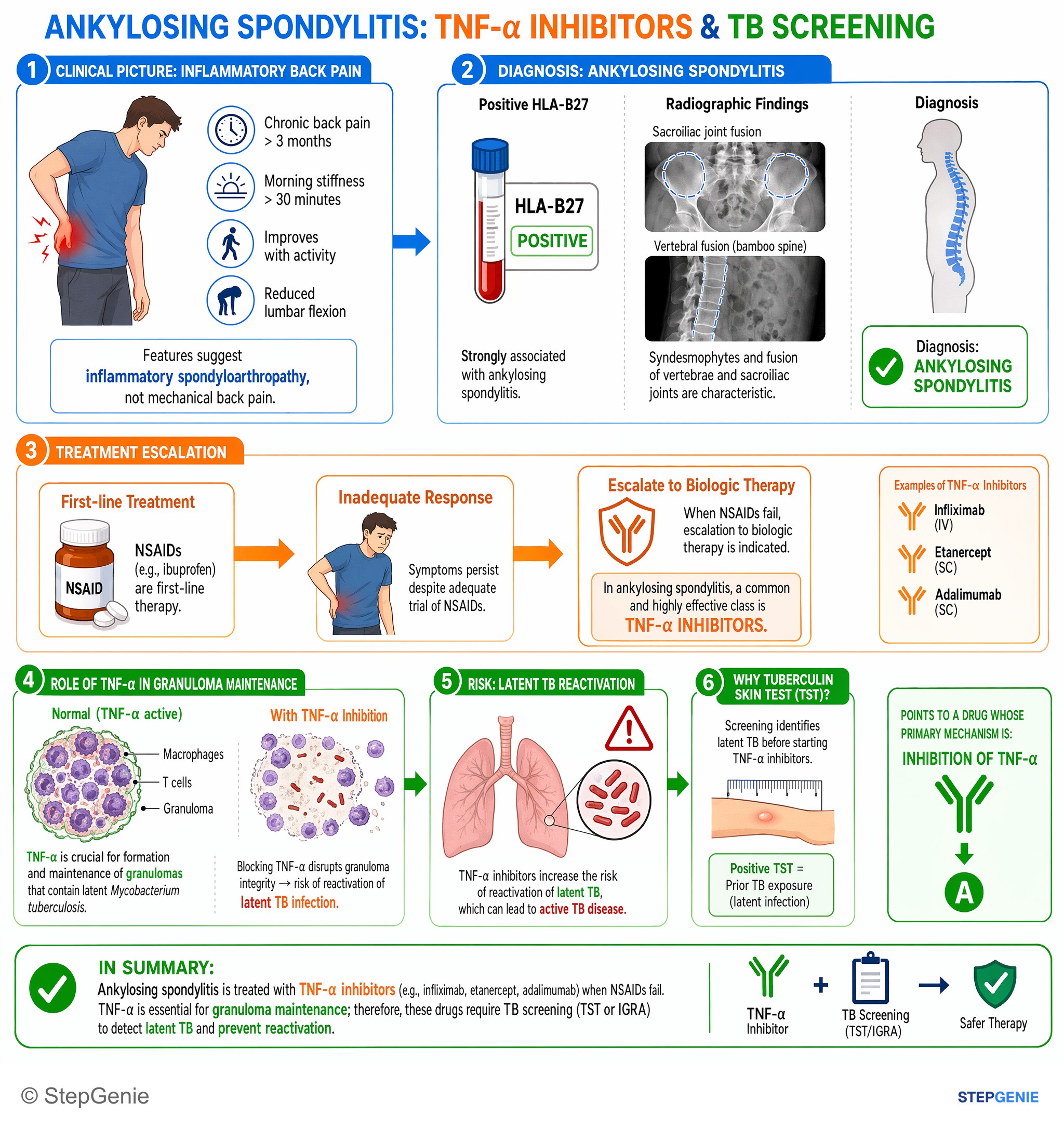
Ankylosing spondylitis is treated with TNF-α inhibitors, which require TB screening due to risk of latent TB reactivation from impaired…
USMLE Step 1Frequently Asked Questions
How do you tell ankylosing spondylitis back pain from mechanical back pain?
Ankylosing spondylitis causes inflammatory back pain that is worse in the morning and improves with exercise. The key contrast is that AS pain is worse with rest and better with movement, while mechanical back pain is usually worse with use and better with rest. Morning stiffness and improvement with activity are classic clues that point away from a mechanical cause.
What imaging findings are classic for ankylosing spondylitis?
The classic imaging findings are bilateral sacroiliitis early on and a bamboo spine later in disease. Sacroiliitis explains the low back or buttock pain, often with alternating sides, and is an important early clue. With progression, chronic enthesitis leads to spinal ligament ossification and vertebral fusion, producing syndesmophytes that create the bamboo spine appearance on x-ray.
Why does ankylosing spondylitis cause heel pain and spinal fusion?
Ankylosing spondylitis causes both heel pain and spinal fusion because its key pathology is enthesitis, which is inflammation where ligaments and tendons insert into bone. In the heel, this affects sites like the Achilles tendon insertion and plantar fascia. In the spine, chronic enthesitis promotes ligament ossification and vertebral fusion, leading to the classic bamboo spine appearance.
What extra-articular findings should make you think of ankylosing spondylitis?
The major extra-articular clues are acute anterior uveitis and cardiac involvement such as aortitis causing aortic regurgitation. Uveitis presents with a painful red eye, photophobia, and blurred vision. Cardiac disease can show up as aortic regurgitation in a young person, and conduction abnormalities can also occur. These findings help identify AS as more than just a cause of back pain.
What is the first-line treatment for ankylosing spondylitis?
NSAIDs are the first-line treatment for ankylosing spondylitis. If disease remains persistent or active, TNF-alpha inhibitors such as etanercept or infliximab, or other biologics, are used. Exercise and physical therapy are also important because they help maintain posture and mobility, which matches the classic pattern that symptoms improve with movement rather than rest.