The four classic B-cell non-Hodgkin lymphomas (NHL) separate on tempo, cell size, immunophenotype and one signature translocation. Diffuse large B-cell lymphoma (DLBCL), the most common NHL (about 30%), is a rapidly enlarging mass made of diffuse sheets of large CD20+ B cells; follicular lymphoma is indolent, grows in follicles and carries t(14;18) IGH::BCL2; Burkitt lymphoma is a "starry-sky" tumor of medium-sized cells with an IG::MYC translocation, usually t(8;14), and a Ki-67 above 95%; mantle cell lymphoma is CD5+, CD23−, cyclin D1+ from t(11;14). The 2022 WHO (5th edition) and International Consensus Classification (ICC) keep all four names, with updates noted below.
The question
A 66-year-old man has a painless lump on the left side of his neck that has grown quickly over 5 weeks. He reports drenching night sweats and a 6-kg (13-lb) weight loss. Examination shows a firm, nontender, 5-cm left cervical lymph node. Serum lactate dehydrogenase (LDH) is elevated. Excisional biopsy shows effacement of the nodal architecture by diffuse sheets of large lymphoid cells with vesicular nuclei and prominent nucleoli. Immunohistochemistry: CD20+, CD10+, BCL6+, BCL2+, CD5−, cyclin D1−; Ki-67 about 80%. FISH shows no MYC rearrangement.
Which of the following is the most likely diagnosis?
A. Burkitt lymphoma B. Chronic lymphocytic leukemia/small lymphocytic lymphoma (CLL/SLL) C. Diffuse large B-cell lymphoma D. Follicular lymphoma E. Mantle cell lymphoma
Answer and every choice explained
Answer: C, diffuse large B-cell lymphoma. An older adult with a node that grew in weeks, B symptoms (fever, night sweats or weight loss), a high LDH and diffuse sheets of large B cells has DLBCL. CD10 and BCL6 mark a germinal-center (GCB) cell of origin; BCL2 expression is common in DLBCL and does not make it follicular. No MYC rearrangement rules out Burkitt and a "double-hit" lymphoma. Next steps: PET/CT staging, HIV and hepatitis B and C testing (rituximab carries a boxed warning for HBV reactivation), then R-CHOP, or pola-R-CHP because his International Prognostic Index is at least 2 (age over 60 plus high LDH).
- A. Burkitt lymphoma: also fast and CD10+/BCL6+, but the cells are medium-sized, the pattern is "starry sky", BCL2 is negative or weak, Ki-67 is above 95%, and an IG::MYC translocation is part of the definition. The usual patient is a child or young adult, or a person with HIV.
- B. CLL/SLL: small, mature CD5+, CD23+ B cells in an older adult, usually with lymphocytosis and an indolent course. Its aggressive turn, Richter transformation (2-10% of CLL), produces a DLBCL, but this patient has no CLL history, and CLL/SLL itself would show small CD5+ cells rather than sheets of large CD5-negative cells.
- D. Follicular lymphoma: shares CD10, BCL6 and BCL2, but grows as follicles of centrocytes and centroblasts and is indolent (median survival 8-15 years). A sudden fast-growing node in a patient with follicular lymphoma signals transformation, and the biopsy then reads as DLBCL.
- E. Mantle cell lymphoma: CD5+, cyclin D1+, CD10−, CD23−; typically an older man with stage III-IV disease involving marrow, spleen and the GI tract. CD5 and cyclin D1 are negative here.
Change one clue, change the answer
| If the stem said instead... | Best answer |
|---|---|
| 8-year-old with an ileocecal mass, starry sky, BCL2-negative, Ki-67 near 100% | Burkitt lymphoma |
| Years of painless waxing-and-waning nodes, follicular pattern, t(14;18) | Follicular lymphoma |
| Older man, CD5+, CD23−, cyclin D1+, colonic polyps | Mantle cell lymphoma |
| Lymphocytosis of small CD5+, CD23+ B cells in a 72-year-old | CLL/SLL |
| Large-cell tumor with both MYC and BCL2 rearrangements | "Double-hit" lymphoma (names below) |
The four lymphomas side by side
| DLBCL | Follicular | Burkitt | Mantle cell | |
|---|---|---|---|---|
| Share | ~30% of NHL, most common | ~20% of NHL, most common indolent type | Most common NHL in children | ~5% of NHL |
| Typical patient | Adult; risk rises with age | Age 50+, widespread at diagnosis | Child, young adult or HIV | Median age ~65, mostly men |
| Tempo | Aggressive, often curable | Indolent, not curable when advanced | Fastest-growing human tumor | Aggressive, usually not curable |
| Histology | Diffuse sheets of large cells | Follicles of centrocytes and centroblasts | Medium cells, starry sky | Mantle-zone B cells, nodes to GI tract |
| Markers | CD20+; GCB (CD10+) or ABC (IRF4/MUM1+) | CD10+, BCL2+ | CD10+, BCL6+, BCL2−/weak, TdT− | CD5+, cyclin D1+, CD10−, CD23− |
| Genetics | Varied: BCL6, BCL2 or MYC rearrangements | t(14;18) IGH::BCL2 (85-90% or more) | IG::MYC: t(8;14), t(2;8), t(8;22) | t(11;14) IGH::CCND1 (≥95%) |
| Classic stem | Rapidly enlarging node, B symptoms | Painless waxing-waning nodes | Jaw mass (endemic) or ileocecal mass (sporadic) | Nodes, spleen, marrow, GI polyposis |
| Treatment hook | R-CHOP or pola-R-CHP | Watchful waiting if asymptomatic | Intensive chemo, CNS prophylaxis, TLS prevention | BTK inhibitors, BR, autologous SCT if fit |
Translocations to know cold
| Translocation | Fusion | Lymphoma | Consequence |
|---|---|---|---|
| t(14;18) | IGH::BCL2 | Follicular (also many GCB DLBCLs) | Anti-apoptotic BCL2 is overexpressed, so cells accumulate instead of dying |
| t(8;14), variants t(2;8), t(8;22) | IG::MYC (heavy, kappa or lambda locus) | Burkitt | MYC drives relentless proliferation |
| t(11;14) | IGH::CCND1 | Mantle cell | Cyclin D1 pushes cells through the cell cycle |
| t(11;18) | BIRC3::MALT1 | Gastric MALT lymphoma | Marks tumors that will not respond to H. pylori eradication |
| MYC plus BCL2 rearrangements | Two hits | "Double-hit" large B-cell lymphoma | Particularly poor prognosis |
Gastric MALT lymphoma and its H. pylori link are covered in the H. pylori guide; t(9;22) belongs to ALL and CML (see the ALL comparison table).
Each lymphoma: the high-yield details
Diffuse large B-cell lymphoma
- Arises de novo or by transformation of an indolent lymphoma (follicular lymphoma, or CLL as Richter transformation).
- Cell of origin: GCB type (enriched for t(14;18)) vs ABC type (IRF4/MUM1+, MYD88 and CD79B mutations, BCL6 rearrangements).
- IPI (5 factors): age over 60, poor performance status, high LDH, more than one extranodal site, stage III-IV.
- R-CHOP gives a complete response in 70-80% and cures about 60-70% (Merck). Pola-R-CHP swaps vincristine for polatuzumab vedotin, an anti-CD79b antibody-drug conjugate; its FDA label covers untreated DLBCL, NOS or high-grade B-cell lymphoma with an IPI of 2 or more. Early relapse or refractory disease: CD19 CAR T cells.
Follicular lymphoma
- About 20% of NHL; most patients are 50 or older with widespread disease at diagnosis, often including marrow and spleen.
- BCL2 rearrangement, usually t(14;18): WHO says about 85% of FL are "classic" FL carrying t(14;18), and NCI puts BCL2 rearrangement at more than 90%; the overexpressed protein blocks apoptosis.
- Advanced disease is not cured, but median survival is 8-15 years, so watchful waiting is standard for patients without symptoms. Radiation alone can control, and sometimes cure, rare stage I disease.
Burkitt lymphoma
- Endemic (central Africa): jaw or facial bones, closely tied to EBV (see EBV and the other herpesviruses). Sporadic: abdomen, often the ileocecal region, sometimes causing bowel obstruction. Immunodeficiency-related: mostly HIV, where it is an AIDS-defining cancer.
- Starry sky = benign macrophages that have swallowed apoptotic tumor cells, scattered through sheets of tumor cells.
- Treat urgently with intensive rituximab-containing regimens (for example R-CODOX-M/IVAC or DA-EPOCH-R) plus CNS prophylaxis.
- Tumor lysis syndrome (high potassium, phosphate and uric acid, low calcium) is common with treatment: IV fluids, allopurinol and often rasburicase. Rasburicase is contraindicated in G6PD deficiency because its hydrogen peroxide by-product causes hemolysis (see G6PD deficiency).
Mantle cell lymphoma
- About 5% of NHL, median age about 65, mostly men; most patients have stage III-IV disease (nodes, spleen, marrow, sometimes GI polyposis, especially in the colon).
- CD5+ like CLL, but CD23-negative or weak and cyclin D1+ (CLL: CD5/CD23 and staging). SOX11 is usually positive; its absence marks the indolent leukemic non-nodal form.
- Blastoid or pleomorphic cells, Ki-67 of 30% or more and TP53 alterations predict a poor course.
- Responsive but rarely curable: bendamustine-rituximab (BR), BTK inhibitors (acalabrutinib with BR is FDA-approved for untreated patients ineligible for autologous transplant; acalabrutinib or zanubrutinib after prior therapy), autologous stem cell transplant for some younger patients, and CD19 CAR T cells after BTK inhibitor failure.
WHO 5th edition vs ICC 2022: names you may now see
- DLBCL, NOS is unchanged in both, and both keep GCB vs ABC subtyping.
- Double hit: WHO calls MYC plus BCL2 rearrangements "DLBCL/high-grade B-cell lymphoma with MYC and BCL2 rearrangements"; ICC calls it "high-grade B-cell lymphoma with MYC and BCL2 rearrangements". MYC plus BCL6 cases are DLBCL, NOS or HGBL, NOS in WHO, but a provisional ICC entity.
- Follicular lymphoma: WHO splits classic FL, FL with uncommon features and follicular large B-cell lymphoma (the old grade 3B), and makes grading optional. ICC keeps grades 1-2, 3A and 3B.
- Burkitt: definition unchanged in both. WHO recommends separating EBV-positive from EBV-negative Burkitt, which it says reflects the biology better than the endemic, sporadic and immunodeficiency-associated subtypes. ICC classifies TdT-positive cases as B-lymphoblastic leukemia/lymphoma with MYC rearrangement.
- MYC-negative Burkitt look-alike with 11q gains and losses: "high-grade B-cell lymphoma with 11q aberration" (WHO) or "large B-cell lymphoma with 11q aberration" (ICC, provisional).
- Mantle cell: both recognize in situ mantle cell neoplasia, conventional MCL and leukemic non-nodal MCL.
- WHO adds an umbrella, large B-cell lymphomas of immune-privileged sites, for primary CNS, vitreoretinal and testicular large B-cell lymphoma.
USMLE questions still use the classic names and translocations; the new terms appear on modern pathology reports.
How USMLE tests it
- CD5+ small B cells: CD23+ means CLL/SLL; cyclin D1+ and t(11;14) mean mantle cell.
- BCL2 protein: positive in follicular lymphoma (and many DLBCLs), negative or weak in Burkitt.
- t(14;18) in a diffuse large-cell tumor is still DLBCL (transformed follicular or GCB type); pattern and cell size decide.
- TdT: a precursor-cell marker; positivity points to lymphoblastic leukemia/lymphoma, and Burkitt is TdT-negative (rare TdT-positive large B-cell lymphomas do exist).
- NHL vs Hodgkin: NHL is less predictable and spreads to extranodal sites far more often; compare with the Hodgkin lymphoma breakdown.
Key takeaways
- DLBCL: most common NHL; rapidly growing node, diffuse large CD20+ cells; R-CHOP or pola-R-CHP, curable in most.
- Follicular: t(14;18) IGH::BCL2, follicular pattern, indolent; watch and wait; can transform to DLBCL.
- Burkitt: IG::MYC, usually t(8;14); starry sky, Ki-67 above 95%, BCL2-negative or weak; jaw (endemic, EBV) or ileocecal (sporadic) mass; prevent tumor lysis and avoid rasburicase in G6PD deficiency.
- Mantle cell: t(11;14) IGH::CCND1, CD5+, CD23−, cyclin D1+; older men, advanced stage, GI polyposis.
- CD5+ pair: CLL is CD23+; mantle cell is cyclin D1+.
- WHO 5th edition: EBV-positive vs EBV-negative Burkitt, optional FL grading, follicular large B-cell lymphoma for old grade 3B; double hit (MYC plus BCL2) is named slightly differently by WHO and ICC.
Sources
- The 5th edition of the WHO Classification of Haematolymphoid Tumours: Lymphoid Neoplasms — Leukemia (2022)
- A comparison of the International Consensus and 5th WHO classifications of mature B-cell lymphomas — Leukemia (2023)
- Non-Hodgkin Lymphomas — Merck Manual Professional Edition (2026)
- Burkitt Lymphoma — Merck Manual Professional Edition (2026)
- Chronic Lymphocytic Leukemia (CLL) — Merck Manual Professional Edition (2026)
- Aggressive B-Cell Non-Hodgkin Lymphoma Treatment (PDQ), Health Professional Version — National Cancer Institute (2025)
- Indolent B-Cell Non-Hodgkin Lymphoma Treatment (PDQ), Health Professional Version — National Cancer Institute (2025)
- Mantle Cell Lymphoma Treatment (PDQ), Health Professional Version — National Cancer Institute (2025)
- Polivy (polatuzumab vedotin) prescribing information — DailyMed (2026)
- Rituxan (rituximab) prescribing information — DailyMed
- Elitek (rasburicase) prescribing information — DailyMed (2025)
- Calquence (acalabrutinib) prescribing information — DailyMed (2026)
Visual explanations from the StepGenie QBank
Infographics StepGenie drew to explain questions in its own QBank, matched to this article's topic. Each caption is the takeaway of the question it explains.
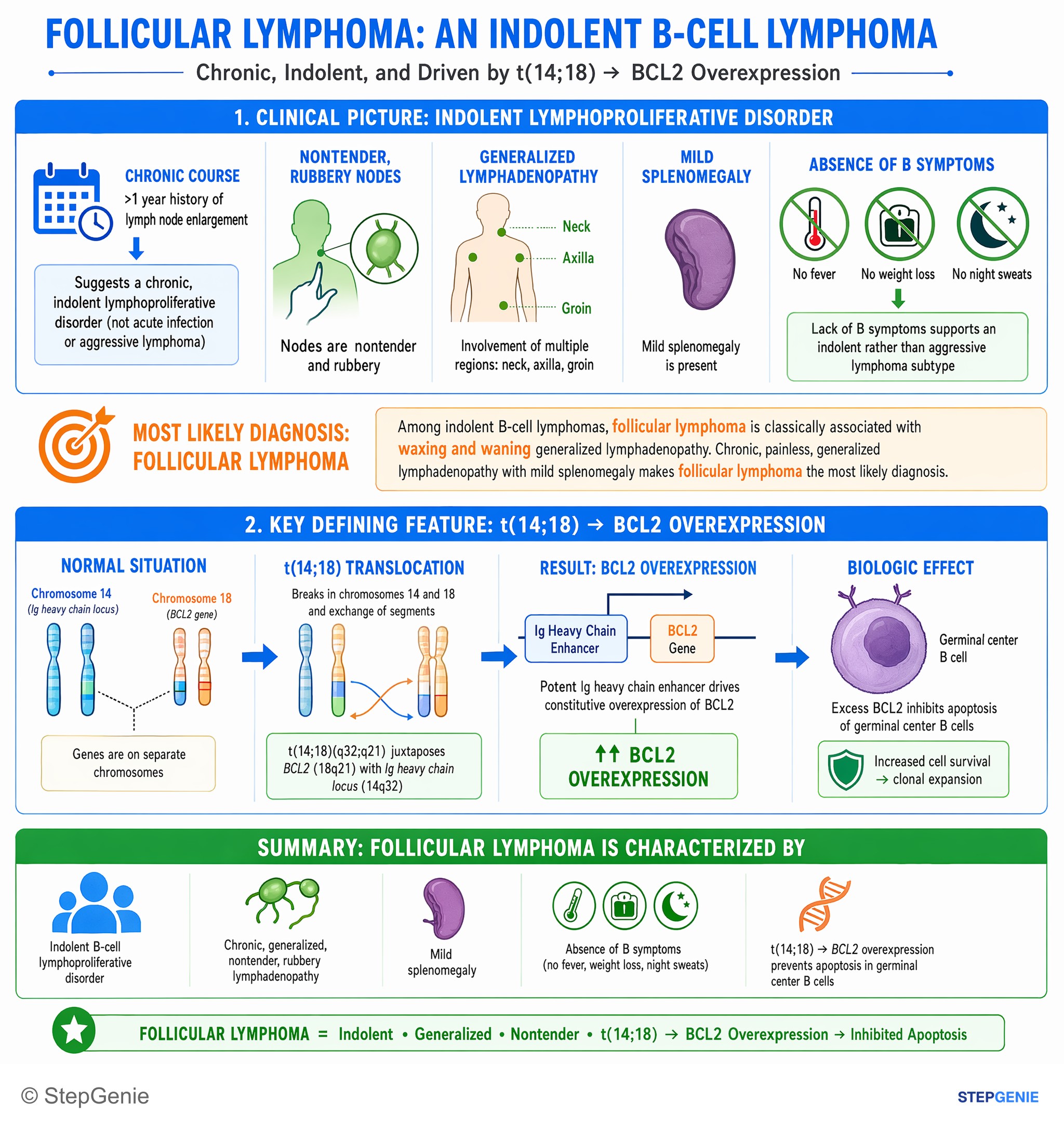
Follicular lymphoma: indolent, generalized, nontender, rubbery lymphadenopathy with t(14;18) → BCL2 overexpression preventing apoptosis in…
USMLE Step 1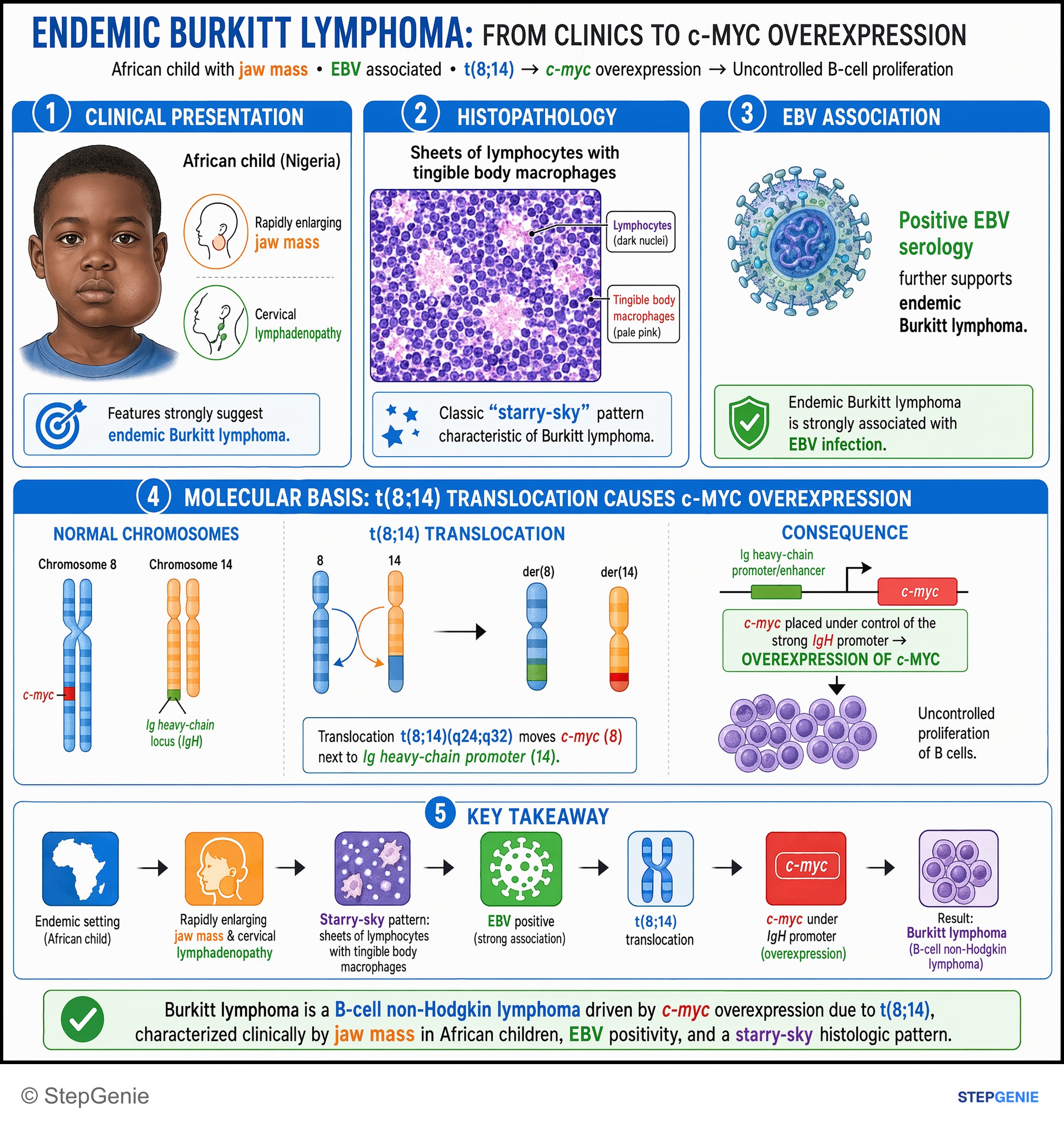
Endemic Burkitt lymphoma (jaw mass in African child, EBV+) has t(8;14) causing c-myc overexpression and a "starry-sky" lymphocyte pattern.
USMLE Step 1Frequently Asked Questions
What is the most common type of non-Hodgkin lymphoma?
Diffuse large B-cell lymphoma (DLBCL) is the most common type, making up about 30% of newly diagnosed non-Hodgkin lymphoma. It typically presents in an adult as a rapidly enlarging lymph node or extranodal mass, often with fever, night sweats or weight loss and a high LDH. Biopsy shows diffuse sheets of large CD20-positive B cells. It is aggressive but often curable with R-CHOP, or with pola-R-CHP in higher-risk patients.
Which translocations go with follicular, Burkitt and mantle cell lymphoma?
Follicular lymphoma carries t(14;18), which joins IGH to BCL2 and blocks apoptosis. Burkitt lymphoma has an IG::MYC translocation, most often t(8;14), with the variants t(2;8) and t(8;22). Mantle cell lymphoma has t(11;14), which joins IGH to CCND1 and overexpresses cyclin D1. Gastric MALT lymphoma with t(11;18) is another favorite, because it predicts that the tumor will not respond to H. pylori eradication.
How do you tell Burkitt lymphoma from DLBCL?
Both can grow fast and express CD10 and BCL6. Burkitt lymphoma has medium-sized cells, a starry-sky pattern from macrophages that have engulfed apoptotic tumor cells, a Ki-67 above 95%, negative or weak BCL2, and an IG::MYC translocation. It classically affects children, young adults or people with HIV, with a jaw mass in endemic disease or an ileocecal mass in sporadic disease. DLBCL shows diffuse sheets of large cells, usually in an older adult.
How is mantle cell lymphoma different from CLL/SLL?
Both are made of CD5-positive B cells, so CD5 alone cannot separate them. CLL/SLL is CD23-positive and cyclin D1-negative, usually indolent, with a lymphocytosis of small mature B cells in an older adult. Mantle cell lymphoma is CD23-negative or weak and cyclin D1-positive because of t(11;14), and it typically presents in an older man with advanced disease involving lymph nodes, spleen, bone marrow and sometimes the GI tract.
Can follicular lymphoma turn into DLBCL?
Yes. Follicular lymphoma is indolent, with a median survival of about 8 to 15 years, but it can undergo high-grade transformation, most often into diffuse large B-cell lymphoma. The clue in a question is a patient with years of painless, slowly changing lymph nodes who suddenly develops a rapidly enlarging node, B symptoms and a rising LDH. A new biopsy then shows diffuse sheets of large B cells, and the disease is treated as an aggressive lymphoma.
What is a double-hit lymphoma?
A double-hit lymphoma is an aggressive B-cell lymphoma with rearrangements of both MYC and BCL2, and it carries a particularly poor prognosis. The 2022 WHO classification calls it diffuse large B-cell lymphoma/high-grade B-cell lymphoma with MYC and BCL2 rearrangements, while the 2022 International Consensus Classification calls it high-grade B-cell lymphoma with MYC and BCL2 rearrangements. Tumors with MYC plus BCL6 rearrangements are classified differently by the two systems.