Cluster C personality disorders are the anxious/fearful ("worried") cluster: avoidant, dependent and obsessive-compulsive personality disorder (OCPD). Avoidant patients want relationships but avoid them because they are hypersensitive to rejection (schizoid patients simply don't want them); dependent patients are submissive and clinging and need others to make their decisions; OCPD is perfectionism, rigidity and control that the patient experiences as right (ego-syntonic), unlike the unwanted obsessions and compulsions of OCD. Like every personality disorder, they are enduring patterns that begin by adolescence or early adulthood, and psychotherapy is the treatment of choice; medications only target specific symptoms.
The mnemonic: Worried, with 3 Cs
The clusters run A-B-C = Weird, Wild, Worried. Cluster C's three members are the 3 Cs:
| C | Disorder | Core drive | Sounds like | Criteria needed |
|---|---|---|---|---|
| Cowardly | Avoidant | Avoid rejection, criticism and ridicule | "I'd love to come, but you won't like me." | 4 of 7 |
| Clingy | Dependent | Be taken care of; never be left alone | "You decide. Please don't leave." | 5 of 8 |
| Compulsive | OCPD | Order, perfectionism and control | "If it isn't perfect, it isn't done." | 4 of 8 |
One-line separator: avoidant patients want people but stay away; dependent patients hold on to people at any cost; OCPD patients control people and tasks, and believe they are right to.
What makes it a personality disorder
The DSM-5-TR general criteria apply to all ten personality disorders:
- An enduring pattern of inner experience and behavior that deviates from the expectations of the person's culture
- Shows in 2 or more of: cognition (how self, others and events are perceived), affectivity (emotional responses), interpersonal functioning and impulse control
- Inflexible and pervasive across personal and social situations
- Causes significant distress or impairment
- Stable, with onset by adolescence or early adulthood
- Not better explained by another mental disorder, a substance or a medical condition
- Under 18: the pattern must have lasted at least 1 year; antisocial personality disorder can't be diagnosed before 18
Ego-syntonic is the exam word: patients often lack insight into how their behavior affects others, and it is the distress caused by the consequences (lost jobs, failed relationships) that usually brings them to treatment. About 9% of US adults have at least one personality disorder (APA, NIMH).
Clusters A, B and C at a glance
| Cluster | Label | Exam word | Disorders and one-liners |
|---|---|---|---|
| A | Odd, eccentric | Weird | Paranoid: mistrust and suspicion. Schizoid: disinterest in others. Schizotypal: eccentric ideas and behavior |
| B | Dramatic, emotional, erratic | Wild | Antisocial: disregard for others, deceitfulness. Borderline: unstable relationships, emotional dysregulation, inner emptiness. Histrionic: attention seeking, excessive emotionality. Narcissistic: grandiosity, need for admiration, lack of empathy |
| C | Anxious, fearful | Worried | Avoidant: avoids contact because of rejection sensitivity. Dependent: submissiveness and a need to be taken care of. OCPD: perfectionism, rigidity, obstinacy |
Question-by-question breakdowns of the other clusters: Cluster A and Cluster B.
Avoidant personality disorder: wants in, stays out
A pervasive pattern of social inhibition, feelings of inadequacy and hypersensitivity to negative evaluation, beginning by early adulthood, with at least 4 of 7 features. Mnemonic CRINGES:
- Certainty of being liked is needed before getting involved with people
- Rejection or criticism preoccupies them in social situations
- Intimate relationships are held back for fear of shame or ridicule
- New interpersonal situations inhibit them because they feel inadequate
- Gets out of work activities that involve significant interpersonal contact, for fear of criticism or rejection
- Embarrassment risk makes them reluctant to take personal risks or try new activities
- Self seen as socially inept, unappealing or inferior
| Versus | Key difference |
|---|---|
| Schizoid PD (Cluster A) | Both are isolated. Schizoid patients are disinterested in relationships and indifferent to praise or criticism; avoidant patients want relationships but fear rejection |
| Social anxiety disorder | The difference is subtle: avoidant PD is more pervasive, with a core sense of inadequacy, while social anxiety disorder is often tied to situations of possible public embarrassment (public speaking, performing). Both can be diagnosed when criteria for each are met |
| Dependent PD | Avoidant patients withdraw until they are sure they will be accepted without criticism; dependent patients seek out and hold on to relationships |
Prevalence is about 2.1% in the US (Merck). Treatment is CBT focused on social skills, often in groups, plus supportive or psychodynamic individual therapy. No drug is FDA-approved for avoidant PD and medications are generally ineffective for the disorder itself (StatPearls), but they can treat a comorbid social anxiety disorder or depression.
Dependent personality disorder: decide for me, don't leave me
A pervasive, excessive need to be taken care of that leads to submissive, clinging behavior and fears of separation, with at least 5 of 8 features. Mnemonic RELIANCE:
- Reassurance and advice are needed for everyday decisions
- Expressing disagreement is hard, for fear of losing support or approval
- Life's major responsibilities are handed to others
- Initiating projects alone is hard (from lack of self-confidence, not motivation)
- Alone = uncomfortable or helpless
- Nurturance is sought to excessive lengths, even volunteering for unpleasant tasks
- Close relationship ends, so another is urgently sought for care and support
- Exaggerated, unrealistic fear of being left to care for themselves
Look-alikes:
- Versus borderline PD: both fear abandonment, but borderline patients swing between submissiveness and rageful hostility; dependent patients stay submissive.
- Versus histrionic PD: histrionic patients seek attention and are flamboyant and disinhibited; dependent patients seek reassurance and are self-effacing and shy.
- Versus dependency in other disorders: depression, panic disorder and agoraphobia can all cause dependency; the personality disorder is an enduring pattern dating to early adulthood.
Prevalence is under 1%, and it is diagnosed more often in females (Merck). Complications include depression, substance use and vulnerability to abuse (MedlinePlus). Treatment is psychodynamic therapy or CBT aimed at fears of independence and difficulty with assertiveness; the therapist must avoid fostering dependence on the therapy itself. Benzodiazepines are avoided because these patients have a higher risk of medication misuse (see benzodiazepine quick tips).
OCPD: perfect, rigid and fine with it
A pervasive preoccupation with orderliness, perfectionism and control, with no room for flexibility, that slows or derails finishing tasks; at least 4 of 8 features, starting by early adulthood. Mnemonic LAW FIRMS:
- Loses the point of an activity in details, rules, lists, order and schedules
- Ability to finish tasks is blocked by perfectionism
- Worn-out or worthless objects can't be thrown away
- Friendships and leisure are sacrificed to work (not out of financial need)
- Inflexible and overconscientious about morality, ethics and values
- Reluctant to delegate unless others do things exactly their way
- Miserly with money
- Stubborn and rigid
The traits feel acceptable and consistent with the patient's sense of self (ego-syntonic): as MedlinePlus puts it, people with OCD have unwanted thoughts, while people with OCPD believe their thoughts are correct. Estimated median prevalence is 4.7% (possibly up to 7.8%) (Merck). Treatment is psychodynamic therapy or CBT, and limited data suggest SSRIs may help; the patient's rigidity and need for control make therapy hard.
OCPD vs OCD
| Feature | OCPD | OCD |
|---|---|---|
| What it is | Cluster C personality disorder | Obsessive-compulsive and related disorder |
| Core problem | Pervasive need for order, perfection and control | Obsessions (recurrent, unwanted, intrusive thoughts, urges or images) and/or compulsions (repetitive acts the patient feels driven to perform) |
| How it feels | Ego-syntonic: "my way is the right way" | Ego-dystonic in the classic framing; DSM-5-TR rates insight as good or fair, poor, or absent (delusional beliefs) |
| Who is bothered | Mostly coworkers and family, plus missed deadlines | The patient, by the obsessions and rituals |
| Treatment | Psychotherapy; limited data for SSRIs | CBT with exposure and ritual prevention; SSRIs or clomipramine |
The two can coexist: OCD is a recognized comorbidity of OCPD. More on OCD itself in the OCD question breakdown.
How USMLE tests Cluster C
- "Turns down a promotion that means leading meetings; wants friends but is sure they'll reject her" = avoidant. "Prefers to be alone, indifferent to praise or criticism" = schizoid (Cluster A).
- "Can't choose an outfit without calling her mother; finds a new partner days after a breakup" = dependent. "Alternates between clinging and rage" = borderline.
- "Misses deadlines perfecting a report, can't delegate, sees no problem" = OCPD. "Distressed by contamination thoughts and hours of hand-washing" = OCD.
- Timing matters: a personality disorder is visible by adolescence or early adulthood. A personality change that starts in middle age doesn't fit; look for another mental disorder, a substance or a medical cause.
- Treatment answer: psychotherapy. No medication specifically treats personality disorders (APA), and benzodiazepines are a trap in dependent PD.
Practice question
A 42-year-old accountant is referred by his employer after missing three filing deadlines. He redoes each report until every table is perfectly formatted and won't let junior staff help because "they never do it right." He works most weekends and hasn't taken a vacation in years, although the family is financially secure, and he keeps detailed lists and schedules. His wife says he has been stubborn and tight with money since they met in college; he refuses to throw out worn-out shoes and broken appliances and insists that household chores follow his rules. He sees no problem with his standards and says his colleagues should raise theirs. He denies intrusive, unwanted thoughts and denies rituals he feels driven to perform. Which of the following is the most likely diagnosis?
A. Avoidant personality disorder B. Dependent personality disorder C. Obsessive-compulsive personality disorder D. Narcissistic personality disorder E. Obsessive-compulsive disorder
Answer: C. He shows most of the LAW FIRMS features, well over the 4 required: details and lists that defeat the task, perfectionism that blocks completion, worthless objects kept, leisure sacrificed to work, refusal to delegate, miserliness and stubbornness. The pattern dates to early adulthood and is ego-syntonic: he thinks everyone else is the problem.
- A: avoidant PD means social inhibition, feelings of inadequacy and fear of criticism. He isn't avoiding people out of fear of rejection; he criticizes them.
- B: dependent PD means needing others to make decisions and take responsibility. He refuses help and insists on his own way.
- D: narcissistic PD means grandiosity, a need for admiration and lack of empathy. His drive is order and perfection, not admiration.
- E: OCD requires obsessions and/or compulsions, classically experienced as unwanted. He denies both, and his traits feel right to him; if he did have them, both diagnoses could be made.
Next step: psychotherapy (psychodynamic or CBT); limited data suggest an SSRI may help.
Key takeaways
- Cluster C = anxious/fearful = Worried, and the 3 Cs: Cowardly (avoidant), Clingy (dependent), Compulsive (OCPD).
- Every personality disorder is an enduring, inflexible pattern from adolescence or early adulthood, showing in 2 or more of cognition, affectivity, interpersonal functioning and impulse control, and is usually ego-syntonic.
- Avoidant wants relationships but fears rejection; schizoid doesn't want them. Avoidant PD is more pervasive than social anxiety disorder, and the two can coexist.
- Dependent = submissive, clinging, needs others to decide, urgently replaces a lost relationship; avoid benzodiazepines.
- OCPD = perfectionism, rigidity and control, ego-syntonic; OCD = obsessions and compulsions, classically ego-dystonic; they can coexist.
- Psychotherapy is the treatment of choice; medications only target symptoms or comorbid disorders.
Sources
- Overview of Personality Disorders — Merck Manual Professional Edition (2026)
- Avoidant Personality Disorder (AVPD) — Merck Manual Professional Edition (2026)
- Dependent Personality Disorder (DPD) — Merck Manual Professional Edition (2026)
- Obsessive-Compulsive Personality Disorder (OCPD) — Merck Manual Professional Edition (2026)
- Schizoid Personality Disorder — Merck Manual Professional Edition (2026)
- Obsessive-Compulsive Disorder (OCD) — Merck Manual Professional Edition (2026)
- Avoidant Personality Disorder — StatPearls, NCBI Bookshelf (2024)
- What Are Personality Disorders? — American Psychiatric Association (2024)
- Personality Disorders (statistics) — National Institute of Mental Health
- Avoidant personality disorder — MedlinePlus Medical Encyclopedia (2024)
- Dependent personality disorder — MedlinePlus Medical Encyclopedia (2024)
- Obsessive-compulsive personality disorder — MedlinePlus Medical Encyclopedia (2024)
Visual explanations from the StepGenie QBank
Infographics StepGenie drew to explain questions in its own QBank, matched to this article's topic. Each caption is the takeaway of the question it explains.
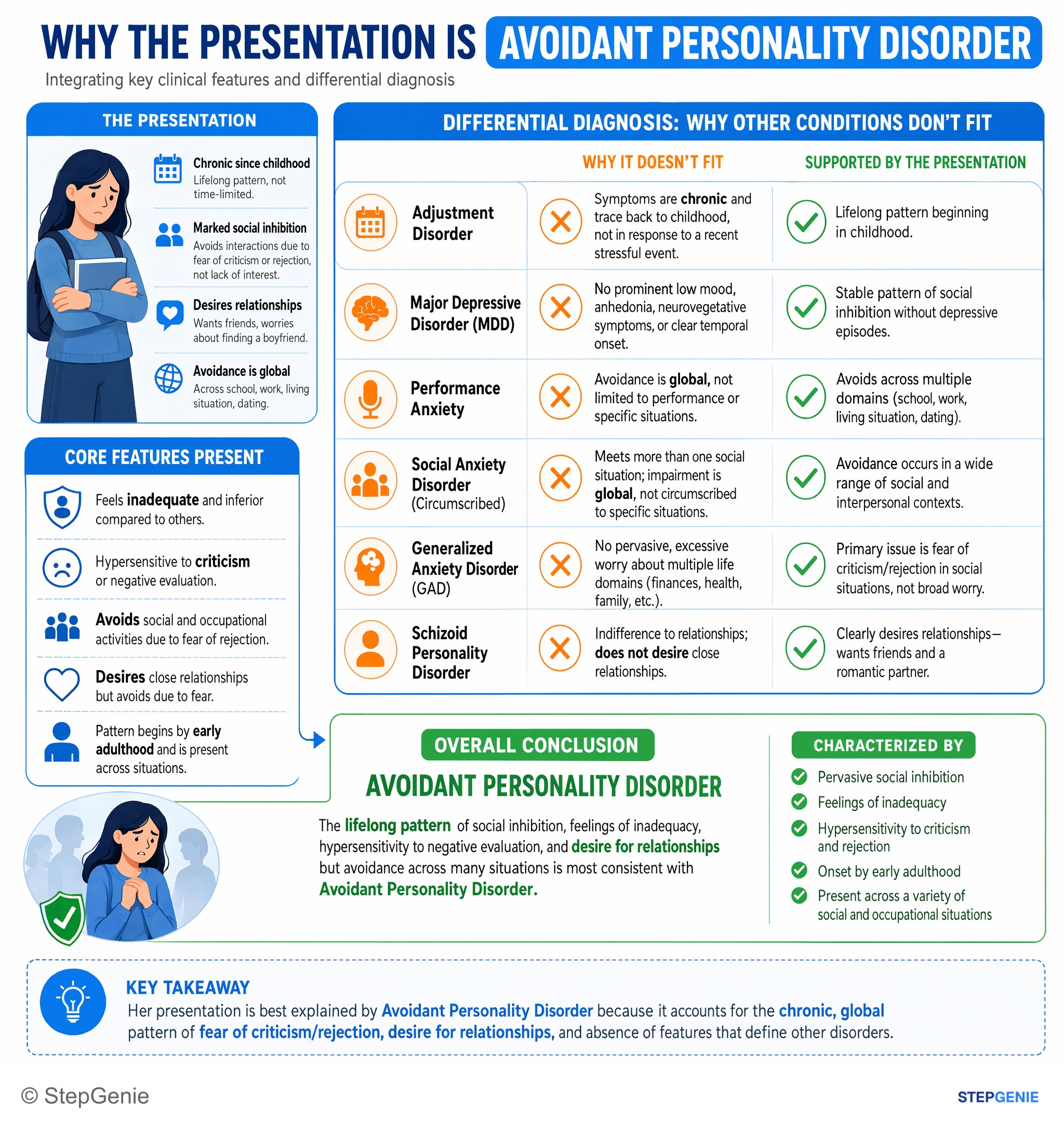
Avoidant personality disorder: pervasive social inhibition, feelings of inadequacy, and hypersensitivity to criticism, starting by early…
USMLE Step 2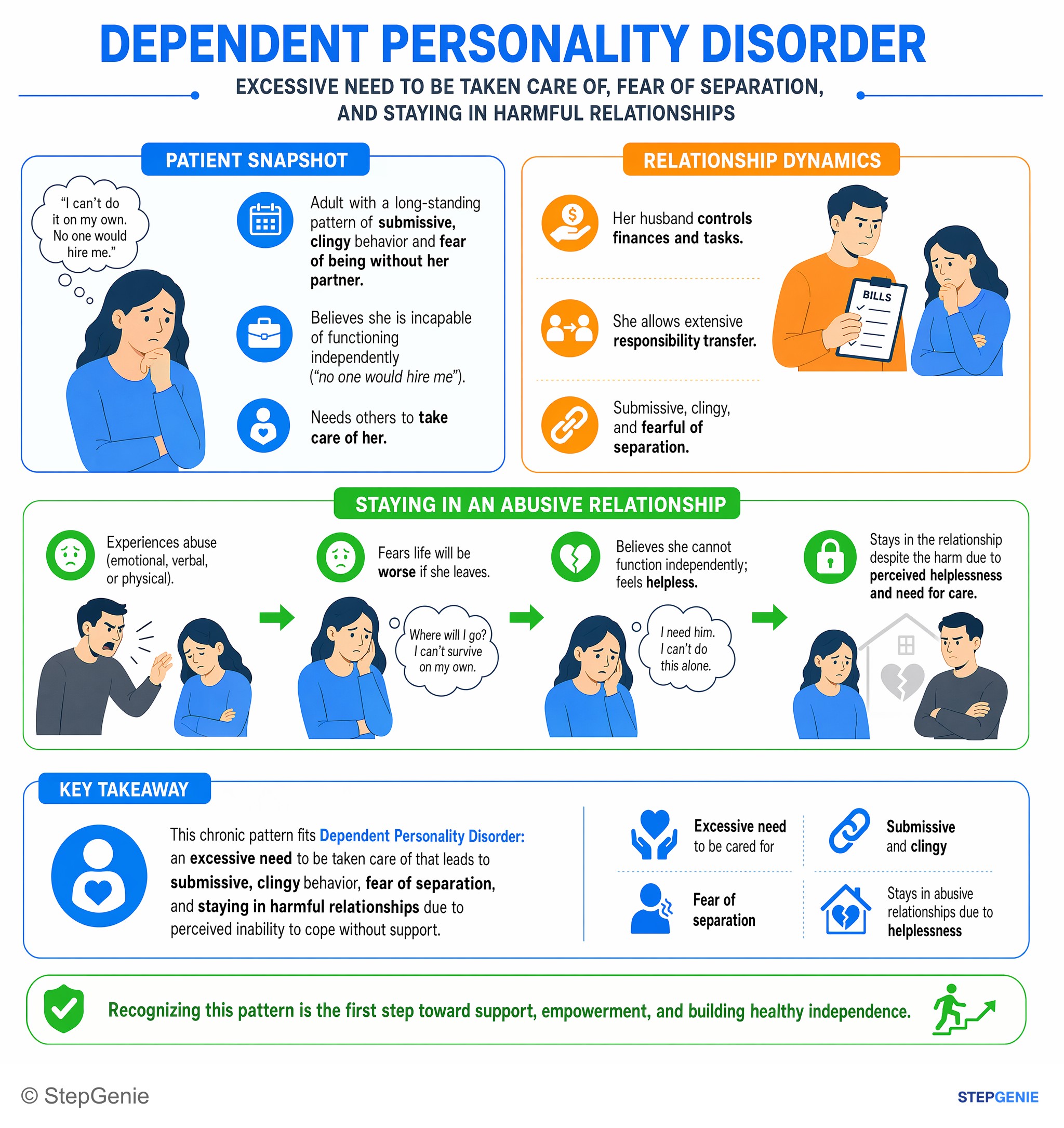
Dependent personality disorder: excessive need to be cared for, submissive/clingy, fear of separation, staying in abusive relationship due…
USMLE Step 2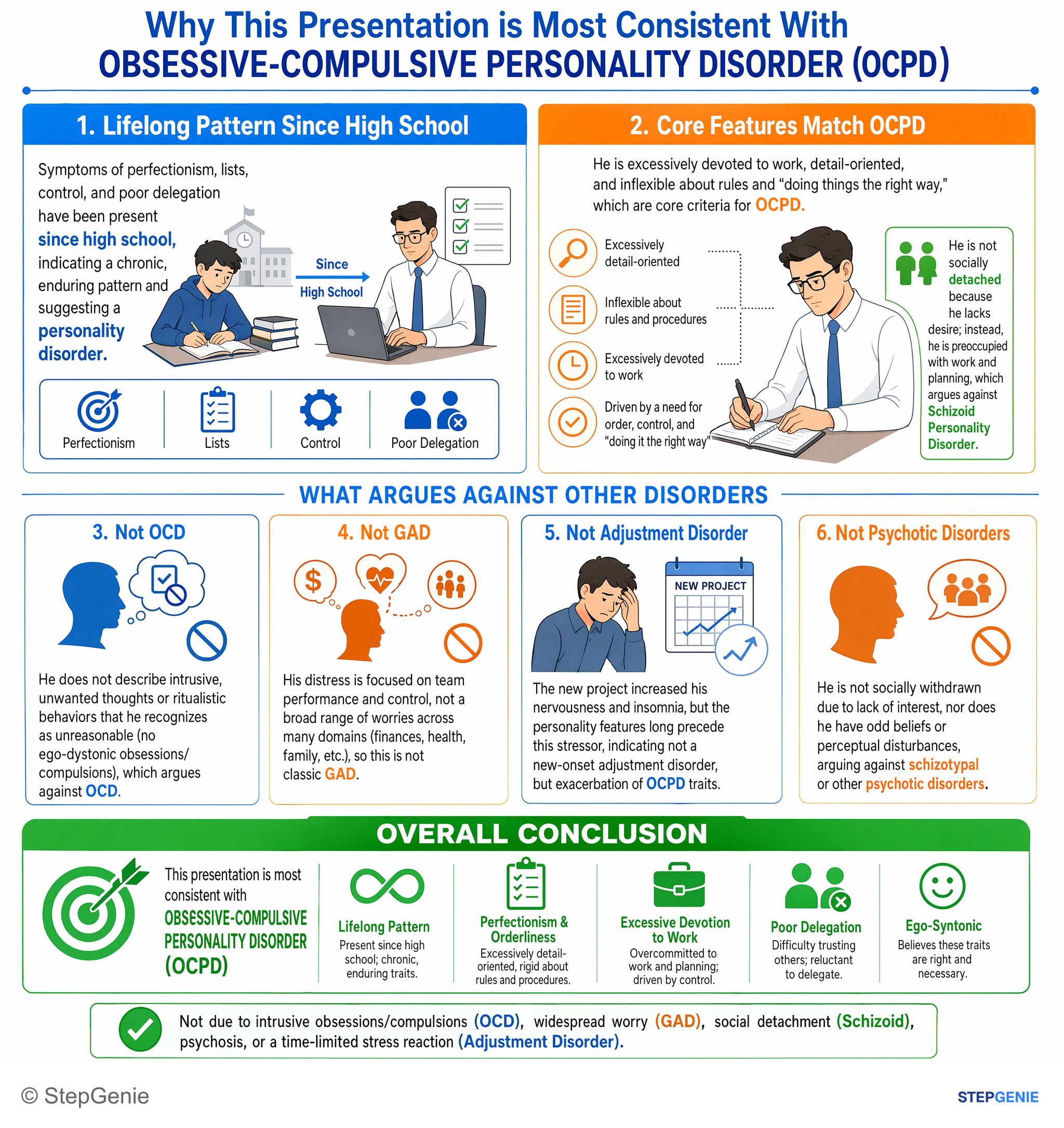
Obsessive-compulsive personality disorder: lifelong perfectionism, excessive orderliness/control, overwork, poor delegation, ego-syntonic…
USMLE Step 2Frequently Asked Questions
What are the Cluster C personality disorders?
Cluster C is the anxious or fearful group of personality disorders: avoidant, dependent and obsessive-compulsive personality disorder (OCPD). A quick mnemonic is the 3 Cs: Cowardly for avoidant (avoids people for fear of rejection), Clingy for dependent (submissive and needs others to make decisions) and Compulsive for OCPD (perfectionism, rigidity and control). Like all personality disorders, they are enduring patterns that begin by adolescence or early adulthood and cause distress or impairment.
How do you remember Cluster A, B and C personality disorders?
Use Weird, Wild, Worried. Cluster A is weird (odd or eccentric): paranoid, schizoid and schizotypal. Cluster B is wild (dramatic, emotional or erratic): antisocial, borderline, histrionic and narcissistic. Cluster C is worried (anxious or fearful): avoidant, dependent and obsessive-compulsive personality disorder. Within Cluster C, the 3 Cs, Cowardly, Clingy and Compulsive, match avoidant, dependent and OCPD.
What is the difference between avoidant and schizoid personality disorder?
Both disorders cause social isolation, but for opposite reasons. People with schizoid personality disorder are not interested in close relationships, prefer solitary activities and seem indifferent to praise or criticism. People with avoidant personality disorder want relationships but avoid them because they feel inadequate and are hypersensitive to rejection, criticism and ridicule. On exams, a lonely patient who wants friends but fears rejection points to avoidant personality disorder.
What is the difference between OCPD and OCD?
OCPD is a personality disorder marked by a pervasive preoccupation with order, perfectionism and control; the traits feel right to the person (ego-syntonic) and mostly frustrate others. OCD involves obsessions, which are unwanted intrusive thoughts, urges or images, and/or compulsions the person feels driven to perform; it is classically ego-dystonic, although insight varies. OCD is treated with exposure and ritual prevention plus SSRIs or clomipramine. The two disorders can coexist in the same patient.
How is avoidant personality disorder different from social anxiety disorder?
The difference is subtle. Avoidant personality disorder is a more pervasive pattern, present by early adulthood, with feelings of inadequacy and avoidance that spread across relationships, work and new activities. Social anxiety disorder is often tied to specific situations in which a person could be embarrassed or judged, such as public speaking or performing. Social anxiety disorder is a common comorbidity of avoidant personality disorder, and both can be diagnosed when the criteria for each are met.
How are Cluster C personality disorders treated?
Psychotherapy is the treatment of choice. Avoidant personality disorder is treated mainly with cognitive behavioral therapy that builds social skills, often in groups. Dependent personality disorder is treated with psychodynamic therapy or CBT that targets fears of independence and assertiveness, and benzodiazepines are avoided because of misuse risk. OCPD is treated with psychodynamic therapy or CBT, and limited data suggest SSRIs may help. No medication specifically treats personality disorders; drugs target symptoms or comorbid conditions.