Cluster B personality disorders are a favorite in Q-banks because the vignettes feel “messy”: intense emotions, chaotic relationships, impulsive behavior, dramatic presentation—and distractors that sound almost right. The trick is to anchor yourself to (1) the core pattern over time, (2) the defining defense mechanisms, and (3) the most appropriate management in that moment.
Tag: Psychiatry > Anxiety, Trauma & Personality
The Clinical Vignette
A 26-year-old woman presents to the outpatient clinic after “another disaster” with her boyfriend. She says, “He didn’t text back for two hours—so I knew he was done with me.” She reports a long history of intense, unstable relationships, alternating between calling partners “perfect” and later “evil.” She has chronic feelings of emptiness and episodes of self-cutting “to calm down.” On exam, her mood is “awful,” affect is intense and rapidly shifting. She denies manic episodes. She asks, “Promise you won’t abandon me like everyone else.”
Which is the most likely diagnosis?
A. Histrionic personality disorder
B. Borderline personality disorder
C. Narcissistic personality disorder
D. Antisocial personality disorder
E. Bipolar I disorder
Correct Answer: B. Borderline Personality Disorder (BPD)
Why this is BPD
This stem is packed with BPD hallmarks:
- Fear of abandonment (real or imagined): “Promise you won’t abandon me”
- Unstable, intense relationships with splitting (idealization → devaluation): “perfect” then “evil”
- Impulsivity/self-harm: cutting to regulate distress
- Affective instability: intense, rapidly shifting emotions
- Chronic emptiness
High-yield BPD facts (USMLE-style)
- Core defense mechanism: Splitting (all good/all bad)
- Suicidality/self-harm risk: elevated; cutting may be non-suicidal self-injury but still serious
- Comorbidity: depression, anxiety, PTSD, substance use, eating disorders
- Most effective psychotherapy: Dialectical behavior therapy (DBT) (skills: mindfulness, distress tolerance, emotion regulation, interpersonal effectiveness)
- Meds: do not “treat BPD” directly; can target symptoms (e.g., SSRIs for depression/anxiety, low-dose antipsychotics for transient stress-related paranoia/dissociation)
- Clinical management pearl: maintain clear boundaries, consistent follow-up, avoid reactive overinvolvement/withdrawal
Why Every Other Answer Choice Is Wrong (and How They Try to Trick You)
A. Histrionic Personality Disorder — The “dramatic and seductive” trap
Why it’s tempting: Both are Cluster B and can present with intense emotion and attention-seeking.
Why it’s wrong here:
- Histrionic PD is defined by excessive emotionality and attention-seeking, often with:
- Inappropriately seductive behavior
- Shallow, rapidly shifting emotions (but not the classic abandonment terror + self-harm pattern)
- Uses physical appearance to draw attention
- Impressionistic speech, theatricality
- This vignette screams abandonment fear + self-injury + splitting, which is classic BPD, not histrionic.
High-yield differentiator
- BPD: self-harm + unstable identity/relationships + abandonment sensitivity
- Histrionic: wants attention, tends to be flamboyant/seductive, less self-destructive
C. Narcissistic Personality Disorder — The “interpersonal dysfunction” trap
Why it’s tempting: Narcissistic PD also causes relationship problems and emotional reactivity to perceived slights.
Why it’s wrong here:
- Narcissistic PD is defined by:
- Grandiosity
- Need for admiration
- Lack of empathy
- Sense of entitlement
- Envy/arrogance
- The patient’s distress is centered on abandonment fear and identity/relationship instability, not on threatened grandiosity or admiration needs.
High-yield differentiator
- NPD: “I’m special; you should treat me accordingly.” (fragile self-esteem behind grandiosity)
- BPD: “Don’t leave me.” (panic at abandonment, unstable self-image)
D. Antisocial Personality Disorder — The “impulsivity” trap
Why it’s tempting: BPD and antisocial PD can both include impulsivity and risky behavior.
Why it’s wrong here:
- Antisocial PD requires a pervasive pattern of violating others’ rights since age 15 with features like:
- Deceitfulness, repeated lying/conning
- Aggressiveness
- Irresponsibility
- Lack of remorse
- Often legal problems
- This vignette shows self-directed harm and interpersonal instability—not predatory behavior or remorseless exploitation.
High-yield differentiator
- Antisocial PD: externalizes harm; “rules don’t apply to me” + lack of remorse
- BPD: internalizes distress; self-harm + emotional chaos + abandonment fear
E. Bipolar I Disorder — The “mood swings = bipolar” trap
Why it’s tempting: The patient has rapid mood shifts, intense affect, impulsive behaviors—students often jump to bipolar.
Why it’s wrong here:
- Bipolar I requires at least one manic episode:
- Elevated/expansive or irritable mood with increased energy
- Lasting week (or any duration if hospitalized)
- Plus symptoms like decreased need for sleep, grandiosity, pressured speech, flight of ideas, risky behavior
- BPD mood shifts are typically:
- Reactive to interpersonal stress
- Rapid (minutes to hours)
- Characterized by intense anger, dysphoria, anxiety—not sustained manic physiology
High-yield differentiator
| Feature | BPD | Bipolar I |
|---|---|---|
| Mood changes | reactive, brief (hours) | episodic, sustained (days–weeks) |
| Trigger | interpersonal stress | may be none |
| Core signs | abandonment fear, splitting, self-harm | mania: ↓ sleep, grandiosity, ↑ goal-directed activity |
| Baseline | chronic interpersonal instability | can be euthymic between episodes |
Step-Style “How to Nail This in 20 Seconds”
When you see a chaotic relationship vignette, quickly run this checklist:
- Abandonment fear + self-harm + splitting? → BPD
- Seductive/attention-seeking, shallow emotions? → Histrionic
- Grandiosity + admiration-seeking + low empathy? → Narcissistic
- Violation of rights + deceit + no remorse? → Antisocial
- Discrete manic episodes (≥ 1 week) + ↓ sleep + grandiosity? → Bipolar I
Bonus: Classic Cluster B “One-Liners” (Use with Caution, But Helpful)
- Borderline: “Don’t leave me.” (unstable relationships, self-harm, splitting)
- Histrionic: “Look at me.” (attention-seeking, seductive, theatrical)
- Narcissistic: “Admire me.” (grandiosity, entitlement, low empathy)
- Antisocial: “I don’t care.” (violates rights, deceit, no remorse)
Management High-Yield: What USMLE Likes to Ask
Borderline Personality Disorder
- First-line: DBT
- In clinic: validate emotion + set boundaries + safety assess
- If suicidal ideation with plan/intent: consider emergency evaluation/inpatient care
- Transference/countertransference: common; splitting can occur within care teams—consistency matters
Important diagnostic principle
Personality disorders are enduring patterns starting by early adulthood, causing impairment across contexts. If symptoms are better explained by episodic mood disorders, substance use, or medical causes, don’t jump straight to a PD diagnosis.
Key Takeaways (Burn These In)
- BPD = abandonment fear + unstable relationships + splitting + self-harm + affective instability
- Bipolar mood episodes are sustained and syndromic; BPD shifts are rapid and reactive
- Cluster B distractors are beaten by pattern recognition + time course + defense mechanisms
- DBT is the high-yield therapy answer for BPD
Visual explanations from the StepGenie QBank
Infographics StepGenie drew to explain questions in its own QBank, matched to this article's topic. Each caption is the takeaway of the question it explains.
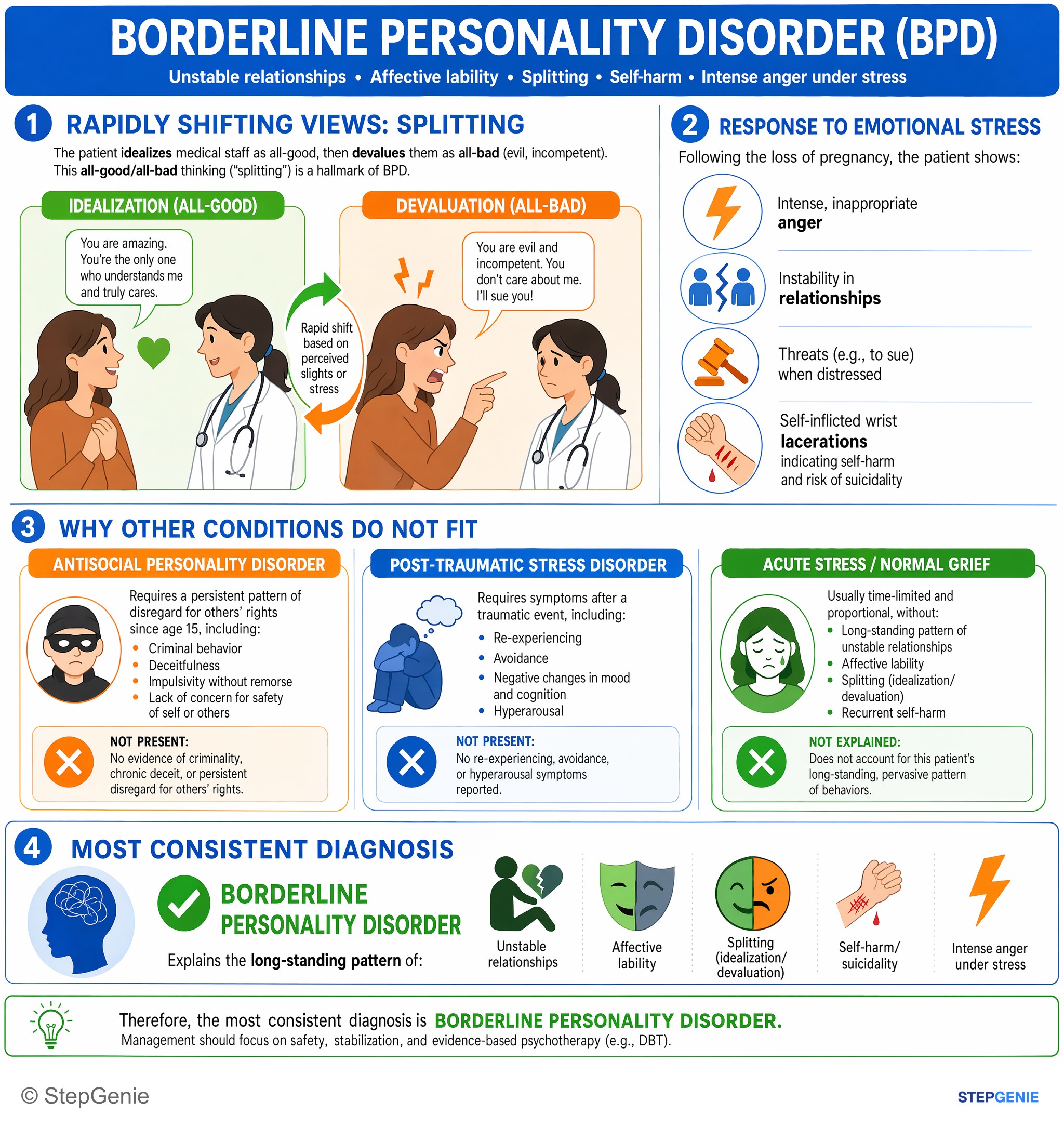
Borderline personality disorder: unstable relationships, affective lability, splitting (idealization/devaluation), self-harm, intense…
USMLE Step 2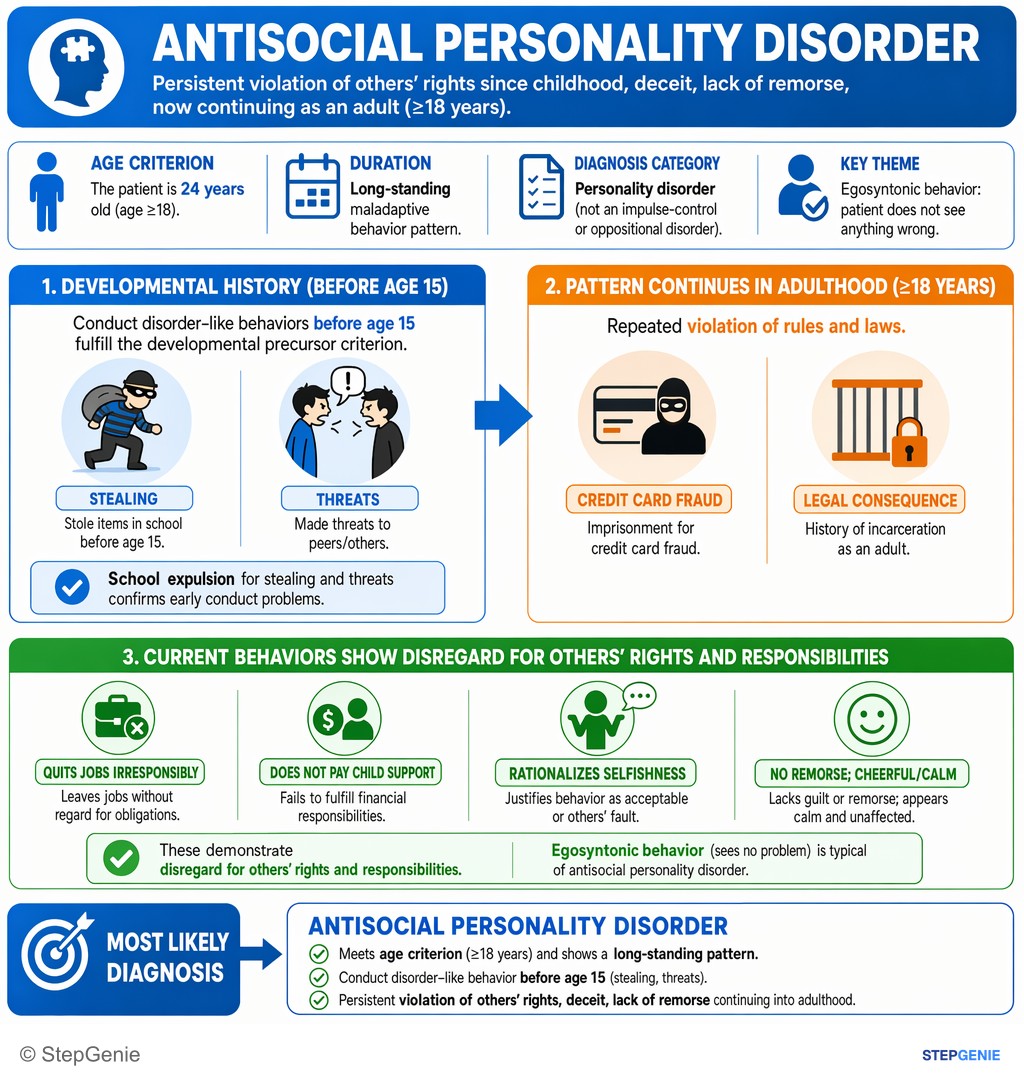
Antisocial personality disorder: persistent violation of others’ rights since childhood, deceit, lack of remorse, now continuing as an…
USMLE Step 2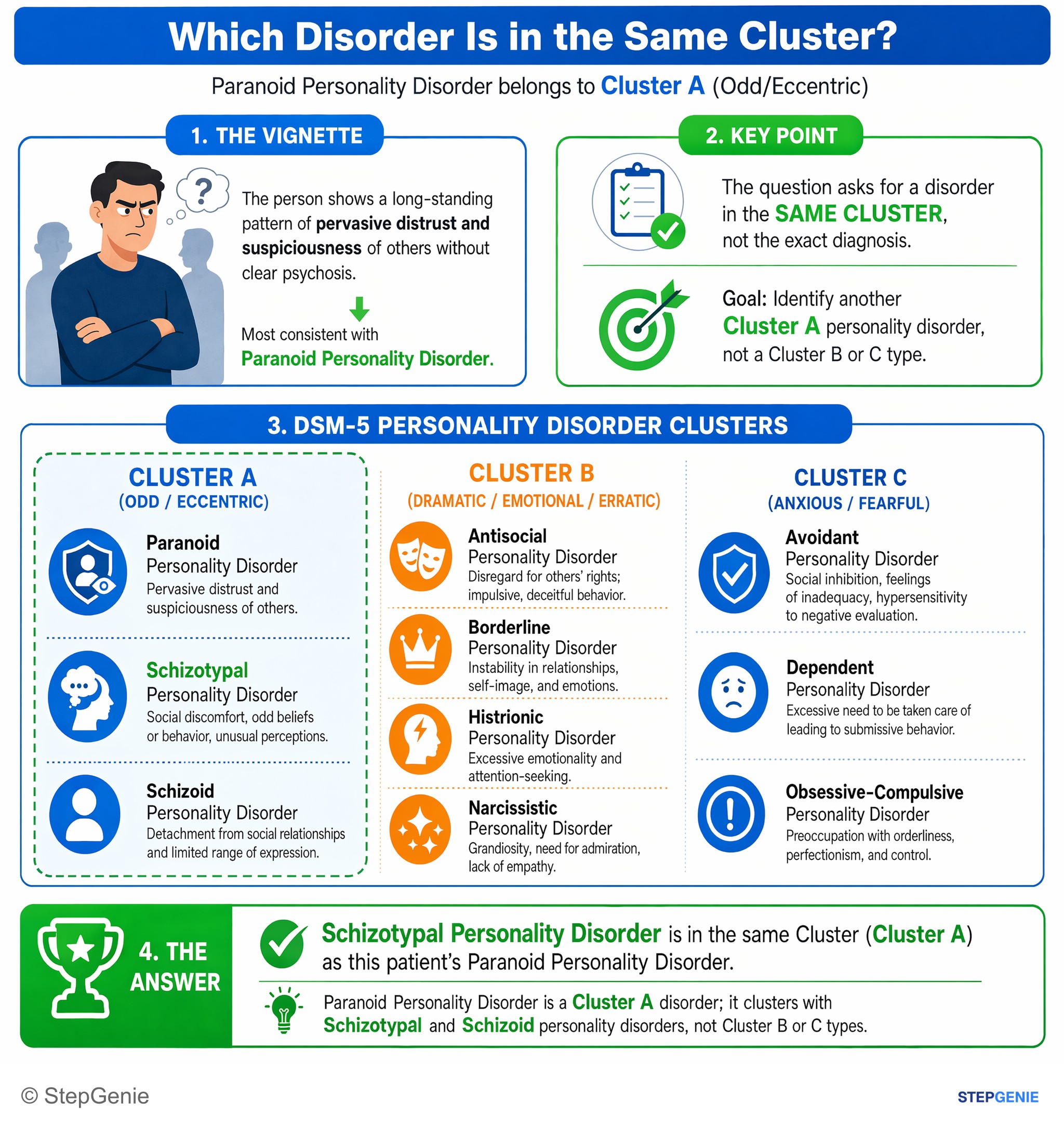
Paranoid personality disorder is a Cluster A disorder; it clusters with schizotypal and schizoid personality disorders, not Cluster B or C…
USMLE Step 1Frequently Asked Questions
How do you tell borderline personality disorder from bipolar I in a vignette with mood swings?
Borderline personality disorder has reactive, brief mood shifts tied to interpersonal stress, whereas bipolar I requires a sustained manic episode. In borderline personality disorder, emotions often change over minutes to hours and are linked to abandonment fears, splitting, and self-harm. Bipolar I instead features mania with elevated or irritable mood, increased energy, decreased need for sleep, grandiosity, and more sustained symptoms.
What defense mechanism is most associated with borderline personality disorder?
The classic defense mechanism in borderline personality disorder is splitting. This means the patient sees people as all good or all bad, often shifting from idealization to devaluation. A typical clue is describing someone as “perfect” and then later as “evil.” When this pattern appears alongside abandonment fear, unstable relationships, emptiness, and self-harm, it strongly points to borderline personality disorder.
What is the most effective psychotherapy for borderline personality disorder?
Dialectical behavior therapy is the most effective psychotherapy for borderline personality disorder. It focuses on practical skills such as mindfulness, distress tolerance, emotion regulation, and interpersonal effectiveness. This fits the core problems seen in borderline personality disorder, including intense emotions, chaotic relationships, and self-harm used to regulate distress. Medications do not directly treat the personality disorder itself, though they can target specific symptoms.
How do you distinguish borderline personality disorder from histrionic personality disorder?
Borderline personality disorder is marked by abandonment fear, self-harm, unstable identity and relationships, and splitting, while histrionic personality disorder is defined more by excessive emotionality and attention-seeking. Histrionic personality disorder often includes inappropriately seductive behavior, theatricality, impressionistic speech, and using physical appearance to draw attention. If the vignette centers on terror of abandonment and self-injury, borderline personality disorder is the better diagnosis.
What is the key management pearl for patients with borderline personality disorder?
A key management principle in borderline personality disorder is to maintain clear boundaries and consistent follow-up. This approach helps avoid reactive overinvolvement or withdrawal, which can worsen instability in the therapeutic relationship. Because these patients often have intense emotions, fear of abandonment, and unstable relationships, steady and structured care is especially important. Self-harm may be non-suicidal, but it is still serious and requires careful management.