Social anxiety disorder questions are “free points” on Step exams if you train your eye to spot the core fear (negative evaluation) and separate it from panic attacks, agoraphobia, and everyday shyness. The trick: test writers often give you a public-speaking vignette with enough overlap to tempt you into the wrong anxiety diagnosis. Let’s walk through a classic stem and then dismantle every answer choice like you would in a real Q-bank review.
Clinical Vignette (Q-Bank Style)
A 24-year-old medical student avoids giving presentations and frequently skips small-group sessions. He reports intense fear that others will notice his trembling hands and judge him as “incompetent.” Before speaking in class, he develops palpitations, sweating, and nausea. He says, “I know it’s irrational, but I can’t stop thinking everyone is watching me.” Symptoms have been present since high school and have interfered with academic performance and relationships. He does not have symptoms when alone. He denies episodes of fear occurring “out of the blue.” No substance use.
Question: What is the most likely diagnosis?
Correct Answer: Social Anxiety Disorder (Social Phobia)
Why this is social anxiety disorder
Social anxiety disorder is defined by marked fear/anxiety about social situations in which the person may be scrutinized and fears negative evaluation (embarrassment, humiliation, rejection). Exposure triggers anxiety and the person avoids the situation or endures it with intense distress.
Clues in the stem
- Fear is specifically about being judged/embarrassed: “others will notice… judge me”
- Performance/social situations trigger symptoms (presentations, small group)
- Physiologic anxiety occurs in the situation (palpitations, sweating)—this can look like panic, but the trigger is social scrutiny
- Persistent + impairing (since high school; academic/relationship impact)
- Insight preserved (“I know it’s irrational” is common)
High-yield add-ons (Step 1/2 favorites)
- Specifiers: “performance only” (e.g., public speaking) vs generalized across many social interactions.
- Treatment (first-line):
- CBT with exposure (gold standard psychotherapy)
- SSRIs/SNRIs (e.g., sertraline, paroxetine, venlafaxine)
- Performance-only: propranolol (or a short-acting benzodiazepine occasionally—but avoid as routine due to dependence)
- Comorbidities: MDD, other anxiety disorders, alcohol use disorder (self-medication), avoidant personality traits.
Why Every Other Answer Choice Is Wrong (But Tempting)
Below is the exact skill that boosts your score: don’t just “know the right answer”—know why the others are not right.
Distractor 1: Panic Disorder
Why it’s tempting: He has palpitations, sweating, nausea—classic panic symptoms.
Why it’s wrong: Panic disorder requires recurrent unexpected panic attacks + ≥1 month of maladaptive worry/behavior change related to attacks.
- In this vignette, symptoms are situational and predictably triggered by scrutiny (presenting in class).
- He denies “out of the blue” attacks—test writers often include this line deliberately.
USMLE tip:
If panic symptoms only happen in one specific context (social scrutiny, specific object, trauma reminder), think social anxiety, specific phobia, or PTSD, not panic disorder.
Distractor 2: Agoraphobia
Why it’s tempting: Avoidance and fear can look like agoraphobia if you skim.
Why it’s wrong: Agoraphobia is fear/avoidance of situations where escape might be difficult or help might not be available if panic-like symptoms occur (e.g., crowds, public transport, being outside alone).
- This patient fears negative evaluation, not inability to escape or being trapped.
- His avoidance is centered on being watched/judged, not on escape safety.
Quick compare
| Feature | Social anxiety disorder | Agoraphobia |
|---|---|---|
| Core fear | Embarrassment, negative evaluation | Unable to escape / no help if symptoms occur |
| Common triggers | Speaking, meeting people, eating in public | Crowds, buses, bridges, being outside alone |
| “Spotlight” theme | Yes | No |
Distractor 3: Specific Phobia
Why it’s tempting: Predictable fear with avoidance.
Why it’s wrong: Specific phobia is fear of a specific object or situation (heights, flying, needles, animals) and the fear is typically not about social judgment.
- If the stem were “intense fear of flying” → specific phobia.
- Here, the trigger is a social performance with scrutiny.
High-yield nuance:
Public speaking anxiety can look “specific,” but because the feared consequence is humiliation, it stays under social anxiety disorder (performance-only subtype), not specific phobia.
Distractor 4: Generalized Anxiety Disorder (GAD)
Why it’s tempting: Chronic anxiety in a high-achieving student.
Why it’s wrong: GAD is excessive anxiety and worry about multiple domains (school, health, money, family) more days than not for ≥6 months, with associated symptoms (restlessness, fatigue, poor concentration, irritability, muscle tension, sleep disturbance).
- This patient’s anxiety is situational and tightly linked to social evaluation.
- He’s not described as having pervasive worry across domains.
Exam move:
If the question stem gives you one consistent trigger (social scrutiny), don’t drift into GAD just because the patient is stressed.
Distractor 5: Avoidant Personality Disorder
Why it’s tempting: Longstanding pattern since adolescence, social avoidance, sensitivity to criticism.
Why it’s wrong (most likely): Avoidant personality disorder is a pervasive pattern of social inhibition, feelings of inadequacy, and hypersensitivity to negative evaluation across most contexts. Social anxiety disorder can be limited (especially “performance only”) and is often framed as a fear response rather than an enduring personality pattern.
In this vignette:
- The stem emphasizes discrete anxiety in social/performance settings with physiologic symptoms and avoidance.
- Personality disorders are about stable traits across time and situations—not just anxiety episodes around scrutiny.
How USMLE differentiates them
- Social anxiety disorder: “I’m afraid I’ll embarrass myself” → fear-based, can improve with exposure/SSRIs.
- Avoidant PD: “I’m inadequate; I avoid most relationships unless I’m certain I’ll be liked” → pervasive pattern, begins by early adulthood, inflexible across contexts.
Clinically important nuance: These can co-exist. On exams, pick avoidant PD only when the vignette screams pervasive interpersonal inhibition and global avoidance beyond performance situations.
Distractor 6: Major Depressive Disorder (MDD)
Why it’s tempting: Social withdrawal and functional impairment.
Why it’s wrong: MDD requires ≥2 weeks of depressed mood or anhedonia plus neurovegetative/cognitive symptoms (sleep, appetite, guilt, concentration, psychomotor changes, suicidality).
- The stem centers on fear of scrutiny, not depressed mood/anhedonia.
- He avoids because of anxiety, not loss of interest/pleasure.
Test writer trick: “Isolation” can come from depression, anxiety, psychosis, autism spectrum disorder—always ask why the patient is withdrawing.
Distractor 7: Autism Spectrum Disorder (ASD)
Why it’s tempting: Social difficulties and avoidance.
Why it’s wrong: ASD involves persistent deficits in social communication/interaction plus restricted/repetitive patterns of behavior with onset early in development.
- This patient has intact social understanding and the problem is fear of judgment, not difficulty reading social cues.
- No mention of restricted interests, stereotypies, or developmental history.
The High-Yield “One-Liner” You Should Memorize
Social anxiety disorder = fear of negative evaluation in social/performance situations → avoidance + distress/impairment; panic symptoms can occur but are situationally triggered.
Rapid-Fire Step Prep: Diagnosis & Treatment Table
| Diagnosis | Core feature | Key differentiator | First-line treatment |
|---|---|---|---|
| Social anxiety disorder | Fear of scrutiny/negative evaluation | Triggered by social/performance | CBT (exposure), SSRI/SNRI; performance-only: propranolol |
| Panic disorder | Unexpected panic attacks | “Out of the blue” attacks + worry | SSRI/SNRI + CBT |
| Agoraphobia | Escape/help concerns | Avoids crowds/transport/outside alone | SSRI/SNRI + CBT |
| Specific phobia | Specific object/situation | Not about judgment | Exposure therapy |
| GAD | Excessive worry about many domains | Chronic diffuse worry | CBT + SSRI/SNRI |
| Avoidant PD | Pervasive inhibition/inadequacy | Trait-like across contexts | Psychotherapy (long-term), sometimes SSRI for symptoms |
Common Exam Pitfalls (and How to Avoid Them)
- Mistaking panic symptoms for panic disorder: Look for unexpected attacks. If the trigger is “everyone is watching me,” it’s social anxiety.
- Confusing shyness with pathology: Social anxiety disorder causes clinically significant distress/impairment and persistent avoidance.
- Overcalling avoidant personality disorder: Choose it when avoidance is pervasive across relationships and framed as a stable personality pattern—not just performance fear.
Takeaway
When the stem screams “I’m scared people will judge me”, anchor on social anxiety disorder—even if the patient is sweating, trembling, and tachycardic. The physiologic symptoms are real, but the why behind them is what gets you the point.
Visual explanations from the StepGenie QBank
Infographics StepGenie drew to explain questions in its own QBank, matched to this article's topic. Each caption is the takeaway of the question it explains.
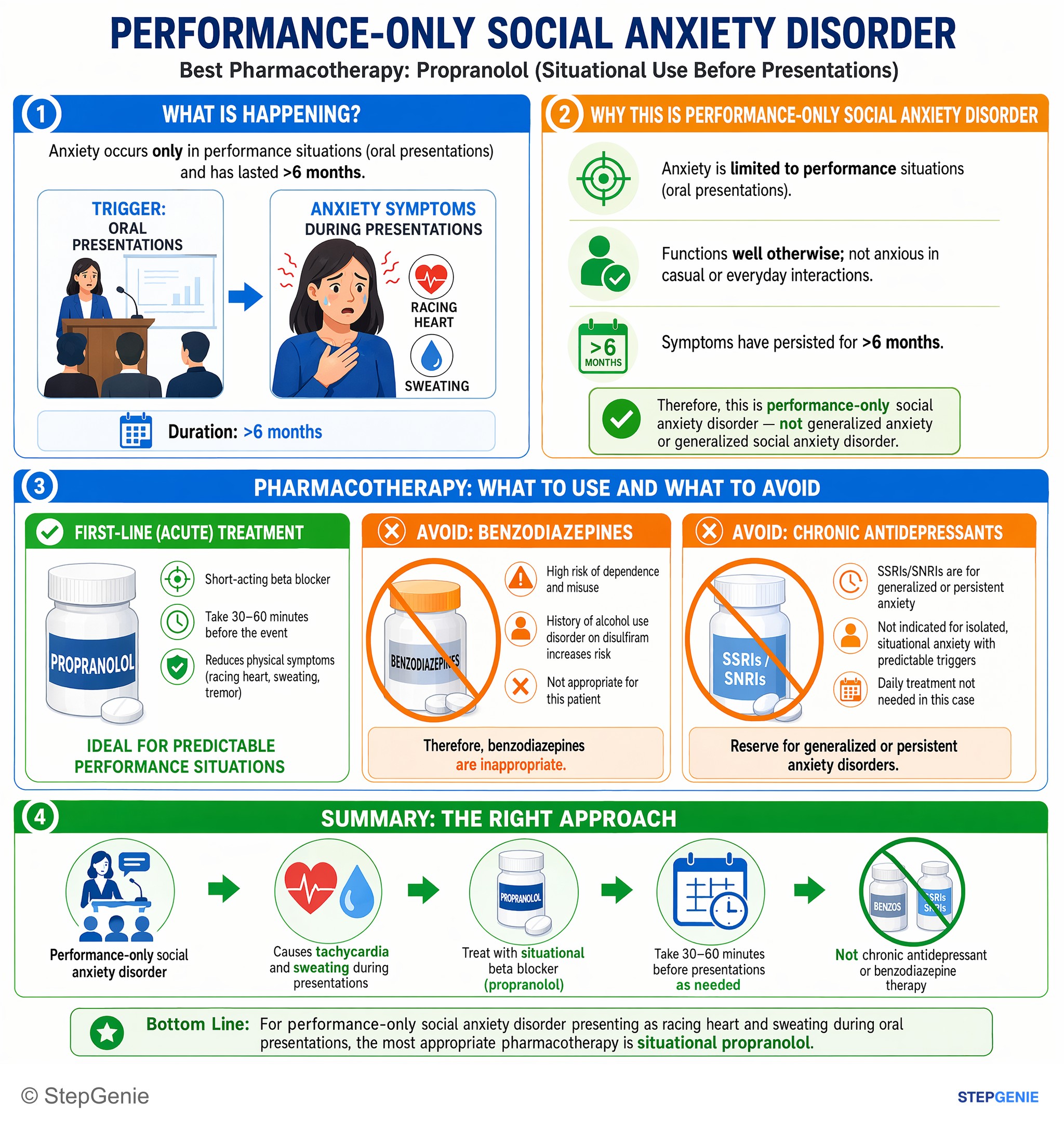
Performance-only social anxiety disorder causing tachycardia/sweating during presentations; treat with situational beta blocker…
USMLE Step 2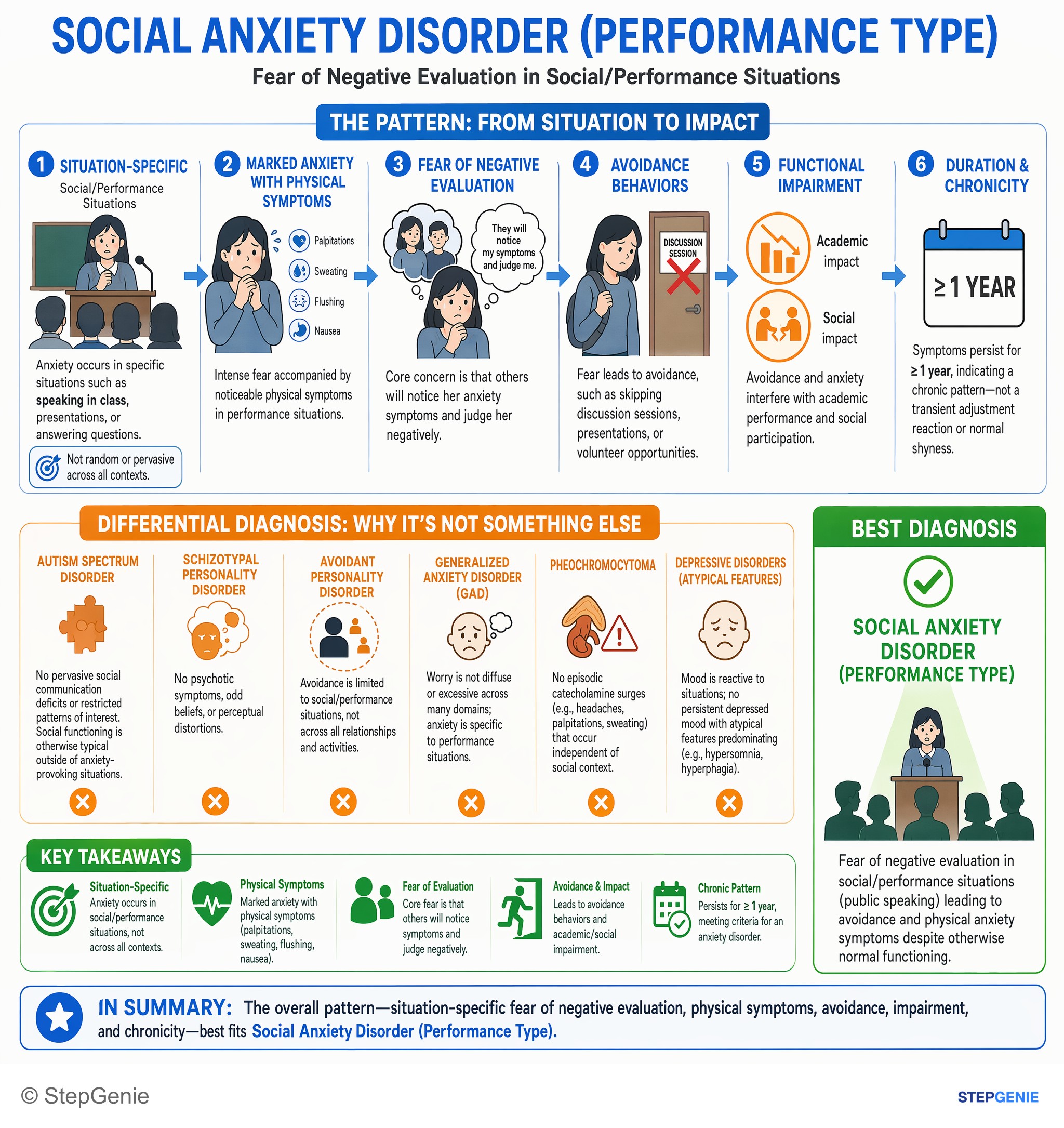
Social anxiety disorder causes fear of negative evaluation in social/performance situations, leading to avoidance and physical anxiety…
USMLE Step 2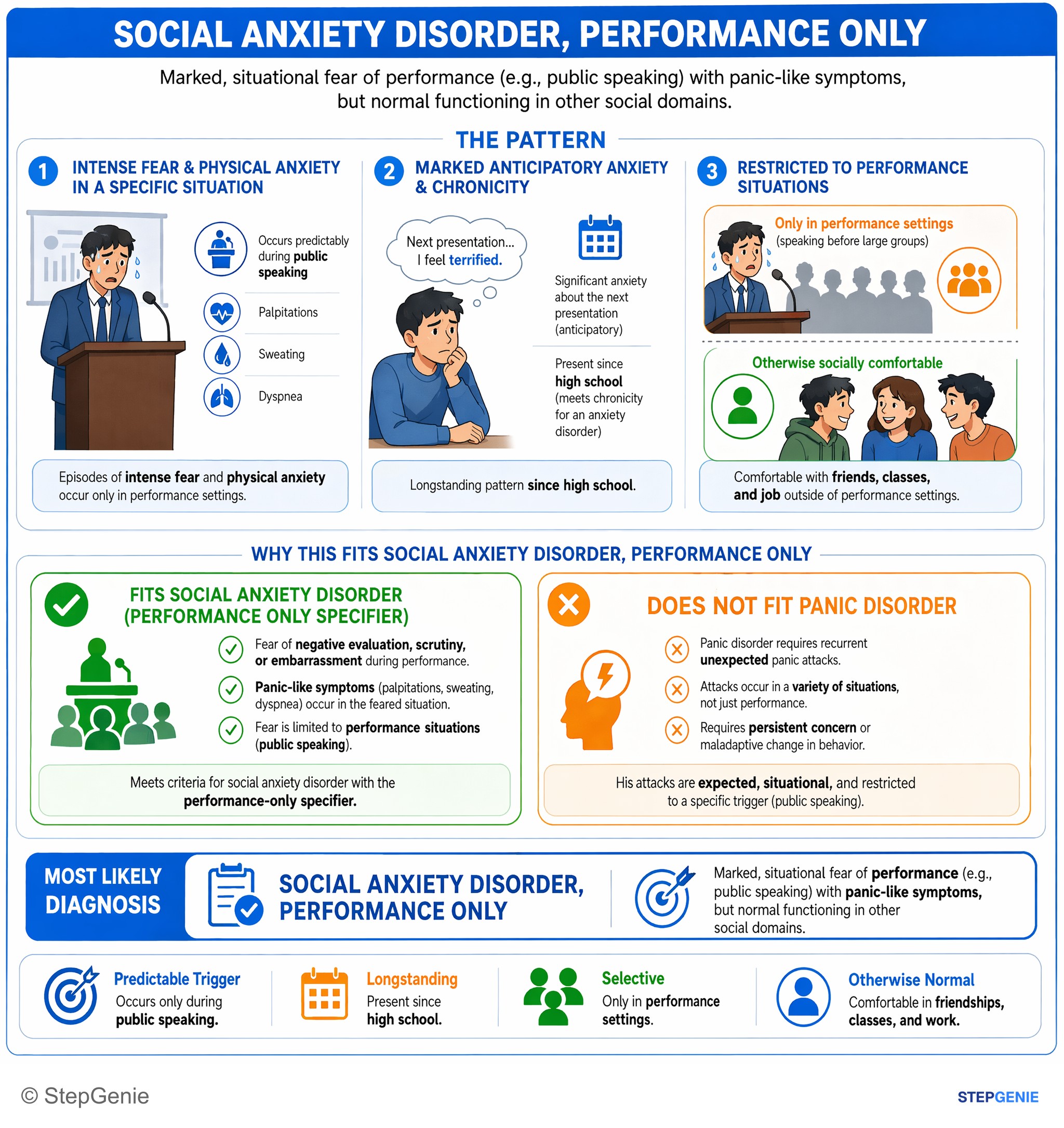
Social anxiety disorder, performance only: marked, situational fear of performance (eg, public speaking) with panic-like symptoms, but…
USMLE Step 2Frequently Asked Questions
How do you tell social anxiety disorder from panic disorder in a question stem?
The key difference is that social anxiety disorder causes panic-like symptoms only in situations involving social scrutiny, while panic disorder requires recurrent unexpected attacks. In a typical social anxiety stem, palpitations, sweating, or nausea happen predictably before presentations, meetings, or other judged situations. A clue against panic disorder is when the patient denies episodes occurring "out of the blue."
Why is fear of public speaking usually social anxiety disorder instead of specific phobia?
Fear of public speaking points to social anxiety disorder when the feared consequence is humiliation or negative evaluation. Specific phobia involves fear of a particular object or situation, such as flying, heights, needles, or animals, and the fear is not primarily about being judged by others. Public speaking stays under social anxiety disorder because the core fear is social scrutiny.
How do you distinguish social anxiety disorder from agoraphobia?
Social anxiety disorder is driven by fear of embarrassment and negative evaluation, whereas agoraphobia is driven by fear that escape will be difficult or help unavailable if symptoms occur. A patient who avoids presentations or group settings because others might notice trembling or judge them has social anxiety disorder. Agoraphobia instead centers on places like crowds, buses, bridges, or being outside alone.
What is the first-line treatment for social anxiety disorder?
First-line treatment for social anxiety disorder is CBT with exposure and SSRIs or SNRIs. CBT with exposure is described as the gold standard psychotherapy, and medication options include sertraline, paroxetine, and venlafaxine. For performance-only symptoms, propranolol can be used, while short-acting benzodiazepines should not be used routinely because of dependence risk.
What clinical clues in a stem strongly suggest social anxiety disorder?
The strongest clues are fear of being judged, anxiety during social or performance situations, avoidance, persistence, and impairment. A classic stem includes statements like worrying that others will notice trembling or see the person as incompetent. Symptoms occur in settings such as presentations or small groups, have lasted for years, interfere with school or relationships, and may still occur despite preserved insight.