You’re mid–Q-bank grind, and a vignette pops up with someone “odd,” “suspicious,” and socially isolated. You recognize Cluster A… but then the answer choices all feel kind of plausible. This is exactly where points are won: not just knowing the right diagnosis, but knowing why every other option is wrong.
The Vignette (Practice Question Style)
A 28-year-old man is brought to the clinic by his sister because he “never leaves his apartment” except to buy groceries late at night when fewer people are around. He has no close friends and says relationships are “more trouble than they’re worth.” During the interview, he is guarded and frequently asks, “Why do you need to know that?” He believes his coworkers have been “quietly trying to get him fired” by making him look incompetent, but he cannot provide evidence. He has no hallucinations. His speech is coherent, affect is irritable, and he denies depressed mood. Symptoms have been present since his early 20s and occur across multiple settings.
Question: Which personality disorder best explains this patient’s presentation?
Answer choices
A. Schizoid personality disorder
B. Schizotypal personality disorder
C. Paranoid personality disorder
D. Avoidant personality disorder
E. Delusional disorder, persecutory type
Correct Answer: C. Paranoid Personality Disorder (PPD)
This patient shows a pervasive pattern of distrust and suspiciousness with interpretation of others’ motives as malevolent, beginning by early adulthood and present across contexts.
Why this is PPD (high-yield features)
Key clues that should light up your Step radar:
- Suspiciousness/guardedness: “Why do you need to know that?”
- Unjustified belief others are out to harm him: coworkers “trying to get him fired” without evidence
- No psychosis: no hallucinations, no disorganized speech, no fixed delusions described as unshakeable
- Personality-level pattern: long-standing since early 20s, multiple settings
Testable detail: In PPD, the beliefs are typically overvalued ideas and misinterpretations, not bizarre delusions. Reality testing is not grossly impaired like in schizophrenia spectrum psychosis.
Cluster A Snapshot (Quick Table)
| Disorder | Core vibe | Hallmark clues | Psychosis? |
|---|---|---|---|
| Paranoid | “People are out to get me” | distrust, reads hidden threats, bears grudges | No (though may have transient stress-related paranoia) |
| Schizoid | “I don’t care about people” | detached, flat affect, prefers solitude | No |
| Schizotypal | “I’m weird and I think weird things” | eccentric, odd beliefs/magical thinking, unusual perceptions | Not full psychosis, but can have brief episodes; ↑ risk schizophrenia |
Now, Let’s Destroy the Distractors (Why Every Answer Choice Matters)
A. Schizoid Personality Disorder — Why it’s tempting, why it’s wrong
Why it tempts you: The patient is socially isolated and has no close friends.
Why it’s wrong: Schizoid is defined by detachment + limited emotional expression, not suspiciousness.
Schizoid patients typically:
- Prefer solitary activities
- Appear indifferent to praise/criticism
- Don’t want close relationships (low desire), but not because they fear betrayal
- Usually aren’t guarded or accusatory
Key differentiator:
- Schizoid = “I’m fine alone.”
- Paranoid = “I’m alone because people can’t be trusted.”
B. Schizotypal Personality Disorder — close cousin, but missing the signature
Why it tempts you: Cluster A overlap; can include paranoia-like ideas.
Why it’s wrong: Schizotypal requires cognitive/perceptual distortions and odd/eccentric behavior—not present here.
Look for:
- Magical thinking (e.g., “I can influence events with my mind”)
- Odd beliefs or superstitions inconsistent with cultural norms
- Ideas of reference (e.g., TV speaks directly to them)
- Unusual perceptual experiences (not full hallucinations)
- Eccentric appearance/behavior and odd speech
This vignette has organized speech, no odd beliefs, no perceptual distortions—just pervasive distrust.
USMLE pearl: Schizotypal is on the schizophrenia spectrum and carries an increased risk of schizophrenia.
D. Avoidant Personality Disorder (AvPD) — the “socially isolated” trap
Why it tempts you: He avoids people and has no close friends.
Why it’s wrong: Avoidant PD is driven by fear of rejection/inadequacy, not suspicion of others’ motives.
Avoidant patients:
- Want relationships but avoid them due to fear of criticism
- Are hypersensitive to negative evaluation
- Often present like “social anxiety plus personality-level rigidity”
Our patient isn’t saying: “I’m not good enough” or “they’ll judge me.”
He’s saying: “They’re plotting against me.”
One-liner:
- Avoidant = fear of rejection.
- Paranoid = fear of harm/betrayal.
E. Delusional Disorder, Persecutory Type — the clinical severity distinction
Why it tempts you: The belief that coworkers are trying to get him fired sounds persecutory.
Why it’s wrong: Delusional disorder requires one or more delusions lasting ≥ 1 month that are fixed and typically more circumscribed, with otherwise relatively preserved functioning outside the delusion’s impact.
In personality disorders:
- Pattern is long-standing and pervasive
- Suspiciousness is trait-like and woven into interpersonal style
Also, in delusional disorder, the belief is typically held with delusional conviction (not just “I suspect”), and the presentation often centers around the delusion as a dominant symptom.
Step-style rule of thumb:
- PPD = pervasive mistrust across relationships, “soft paranoid” style.
- Delusional disorder = fixed delusion(s) with stronger conviction and a more discrete psychopathology.
High-Yield Exam Hooks for Cluster A
Fast pattern recognition
- Paranoid: interprets benign remarks as threatening; reluctant to confide; bears grudges; “tests” loyalty.
- Schizoid: emotionally cold, indifferent, solitary; low interest in sex; seems unaffected by relationships.
- Schizotypal: eccentric; odd beliefs; unusual perceptual experiences; odd speech/appearance.
Comorbidities & differentials to keep straight
- Schizotypal vs schizophrenia: schizotypal = personality disorder (chronic traits) with odd beliefs; schizophrenia = persistent psychotic symptoms (delusions/hallucinations/disorganization) + functional decline.
- Paranoid vs PTSD: PTSD has a clear trauma link and includes intrusive symptoms, avoidance, negative mood/cognition changes, and hyperarousal. PPD is lifelong and not trauma-anchored.
- Avoidant vs schizoid: avoidant wants connection but fears rejection; schizoid prefers distance and feels fine with it.
How Q-Banks Want You to Think (A Mini Algorithm)
When you see social isolation + “oddness,” ask:
-
Does the patient want relationships?
- Yes, but avoids due to fear of rejection → Avoidant PD
- No, indifferent → Schizoid PD
-
Is there suspiciousness/distrust as the main feature?
- Yes → Paranoid PD
-
Are there eccentric behaviors/odd beliefs/perceptual distortions?
- Yes → Schizotypal PD
-
Is there a fixed delusion or frank psychosis?
- Fixed delusion ≥ 1 month → Delusional disorder
- Psychosis + functional decline → think schizophrenia spectrum
Take-Home Summary (What to remember on test day)
- Paranoid PD = pervasive distrust + suspiciousness without frank psychosis.
- Schizoid PD = detached, flat, indifferent—not suspicious.
- Schizotypal PD = eccentric with odd beliefs/magical thinking and unusual perceptions.
- Avoidant PD = socially inhibited because of fear of rejection, not paranoia.
- Delusional disorder = fixed delusions (≥1 month), not just a lifelong suspicious interpersonal style.
Visual explanations from the StepGenie QBank
Infographics StepGenie drew to explain questions in its own QBank, matched to this article's topic. Each caption is the takeaway of the question it explains.
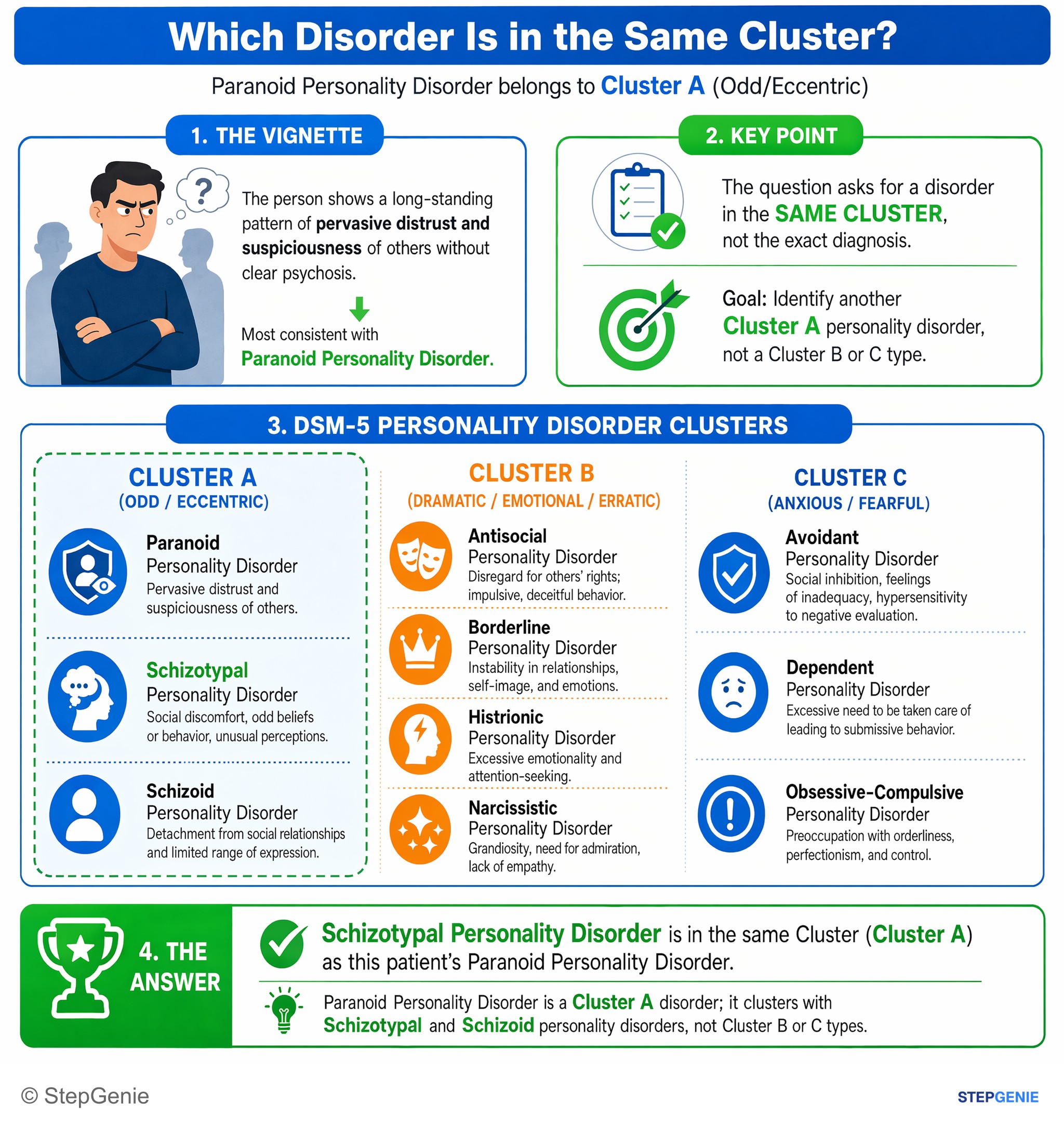
Paranoid personality disorder is a Cluster A disorder; it clusters with schizotypal and schizoid personality disorders, not Cluster B or C…
USMLE Step 1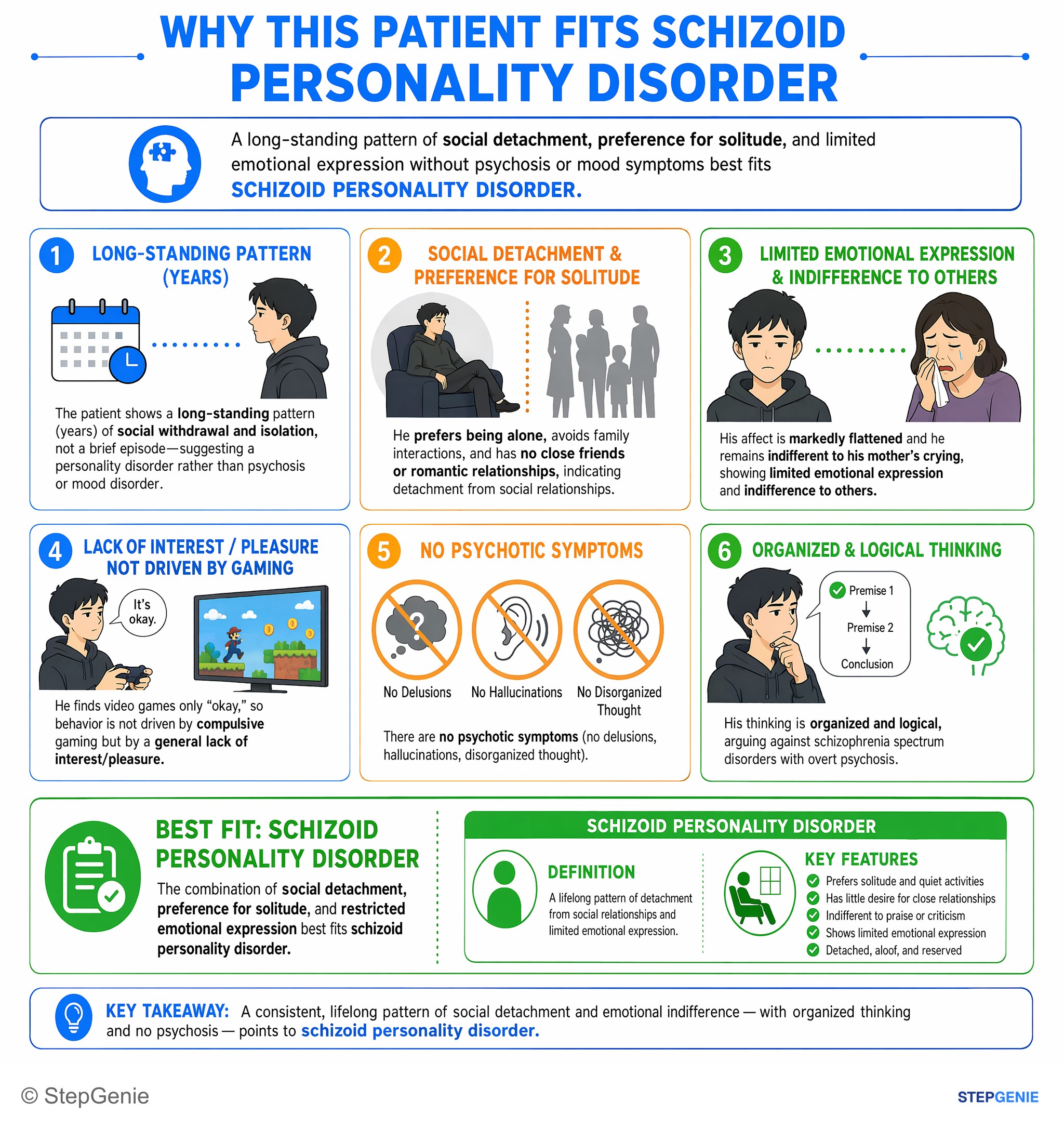
Schizoid personality disorder: lifelong pattern of detachment from social relationships and limited emotional expression; prefers…
USMLE Step 2Frequently Asked Questions
How do you tell paranoid personality disorder from schizoid personality disorder in a vignette?
Paranoid personality disorder is distinguished by distrust and suspiciousness, while schizoid personality disorder is defined by detachment and limited emotional expression. A patient with paranoid personality disorder is socially isolated because other people seem threatening or untrustworthy. A schizoid patient is more likely to prefer being alone, seem indifferent to praise or criticism, and not appear guarded or accusatory.
What clues point to paranoid personality disorder instead of schizotypal personality disorder?
Paranoid personality disorder is more likely when the main pattern is pervasive distrust without odd beliefs or perceptual distortions. Schizotypal personality disorder requires cognitive or perceptual distortions and eccentric behavior, such as magical thinking, unusual perceptions, ideas of reference, odd speech, or eccentric appearance. Organized speech and the absence of odd beliefs support paranoid personality disorder instead.
How do you differentiate avoidant personality disorder from paranoid personality disorder?
Avoidant personality disorder is driven by fear of rejection and feelings of inadequacy, whereas paranoid personality disorder is driven by fear of harm or betrayal. Patients with avoidant personality disorder usually want relationships but avoid them because they are hypersensitive to criticism or negative evaluation. In paranoid personality disorder, the patient withdraws because they believe other people have malevolent motives.
Why isn’t this persecutory delusional disorder instead of paranoid personality disorder?
Paranoid personality disorder fits better when suspiciousness is a long-standing, pervasive personality pattern across multiple settings rather than a discrete fixed delusion. Delusional disorder involves one or more fixed delusions with stronger conviction and typically more preserved functioning outside the delusional theme. In paranoid personality disorder, the beliefs are better described as overvalued ideas and misinterpretations, not unshakeable delusions.
What are the high-yield features of paranoid personality disorder for exam questions?
The key features are pervasive distrust, suspiciousness, and interpreting other people’s motives as malevolent beginning by early adulthood and occurring across contexts. Typical clues include guarded behavior, unjustified beliefs that others are trying to harm them, and long-standing interpersonal mistrust. The absence of hallucinations, disorganized speech, and fixed bizarre delusions helps separate it from psychotic disorders.