The pyruvate dehydrogenase complex (PDH) needs five cofactors, remembered as "Tender Loving Care For Nancy": thiamine pyrophosphate (TPP, from vitamin B1), lipoic acid, coenzyme A (CoA, from vitamin B5), FAD (from vitamin B2) and NAD⁺ (from vitamin B3). The words follow the order the complex uses them: E1 uses TPP, E2 uses lipoic acid and CoA, and E3 uses FAD and NAD⁺. PDH irreversibly converts pyruvate to acetyl-CoA, CO₂ and NADH in the mitochondrial matrix, the link between glycolysis and the TCA cycle. It is switched off by phosphorylation (PDH kinase, stimulated by ATP, NADH and acetyl-CoA) and on by dephosphorylation (PDH phosphatase, stimulated by Ca²⁺ and insulin). When PDH fails, whether from an inherited defect, thiamine deficiency or arsenic, pyruvate backs up into lactate and alanine.
The 5 cofactors of pyruvate dehydrogenase at a glance
| Letter | Cofactor | Comes from | Used by | What it does |
|---|---|---|---|---|
| Tender | Thiamine pyrophosphate (TPP) | Vitamin B1 (thiamine) | E1, pyruvate dehydrogenase (the decarboxylase) | Removes CO₂ from pyruvate and holds the remaining two carbons as a hydroxyethyl group |
| Loving | Lipoic acid (as lipoamide) | Made in mitochondria from octanoic acid; not a vitamin | E2, dihydrolipoyl transacetylase | A swinging arm, attached to a lysine of E2, that takes the two-carbon group from TPP |
| Care | Coenzyme A (CoA) | Vitamin B5 (pantothenic acid) | E2 | Receives the acetyl group and leaves as acetyl-CoA |
| For | FAD | Vitamin B2 (riboflavin) | E3, dihydrolipoyl dehydrogenase | Reoxidizes lipoamide so E2 can work again |
| Nancy | NAD⁺ | Vitamin B3 (niacin) | E3 | Final electron acceptor; leaves as NADH |
The net reaction is pyruvate + CoA + NAD⁺ → acetyl-CoA + CO₂ + NADH + H⁺. In mammals, E2 and an E3-binding protein (E3BP, gene PDHX) together form a 60-subunit core; the human core holds 48 E2 and 12 E3BP subunits.
Exam shortcut: α-ketoglutarate dehydrogenase uses the same five cofactors, so one mnemonic covers both enzymes, and thiamine deficiency or arsenic hits both.
How to use "Tender Loving Care For Nancy"
The mnemonic answers the three ways exams ask about PDH cofactors:
- Name the five. One cofactor per word: TPP, Lipoic acid, CoA, FAD, NAD⁺.
- Put them in order. The words follow the reaction: E1 (TPP), then E2 (lipoic acid, then CoA), then E3 (FAD, then NAD⁺). The first cofactor to act is TPP and the last is NAD⁺.
- Match the vitamins. Four of the five come from B vitamins. In mnemonic order the vitamin numbers run 1, none, 5, 2, 3: thiamine (B1), lipoic acid (no vitamin), pantothenic acid (B5), riboflavin (B2) and niacin (B3).
Lipoic acid is the odd one out. Humans synthesize it in mitochondria from octanoic acid, an 8-carbon fatty acid, so there is no dietary lipoic acid deficiency. Deficiency has been described only in rare inherited defects of its synthesis (genes such as LIAS, LIPT1 and LIPT2), which cause a secondary PDH deficiency. Its board hook is poisoning: arsenite binds the lipoamide arm.
For the rest of the B-vitamin cofactors, from PLP (B6) to B12, see the enzyme cofactors mnemonic.
Cofactors vs coenzymes: catalytic and stoichiometric
Whether a question asks for the "5 cofactors" or the "5 coenzymes" of PDH, it means the same five molecules. Biochemistry texts sort them by how they behave in the reaction:
| Type | Members | How they behave |
|---|---|---|
| Catalytic cofactors | TPP, lipoic acid, FAD | Stay with the complex and are regenerated every turn. Lipoic acid is joined to a lysine side chain of E2 by an amide linkage (lipoamide), and FAD is bound very tightly to E3 |
| Stoichiometric cofactors | CoA, NAD⁺ | Used once per pyruvate and released as products: acetyl-CoA and NADH |
So if a question asks which PDH cofactors are consumed by the reaction, the answer is CoA and NAD⁺; TPP, lipoamide and FAD are back in their starting form at the end of each cycle.
What each cofactor does, step by step
- TPP decarboxylates pyruvate (E1). Pyruvate combines with TPP and loses CO₂, leaving a hydroxyethyl group on TPP.
- Lipoamide takes the two carbons (E1 to E2). The hydroxyethyl group is oxidized to an acetyl group and passed to the lipoamide arm of E2 as a thioester; the arm's disulfide is reduced in the process.
- CoA receives the acetyl group (E2). E2 transfers the acetyl group to CoA, and acetyl-CoA leaves for the TCA cycle. Lipoamide is left in its reduced form, dihydrolipoamide.
- FAD reoxidizes lipoamide (E3). Two electrons pass from dihydrolipoamide to FAD, forming FADH₂.
- NAD⁺ collects the electrons (E3). FADH₂ is reoxidized by NAD⁺, which leaves as NADH.
The swinging lipoamide arm carries the intermediate between the three active sites, which is why a poison that binds its sulfur groups shuts down the whole complex.
| Step | What blocks it |
|---|---|
| 1 (TPP, E1) | Thiamine deficiency; inherited E1 defects (PDHA1, PDHB) |
| 2–3 (lipoamide, E2) | Arsenite binding the dihydrolipoyl groups; inherited lipoic acid synthesis defects |
| 4–5 (FAD and NAD⁺, E3) | E3 (DLD) deficiency, which also disables α-KGDH and BCKDH |
One mnemonic, three enzymes: PDH, α-KGDH and BCKDH
PDH has two relatives that exams test, built on the same plan: a decarboxylating E1, a lipoamide-carrying E2 and the same E3.
| Complex | Reaction | Pathway | When it fails |
|---|---|---|---|
| Pyruvate dehydrogenase (PDH) | Pyruvate → acetyl-CoA + CO₂, with NADH | Links glycolysis to the TCA cycle | Lactic acidosis; inherited PDH deficiency |
| α-Ketoglutarate dehydrogenase (α-KGDH) | α-Ketoglutarate → succinyl-CoA + CO₂, with NADH | TCA cycle | Thiamine deficiency, together with PDH and transketolase |
| Branched-chain α-keto acid dehydrogenase (BCKDH) | Decarboxylates the α-keto acids made from leucine, isoleucine and valine | Second step of branched-chain amino acid breakdown | Maple syrup urine disease |
- α-KGDH uses all five cofactors: TPP, lipoic acid, CoA, FAD and NAD⁺. Its step is worked through in the TCA cycle Q-bank breakdown.
- E3 is shared by all three. One gene, DLD, encodes the E3 (dihydrolipoamide dehydrogenase) of PDH, α-KGDH and BCKDH, so E3 deficiency can combine lactic acidosis with raised leucine, isoleucine, valine and alloisoleucine and urinary α-ketoglutarate. Many patients with the early-onset or liver-predominant forms lack the branched-chain markers.
- BCKDH also leans on thiamine. Thiamine takes part in decarboxylating branched-chain α-keto acids, and a thiamine trial is considered reasonable in maple syrup urine disease, although whether truly thiamine-responsive MSUD exists is uncertain.
- TPP has one more classic job. It is the cofactor for transketolase in the pentose phosphate pathway. In the functional transketolase assay, a rise in activity of more than 25% when TPP is added is abnormal and points to thiamine deficiency; see the pentose phosphate pathway.
How PDH is regulated: kinase off, phosphatase on
PDH kinase (PDK) phosphorylates the E1 subunit and inactivates the complex; PDH phosphatase (PDP) removes the phosphate and reactivates it. Mammals have four PDK isoforms (PDK1 to PDK4), expressed in a tissue-specific pattern. Most regulators work by pushing the kinase or the phosphatase, and the products also inhibit the complex directly.
| Signal | Net effect on PDH | How |
|---|---|---|
| ↑ ATP, NADH, acetyl-CoA (energy is plentiful) | Off | Stimulate PDH kinase; acetyl-CoA (at E2) and NADH (at E3) also inhibit the complex directly |
| ↑ ADP, pyruvate, NAD⁺, free CoA | On | Inhibit PDH kinase |
| ↑ Ca²⁺ (contracting muscle) | On | Stimulates PDH phosphatase |
| Insulin (fed state) | On | Stimulates PDH phosphatase in liver and adipose tissue; represses PDK2 and PDK4 expression |
| Fasting, diabetes | Off | PDK2 and PDK4 expression rises in many tissues |
| Dichloroacetate | On | Inhibits PDH kinase; investigational for PDH deficiency, not FDA-approved as of October 2026 |
Muscle shows the logic. At rest, energy charge is high and PDH is switched off. As exercise begins, ADP and pyruvate rise and inhibit the kinase, while the Ca²⁺ that triggers contraction activates the phosphatase, so PDH turns on just as demand climbs.
Why fasting shuts PDH off. Fatty-acid oxidation raises mitochondrial acetyl-CoA, which stimulates PDH kinase and, at the same time, allosterically activates pyruvate carboxylase. Pyruvate is steered toward oxaloacetate and gluconeogenesis instead of being burned.
| Pyruvate dehydrogenase | Pyruvate carboxylase | |
|---|---|---|
| Product | Acetyl-CoA + CO₂ + NADH | Oxaloacetate |
| What it feeds | Oxidation in the TCA cycle | Gluconeogenesis |
| Cofactors | TPP, lipoic acid, CoA, FAD, NAD⁺ | Biotin; uses ATP |
| Effect of acetyl-CoA | Inhibits | Activates |
| Favored when | Fed (insulin) | Fasting |
Biotin's other carboxylases are covered in biotin (vitamin B7).
Irreversibility matters. PDH cannot run backward, so acetyl-CoA never becomes pyruvate. That is why even-chain fatty acids and the purely ketogenic amino acids, leucine and lysine, cannot be used to make glucose, while odd-chain fatty acids can, through propionyl-CoA. The full glucogenic-versus-ketogenic split is in essential vs nonessential amino acids.
When PDH fails: inherited deficiency, thiamine and arsenic
| Cause | Mechanism | Stem clues | Treatment |
|---|---|---|---|
| Inherited PDH complex deficiency | 76–85% of cases are variants in PDHA1 (the E1α subunit) on the X chromosome; PDHB, PDHX, DLAT, DLD and PDP1 defects are autosomal recessive | Infant or child with lactic acidosis, hypotonia, developmental delay, seizures, microcephaly, corpus callosum dysgenesis or Leigh syndrome; lactate and pyruvate both high with a normal lactate:pyruvate ratio; alanine may be raised | Ketogenic diet; thiamine trial; dichloroacetate is investigational |
| Thiamine (B1) deficiency | No TPP for PDH, α-KGDH or transketolase | Alcohol use disorder, malnutrition, bariatric surgery, hyperemesis gravidarum, dialysis; lactic acidosis; Wernicke encephalopathy (confusion, ophthalmoplegia, ataxia); dry beriberi (neuropathy) or wet beriberi (high-output heart failure) | Parenteral thiamine, given before or with glucose |
| Arsenic poisoning | Arsenite binds the dihydrolipoyl groups of lipoamide; arsenate replaces phosphate in ATP formation and depletes ATP | Vomiting, rice-water diarrhea, garlic odor on the breath, QTc prolongation; stocking-glove neuropathy 1–3 weeks later; Mees lines after 4–6 weeks | Chelation: dimercaprol for severe acute poisoning; succimer or DMPS |
| E3 deficiency | Biallelic DLD variants disable PDH, α-KGDH and BCKDH | Lactic acidosis with raised branched-chain amino acids or urinary α-ketoglutarate; liver failure in some | No consensus; avoid fasting; mixed results with high-fat diets |
Inherited PDH deficiency. Although PDHA1 is X-linked, clinically affected girls are seen about as often as boys; affected girls more often carry insertion or deletion variants, and most have a new (de novo) variant. Lactate and pyruvate rise together, so the lactate:pyruvate ratio stays in the normal range of 10–20, whereas a ratio above 20 points to a respiratory chain defect. Plasma alanine may be high, because alanine and pyruvate are linked by a single transamination. Patients don't metabolize carbohydrate effectively, so carbohydrate can precipitate lactic acidosis, and the ketogenic diet, which supplies acetyl-CoA from fat without passing through PDH, is the gold-standard therapy, although no treatment is reliably effective and benefit varies. High-dose thiamine (300–1,000 mg/day in divided doses) helps only a minority, mostly those with missense variants. Dichloroacetate, a PDH kinase inhibitor, is still investigational: no drug for PDH deficiency was FDA-approved as of October 2026, and chronic dichloroacetate use can cause polyneuropathy. Pedigree patterns for X-linked conditions are drawn out in X-linked disorders.
PDH phosphatase deficiency is the regulatory version of the disease: the complex stays phosphorylated and inactive, causing unremitting lactic acidosis. PDP1 accounts for about 1% of primary PDH deficiency.
Thiamine deficiency. Without TPP, pyruvate is shunted to lactate, so thiamine deficiency can cause lactic acidosis. In a malnourished or alcohol-using patient, give parenteral thiamine before or together with any glucose; glucose given without thiamine can precipitate Wernicke encephalopathy. Beriberi, Wernicke and Korsakoff are covered in thiamine deficiency for Step 1.
Arsenic. Arsenite has a high affinity for thiol and dithiol groups, and PDH, which depends on lipoic acid, is particularly affected; α-KGDH depends on the same cofactor. Both arsenic and thiamine deficiency stall PDH, but thiamine is not the treatment for arsenic poisoning, because the target is lipoamide, not TPP. Treatment is chelation: dimercaprol (2,3-dimercaptopropanol, first called British anti-Lewisite, or BAL) came from research begun at Oxford in 1939, early in World War II, to find antidotes to arsenical blister agents such as lewisite. Pentavalent arsenate adds a second hit by standing in for phosphate during ATP formation. Most exposure comes from contaminated groundwater; pesticides, herbicides, wood treatments and rice are other sources. A urine arsenic above 100 μg/L supports the diagnosis, and a 24-hour collection is preferred.
What a shortage of each cofactor looks like
| Cofactor | Vitamin | Deficiency | Classic findings |
|---|---|---|---|
| TPP | B1 (thiamine) | Beriberi, Wernicke encephalopathy | Dry beriberi: symmetric peripheral neuropathy; wet beriberi: high-output heart failure; Wernicke: confusion, ophthalmoplegia, ataxia; lactic acidosis |
| Lipoic acid | None | No dietary deficiency | Rare inherited synthesis defects cause secondary PDH deficiency; arsenite inactivates it |
| CoA | B5 (pantothenic acid) | Pantothenic acid deficiency | Dermatitis, enteritis, alopecia, adrenal insufficiency |
| FAD | B2 (riboflavin) | Riboflavin deficiency | Cheilosis (inflamed, fissured lips and mouth corners) and corneal vascularization |
| NAD⁺ | B3 (niacin) | Pellagra | The 3 Ds: diarrhea, dermatitis, dementia; niacin can also be made from tryptophan |
In vignettes, thiamine is the vitamin whose deficiency shows up as PDH failure with lactic acidosis; riboflavin, niacin and pantothenic acid are usually tested through their own syndromes.
How USMLE tests PDH: traps and look-alikes
| Trap | What's actually true |
|---|---|
| Biotin is a PDH cofactor | Biotin serves pyruvate carboxylase; PDH's five are TPP, lipoic acid, CoA, FAD and NAD⁺ |
| Lipoic acid is a B vitamin | Humans make it from octanoic acid; its exam hook is arsenic, not diet |
| Phosphorylated PDH is active | Phosphorylation by PDH kinase switches PDH off; don't assume phosphorylation always activates an enzyme |
| A child with PDH deficiency needs dextrose | Carbohydrate can precipitate lactic acidosis; the mainstay is a ketogenic diet (E3 deficiency differs: high-fat diets have mostly not helped) |
| Dextrose comes first in a malnourished, alcohol-using patient | Give parenteral thiamine before or with glucose |
| Thiamine treats arsenic poisoning | Arsenite targets lipoamide; treatment is chelation |
| PDH deficiency has a high lactate:pyruvate ratio | The ratio is normal (10–20); a ratio above 20 suggests a respiratory chain defect |
| X-linked means only boys are affected | Girls with PDHA1 variants are clinically affected about as often as boys |
| Fat can be turned into glucose through acetyl-CoA | PDH is irreversible, so even-chain fatty acids can't make glucose; odd-chain fatty acids can, through propionyl-CoA |
Diseases with similar names are the other favorite distractor:
| Condition | Enzyme and inheritance | Key findings |
|---|---|---|
| PDH deficiency | PDH complex; mostly X-linked (PDHA1) | Lactic acidosis with a normal lactate:pyruvate ratio, raised alanine, brain malformations |
| Pyruvate carboxylase deficiency | Pyruvate carboxylase (biotin); autosomal recessive | Lactic acidosis with hyperammonemia, ketoacidosis and hypoglycemia; raised citrulline, lysine, alanine and proline |
| Pyruvate kinase deficiency | Red-cell glycolytic enzyme; autosomal recessive | Hemolytic anemia, the most common glycolytic enzyme defect; nonspecific smear with echinocytes; mitapivat for symptomatic adults |
| Maple syrup urine disease | BCKDH; autosomal recessive | Maple syrup odor in cerumen soon after birth; alloisoleucine is the most specific marker |
More pathway guides are collected on the Biochemistry hub.
Worked vignettes
Vignette 1. A 48-year-old man with alcohol use disorder is brought in confused and unsteady on his feet. He has nystagmus and ophthalmoplegia, and his serum lactate is raised. Deficiency of which cofactor explains both the neurologic findings and the lactic acidosis, and which enzymes depend on it?
Answer: Thiamine pyrophosphate (from vitamin B1), the cofactor for E1 of PDH, α-ketoglutarate dehydrogenase and transketolase, and for decarboxylating branched-chain α-keto acids.
Reasoning: Without TPP, PDH can't decarboxylate pyruvate, so pyruvate is shunted to lactate, and α-KGDH stalls inside the TCA cycle. Confusion, ophthalmoplegia and ataxia make up the classic Wernicke triad. Give parenteral thiamine before or together with any glucose.
Vignette 2. Hours after drinking from an unlabeled container of old pesticide, a 35-year-old farmworker develops vomiting, profuse rice-water diarrhea and a garlic odor on his breath, and his ECG shows a prolonged QTc. Two weeks later he has burning numbness of the feet and hands in a stocking-glove pattern. Which PDH cofactor does the toxin target, and what is the treatment?
Answer: Lipoic acid, as the lipoamide arm of E2; treat with chelation (dimercaprol for severe acute poisoning, or succimer or DMPS).
Reasoning: Arsenite binds the dihydrolipoyl groups that PDH and α-KGDH need, so it stalls the same enzymes as thiamine deficiency, but the treatment is chelation, not thiamine. A sensory neuropathy 1–3 weeks after ingestion fits, and a urine arsenic above 100 μg/L supports the diagnosis.
Vignette 3. A 6-month-old girl has hypotonia, developmental delay and new seizures, and MRI shows dysgenesis of the corpus callosum. Blood lactate and pyruvate are both elevated with a lactate:pyruvate ratio of 15, and plasma alanine is high. Her acidosis worsened on dextrose-containing IV fluids. Which gene is most likely affected, and which diet is the mainstay of treatment?
Answer: PDHA1, the X-linked gene for the E1α subunit; a ketogenic (high-fat, low-carbohydrate) diet.
Reasoning: High lactate and pyruvate with a normal ratio point to PDH rather than the respiratory chain. PDHA1 causes 76–85% of primary PDH deficiency, and girls are affected about as often as boys. Carbohydrate makes more pyruvate, which with PDH blocked piles up as lactate and alanine, while fat is oxidized to acetyl-CoA without passing through PDH. A thiamine trial is reasonable, but only a minority respond.
Vignette 4. A 3-year-old boy has had several episodes of vomiting and lactic acidosis during viral illnesses. Plasma leucine, isoleucine, valine and alloisoleucine are raised, and urine α-ketoglutarate is high. Which subunit is defective, and which cofactors does it use?
Answer: E3, dihydrolipoamide dehydrogenase (DLD), which uses FAD and NAD⁺ to reoxidize lipoamide.
Reasoning: One E3 serves PDH (lactate), α-KGDH (α-ketoglutarate) and BCKDH (branched-chain amino acids and alloisoleucine), so only an E3 defect explains all three findings; an E1 defect raises lactate and pyruvate without the branched-chain or α-ketoglutarate markers. Normal markers don't rule it out: in the liver-predominant form, seen in people homozygous for the Ashkenazi Jewish founder variant c.685G>T, branched-chain amino acids and urine α-ketoglutarate are typically normal. There is no consensus treatment: high-fat diets have given mixed results, and patients should avoid fasting and catabolic stress.
Key takeaways
- Tender Loving Care For Nancy: TPP (B1), lipoic acid (not a vitamin), CoA (B5), FAD (B2), NAD⁺ (B3), in the order E1, E2 and E3 use them.
- TPP, lipoic acid and FAD are catalytic cofactors; CoA and NAD⁺ are stoichiometric, leaving as acetyl-CoA and NADH.
- PDH turns pyruvate into acetyl-CoA, CO₂ and NADH, irreversibly, in the mitochondrial matrix.
- α-KGDH uses the same five cofactors, and E3 (DLD) is shared by PDH, α-KGDH and BCKDH.
- Kinase = off, phosphatase = on. ATP, NADH and acetyl-CoA switch PDH off; ADP, pyruvate, Ca²⁺ and insulin switch it on.
- PDH deficiency: mostly X-linked PDHA1, girls affected as often as boys, lactic acidosis with a normal lactate:pyruvate ratio (10–20), treated with a ketogenic diet.
- Thiamine before glucose; arsenite targets lipoamide and needs chelation, not thiamine.
Sources
- Primary Pyruvate Dehydrogenase Complex Deficiency Overview — GeneReviews, NCBI Bookshelf (2021)
- Saol Therapeutics Announces the Acceptance of Resubmission of SL1009 (DCA) by the FDA with PDUFA Date of Dec. 30, 2026 — Saol Therapeutics press release, BioSpace (2026)
- Section 17.1, The Citric Acid Cycle Oxidizes Two-Carbon Units — Berg, Tymoczko & Stryer, Biochemistry, 5th ed., NCBI Bookshelf (2002)
- 16.1: Production of Acetyl-CoA (Activated Acetate) — Jakubowski & Flatt, Fundamentals of Biochemistry, LibreTexts (2026)
- 18.2 The Pyruvate Dehydrogenase Complex Is Regulated by Two Mechanisms — Tymoczko, Berg & Stryer, Biochemistry: A Short Course, 3rd ed., Macmillan (2015)
- Jeong JY, et al. Transcriptional Regulation of Pyruvate Dehydrogenase Kinase — Diabetes & Metabolism Journal (2012)
- Zdanowicz R, et al. Stoichiometry and Architecture of the Human Pyruvate Dehydrogenase Complex — Science Advances (2024)
- Biochemistry, Citric Acid Cycle — StatPearls, NCBI Bookshelf (2023)
- Lipoic Acid — Linus Pauling Institute Micronutrient Information Center, Oregon State University (2019)
- Dihydrolipoamide Dehydrogenase Deficiency — GeneReviews, NCBI Bookshelf (2021)
- Maple Syrup Urine Disease — GeneReviews, NCBI Bookshelf (2020)
- Vitamin B1 (Thiamine) Deficiency — StatPearls, NCBI Bookshelf (2026)
- Biochemistry, Water Soluble Vitamins — StatPearls, NCBI Bookshelf (2023)
- Arsenic Toxicity — StatPearls, NCBI Bookshelf (2026)
- Arsenic Toxicity: Clinical Assessment — ATSDR, CDC (2023)
- Peters RA, Stocken LA, Thompson RHS. British Anti-Lewisite (BAL) — Nature (1945)
- Biochemistry, Gluconeogenesis — StatPearls, NCBI Bookshelf (2023)
- Pyruvate Metabolism Disorders — Merck Manual Professional Edition (2024)
- Glycolytic Pathway Defects — Merck Manual Professional Edition (2026)
Visual explanations from the StepGenie QBank
Infographics StepGenie drew to explain questions in its own QBank, matched to this article's topic. Each caption is the takeaway of the question it explains.
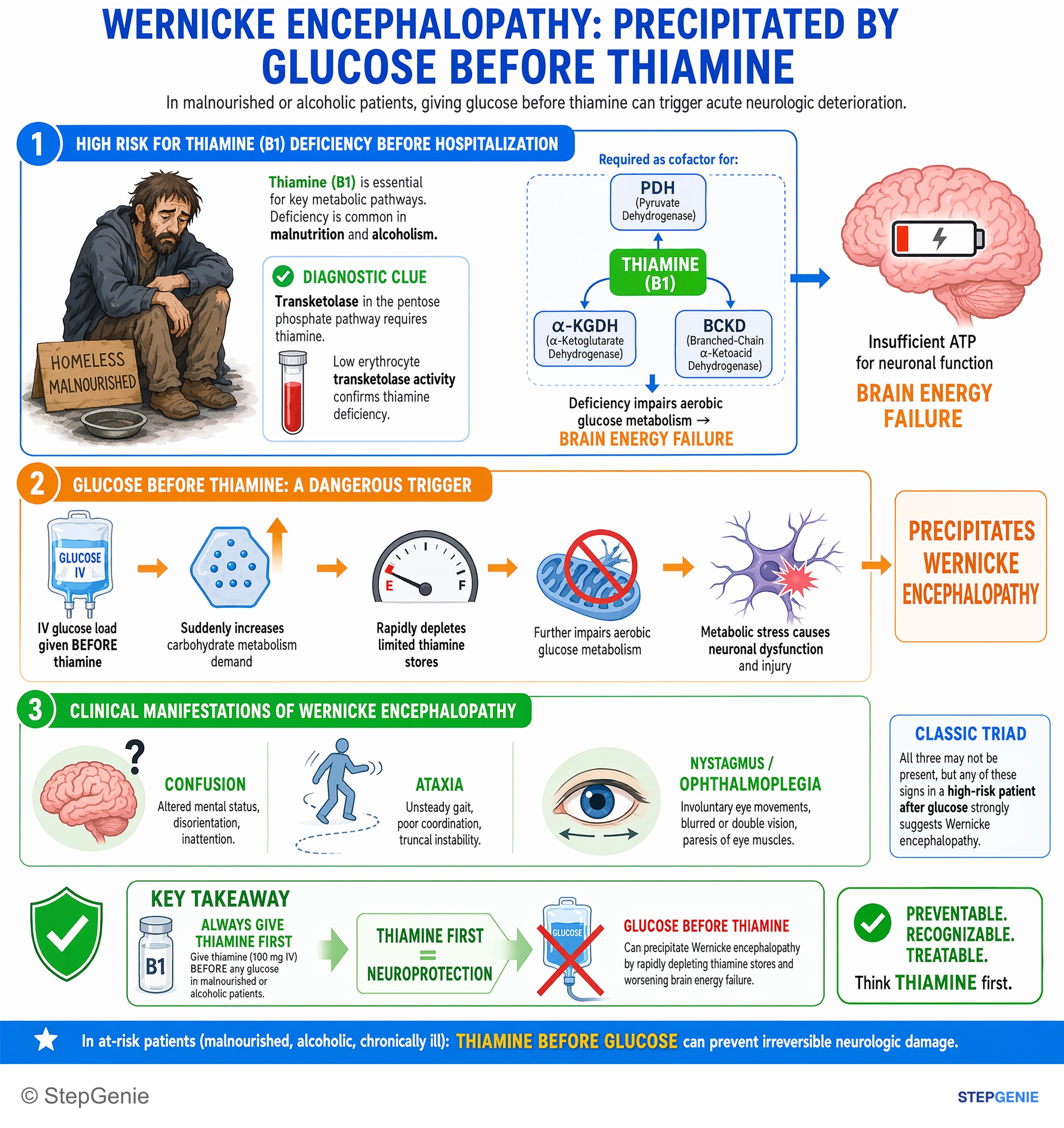
Wernicke encephalopathy due to thiamine deficiency is precipitated by giving glucose before thiamine in malnourished/alcoholic patients.
USMLE Step 1Frequently Asked Questions
What are the 5 cofactors of pyruvate dehydrogenase?
Pyruvate dehydrogenase uses five cofactors: thiamine pyrophosphate (TPP, from vitamin B1), lipoic acid, coenzyme A (from vitamin B5), FAD (from vitamin B2) and NAD⁺ (from vitamin B3). E1 uses TPP to decarboxylate pyruvate, E2 uses lipoic acid and coenzyme A to form acetyl-CoA, and E3 uses FAD and NAD⁺ to reoxidize lipoic acid, releasing NADH. The mnemonic Tender Loving Care For Nancy lists them in that order.
What does Tender Loving Care For Nancy stand for?
Tender Loving Care For Nancy is the mnemonic for the five cofactors of pyruvate dehydrogenase: thiamine pyrophosphate (B1), lipoic acid, coenzyme A (B5), FAD (B2) and NAD⁺ (B3). The words follow the order the complex uses them, from E1 through E2 to E3. The same mnemonic covers α-ketoglutarate dehydrogenase in the TCA cycle, which needs the same five cofactors. Lipoic acid is the only one not made from a vitamin.
Which vitamins does pyruvate dehydrogenase need?
Pyruvate dehydrogenase needs four B vitamins: thiamine (B1) for thiamine pyrophosphate, riboflavin (B2) for FAD, niacin (B3) for NAD⁺ and pantothenic acid (B5) for coenzyme A. Its fifth cofactor, lipoic acid, is made in mitochondria from octanoic acid, so it is not a vitamin. Thiamine deficiency is the classic vitamin cause of PDH failure, shunting pyruvate to lactate; at-risk patients need parenteral thiamine before or with glucose, because glucose alone can precipitate Wernicke encephalopathy.
What activates and inhibits pyruvate dehydrogenase?
PDH is switched off when PDH kinase phosphorylates it and switched back on when PDH phosphatase removes the phosphate. ATP, NADH and acetyl-CoA stimulate the kinase, and acetyl-CoA and NADH also inhibit the complex directly. ADP, pyruvate, NAD⁺ and free CoA inhibit the kinase. Calcium in contracting muscle and insulin in the fed state stimulate the phosphatase, while fasting and diabetes increase PDK2 and PDK4 expression and keep PDH off.
How does arsenic affect pyruvate dehydrogenase?
Arsenite, trivalent arsenic, binds thiol groups, including the dihydrolipoyl groups of lipoic acid on the E2 subunit, so PDH is one of the enzymes it hits hardest; α-ketoglutarate dehydrogenase depends on the same cofactor. Acute poisoning causes vomiting, rice-water diarrhea, a garlic odor on the breath and QTc prolongation, followed 1 to 3 weeks later by a stocking-glove neuropathy. Treatment is chelation with dimercaprol, succimer or DMPS, not thiamine.
How is pyruvate dehydrogenase deficiency inherited and treated?
About 76–85% of primary PDH deficiency is caused by variants in PDHA1, the X-linked gene for the E1α subunit, yet affected girls are seen about as often as boys. Defects in PDHB, PDHX, DLAT, DLD and PDP1 are autosomal recessive. Children have lactic acidosis with a normal lactate:pyruvate ratio, hypotonia and developmental delay. A ketogenic diet is the gold-standard treatment because carbohydrate worsens the acidosis, and a minority respond to high-dose thiamine.