You just opened a TCA cycle question and thought, “I know this… why are all the answer choices kind of true?” Welcome to bioenergetics: the test writers love the TCA cycle because every enzyme sits at the intersection of energy production, cofactors, and vitamin deficiencies—and the distractors are usually “near-misses” that reveal whether you understand the pathway or just memorized it.
Tag: Biochemistry > Bioenergetics & Carb Metabolism
The Clinical Vignette (Q-bank style)
A 54-year-old man with a history of chronic alcohol use presents with confusion, unsteady gait, and horizontal nystagmus. He is malnourished and has lost weight. Labs show a high anion gap metabolic acidosis with elevated lactate. You suspect thiamine deficiency. Which enzyme is most directly impaired, leading to decreased entry of acetyl-CoA into the citric acid cycle and shunting of pyruvate to lactate?
A. Citrate synthase
B. Isocitrate dehydrogenase
C. -ketoglutarate dehydrogenase
D. Succinate dehydrogenase
E. Fumarase
Step-wise Approach (What the stem is really asking)
This is a “thiamine deficiency → enzyme cofactor” question with a clinical overlay (Wernicke encephalopathy + lactic acidosis). When thiamine (B1) is low, pyruvate can’t be efficiently processed, so it gets reduced to lactate to regenerate NAD⁺.
High-yield thiamine-dependent enzymes you must know:
- Pyruvate dehydrogenase (PDH)
- -ketoglutarate dehydrogenase (TCA)
- Branched-chain -ketoacid dehydrogenase (BCAA metabolism)
- Transketolase (HMP shunt)
Mnemonic: “Tender Loving Care For Nancy”
- Transketolase
- Lipoic acid (cofactor used in PDH and KGDH)
- CoA (B5)
- FAD (B2)
- NAD (B3)
Correct Answer: C. -ketoglutarate dehydrogenase
Why it’s correct
-ketoglutarate dehydrogenase is a thiamine (TPP)-dependent enzyme inside the TCA cycle:
It uses the same cofactor set as PDH:
- TPP (B1)
- Lipoic acid
- CoA (B5)
- FAD (B2)
- NAD⁺ (B3)
How this links to the vignette
In thiamine deficiency:
- PDH slows → pyruvate accumulates → lactate rises (lactic acidosis)
- TCA flux decreases, especially at thiamine-dependent steps (including KGDH)
- CNS tissues suffer because they are highly reliant on aerobic metabolism
Clinical pearl: In alcoholism/malnutrition, giving glucose before thiamine can worsen neurologic injury because carbohydrate metabolism increases thiamine demand.
Why Every Distractor Is Wrong (and what it’s testing)
A. Citrate synthase — wrong, but tempting
What it does: Condenses acetyl-CoA + oxaloacetate → citrate.
Why it’s tempting: It’s the “entry” step of the TCA cycle, so it sounds like the best match for “entry into the cycle.”
Why it’s wrong: It is not thiamine-dependent. Thiamine deficiency blocks upstream processing (especially PDH) and specific thiamine-dependent dehydrogenase complexes—not citrate synthase.
High-yield association: Citrate synthase is classically rate-limiting only in simplified diagrams; in reality, major regulated steps include isocitrate dehydrogenase and KGDH.
B. Isocitrate dehydrogenase — wrong enzyme, right vibe
What it does: Isocitrate → -ketoglutarate + CO₂ + NADH.
Key concept tested: Regulation of the TCA cycle.
- Activated by ADP and Ca²⁺
- Inhibited by ATP and NADH
Why it’s wrong here: It does not require thiamine (TPP). If the stem were about “rate-limiting step” or “regulated step increased in muscle during exercise,” isocitrate dehydrogenase becomes a better candidate.
USMLE move: If you see Ca²⁺ activation, think muscle contraction → increased TCA flux (isocitrate dehydrogenase and KGDH both respond to Ca²⁺).
D. Succinate dehydrogenase — the Step 1 favorite distractor
What it does: Succinate → fumarate, producing FADH₂.
Where it lives: Inner mitochondrial membrane, and it is Complex II of the electron transport chain.
Why it’s wrong here: Not thiamine-dependent, and the stem is screaming vitamin deficiency + lactic acidosis, which points you toward PDH/TPP biology.
High-yield tie-ins:
- Malonate inhibits succinate dehydrogenase (competitive inhibitor)
- Succinate dehydrogenase feeds electrons into ubiquinone (CoQ) via FADH₂
E. Fumarase — wrong, but a classic “don’t ignore rare diseases” enzyme
What it does: Fumarate ↔ malate (hydration step).
Why it’s wrong: Not thiamine-dependent and not involved in pyruvate handling or lactate buildup.
High-yield clinical aside (optional brain-file):
- Fumarase deficiency is rare and can present with severe neurologic impairment and developmental delay—but it won’t map cleanly to the classic alcoholism + Wernicke + lactic acidosis stem.
The “Missing” Answer Choice: Pyruvate Dehydrogenase (PDH)
You probably noticed PDH isn’t listed—yet the stem says “decreased entry of acetyl-CoA into the citric acid cycle.” That sounds like PDH:
So why would a question omit it? Because Q-banks love to see whether you can:
- Recognize thiamine deficiency
- Know that TPP-dependent enzymes include a TCA enzyme (KGDH) and not just PDH
Exam takeaway:
- Lactic acidosis in thiamine deficiency is often explained via PDH impairment
- But if PDH isn’t offered, the next best thiamine-dependent target is KGDH
Rapid-Fire High-Yield TCA Cycle Table
| Enzyme | Reaction snapshot | Produces | Key regulation/cofactor | Board-relevant hook |
|---|---|---|---|---|
| Citrate synthase | OAA + acetyl-CoA → citrate | — | Inhibited by ATP/NADH/succinyl-CoA | “Entry step,” not vitamin-dependent |
| Isocitrate dehydrogenase | isocitrate → KG | NADH + CO₂ | ↑ADP, ↑Ca²⁺; ↓ATP, ↓NADH | Often called rate-limiting |
| KG dehydrogenase | KG → succinyl-CoA | NADH + CO₂ | TPP, lipoate, CoA, FAD, NAD⁺; inhibited by NADH/succinyl-CoA | Thiamine deficiency |
| Succinate dehydrogenase | succinate → fumarate | FADH₂ | Inner membrane; Complex II | Malonate inhibitor; ETC crossover |
| Fumarase | fumarate → malate | — | — | Less tested; don’t overpick |
| Malate dehydrogenase | malate → OAA | NADH | Driven forward by citrate synthase pulling OAA | OAA regeneration |
The Micro-Algorithm: How to Nail These in 10 Seconds
- Alcoholic/malnourished + confusion/ataxia/nystagmus ± lactate ↑ → think thiamine (B1) deficiency
- Thiamine deficiency hits dehydrogenase complexes and transketolase
- If PDH isn’t an option, pick the TCA thiamine enzyme: KGDH
Final Takeaways (the stuff that actually earns points)
- Thiamine (B1) deficiency → impaired PDH + KGDH → decreased aerobic metabolism, lactic acidosis, neurologic dysfunction
- KGDH uses TPP + lipoate + CoA + FAD + NAD⁺ (same “big 5” as PDH)
- Succinate dehydrogenase = Complex II (inner mitochondrial membrane) → classic distractor
- “Entry into TCA” can refer to PDH (pyruvate → acetyl-CoA) or to citrate synthase (acetyl-CoA + OAA → citrate)—read what the answers allow
Visual explanations from the StepGenie QBank
Infographics StepGenie drew to explain questions in its own QBank, matched to this article's topic. Each caption is the takeaway of the question it explains.
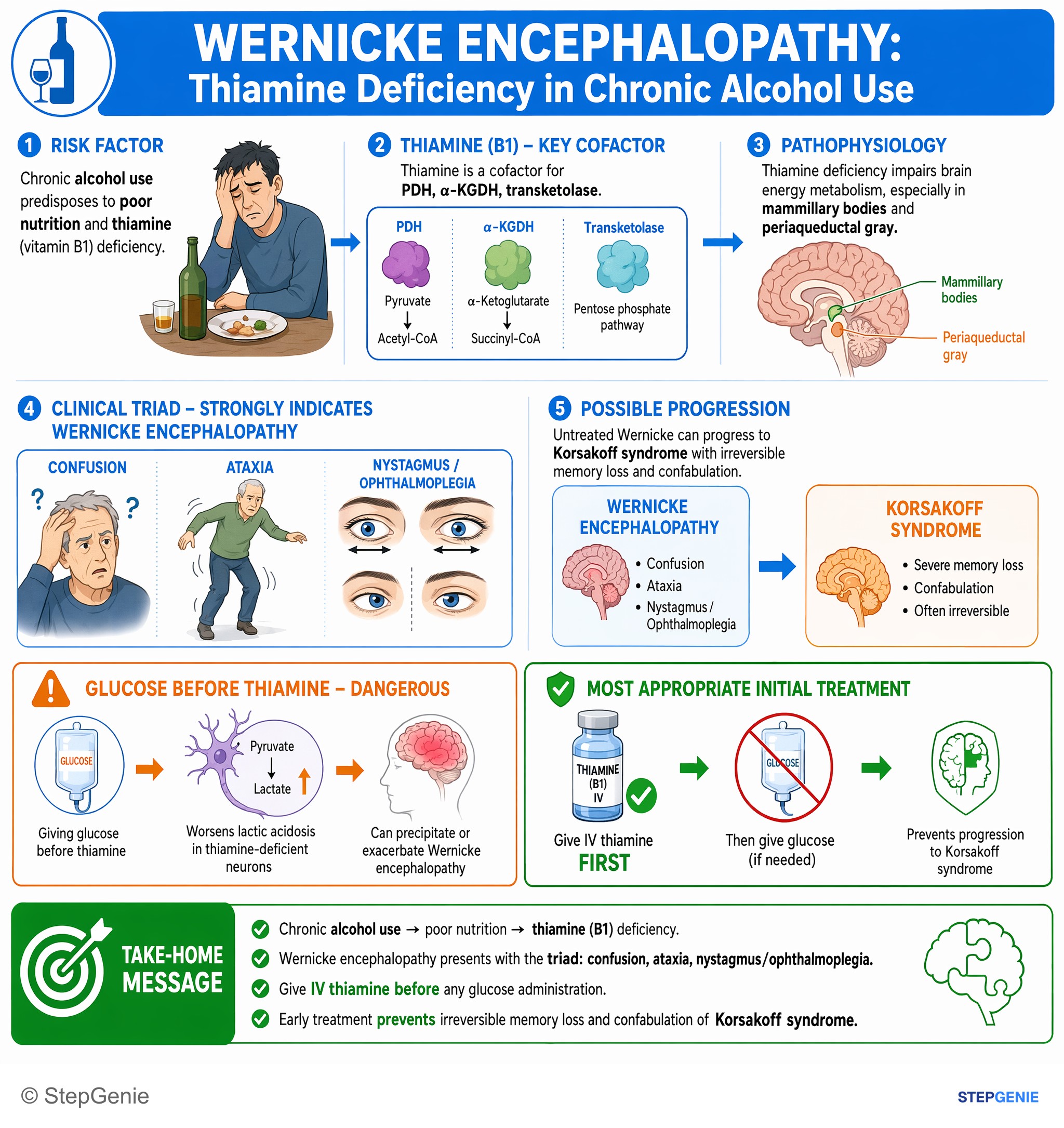
Wernicke encephalopathy from thiamine deficiency in an alcoholic: confusion, ataxia, nystagmus/ophthalmoplegia. Give IV thiamine before…
USMLE Step 2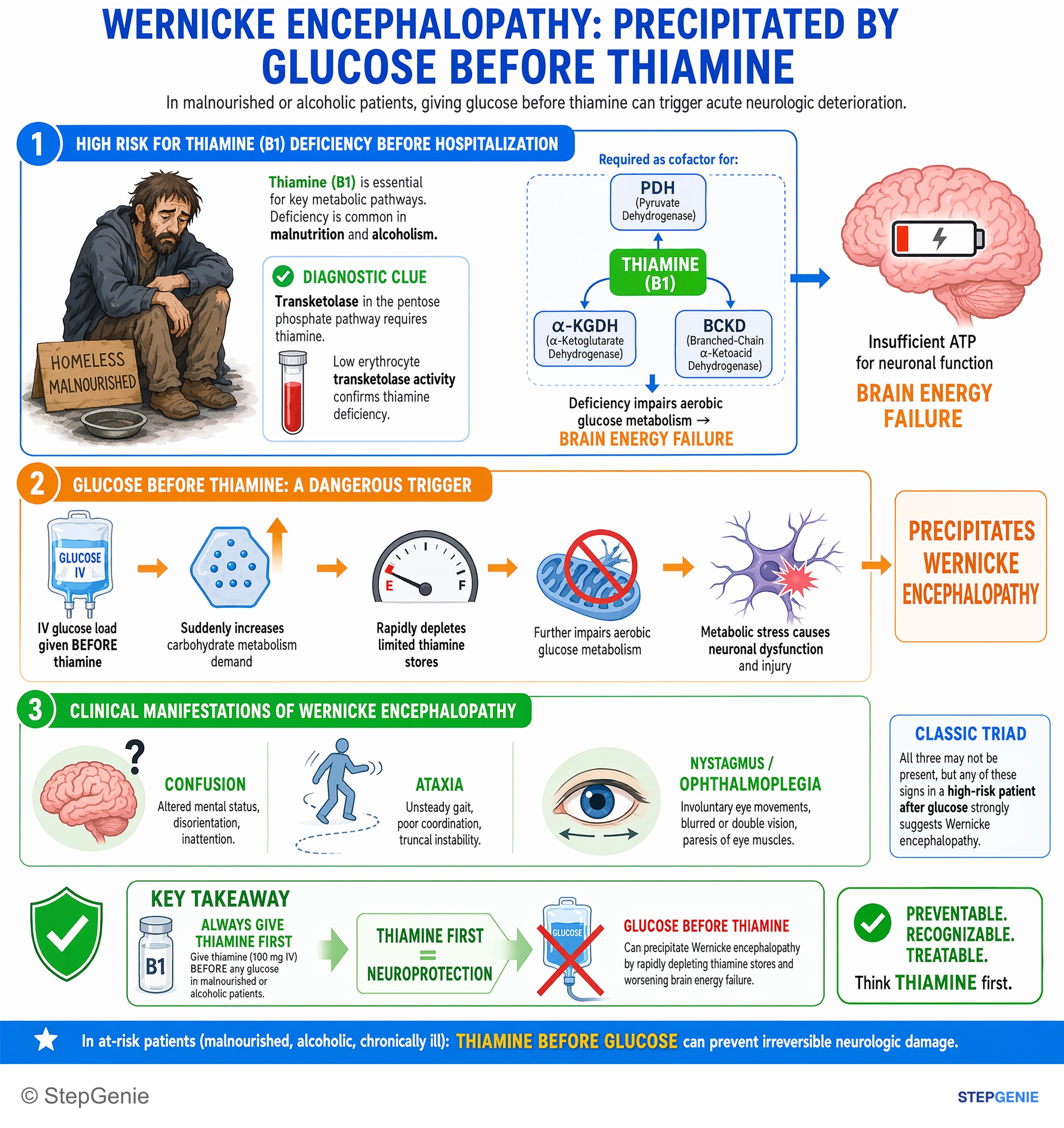
Wernicke encephalopathy due to thiamine deficiency is precipitated by giving glucose before thiamine in malnourished/alcoholic patients.
USMLE Step 1Frequently Asked Questions
Which TCA cycle enzyme is impaired in thiamine deficiency if pyruvate dehydrogenase is not an answer choice?
The best answer is alpha-ketoglutarate dehydrogenase. Thiamine deficiency classically impairs pyruvate dehydrogenase and causes pyruvate to accumulate and be reduced to lactate, but if PDH is not listed, the key TCA enzyme to recognize is alpha-ketoglutarate dehydrogenase because it is also thiamine dependent and uses the same major cofactor set as PDH.
Why does thiamine deficiency cause lactic acidosis?
Thiamine deficiency causes lactic acidosis because pyruvate cannot be efficiently processed and is instead reduced to lactate to regenerate NAD+. This happens when thiamine-dependent metabolism slows, especially pyruvate dehydrogenase activity, so pyruvate accumulates rather than entering aerobic metabolism efficiently. The result is elevated lactate and a high anion gap metabolic acidosis.
How do you tell alpha-ketoglutarate dehydrogenase from isocitrate dehydrogenase on a TCA question?
Alpha-ketoglutarate dehydrogenase is the better choice when the stem points to thiamine deficiency, because it is TPP dependent. Isocitrate dehydrogenase is instead a classic regulation enzyme: it converts isocitrate to alpha-ketoglutarate, is activated by ADP and Ca2+, and inhibited by ATP and NADH. A stem about vitamin deficiency favors alpha-ketoglutarate dehydrogenase, not isocitrate dehydrogenase.
Why is succinate dehydrogenase such a common distractor in TCA cycle questions?
Succinate dehydrogenase is a common distractor because it is highly testable but does not fit thiamine deficiency. It converts succinate to fumarate, produces FADH2, sits in the inner mitochondrial membrane, and is also Complex II of the electron transport chain. Those details make it memorable, but it is not thiamine dependent and does not explain the classic vitamin deficiency plus lactic acidosis vignette.
Why can giving glucose before thiamine worsen neurologic injury in alcoholism or malnutrition?
Giving glucose before thiamine can worsen neurologic injury because carbohydrate metabolism increases thiamine demand. In a malnourished patient with alcoholism and thiamine deficiency, the nervous system is already vulnerable because thiamine-dependent aerobic metabolism is impaired. Adding glucose first increases reliance on pathways that need thiamine, which can aggravate neurologic dysfunction such as Wernicke features.