The one rule that sorts fructose and galactose disorders: "the kinase is kind, the next enzyme is nasty." Missing the first enzyme (a kinase) leaves the free sugar behind, so fructokinase deficiency (essential fructosuria) is harmless and galactokinase deficiency causes cataracts but little else. Missing the second enzyme traps a sugar-1-phosphate inside cells, so aldolase B deficiency (hereditary fructose intolerance) causes vomiting, hypoglycemia and liver damage once fruit or table sugar enters the diet, and GALT deficiency (classic galactosemia) causes jaundice, hepatomegaly, cataracts and E. coli sepsis within days to weeks of the first milk feeds.
The mnemonic, decoded
| Sugar | Step 1: kinase (kind) | If it's missing | Step 2 (nasty) | If it's missing |
|---|---|---|---|---|
| Fructose | Fructokinase: fructose → fructose-1-phosphate | Essential fructosuria: fructose in blood and urine, no symptoms | Aldolase B: fructose-1-phosphate → DHAP + glyceraldehyde | Hereditary fructose intolerance: hypoglycemia, vomiting, liver and kidney damage after fructose |
| Galactose | Galactokinase: galactose → galactose-1-phosphate | Galactokinase deficiency: galactitol cataracts, otherwise well | GALT: galactose-1-phosphate + UDP-glucose → UDP-galactose + glucose-1-phosphate | Classic galactosemia: jaundice, hepatomegaly, failure to thrive, cataracts, E. coli sepsis |
Why the rule works:
- Kinase block: the free sugar has somewhere harmless to go. Fructose spills into the urine or is phosphorylated by hexokinase in muscle; galactose spills into the urine but is also reduced by aldose reductase to galactitol, which osmotically damages the lens.
- Second-step block: the phosphorylated sugar is trapped. Fructose-1-phosphate ties up the cell's phosphate; galactose-1-phosphate and other galactose metabolites build up to toxic levels.
Two add-on hooks:
- "Milk in days, fruit at weaning." Classic galactosemia starts within days of breast milk or lactose formula; hereditary fructose intolerance starts when fruit, juice or sweetened foods are introduced.
- "Cataracts mean galactose." Both galactose disorders can cause cataracts; the fructose disorders don't.
The pathways in two lines
- Fructose (mainly liver, kidney, small intestine): fructose → fructokinase → fructose-1-phosphate → aldolase B → DHAP + glyceraldehyde → glycolysis. Entering as trioses bypasses PFK-1, the regulated step covered in glycolysis regulation, so the liver handles fructose fast.
- Galactose (the Leloir pathway): galactose → galactokinase → galactose-1-phosphate → GALT (swaps in UDP-glucose) → UDP-galactose + glucose-1-phosphate. UDP-galactose 4-epimerase turns UDP-galactose back into UDP-glucose, and glucose-1-phosphate becomes glucose-6-phosphate.
Where the sugars come from: sucrose (table sugar) = glucose + fructose; sorbitol is converted to fructose; lactose (milk sugar) = glucose + galactose, split by lactase.
The four disorders compared
| Feature | Essential fructosuria | Hereditary fructose intolerance | Galactokinase deficiency | Classic galactosemia |
|---|---|---|---|---|
| Enzyme (gene) | Fructokinase | Aldolase B (ALDOB) | Galactokinase (GALK1) | GALT (GALT) |
| Inheritance | AR | AR | AR | AR |
| Trigger and timing | Found by chance | Fruit, juice, honey, sucrose or sorbitol, usually at weaning | Milk from birth | Breast milk or lactose formula, within days |
| What builds up | Fructose | Fructose-1-phosphate | Galactose, galactitol | Galactose-1-phosphate, galactitol |
| Key findings | None | Vomiting, sweating, lethargy, hypoglycemia; hepatomegaly, jaundice, cirrhosis; Fanconi-type renal tubular dysfunction | Cataracts; rarely pseudotumor cerebri | Poor feeding, vomiting, jaundice, hepatomegaly, hypoglycemia, bleeding, cataracts, E. coli sepsis |
| Treatment | None | Remove fructose, sucrose and sorbitol; glucose for acute hypoglycemia | Galactose-restricted diet | Lactose-free (soy-based, casein hydrolysate or elemental) formula at once; lifelong dairy restriction |
Classic stem clues
| Stem clue | Think |
|---|---|
| Healthy person with a reducing sugar in the urine and a negative glucose dipstick | Essential fructosuria (fructokinase) |
| Infant fine on breast milk, sick after fruit or juice at weaning; later avoids sweets and has no cavities | Hereditary fructose intolerance (aldolase B) |
| Infant with cataracts but normal growth and a normal liver | Galactokinase deficiency |
| Newborn with vomiting, jaundice, hepatomegaly and E. coli sepsis within days to weeks of starting breast milk | Classic galactosemia (GALT) |
| Galactosemia-like illness with normal GALT activity | Severe UDP-galactose 4-epimerase deficiency (rare; a benign form also exists) |
Hereditary fructose intolerance: the details that get tested
- Mechanism: fructose-1-phosphate accumulates and traps phosphate in an unusable form, depleting ATP. That acutely inhibits glycogenolysis and gluconeogenesis, so blood glucose falls after a fructose load because the liver can neither release glycogen nor make new glucose.
- Other labs: chronic intake can cause hyperuricemia and a proximal tubulopathy (Fanconi syndrome) that wastes phosphate and glucose.
- Behavioral clue: many patients develop a natural aversion to sweets, and with almost no dietary sucrose their teeth are usually excellent.
- Diagnosis: ALDOB molecular testing. Treatment: strict avoidance of fructose, sucrose and sorbitol; prognosis is excellent with adherence.
Classic galactosemia: the details that get tested
- Presentation: within a few days to weeks of breast milk or lactose formula: vomiting, poor feeding and growth, lethargy, jaundice, hepatomegaly, hypoglycemia, bleeding, and sepsis, usually E. coli. Renal tubular dysfunction (Fanconi syndrome) and cataracts also occur.
- Screening: every US state screens newborns for GALT deficiency. Confirmation: high red cell galactose-1-phosphate, low red cell GALT activity and/or two GALT variants.
- Management (2017 international guideline): switch at once to a soy-based, casein hydrolysate or elemental formula when the disease is suspected, then a diet that removes lactose and dairy galactose but allows galactose from non-milk sources such as fruits, vegetables, legumes and some mature cheeses. Duarte variant galactosemia, a much milder form, is not treated.
- Complications despite good treatment: developmental delay, speech problems (childhood apraxia of speech, dysarthria), motor abnormalities, and premature ovarian insufficiency in almost all girls and women. The body makes some galactose itself, so a strict diet can't bring it to zero.
The benign cousins
- Essential fructosuria: autosomal recessive, asymptomatic, and usually discovered when a routine urine test finds a non-glucose reducing sugar. No treatment.
- Galactokinase deficiency: infantile cataracts from galactitol, without the liver, kidney or ovarian damage of classic galactosemia. Started early, a galactose-restricted diet stops galactitol from forming and can prevent cataracts; cataracts found late need surgery.
Exam traps
- Fruit-triggered hypoglycemia is aldolase B, not fructokinase. Essential fructosuria is asymptomatic.
- Timing separates classic galactosemia from HFI. Symptoms from the first days of breast milk point to GALT; a baby who tolerated milk and got sick at weaning points to aldolase B.
- Reducing sugar in the urine with a negative glucose dipstick means a non-glucose sugar, such as fructose in essential fructosuria or galactose in galactosemia. The dipstick's glucose oxidase reacts only with glucose.
- A newborn with E. coli sepsis and jaundice is a galactosemia clue; stop breast milk and lactose formula while testing.
- Fasting hypoglycemia with lactic acidosis, hyperuricemia and hyperlipidemia points to von Gierke disease (glucose-6-phosphatase), not HFI, whose hypoglycemia follows a fructose load.
- Lactase deficiency causes bloating and diarrhea after dairy, not liver failure or cataracts; see lactose intolerance.
Practice question
Vignette. A 6-month-old boy was exclusively breastfed and growing well until 3 weeks ago, when his parents started pureed fruit and apple juice. Since then he has had repeated episodes of vomiting, sweating and lethargy 20 to 30 minutes after meals, and he has stopped gaining weight. He is jaundiced and his liver is palpable 4 cm below the costal margin. During an episode, serum glucose is 36 mg/dL. Deficiency of which enzyme is most likely?
- A. Aldolase B
- B. Fructokinase
- C. Galactokinase
- D. Galactose-1-phosphate uridyltransferase
- E. Glucose-6-phosphatase
- F. Lactase
Answer: A. Symptoms began with the first fructose (fruit, juice), not with breast milk. Without aldolase B, fructose-1-phosphate accumulates and sequesters phosphate, ATP falls, and glycogenolysis and gluconeogenesis stall, so hypoglycemia follows each fructose meal while the liver is injured over time. Treatment is lifelong avoidance of fructose, sucrose and sorbitol.
Why the others are wrong:
- B: fructokinase deficiency is essential fructosuria, harmless fructose in the urine.
- C: galactokinase deficiency causes cataracts only, and breast milk would have exposed him to galactose since birth.
- D: classic galactosemia starts within days of the first breast milk feeds, with jaundice, hepatomegaly and E. coli sepsis; this baby thrived on breast milk for 5 months.
- E: von Gierke disease causes fasting hypoglycemia, typically from around 3 to 4 months when feeds are spaced out, with lactic acidosis, hyperuricemia and hyperlipidemia; it isn't triggered by fruit.
- F: lactase deficiency causes diarrhea and bloating with milk, not hypoglycemia or liver disease.
Key takeaways
- Kinase is kind, the next enzyme is nasty: fructokinase (benign) and galactokinase (cataracts) versus aldolase B and GALT (severe).
- HFI: aldolase B; fructose-1-phosphate traps phosphate, ATP falls, and glycogenolysis and gluconeogenesis stop; hypoglycemia, vomiting, liver and kidney damage after fruit, sucrose or sorbitol.
- Classic galactosemia: GALT; within days to weeks of milk: jaundice, hepatomegaly, cataracts, E. coli sepsis; lactose-free formula immediately.
- Cataracts mean galactose: galactitol from aldose reductase.
- Even treated classic galactosemia carries risks of speech and developmental problems and premature ovarian insufficiency.
Sources
- Fructose Metabolism Disorders — Merck Manual Professional Edition
- Galactosemia — Merck Manual Professional Edition
- Hereditary fructose intolerance — MedlinePlus Genetics
- Galactosemia — MedlinePlus Genetics
- Galactokinase deficiency — Orphanet
- Classic Galactosemia and Clinical Variant Galactosemia — GeneReviews, NCBI Bookshelf (updated 2021)
- Welling L, et al. International clinical guideline for the management of classical galactosemia: diagnosis, treatment, and follow-up — Journal of Inherited Metabolic Disease (2017)
- Succoio M, et al. Galactosemia: Biochemistry, Molecular Genetics, Newborn Screening, and Treatment — Biomolecules (2022)
- Hereditary Fructose Intolerance — ScienceDirect Topics (Elsevier)
- Fructokinase — ScienceDirect Topics (Elsevier)
- Galactitol — ScienceDirect Topics (Elsevier)
- Leloir Pathway — ScienceDirect Topics (Elsevier)
Visual explanations from the StepGenie QBank
Infographics StepGenie drew to explain questions in its own QBank, matched to this article's topic. Each caption is the takeaway of the question it explains.
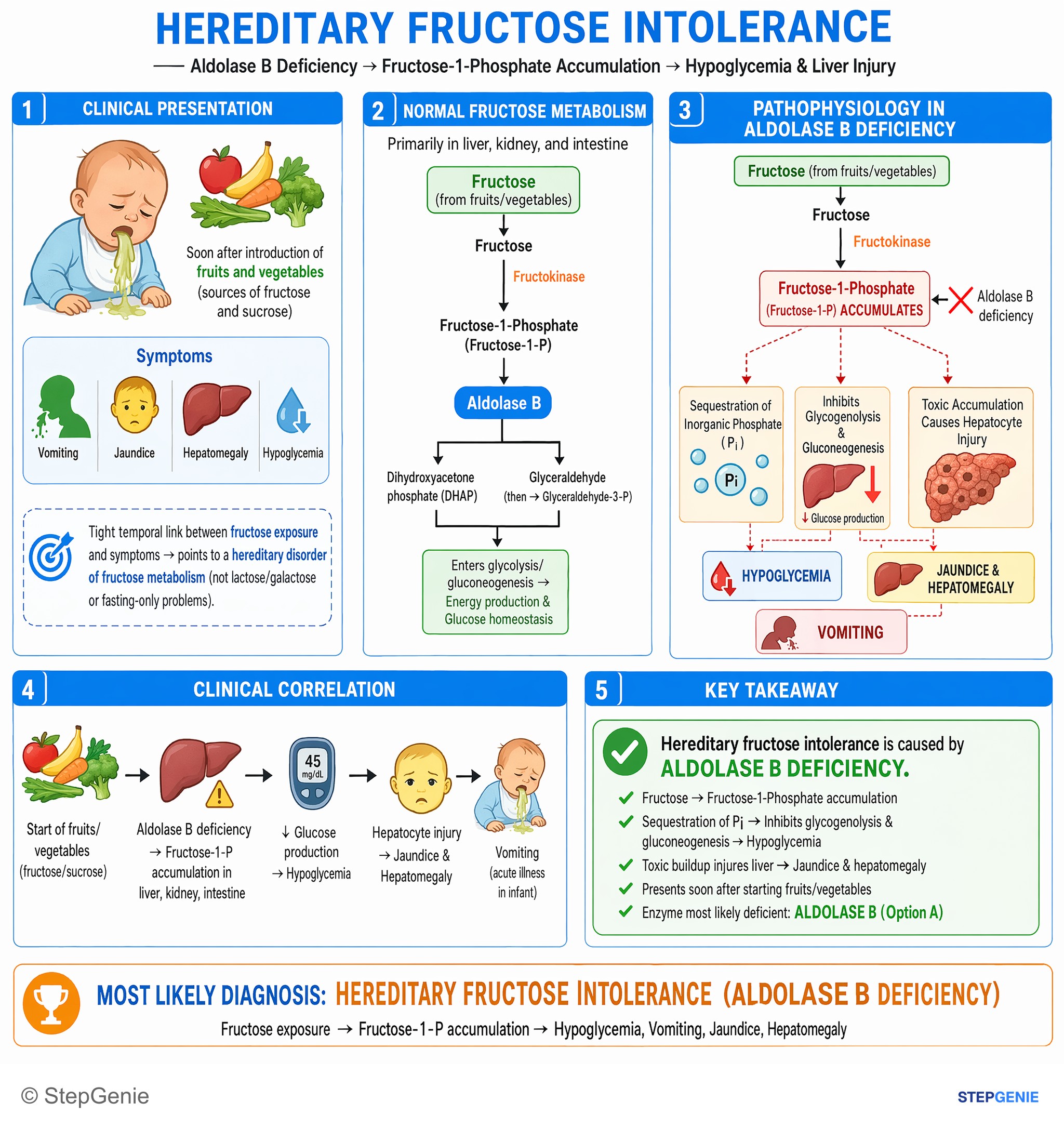
Hereditary fructose intolerance from aldolase B deficiency → fructose-1-P accumulation, hypoglycemia, vomiting, jaundice, hepatomegaly…
USMLE Step 1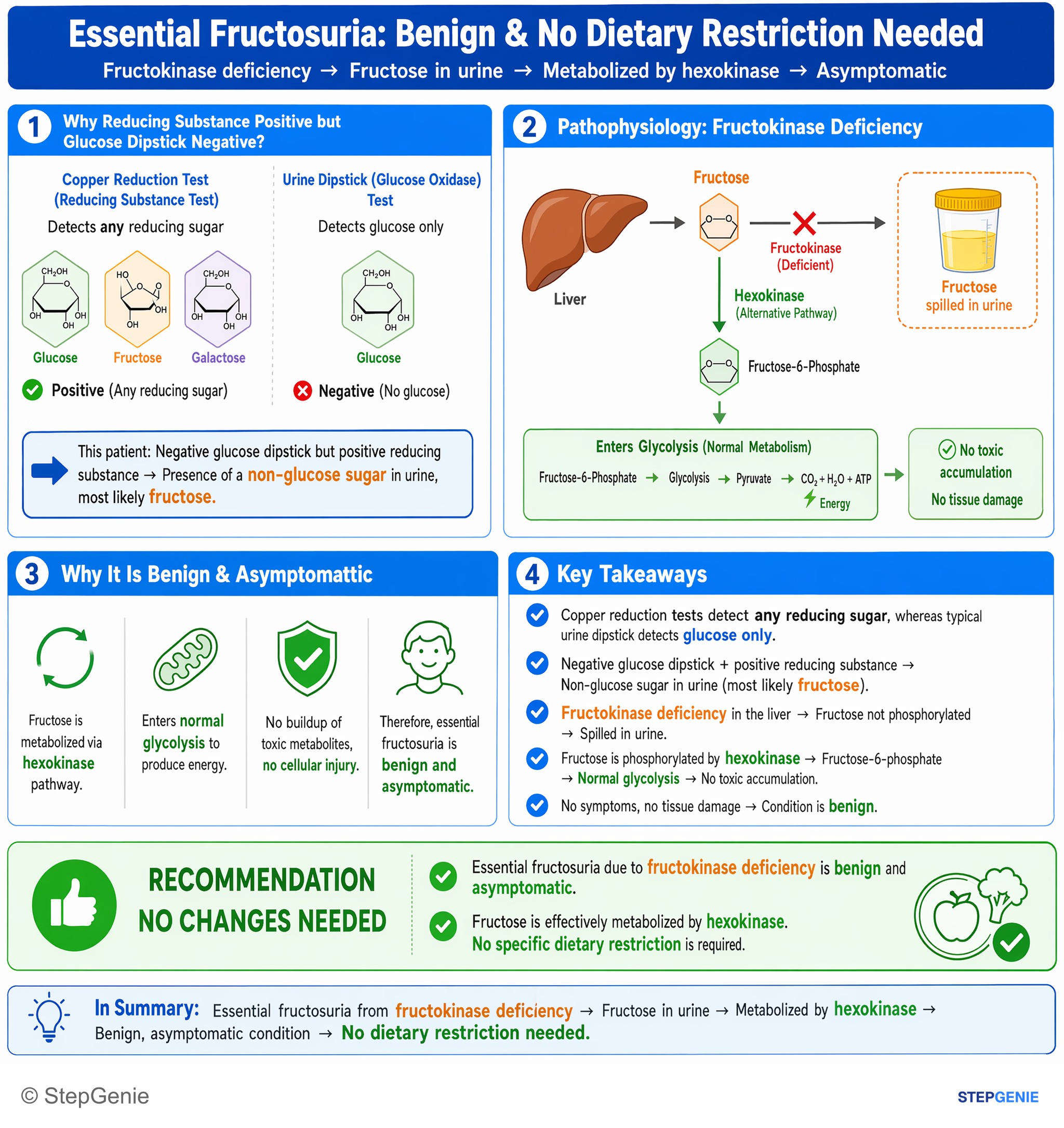
Essential fructosuria from fructokinase deficiency → benign, asymptomatic; fructose metabolized by hexokinase. No dietary restriction…
USMLE Step 1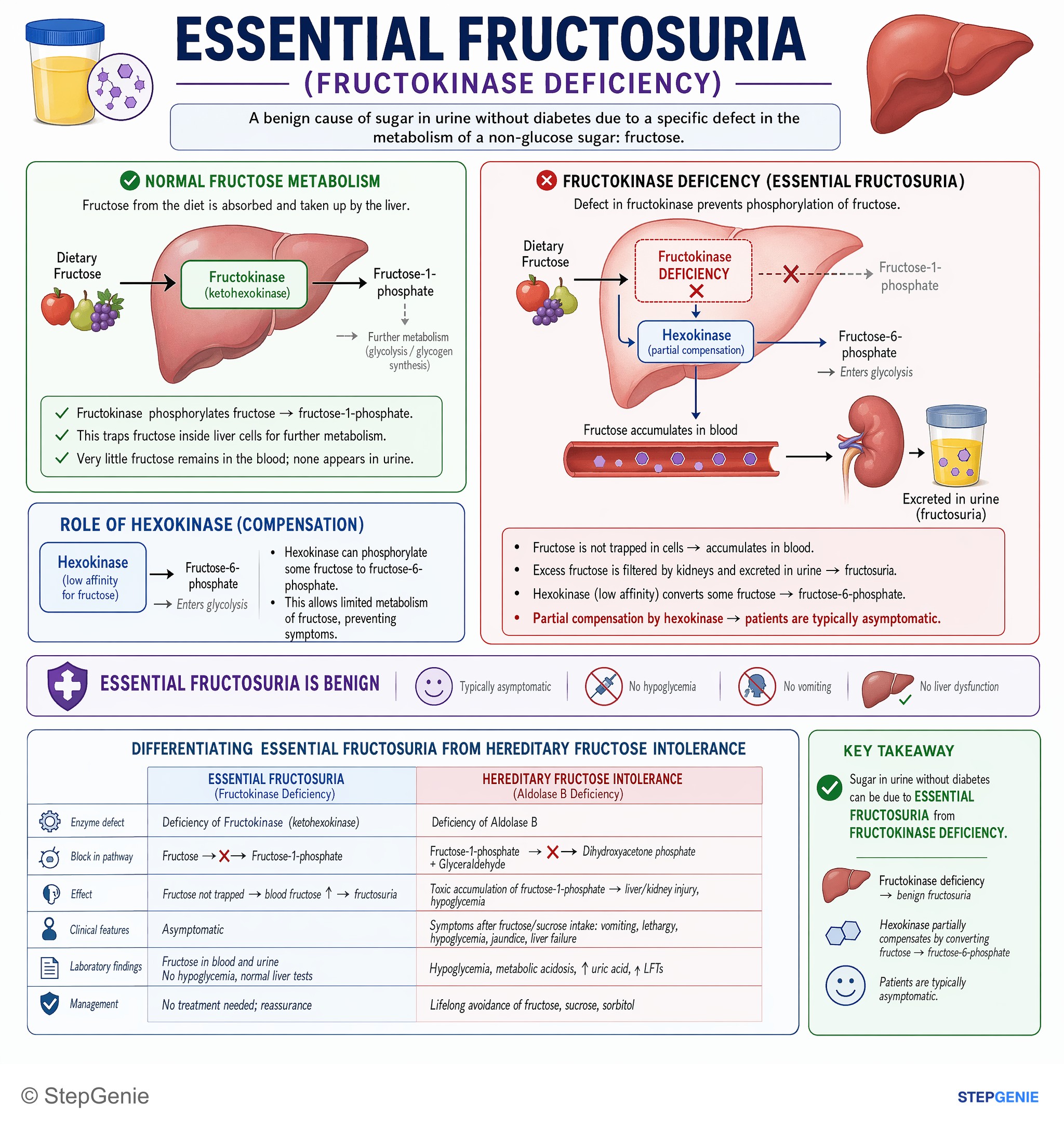
Essential fructosuria from fructokinase deficiency → benign, asymptomatic fructose in blood/urine; hexokinase compensates by…
USMLE Step 1Frequently Asked Questions
What is the difference between essential fructosuria and hereditary fructose intolerance?
Essential fructosuria is a harmless, autosomal recessive deficiency of fructokinase, the first enzyme of fructose metabolism; fructose simply appears in the blood and urine and is usually found by chance as a non-glucose reducing sugar. Hereditary fructose intolerance is an autosomal recessive deficiency of aldolase B, the second enzyme, so fructose-1-phosphate accumulates. Eating fruit, juice, sucrose or sorbitol then causes vomiting and hypoglycemia and, over time, liver and kidney damage.
Why does hereditary fructose intolerance cause hypoglycemia?
Without aldolase B, fructose-1-phosphate builds up in the liver and traps phosphate in an unusable form, depleting ATP. The shortage acutely inhibits glycogenolysis and gluconeogenesis, so the liver cannot keep blood glucose up after a fructose load. Acute episodes are treated with glucose, and long-term treatment is strict avoidance of fructose, sucrose and sorbitol.
What are the symptoms of classic galactosemia?
Classic galactosemia, caused by GALT deficiency, presents within days to weeks of starting breast milk or lactose-containing formula with poor feeding, vomiting, lethargy, poor growth, jaundice, hepatomegaly, hypoglycemia and bleeding. Cataracts and kidney tubular dysfunction can occur, and affected newborns are prone to sepsis, usually from E. coli. All US states screen newborns for this disorder.
Why does galactokinase deficiency cause cataracts?
When galactokinase is missing, galactose accumulates and aldose reductase reduces it to galactitol, a sugar alcohol that cannot leave lens cells, raises their osmotic pressure and damages the lens fibers. Galactokinase deficiency causes cataracts without the liver, kidney or ovarian damage seen in classic galactosemia. A galactose-restricted diet stops further galactitol formation; started early it can prevent cataracts, while cataracts found late need surgery.
How is classic galactosemia treated?
As soon as classic galactosemia is suspected, breast milk and lactose-containing formula are replaced with a soy-based, casein hydrolysate or elemental formula. The 2017 international guideline then recommends a diet that removes lactose and dairy galactose but allows galactose from non-milk sources such as fruits, vegetables, legumes and some mature cheeses. Even with good treatment, patients remain at risk for developmental and speech problems, and almost all girls and women develop premature ovarian insufficiency.
What is a good mnemonic for fructose and galactose metabolism disorders?
Remember that the kinase is kind and the next enzyme is nasty. Loss of the first enzyme, fructokinase or galactokinase, leaves the free sugar behind and causes harmless fructosuria or isolated cataracts. Loss of the second enzyme, aldolase B or GALT, traps a sugar-1-phosphate inside cells and causes the severe diseases, hereditary fructose intolerance and classic galactosemia.