You’ll never feel more “Step 1 betrayed me” than when a stem screams mitochondria and the answer choices are all things you kind of remember from a blurry electron transport chain diagram. The trick with oxidative phosphorylation questions isn’t just knowing the correct mechanism—it’s knowing why every other choice is wrong. That’s how you turn a 50/50 into a gimme.
Tag: Biochemistry > Bioenergetics & Carb Metabolism
The Clinical Vignette (Q-bank style)
A 32-year-old woman is evaluated for progressive exercise intolerance and episodic muscle weakness. She notes that even mild exertion causes early fatigue and shortness of breath. Physical exam is normal. After a brief treadmill test, labs show:
- Elevated lactate
- Increased NADH:NAD ratio
- Decreased ATP production in skeletal muscle biopsy
- Mitochondrial studies suggest impaired electron transfer to oxygen, with accumulation of reduced electron carriers
Which of the following is the most likely underlying defect?
A. Inhibition of ATP synthase (Complex V)
B. Defect in cytochrome c oxidase (Complex IV)
C. Defect in succinate dehydrogenase (Complex II)
D. Increased permeability of the inner mitochondrial membrane to protons
E. Inhibition of citrate synthase
How to Approach This Stem (Pattern recognition)
Key clues:
- Exercise intolerance + lactic acidosis → oxidative phosphorylation can’t keep up → cells shift toward anaerobic glycolysis.
- High NADH:NAD → NADH isn’t being oxidized back to NAD in the ETC.
- “Impaired electron transfer to oxygen” → points to the final electron acceptor step.
- “Accumulation of reduced electron carriers” → upstream complexes get backed up if oxygen can’t be reduced.
This is classic for a Complex IV problem.
✅ Correct Answer: B. Defect in cytochrome c oxidase (Complex IV)
Why Complex IV fits best
Complex IV (cytochrome c oxidase) transfers electrons from cytochrome c to oxygen, reducing it to water:
If Complex IV is impaired:
- Electrons can’t flow to O → the chain backs up
- NADH stays high (can’t offload electrons via Complex I)
- TCA slows because NAD becomes scarce
- Cells compensate via anaerobic glycolysis → ↑ lactate
- Net effect: ↓ ATP, especially in high-demand tissues (muscle, brain, heart)
High-yield: Complex IV essentials
- Function: reduces O → HO
- Pumps protons: yes (helps build the proton gradient)
- Inhibitors: cyanide, carbon monoxide, azide
- Clinical tie-in: mitochondrial disorders → myopathy, neuro symptoms, lactic acidosis
Now, Why Every Other Answer Choice Is Wrong (and when it would be right)
A. Inhibition of ATP synthase (Complex V)
Why it’s wrong here:
ATP synthase inhibition blocks ATP production despite an intact electron transport chain up to that point—but it also causes a distinctive upstream effect: the proton gradient becomes so high that it impedes further electron flow (ETC slows because pumping more protons becomes energetically unfavorable).
What you’d expect instead:
- ↓ ATP
- ↓ O consumption (ETC stalls)
- ↑ proton gradient across inner membrane
- ↓ electron flow (secondary effect)
Classic association:
- Oligomycin inhibits ATP synthase by blocking the proton channel (F portion).
- Good “tell” in questions: ETC intact but phosphorylation blocked.
Bottom line: Complex V inhibition can raise NADH too, but the stem explicitly says impaired electron transfer to oxygen, which is more directly a Complex IV problem.
C. Defect in succinate dehydrogenase (Complex II)
Why it’s wrong here:
Complex II is unique:
- It is part of the TCA cycle (succinate → fumarate)
- It transfers electrons to FAD → FADH → CoQ
- Does NOT pump protons
A Complex II defect reduces electron input from FADH, but:
- It doesn’t typically cause the dramatic “everything backs up to oxygen” picture the way Complex IV does.
- NADH oxidation via Complex I can still proceed.
What you’d expect instead:
- Less efficient ATP production, but often milder than Complex I/IV issues
- Potential buildup of succinate-related pathways depending on scenario
- No direct “oxygen can’t be reduced” signature
High-yield pearl:
Because Complex II doesn’t pump protons, electrons entering at Complex II yield fewer ATP than those entering at Complex I (FADH is “worth less” than NADH).
D. Increased permeability of the inner mitochondrial membrane to protons
This is uncoupling.
Why it’s wrong here:
Uncouplers dissipate the proton gradient, so electron transport speeds up, not backs up. Oxygen consumption increases because the ETC runs hard trying to re-establish the gradient.
What you’d expect with uncoupling:
- ↑ O consumption
- ↑ heat production
- ↓ ATP
- ↓ proton gradient
- Often ↓ NADH (because NADH is oxidized faster)
Classic uncouplers (Step favorites):
- 2,4-DNP (chemical uncoupler)
- Thermogenin (UCP1) in brown fat (physiologic uncoupling)
- High-yield clinical tie: overheating/weight loss potential with toxic uncouplers
Stem mismatch:
The vignette describes accumulation of reduced carriers—that’s the opposite of uncoupling, where carriers tend to be more oxidized due to faster electron flow.
E. Inhibition of citrate synthase
Why it’s wrong here:
Citrate synthase is a TCA enzyme, not oxidative phosphorylation. Inhibiting it reduces flux through the TCA cycle, which lowers production of NADH and FADH—meaning you’d have less reducing equivalents feeding the ETC.
What you’d expect instead:
- ↓ NADH production (so NADH:NAD would not increase the same way)
- Decreased ATP overall, but via reduced substrate supply, not “oxygen can’t accept electrons”
- No primary ETC backup
High-yield:
- TCA enzymes generate NADH/FADH; ETC uses them.
- When ETC is blocked → NADH rises and TCA slows.
- When TCA is blocked → NADH supply falls and ETC slows for lack of electrons.
One Table to Cement It: Block vs Uncouple vs ATP Synthase Inhibit
| Scenario | O consumption | NADH | Proton gradient | ATP | Heat |
|---|---|---|---|---|---|
| Complex IV defect (or CN/CO) | ↓ | ↑ | ↓ | ↓ | ↓ |
| ATP synthase inhibited (oligomycin) | ↓ | ↑ | ↑ | ↓ | ↓ |
| Uncoupler (2,4-DNP, UCP1) | ↑ | ↓ | ↓ | ↓ | ↑ |
How to use this table on test day:
If you see ↑ heat + ↑ O use, think uncoupling.
If you see ↓ O use + ↑ NADH, think ETC inhibition or ATP synthase inhibition—then decide based on whether the issue is electron transfer to oxygen (Complex IV) vs phosphorylation machinery (Complex V).
High-Yield USMLE Facts You Should Be Able to Recall in 15 Seconds
ETC Complexes (core functions)
- Complex I: NADH → CoQ (pumps H)
- Complex II: succinate dehydrogenase; FADH → CoQ (no H pumping)
- Complex III: CoQ → cytochrome c (pumps H)
- Complex IV: cytochrome c → O (pumps H; makes HO)
- Complex V: ATP synthase uses H gradient to make ATP
Inhibitors you’re expected to know
- Complex I: rotenone, amytal
- Complex III: antimycin A
- Complex IV: cyanide, carbon monoxide, azide
- Complex V: oligomycin
- Uncouplers: 2,4-DNP, high-dose salicylates; thermogenin (UCP1)
Why lactic acidosis happens in ETC defects
When ETC can’t oxidize NADH → NAD drops → aerobic metabolism stalls → pyruvate is pushed to lactate to regenerate NAD:
Rapid-Fire Takeaway (what the question was really testing)
This was a “where does oxygen fit in the ETC?” question dressed up as a myopathy vignette. Oxygen is the final electron acceptor, and Complex IV is the complex that hands electrons to it. When that step fails, the entire chain backs up—giving you the signature ↑ NADH, ↓ ATP, and ↑ lactate.
Visual explanations from the StepGenie QBank
Infographics StepGenie drew to explain questions in its own QBank, matched to this article's topic. Each caption is the takeaway of the question it explains.
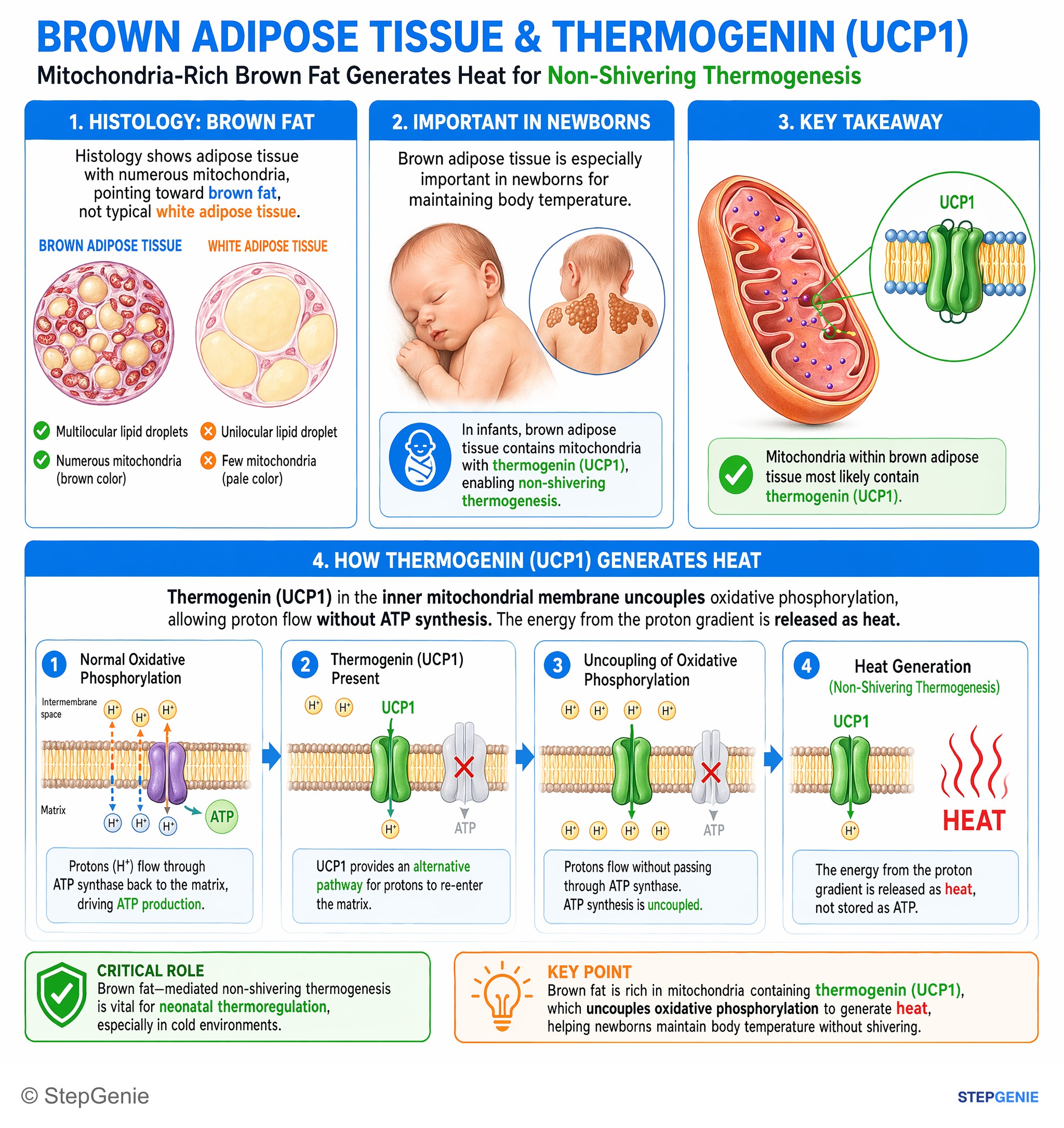
Brown adipose tissue in infants contains mitochondria with thermogenin (UCP1), uncoupling oxidative phosphorylation to generate…
USMLE Step 1Frequently Asked Questions
Why does a defect in cytochrome c oxidase cause high lactate and a high NADH:NAD+ ratio?
A defect in cytochrome c oxidase causes both because Complex IV normally transfers electrons to oxygen, and when that step fails the electron transport chain backs up. NADH cannot be oxidized back to NAD+, so the NADH:NAD+ ratio rises and the TCA cycle slows. Cells then compensate with anaerobic glycolysis, which leads to increased lactate and reduced ATP production.
How do you tell a Complex IV defect from ATP synthase inhibition in an oxidative phosphorylation question?
The best clue for a Complex IV defect is impaired electron transfer to oxygen. In cytochrome c oxidase deficiency, electrons cannot reach the final electron acceptor, so reduced carriers accumulate upstream. ATP synthase inhibition also lowers ATP and can secondarily slow the ETC, but its classic pattern is blocked phosphorylation with an intact chain up to that point and a buildup of the proton gradient.
How do you distinguish uncoupling from a blocked electron transport chain on a vignette?
Uncoupling increases electron transport, whereas a blocked electron transport chain causes electrons to back up. When the inner mitochondrial membrane becomes permeable to protons, the proton gradient is dissipated, so oxygen consumption rises, heat production increases, ATP falls, and NADH tends to be oxidized faster. By contrast, a true block such as a Complex IV defect causes accumulation of reduced carriers and impaired transfer of electrons to oxygen.
Why is succinate dehydrogenase deficiency less likely than Complex IV deficiency in a stem with reduced carrier buildup?
Succinate dehydrogenase deficiency is less likely because Complex II only handles electron input from FADH2 and does not pump protons. A Complex II defect can reduce ATP production, but it does not create the classic picture of electron transfer failing at oxygen with the whole chain backing up. NADH oxidation through Complex I can still continue, so the pattern is usually milder than a Complex IV problem.
Why would citrate synthase inhibition not explain impaired electron transfer to oxygen?
Citrate synthase inhibition would not explain that pattern because citrate synthase is a TCA cycle enzyme, not part of oxidative phosphorylation. Blocking it reduces TCA flux and lowers production of NADH and FADH2, so there are fewer reducing equivalents feeding the electron transport chain. That causes decreased ATP through reduced substrate supply, not a primary backup of electrons at the step where oxygen accepts them.