Beta-oxidation breaks fatty acids into two-carbon acetyl-CoA units inside the mitochondrial matrix, producing one FADH₂ and one NADH per turn. Long-chain fatty acids are first activated to fatty acyl-CoA and carried in by the carnitine shuttle, whose first enzyme, CPT-1, is the rate-limiting step and is inhibited by malonyl-CoA, so the liver doesn't burn fat while it is making it. Each turn runs oxidation (FAD) → hydration → oxidation (NAD⁺) → thiolysis, and one palmitate (16:0) nets 106 ATP. When any step fails, fasting causes hypoketotic hypoglycemia; the most common inherited defect is MCAD deficiency.
Beta-oxidation steps at a glance
| Step | Where | Enzyme | Reaction | Cost or yield |
|---|---|---|---|---|
| 1. Activation | Outer mitochondrial membrane | Acyl-CoA synthetase | Fatty acid + CoA + ATP → fatty acyl-CoA + AMP + PPᵢ | 2 ATP equivalents |
| 2. Entry | Outer and inner mitochondrial membranes | CPT-1 → carnitine–acylcarnitine translocase → CPT-2 | Acyl group moved onto carnitine, carried across the inner membrane, moved back onto CoA | No ATP; CPT-1 is rate-limiting |
| 3. Oxidation | Matrix | Acyl-CoA dehydrogenase (very long-, long-, medium- or short-chain specific) | Acyl-CoA → trans-Δ²-enoyl-CoA | 1 FADH₂ |
| 4. Hydration | Matrix | Enoyl-CoA hydratase | Water added across the double bond → L-3-hydroxyacyl-CoA | None |
| 5. Oxidation | Matrix | 3-Hydroxyacyl-CoA dehydrogenase | Hydroxyl oxidized → 3-ketoacyl-CoA | 1 NADH |
| 6. Thiolysis | Matrix | Thiolase | CoA splits off acetyl-CoA; the chain, now 2 carbons shorter, goes round again | 1 acetyl-CoA |
Memory hook for steps 3–6: "FAD, water, NAD, CoA" (oxidize, hydrate, oxidize, thiolyze).
Getting fatty acids into the mitochondria
- Activation costs two high-energy bonds. Acyl-CoA synthetase splits ATP to AMP and pyrophosphate, and the pyrophosphate is then hydrolyzed, so the cost counts as 2 ATP.
- Only long chains need carnitine. Fatty acids longer than about 12 carbons cross the inner membrane as acylcarnitine esters. Medium- and short-chain fatty acids enter the matrix directly, which is why medium-chain triglyceride (MCT) oil can fuel patients with carnitine shuttle defects.
- CPT-1 (outer membrane) loads, the translocase (inner membrane) ferries, CPT-2 (matrix side) unloads. The translocase swaps acylcarnitine in for free carnitine out; the sequence is drawn out in the carnitine shuttle flowchart.
- Malonyl-CoA is the brake. Malonyl-CoA, made by acetyl-CoA carboxylase, allosterically inhibits CPT-1. After a meal, insulin keeps the carboxylase active and malonyl-CoA high, so new fatty acids are stored, not oxidized. In fasting, glucagon and AMP-activated protein kinase switch the carboxylase off, malonyl-CoA falls and CPT-1 opens. The synthesis side is covered in fatty acid synthesis: ACC, citrate shuttle and NADPH.
What each turn produces
Each turn shortens the chain by two carbons and yields 1 FADH₂, 1 NADH and 1 acetyl-CoA. The FADH₂ electrons reach coenzyme Q through electron-transfer flavoprotein (ETF) and ETF:ubiquinone oxidoreductase, bypassing complex I (see the electron transport chain mnemonic). Heart and muscle burn the acetyl-CoA in the TCA cycle; the fasting liver turns much of it into ketone bodies. Fatty acids are the heart's preferred fuel and a key fuel for muscle during prolonged exertion, so both suffer when the pathway fails.
ATP yield: palmitate worked out
A saturated fatty acid with an even number of carbons, n, needs n/2 − 1 turns and gives n/2 acetyl-CoA. For palmitate (16:0) that is 7 turns and 8 acetyl-CoA. Using current P/O ratios (2.5 ATP per NADH, 1.5 per FADH₂):
| Source | Number | ATP each | ATP |
|---|---|---|---|
| FADH₂ from 7 turns | 7 | 1.5 | 10.5 |
| NADH from 7 turns | 7 | 2.5 | 17.5 |
| Acetyl-CoA through the TCA cycle (3 NADH + 1 FADH₂ + 1 GTP each) | 8 | 10 | 80 |
| Activation (ATP → AMP) | 1 | −2 | −2 |
| Net per palmitate | 106 |
Palmitoyl-CoA, already activated, yields 108. If a question uses whole-number ratios instead (3 ATP per NADH and 2 per FADH₂, so 12 per acetyl-CoA), the same sum gives , so check which ratios it assumes.
Special cases: odd chains, double bonds and very long chains
- Odd-chain fatty acids give acetyl-CoA plus a final three-carbon propionyl-CoA. Biotin-dependent propionyl-CoA carboxylase converts it to methylmalonyl-CoA, and methylmalonyl-CoA mutase, which needs adenosylcobalamin (vitamin B₁₂), converts that to succinyl-CoA, a TCA intermediate. These three carbons are the only part of a fatty acid that can yield net glucose (acetyl-CoA can't), and this pathway is why B₁₂ deficiency raises methylmalonic acid while folate deficiency does not.
- Unsaturated fatty acids need an isomerase and, for some, 2,4-dienoyl-CoA reductase; an existing double bond skips an FAD step, so the yield is slightly lower.
- Very long-chain fatty acids can't be handled by mitochondrial enzymes; peroxisomes shorten them first. In X-linked adrenoleukodystrophy, a defective peroxisomal membrane transporter (ALDP, gene ABCD1) lets them accumulate: affected boys can develop behavioral decline, cerebral demyelination and adrenal insufficiency. In Zellweger syndrome, peroxisomes don't form properly, causing hypotonia, hepatomegaly and renal cysts.
Why a block causes hypoketotic hypoglycemia
During a fast the liver relies on β-oxidation for three things, and a block removes all three:
- No acetyl-CoA, so no ketones. Ketones stay inappropriately low for the length of the fast.
- Gluconeogenesis stalls. β-Oxidation normally supplies the ATP and NADH that gluconeogenesis spends, and acetyl-CoA, which activates pyruvate carboxylase.
- Glucose runs out faster, because tissues that would burn fat burn glucose instead.
Meanwhile, unoxidized fatty acids and acylcarnitines build up and injure the liver, heart and muscle, so attacks can bring hepatomegaly, raised liver enzymes, hyperammonemia, cardiomyopathy or rhabdomyolysis and can be mistaken for Reye syndrome.
Fatty acid oxidation disorders compared
The mitochondrial disorders are all autosomal recessive, and MCAD and LCHAD deficiency are on every US newborn screen.
| Disorder | Defect | Key labs | Distinguishing clue | Treatment |
|---|---|---|---|---|
| MCAD deficiency | Medium-chain acyl-CoA dehydrogenase (ACADM) | ↑ C8–C10 acylcarnitines; urinary C6–C10 dicarboxylic acids; low free carnitine | Infant with vomiting and lethargy after fasting or illness; sudden death | Avoid fasting; IV dextrose in attacks; no MCT oil |
| Primary carnitine deficiency | Carnitine transporter OCTN2 | Very low plasma carnitine despite high urinary carnitine | Dilated cardiomyopathy, hypotonia, hypoketotic hypoglycemia | L-carnitine |
| CPT-1 deficiency | Liver CPT-1A | Normal or high plasma carnitine; no dicarboxylic aciduria | Fasting hypoketotic hypoglycemia with hepatomegaly | Avoid fasting; replace long-chain fat with MCT |
| CPT-2 deficiency, myopathic form | CPT-2 | ↑ C16 acylcarnitine | Muscle pain and myoglobinuria after prolonged exercise, fasting, cold or infection | Avoid fasting and strenuous exercise; frequent carbohydrate |
| VLCAD and LCHAD deficiency | Very long-chain acyl-CoA dehydrogenase; long-chain 3-hydroxyacyl-CoA dehydrogenase | ↑ C14–C18 acylcarnitines (hydroxylated in LCHAD) | Cardiomyopathy (VLCAD); retinopathy and maternal HELLP syndrome (LCHAD) | Avoid fasting; high-carbohydrate diet; MCT oil |
MCAD deficiency: the one boards test most
- Most common β-oxidation defect: about 1 in 17,000 in the United States, more common with northern European ancestry.
- Timing: symptoms usually start after 2–3 months of age, triggered by fasting (as little as 12 hours) or an illness such as a viral infection.
- Attack: vomiting and lethargy that can progress quickly to seizures, coma and death, sometimes as sudden unexpected infant death. Labs show hypoglycemia, hyperammonemia and unexpectedly low ketones; metabolic acidosis may come late.
- Diagnosis: C8–C10 acylcarnitines in plasma; C6–C10 dicarboxylic acids, hexanoylglycine and suberylglycine in urine; DNA testing confirms most cases.
- Acute treatment: IV 10% dextrose at 1.5 times the maintenance fluid rate; some clinicians add carnitine.
- Prevention: avoid prolonged fasting, feed frequently (including a bedtime snack) and use a low-fat, high-carbohydrate diet, with cornstarch for overnight cover. MCT oil is avoided: medium-chain fat is exactly what these patients can't oxidize.
Exam traps
- Low glucose with low ketones after a fast means a fatty acid oxidation or carnitine defect; low glucose with high ketones is the normal fasting response.
- Malonyl-CoA inhibits CPT-1, not CPT-2 or the translocase.
- MCT oil helps shuttle and long-chain defects, not MCAD deficiency.
- Free carnitine separates the shuttle defects: normal or high in CPT-1 deficiency, very low in primary carnitine deficiency.
- Recurrent myoglobinuria after prolonged exercise, with no symptoms between attacks, is the myopathic form of CPT-2 deficiency, its most common form.
- Very long chains start in peroxisomes: high very long-chain fatty acids with adrenal insufficiency in a boy is X-linked adrenoleukodystrophy.
Worked example
Vignette. A 10-month-old girl has had vomiting and diarrhea for a day and has barely eaten for 16 hours. She becomes hard to rouse and has a seizure. Glucose is 30 mg/dL, urine ketones are negative, ammonia is mildly elevated and the liver edge is 3 cm below the costal margin. Plasma acylcarnitines show elevated C8 and C10 species, and urine organic acids show C6–C10 dicarboxylic acids. Which enzyme is deficient, and what is the first treatment?
Answer: Medium-chain acyl-CoA dehydrogenase. Give IV 10% dextrose now, then prevent attacks by avoiding fasting.
Why the distractors are wrong:
- CPT-1 deficiency: also causes hypoketotic hypoglycemia with hepatomegaly, but plasma carnitine is normal or high and there is no dicarboxylic aciduria.
- Primary carnitine deficiency: plasma carnitine is very low while urinary carnitine is high, and cardiomyopathy is common.
- CPT-2 or VLCAD deficiency: the acylcarnitines that rise are long-chain (C14–C18), not C8–C10.
- Reye syndrome: most cases follow aspirin use during a viral illness; MCAD deficiency can be mistaken for it, but the medium-chain acylcarnitine pattern settles it.
- MCT oil: helpful in long-chain defects, but medium-chain fat is exactly what she can't oxidize.
Key takeaways
- β-Oxidation runs in the mitochondrial matrix: FAD oxidation → hydration → NAD⁺ oxidation → thiolysis, giving 1 FADH₂, 1 NADH and 1 acetyl-CoA per turn.
- CPT-1 is rate-limiting and inhibited by malonyl-CoA; only long-chain fatty acids need the carnitine shuttle.
- Palmitate: 7 turns, 8 acetyl-CoA, 106 ATP net (108 from palmitoyl-CoA; 129 if whole-number ratios of 3 and 2 are used).
- Odd chains → propionyl-CoA → succinyl-CoA (biotin, B₁₂); very long chains start in peroxisomes.
- A block causes hypoketotic hypoglycemia during fasting, plus liver, heart or muscle injury.
- MCAD deficiency: most common; ↑ C8–C10 acylcarnitines and dicarboxylic aciduria; IV dextrose, avoid fasting, no MCT oil.
Sources
- Beta-Oxidation Cycle Disorders — Merck Manual Professional Edition
- Overview of Fatty Acid and Glycerol Metabolism Disorders — Merck Manual Professional Edition
- Peroxisomal Disorders — Merck Manual Professional Edition
- Vitamin B12 Deficiency — Merck Manual Professional Edition
- Medium-chain acyl-CoA dehydrogenase deficiency — MedlinePlus Genetics
- Medium Chain Acyl CoA Dehydrogenase Deficiency — National Organization for Rare Disorders (NORD)
- Carnitine palmitoyltransferase II deficiency — MedlinePlus Genetics
- MMUT gene (methylmalonyl-CoA mutase) — MedlinePlus Genetics
- Dawson J. Fatty Acid Beta Oxidation — BIOC*2580: Introduction to Biochemistry (eCampusOntario Pressbooks)
- Dawson J. The Overall Efficiency of Oxidative Phosphorylation — BIOC*2580: Introduction to Biochemistry (eCampusOntario Pressbooks)
- Wang Y, et al. Acetyl-CoA Carboxylases and Diseases — Frontiers in Oncology (2022)
- Biotin — Linus Pauling Institute Micronutrient Information Center, Oregon State University
Visual explanations from the StepGenie QBank
Infographics StepGenie drew to explain questions in its own QBank, matched to this article's topic. Each caption is the takeaway of the question it explains.
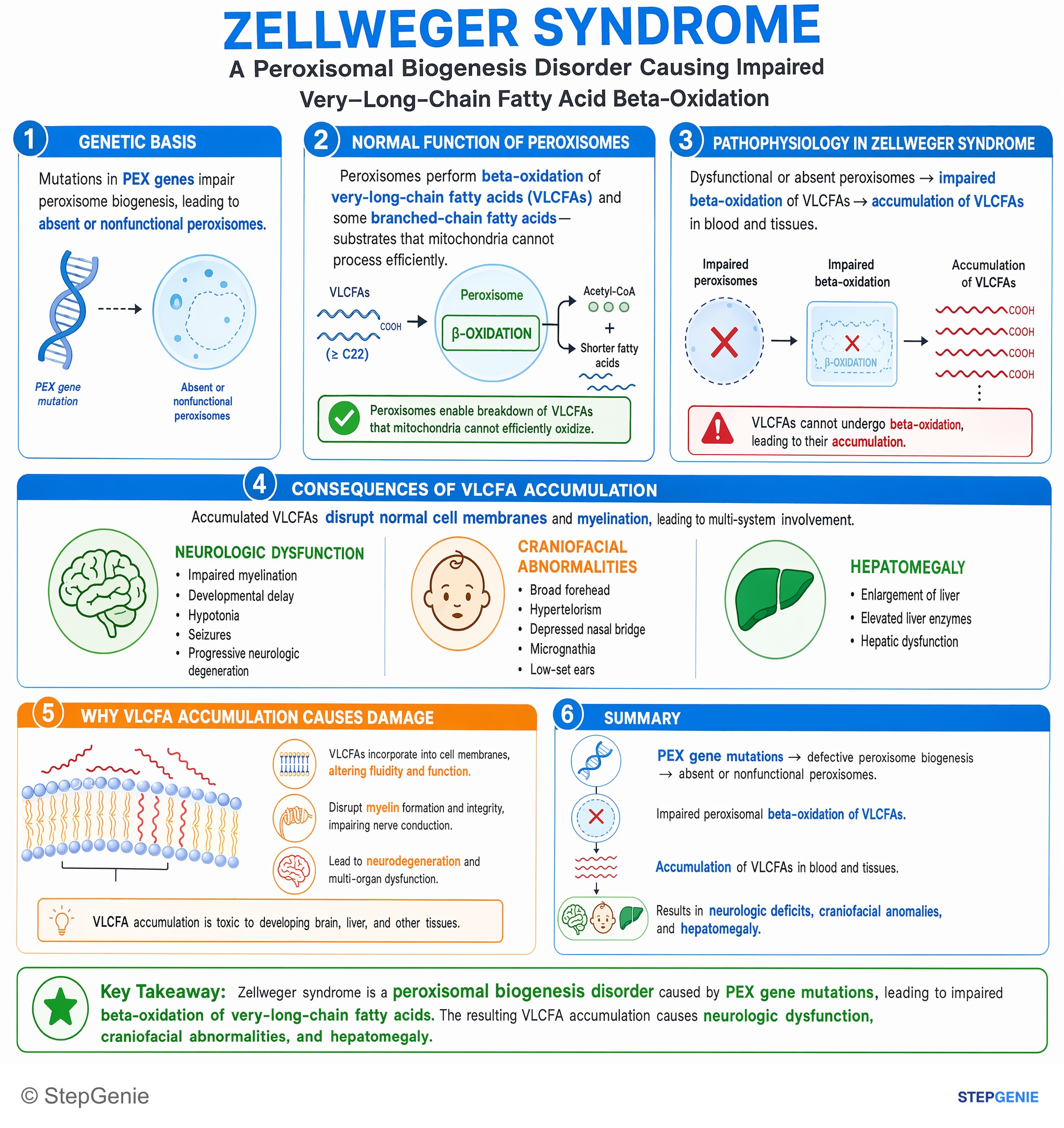
Zellweger syndrome is a peroxisomal biogenesis disorder causing impaired very-long-chain fatty acid beta-oxidation, leading to neurologic…
USMLE Step 1Frequently Asked Questions
What are the four steps of beta-oxidation?
Each turn has four reactions. Acyl-CoA dehydrogenase oxidizes the fatty acyl-CoA with FAD, forming a trans double bond and FADH₂. A hydratase adds water across that bond. 3-Hydroxyacyl-CoA dehydrogenase then oxidizes the new hydroxyl group with NAD⁺, making NADH. Finally, thiolase uses CoA to split off acetyl-CoA, leaving a chain two carbons shorter for the next turn. Palmitate needs seven turns.
How many ATP are made from beta-oxidation of palmitate?
About 106 ATP net. Seven turns make 7 FADH₂ and 7 NADH, worth 10.5 and 17.5 ATP at 1.5 and 2.5 ATP each, and the 8 acetyl-CoA yield 80 ATP through the TCA cycle. That totals 108 from palmitoyl-CoA; subtracting the 2 ATP equivalents spent on activation gives 106. If a question uses whole-number ratios of 3 and 2 ATP per NADH and FADH₂, the same sum gives 129.
What is the rate-limiting step of beta-oxidation?
Carnitine palmitoyltransferase 1 (CPT-1), on the outer mitochondrial membrane, is rate-limiting because it controls entry of long-chain fatty acids into the mitochondria. Malonyl-CoA, the product of acetyl-CoA carboxylase, inhibits it. After a meal, insulin keeps malonyl-CoA high, so fatty acids are stored; in fasting, glucagon and AMP-activated protein kinase shut the carboxylase down, malonyl-CoA falls and oxidation resumes.
Why does MCAD deficiency cause hypoketotic hypoglycemia?
During a fast the liver needs β-oxidation both to make acetyl-CoA for ketone bodies and to power gluconeogenesis. When medium-chain acyl-CoA dehydrogenase is missing, fatty acids can't be fully oxidized, so ketone production stays low while glucose is used up and not replaced. Medium-chain acylcarnitines and dicarboxylic acids accumulate, and attacks bring vomiting, lethargy, hyperammonemia, seizures and a risk of sudden death.
What happens to odd-chain fatty acids in beta-oxidation?
They are oxidized like even-chain fatty acids until the last three carbons remain as propionyl-CoA. Propionyl-CoA carboxylase, which needs biotin, converts it to methylmalonyl-CoA, and methylmalonyl-CoA mutase, which needs vitamin B₁₂ as adenosylcobalamin, converts that to succinyl-CoA for the TCA cycle. This route lets odd-chain fatty acids contribute to glucose and explains why B₁₂ deficiency raises methylmalonic acid.