Essential amino acids are the 9 that the body can't make in adequate amounts and must get from food: histidine, isoleucine, leucine, lysine, methionine, phenylalanine, threonine, tryptophan and valine. The board mnemonic PVT TIM HALL lists those nine plus arginine, which is conditionally essential: the body makes it, but newborns and severely ill or stressed patients may not make enough. The other 11 amino acids are nonessential, built mostly from glycolysis and TCA-cycle intermediates, but tyrosine comes from phenylalanine and cysteine takes its sulfur from methionine, which is why those two become essential in PKU and classic homocystinuria. Leucine and lysine are the only purely ketogenic amino acids: their carbon ends up only as acetyl-CoA or acetoacetate, which can't make new glucose.
Essential vs nonessential amino acids at a glance
| Feature | Essential (9) | Conditionally essential (6 of the 11 nonessential) | Dispensable (the other 5 nonessential) |
|---|---|---|---|
| Definition | Can't be made in adequate amounts; must be eaten | Normally made, but needed from food when synthesis can't meet need | Made in adequate amounts |
| Members | His, Ile, Leu, Lys, Met, Phe, Thr, Trp, Val | Arg, Cys, Gln, Gly, Pro, Tyr | Ala, Asn, Asp, Glu, Ser |
| Made from | Nothing in the body: diet only | An essential amino acid (Tyr from Phe; Cys takes Met's sulfur) or longer pathways from glutamate, glutamine and serine | Pyruvate, oxaloacetate, α-ketoglutarate, 3-phosphoglycerate |
| When diet matters | Always | Prematurity and growth, severe illness or catabolic stress, a blocked pathway | Not normally |
| Board hook | PVT TIM HALL minus the A | Tyr in PKU, Cys in homocystinuria, Arg in growth | "Everything else" |
Lists vary slightly by source. The 6/5 split above follows the National Academies' Dietary Reference Intakes; MedlinePlus also counts serine as conditionally essential. MedlinePlus, Merck and the National Academies all put histidine among the nine, but Merck adds that all people need eight of them and infants also need histidine, and the National Academies note that removing histidine, unlike the other eight, doesn't promptly cause negative nitrogen balance. For exams, histidine is essential and arginine is not. You don't need every essential amino acid at every meal, only enough of each over the day.
PVT TIM HALL, decoded
| Letter | Amino acid | Glucogenic or ketogenic | High-yield link |
|---|---|---|---|
| P | Phenylalanine | Both | Becomes tyrosine via phenylalanine hydroxylase, which needs tetrahydrobiopterin (BH4); PKU |
| V | Valine | Glucogenic | Branched-chain; MSUD |
| T | Threonine | Both | Feeds propionyl-CoA (VOMIT) |
| T | Tryptophan | Both | Makes serotonin, melatonin and niacin; lost in Hartnup disease |
| I | Isoleucine | Both | Branched-chain; MSUD |
| M | Methionine | Glucogenic | Becomes SAM, the main methyl donor; supplies cysteine's sulfur |
| H | Histidine | Glucogenic | Precursor of histamine |
| A | Arginine* | Glucogenic | Urea cycle and nitric oxide; *conditionally essential |
| L | Leucine | Ketogenic only | Branched-chain; MSUD |
| L | Lysine | Ketogenic only | The limiting amino acid in grains |
Why arginine is in the mnemonic but not in the nine:
- The body can make it. The small intestine turns glutamine into citrulline, and urea cycle enzymes convert citrulline into arginine. In the liver, the cycle's last step, arginase, splits arginine into urea and ornithine.
- Supply can fall short of need. Newborns may have too little of the enzymes in this pathway, and MedlinePlus lists arginine among the amino acids that become essential in illness and stress. The classic exam line "arginine and histidine are required during growth" reflects this; Merck likewise notes that infants need histidine.
- Clinical echo: most urea cycle disorders (not arginase deficiency) are treated in part with arginine or citrulline supplements.
- Exam rule: asked for "the 9 essential amino acids", drop the A and keep histidine.
Two more hooks. The two L's in HALL, leucine and lysine, are the only purely ketogenic amino acids and the only amino acids whose names start with L. VOMIT (valine, odd-chain fatty acids, methionine, isoleucine, threonine) lists the sources of propionyl-CoA, which biotin-dependent propionyl-CoA carboxylase and B12-dependent methylmalonyl-CoA mutase turn into succinyl-CoA, a glucogenic TCA intermediate.
Where the 11 nonessential amino acids come from
| Amino acid | Made from | Key step or enzyme |
|---|---|---|
| Alanine | Pyruvate | Transamination by alanine aminotransferase (ALT) |
| Aspartate | Oxaloacetate | Transamination by aspartate aminotransferase (AST) |
| Asparagine | Aspartate | Asparagine synthetase adds glutamine's amide nitrogen, using ATP |
| Glutamate | α-Ketoglutarate | Transamination or glutamate dehydrogenase |
| Glutamine | Glutamate + ammonia | Glutamine synthetase |
| Proline | Glutamate | Reduction via glutamate-5-semialdehyde, then cyclization |
| Arginine | Glutamine and glutamate, via ornithine and citrulline | Urea cycle enzymes turn citrulline into arginine |
| Serine | 3-Phosphoglycerate (glycolysis) | Oxidation, transamination, then a phosphatase |
| Glycine | Serine | Serine hydroxymethyltransferase hands one carbon to tetrahydrofolate |
| Cysteine | Serine's carbon skeleton + methionine's sulfur | Homocysteine + serine → cystathionine (cystathionine β-synthase) → cysteine (cystathionine γ-lyase) |
| Tyrosine | Phenylalanine | Phenylalanine hydroxylase + BH4 |
Grouped by precursor: α-ketoglutarate → Glu, Gln, Pro, Arg; 3-phosphoglycerate → Ser, Gly, Cys; oxaloacetate → Asp, Asn; pyruvate → Ala; phenylalanine → Tyr.
Transamination ties the table together. Aminotransferases move an amino group between an amino acid and a keto acid, and α-ketoglutarate is the usual final acceptor, becoming glutamate. They need pyridoxal phosphate (PLP), the active form of vitamin B6, and so does cystathionine β-synthase, which is why high-dose pyridoxine helps about half of patients with classic homocystinuria. ALT and AST, the "liver enzymes" on a metabolic panel, are the aminotransferases that make alanine and aspartate. B-vitamin cofactors are drilled in the enzyme cofactors mnemonic.
Conditionally essential: when making them isn't enough
| Amino acid | Depends on | Needed from food when | Board example |
|---|---|---|---|
| Tyrosine | Phenylalanine, phenylalanine hydroxylase, BH4 | The enzyme or BH4 fails | PKU |
| Cysteine | Methionine's sulfur, serine, transsulfuration enzymes | Prematurity (slow synthesis from methionine); cystathionine β-synthase deficiency | Classic homocystinuria |
| Arginine | Citrulline and urea cycle enzymes | Newborns, illness and stress | The A in PVT TIM HALL |
| Glutamine | Glutamate, glutamine synthetase | Severe catabolic stress | Critical illness |
| Glycine, proline | Serine; glutamate | Prematurity or severe illness | Rarely tested |
- PKU: 98-99% of cases are phenylalanine hydroxylase deficiency (autosomal recessive). Treatment is lifelong phenylalanine restriction with phenylalanine-free medical foods, aiming for blood phenylalanine of 120-360 µmol/L (2-6 mg/dL) in children, plus tyrosine supplementation (Merck calls tyrosine "an essential amino acid in patients with PKU") and a trial of sapropterin (synthetic BH4). If BH4 itself is deficient, treatment adds oral BH4, levodopa-carbidopa and 5-hydroxytryptophan, because BH4 is also needed to make dopamine and serotonin.
- Classic homocystinuria: about half of patients respond to high-dose pyridoxine alone; the rest also need a low-methionine diet with supplemental cysteine, plus betaine (which helps remethylate homocysteine). Folate is given as well.
- Restrict the substrate, supply the product: the same logic runs through both.
Glucogenic vs ketogenic: why only leucine and lysine are purely ketogenic
| Category | Amino acids | Carbon enters metabolism as |
|---|---|---|
| Ketogenic only | Leucine, lysine | Acetyl-CoA and acetoacetate (or acetoacetyl-CoA) only |
| Both | Phenylalanine, tyrosine | Fumarate + acetoacetate |
| Both | Tryptophan | Alanine (→ pyruvate) + acetoacetyl-CoA |
| Both | Isoleucine | Succinyl-CoA (via propionyl-CoA) + acetyl-CoA |
| Both | Threonine | Mainly propionyl-CoA → succinyl-CoA; a second route gives glycine + acetyl-CoA |
| Glucogenic only | Alanine, serine, glycine, cysteine | Pyruvate |
| Glucogenic only | Aspartate, asparagine | Oxaloacetate |
| Glucogenic only | Glutamate, glutamine, proline, arginine, histidine | α-Ketoglutarate |
| Glucogenic only | Valine, methionine | Succinyl-CoA |
Why acetyl-CoA can't become glucose. Gluconeogenesis needs a net supply of pyruvate or oxaloacetate. The pyruvate dehydrogenase reaction can't run backward, and the two carbons acetyl-CoA carries into the TCA cycle leave as two CO₂, so the cycle gains no oxaloacetate. Carbon that ends only as acetyl-CoA or acetoacetate can make ketone bodies but not net glucose, and leucine and lysine are the only amino acids in that position. The five "both" amino acids split into two pieces, one of which can still reach glucose.
Exam angle: in a prolonged fast, muscle protein supplies carbon for gluconeogenesis, but leucine and lysine can't contribute; their carbon goes to ketogenesis instead. Even-chain fatty acids hit the same acetyl-CoA wall.
Amino acid groups and the diseases they explain
| Group | Members | Disorder: defect and clues | Management |
|---|---|---|---|
| Branched-chain | Leucine, isoleucine, valine | Maple syrup urine disease (MSUD): branched-chain α-ketoacid dehydrogenase complex deficiency; maple syrup odor of urine and cerumen, vomiting and lethargy in the first days of life, then seizures and coma; high leucine, isoleucine, valine and alloisoleucine | Restrict branched-chain amino acids; dialysis if acutely ill; high-dose thiamine helps some; liver transplant is curative |
| Aromatic | Phenylalanine, tyrosine, tryptophan | PKU: normal at birth, then intellectual disability, seizures, an eczema-like rash, mousy odor, lighter skin, hair and eyes. Tyrosine is the precursor of catecholamines, thyroid hormones and melanin | Restrict phenylalanine, supplement tyrosine |
| Sulfur-containing | Methionine, cysteine | Classic homocystinuria: cystathionine β-synthase deficiency; ectopia lentis, marfanoid habitus, intellectual disability, osteoporosis, arterial and venous thromboembolism | Pyridoxine; low-methionine diet plus cysteine; betaine; folate |
| Neutral (transport) | Tryptophan and other neutral amino acids | Hartnup disease: SLC6A19 transporter defect in gut and kidney; neutral aminoaciduria; tryptophan loss causes a pellagra-like photosensitive rash, cerebellar ataxia and psychiatric symptoms, triggered by sun, fever or poor intake | Niacin or nicotinamide, good nutrition, sun avoidance |
| Dibasic (transport) | Lysine, arginine, ornithine, plus cystine | Cystinuria: renal reabsorption defect; only cystine precipitates, causing cystine stones and hexagonal urine crystals | Fluids, urine alkalinization above pH 7, then tiopronin or penicillamine |
PKU, MSUD, classic homocystinuria and Hartnup disease are all autosomal recessive. PKU, MSUD and homocystinuria are core conditions on the US Recommended Uniform Screening Panel for newborns; homocystinuria is flagged by a high methionine.
Too little protein: kwashiorkor vs marasmus
| Feature | Marasmus | Kwashiorkor |
|---|---|---|
| Deficit | Severe lack of calories and protein | More likely with a diet more deficient in protein than in energy; infection and cytokine release contribute |
| Who | Infants and very young children; the most common childhood form where food insecurity is high | Somewhat older children, often after breastfeeding stops early |
| Edema | None | Peripheral and periorbital edema from low serum albumin, with fluid and protein leaking out of vessels |
| Body | Hunger, growth retardation, loss of most fat stores and of muscle | Protruding abdomen from weak abdominal muscles, enlarged liver, ascites |
| Skin and hair | Loose, redundant skin folds | Skin darkens and cracks, then becomes pale, fragile and thin; thin reddish-brown or gray hair, with "striped flag" bands |
| Recovery | Slower | Faster |
Low albumin lowers plasma oncotic pressure, the force that holds fluid in capillaries; see Starling forces.
Protein quality, the RDA and nitrogen balance
Complete vs incomplete proteins. A complete protein provides adequate amounts of all nine essential amino acids: meat, fish, milk and eggs, and, among plants, soy. Most plant proteins are incomplete, and the essential amino acid in shortest supply is the limiting amino acid: lysine in grains, methionine and tryptophan in beans and most legumes. Foods with different limiting amino acids, such as beans and rice, are complementary proteins, and they don't have to be eaten at the same meal.
Scoring quality. Biological value measures how closely a protein's amino acid pattern matches that of body tissue: egg protein 100, milk and meat about 90, cereals and vegetables about 40, gelatin 0. PDCAAS multiplies an amino acid score by digestibility; the newer DIAAS uses the ileal digestibility of each indispensable amino acid and is not capped at 100.
How much protein. The RDA is 0.8 g/kg/day of good-quality protein for adult men and women, about 56 g/day at 70 kg. Per kilogram, needs are higher in infants (about 1.5 g/kg at 0-6 months) and toddlers (about 1.0 g/kg at 1-3 years), and rise in pregnancy, lactation, rapid growth and recovery from illness. The Dietary Guidelines for Americans, 2025-2030 (January 2026) set higher "protein serving goals" of 1.2-1.6 g/kg/day; questions about the RDA still mean 0.8 g/kg/day.
Nitrogen balance is nitrogen eaten minus nitrogen lost in urine and feces.
- Positive: net tissue building, as in growth, pregnancy and recovery from illness.
- Negative: catabolic states such as starvation, infection and burns, and protein-energy undernutrition, when protein is burned for energy.
- One essential amino acid missing: protein deposition falls and balance turns negative even if the rest of the diet is adequate. The National Academies use this test to define essentiality; histidine is the one essential amino acid whose removal doesn't promptly trigger it.
Exam traps
- Arginine is in PVT TIM HALL but not in the nine; histidine is in both.
- Tyrosine is nonessential unless phenylalanine hydroxylase or BH4 fails; cysteine unless transsulfuration fails or the baby is premature.
- Homocystinuria vs Marfan: in homocystinuria the lens usually displaces inferiorly or nasally (down and in), with intellectual disability and thrombosis; in Marfan syndrome it usually goes superotemporally (up and out).
- Not every homocystinuria raises methionine: MTHFR and cobalamin defects leave methionine low or normal, so a newborn screen for high methionine misses them; cobalamin defects add megaloblastic anemia, often with methylmalonic acidemia.
- Odor clues: maple syrup (MSUD), mousy (PKU), sweaty (isovaleric acidemia, a block in leucine breakdown).
- Ornithine and citrulline are urea cycle intermediates, not among the 20 amino acids that build proteins.
- "Which amino acid can't supply carbon for gluconeogenesis?" Leucine or lysine.
Worked vignettes
Vignette 1 (practice question). A 2-year-old boy who recently immigrated and never had newborn screening has developmental delay, seizures, an eczema-like rash, light skin and hair, and a mousy body odor. Plasma phenylalanine is markedly elevated and tyrosine is low. Along with restricting phenylalanine, which amino acid must now be supplied because of his enzyme defect?
- A. Cysteine
- B. Tyrosine
- C. Arginine
- D. Phenylalanine
- E. Tryptophan
Answer: B. Phenylalanine hydroxylase normally makes tyrosine from phenylalanine; with the enzyme (or BH4) missing, tyrosine becomes conditionally essential.
- A: cysteine depends on methionine and cystathionine β-synthase; it is added in classic homocystinuria, not PKU.
- C: arginine can become conditionally essential in newborns and during illness, but not because of this enzyme defect.
- D: phenylalanine is essential, so it is restricted, not eliminated: the child still needs a small, measured amount for growth.
- E: tryptophan is essential regardless; its loss in Hartnup disease causes pellagra-like symptoms.
Vignette 2. A 15-year-old girl with mild intellectual disability, long thin limbs and osteoporosis develops a deep vein thrombosis. Eye exam shows a lens displaced downward and nasally. Plasma total homocysteine and methionine are both high. What is the defect, and what changes in her diet?
Answer: Cystathionine β-synthase deficiency (classic homocystinuria). Homocysteine can't combine with serine to make cystathionine, so cysteine becomes conditionally essential. Start high-dose pyridoxine, with folate; if she doesn't respond, add a low-methionine diet with supplemental cysteine, plus betaine. High methionine places the block in transsulfuration rather than remethylation, and a lens displaced down and in, with thrombosis, separates her from Marfan syndrome.
Vignette 3. A 2-year-old in a famine area was weaned early when a sibling was born and now eats mostly starchy gruel. She has swollen feet, puffy eyelids, a protruding abdomen, an enlarged liver, cracked skin with pale patches and thin reddish hair. Serum albumin is low. Why is she edematous when a child with marasmus is not?
Answer: Kwashiorkor. A diet more deficient in protein than energy, often with infection, lowers serum albumin and lets fluid and protein leak out of vessels; low oncotic pressure lets fluid collect in the tissues. A marasmic child, short of both calories and protein, is wasted, with loss of fat and muscle, but has no edema.
Key takeaways
- 9 essential amino acids: His, Ile, Leu, Lys, Met, Phe, Thr, Trp, Val. PVT TIM HALL adds arginine, which is conditionally essential (newborns, illness, stress).
- 11 nonessential amino acids come from pyruvate (Ala), oxaloacetate (Asp, Asn), α-ketoglutarate (Glu, Gln, Pro, Arg), 3-phosphoglycerate (Ser, Gly, Cys) and phenylalanine (Tyr); transamination needs PLP (B6).
- Conditionally essential: tyrosine (PKU), cysteine (classic homocystinuria, prematurity), arginine, glutamine, glycine and proline; MedlinePlus adds serine.
- Purely ketogenic: leucine and lysine, because acetyl-CoA can't make net glucose. Both: Phe, Tyr, Trp, Ile, Thr. The other 13: glucogenic.
- Disease links: branched-chain → MSUD; phenylalanine → PKU; sulfur → homocystinuria; neutral transport → Hartnup; dibasic transport → cystinuria; low protein → kwashiorkor with edema.
- Protein: RDA 0.8 g/kg/day; complete proteins supply all nine essential amino acids; a diet missing one essential amino acid causes negative nitrogen balance.
Sources
- Amino acids — MedlinePlus Medical Encyclopedia (2025)
- Protein and Amino Acids (Chapter 10), Dietary Reference Intakes for Energy, Carbohydrate, Fiber, Fat, Fatty Acids, Cholesterol, Protein, and Amino Acids — National Academies Press (2005)
- Dietary Guidelines for Americans, 2025–2030 — HHS and USDA (2026)
- Overview of Nutrition — Merck Manual Professional Edition (2026)
- 2.4: Protein Quality and Protein-Energy Malnutrition — Human Nutrition (Lindshield), Medicine LibreTexts (2026)
- 22.2: Biosynthesis of Amino Acids — Fundamentals of Biochemistry (Jakubowski and Flatt), Biology LibreTexts
- 18.5: Pathways of Amino Acid Degradation — Fundamentals of Biochemistry (Jakubowski and Flatt), Biology LibreTexts
- Phenylketonuria (PKU) — Merck Manual Professional Edition (2024)
- Methionine Metabolism Disorders — Merck Manual Professional Edition (2024)
- Branched-Chain Amino Acid Metabolism Disorders — Merck Manual Professional Edition (2025)
- Hartnup Disease — Merck Manual Professional Edition (2024)
- Urea Cycle Disorders — Merck Manual Professional Edition (2024)
- Protein-Energy Undernutrition (PEU) — Merck Manual Professional Edition (2026)
- Ectopia Lentis — EyeWiki, American Academy of Ophthalmology (2026)
Visual explanations from the StepGenie QBank
Infographics StepGenie drew to explain questions in its own QBank, matched to this article's topic. Each caption is the takeaway of the question it explains.
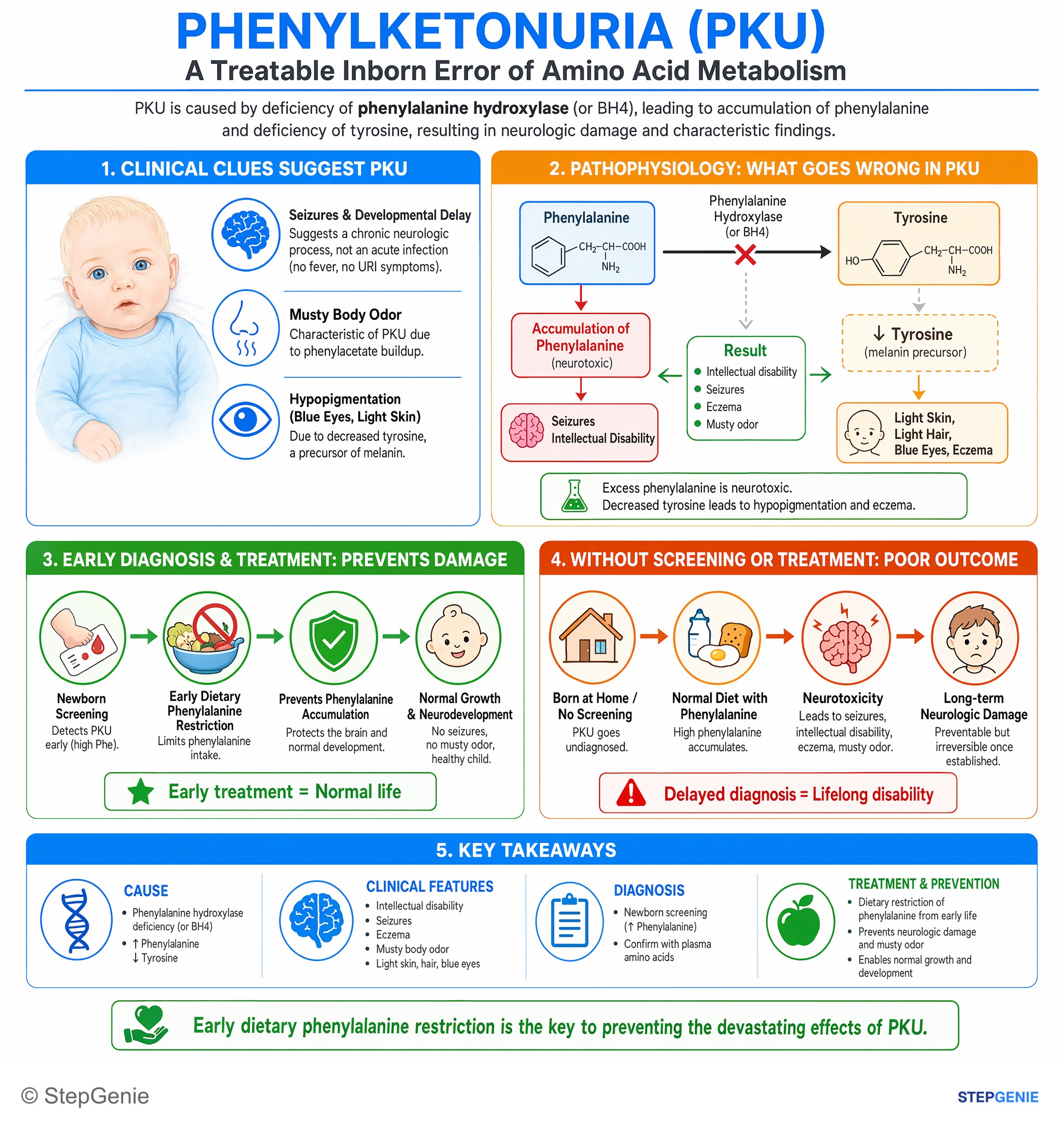
Phenylketonuria (PKU) from phenylalanine hydroxylase deficiency causes intellectual disability, seizures, eczema, and musty odor…
USMLE Step 1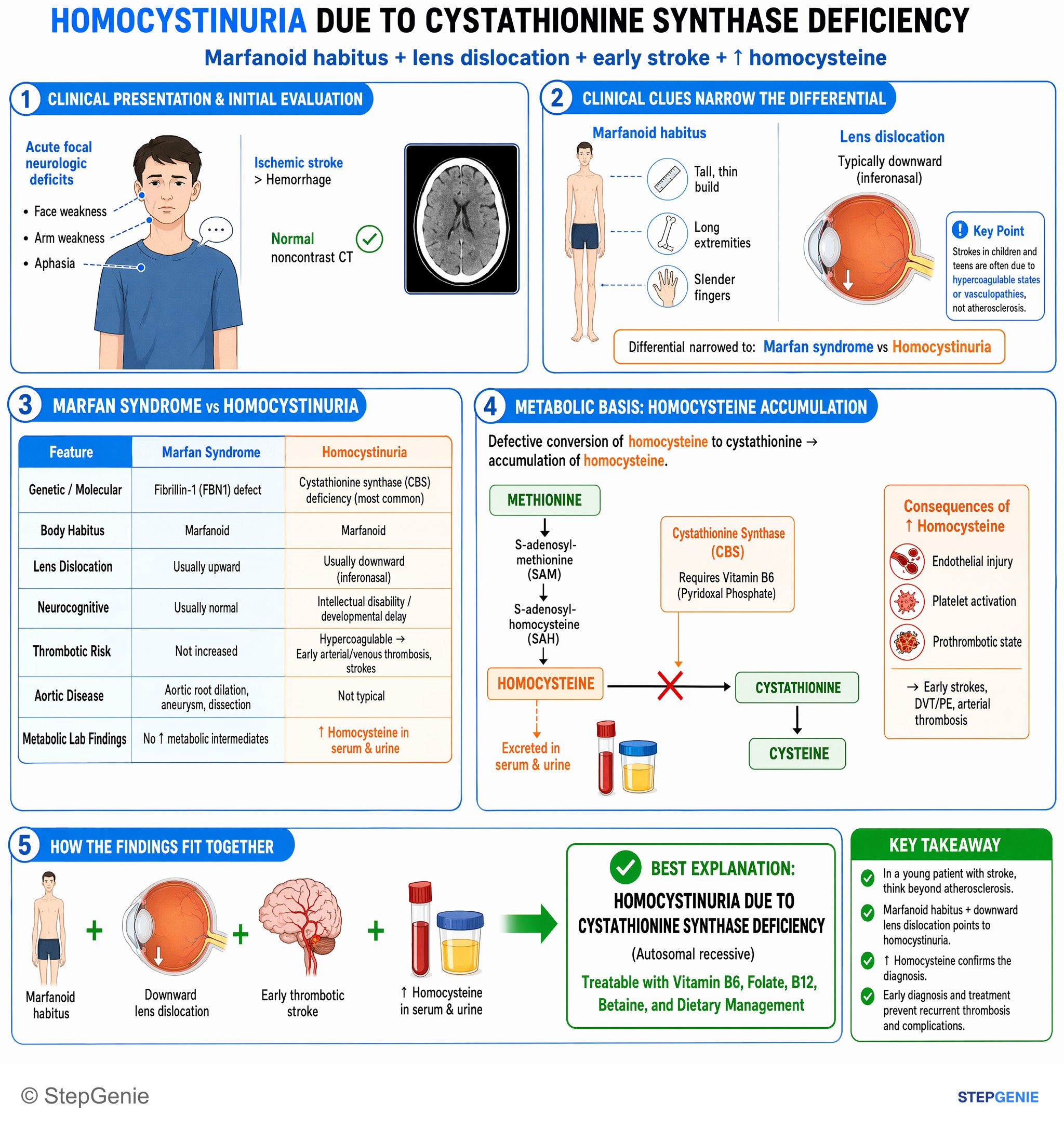
Homocystinuria due to cystathionine synthase deficiency → marfanoid habitus, lens dislocation, thrombotic strokes in young patients…
USMLE Step 1Frequently Asked Questions
What does PVT TIM HALL stand for?
PVT TIM HALL is a mnemonic for the essential amino acids: phenylalanine, valine, threonine, tryptophan, isoleucine, methionine, histidine, arginine, leucine and lysine. It lists ten, one more than the nine that must come from food, because it includes arginine. Arginine is conditionally essential: the body makes it, but newborns and severely ill or stressed patients may not make enough. For the strict nine, drop the A. The two L's, leucine and lysine, are the only purely ketogenic amino acids.
Is arginine an essential amino acid?
Not for healthy adults. MedlinePlus and Merck list arginine among the 11 nonessential amino acids, and the National Academies class it as conditionally indispensable. The body makes it from citrulline using urea cycle enzymes, but newborns may have too little of the synthetic enzymes, and needs can outstrip synthesis in illness and stress. That is why the PVT TIM HALL mnemonic includes it. If a question asks for the nine essential amino acids, leave arginine out and keep histidine.
What is the difference between essential and nonessential amino acids?
Essential amino acids are the nine the body can't make in adequate amounts, so they must come from food: histidine, isoleucine, leucine, lysine, methionine, phenylalanine, threonine, tryptophan and valine. The other 11 are nonessential because the body builds them, mostly from pyruvate, oxaloacetate, alpha-ketoglutarate and 3-phosphoglycerate, adding amino groups by PLP-dependent transamination; tyrosine and cysteine are made from essential amino acids. You need enough of each essential amino acid over the day, not at every meal.
Why do tyrosine and cysteine become essential in PKU and homocystinuria?
Both are made from an essential amino acid. Tyrosine comes only from phenylalanine, via phenylalanine hydroxylase and its cofactor tetrahydrobiopterin (BH4); in phenylketonuria that step fails, so phenylalanine is restricted and tyrosine supplemented. Cysteine is built from serine plus sulfur from methionine, through homocysteine and cystathionine; in classic homocystinuria, cystathionine beta-synthase is deficient, so treatment uses high-dose pyridoxine and, if needed, a low-methionine diet with added cysteine. Arginine, glutamine, glycine and proline are the other conditionally essential amino acids; MedlinePlus also lists serine.
Which amino acids are purely ketogenic, and why?
Only leucine and lysine, the two amino acids whose names start with L. Their carbon skeletons are broken down only to acetyl-CoA and acetoacetate (or acetoacetyl-CoA), which can form ketone bodies but not new glucose: the pyruvate dehydrogenase reaction can't run backward, and the two carbons acetyl-CoA brings into the TCA cycle leave as carbon dioxide. Phenylalanine, tyrosine, tryptophan, isoleucine and threonine are both ketogenic and glucogenic; the other 13 amino acids are purely glucogenic.
How do kwashiorkor and marasmus differ?
Both are forms of protein-energy undernutrition in children. Marasmus is a severe deficiency of calories and protein, usually in infants and very young children, with loss of fat and muscle, loose skin folds and no edema. Kwashiorkor is the edematous form: it is more likely with a diet more deficient in protein than energy, affects somewhat older children, often after early weaning, and causes peripheral and periorbital edema from low serum albumin, a protruding abdomen, an enlarged liver, and skin and hair changes.