A competitive inhibitor binds the free enzyme's active site, so more substrate can outcompete it: Km rises and Vmax is unchanged. A noncompetitive inhibitor binds a separate (allosteric) site on both the free enzyme and the enzyme-substrate complex with equal affinity, so it removes working enzyme: Vmax falls, Km is unchanged, and extra substrate cannot overcome it. An uncompetitive inhibitor binds only the enzyme-substrate (ES) complex, so both Vmax and Km fall. Classic drug examples: fomepizole (alcohol dehydrogenase) and statins (HMG-CoA reductase) are competitive; the NNRTI efavirenz inhibits reverse transcriptase noncompetitively; aspirin and organophosphates are irreversible.
The draw-it-out method: one sketch, three questions
Sketch a Michaelis-Menten curve: reaction velocity (v) on the y-axis, substrate concentration [S] on the x-axis. The curve is a rectangular hyperbola that climbs and then flattens at Vmax, when the enzyme is saturated. Mark Vmax/2, drop a line to the x-axis, and that point is Km: the substrate concentration that gives half-maximal velocity. Equation: v = Vmax × [S] ÷ (Km + [S]). A higher Km means lower apparent affinity.
Now draw the inhibited curve on the same axes and ask three questions:
- Is the ceiling the same? Same plateau = Vmax unchanged (competitive). Lower plateau = Vmax down (noncompetitive, uncompetitive, mixed, irreversible).
- Where is the new halfway point? Further right = Km up (competitive). Same spot = Km unchanged (noncompetitive). Further left = Km down (uncompetitive).
- Does flooding with substrate fix it? Yes only for competitive inhibition.
| Inhibition | How to draw it | Memory line |
|---|---|---|
| Competitive | Same plateau, curve shifted right (halfway point moves right) | "Same ceiling, slower climb" |
| Noncompetitive (pure) | Lower plateau, halfway point at the same [S] | "Lower ceiling, same midpoint" |
| Uncompetitive | Lower plateau, halfway point moves left | "Lower ceiling, earlier midpoint" |
| Mixed | Lower plateau, halfway point moves right (inhibitor prefers free enzyme) or left (prefers ES) | "Lower ceiling, shifted midpoint" |
Competitive vs noncompetitive vs uncompetitive
| Competitive | Noncompetitive (pure) | Uncompetitive | Mixed | |
|---|---|---|---|---|
| Binds | Free enzyme only, at the active site; substrate and inhibitor binding are mutually exclusive | E and ES equally, at a site distinct from the active site | ES complex only | E and ES, with unequal affinity |
| Resembles substrate? | Usually (a substrate analog) | No | No | No |
| Overcome by more substrate? | Yes | No | No; it gets more potent as substrate builds up | No |
| Vmax | Unchanged | ↓ | ↓ | ↓ |
| Km | ↑ (apparent Km = Km × (1 + [I]/Ki)) | Unchanged | ↓ | ↑ if it prefers free E, ↓ if it prefers ES |
| Lineweaver-Burk lines | Cross on the y-axis | Cross on the x-axis | Parallel | Cross left of the y-axis, off the x-axis |
Plot intercepts (1/Vmax on the y-axis, −1/Km on the x-axis) and slopes are worked through in the Lineweaver-Burk plot guide.
Why each pattern happens
Competitive: a contest for the same seat. The inhibitor and substrate cannot be bound at the same time. At low [S] the inhibitor wins many of the contests, so you need more substrate to reach half-maximal speed (Km up). At very high [S], substrate wins almost every contest and the enzyme reaches its usual top speed (Vmax unchanged). Apparent Km rises with inhibitor concentration: Km(app) = Km × (1 + [I]/Ki).
Noncompetitive: workers taken off the line. The inhibitor sits at a different site and binds the enzyme whether or not substrate is bound, so it simply lowers the concentration of functional enzyme. Fewer working enzymes means a lower ceiling (Vmax down), but the enzymes still working bind substrate normally (Km unchanged). Adding substrate cannot help, because competition for the active site is not the problem.
Uncompetitive: the inhibitor needs the substrate first. It binds only after substrate has bound, trapping an inactive ESI complex. Pulling ES out of circulation drags the E + S binding step forward, so the enzyme looks as if it has a higher affinity (Km down), while trapped complexes cannot make product (Vmax down). Because more substrate creates more ES, uncompetitive inhibitors become more potent as substrate rises, the opposite of competitive inhibitors.
Mixed: the general case. The inhibitor binds both E and ES but not equally. Pure noncompetitive inhibition is the special case of equal affinity for E and ES.
Reversible vs irreversible inhibition
- Reversible inhibitors dissociate rapidly from the enzyme; competitive, noncompetitive, uncompetitive and mixed inhibition are all reversible patterns.
- Irreversible inhibitors dissociate very slowly or not at all, because they bind tightly, often covalently. They effectively remove enzyme, so kinetically they behave like noncompetitive inhibitors (lower Vmax). Time-dependent and tight-binding inhibitors also show a noncompetitive pattern, whatever their true binding site.
- Classic irreversible examples: aspirin covalently modifies cyclooxygenase, penicillin covalently modifies bacterial transpeptidase, and organophosphates can bind acetylcholinesterase irreversibly (carbamates, by contrast, are cleared spontaneously within about 48 hours).
Drug and toxin examples that get tested
| Drug or toxin | Target | Type | Why it matters |
|---|---|---|---|
| Fomepizole | Alcohol dehydrogenase | Competitive | Antidote for methanol and ethylene glycol: blocks their conversion to toxic metabolites |
| Statins (e.g., atorvastatin) | HMG-CoA reductase (rate-limiting step to mevalonate) | Competitive ("selective, competitive inhibitor") | Lower cholesterol synthesis; see the HMG-CoA reductase question |
| Sulfamethoxazole | Bacterial folate synthesis | Competes with PABA | Substrate analog; paired with trimethoprim, which reversibly inhibits bacterial DHFR |
| Methotrexate | Dihydrofolate reductase (DHFR) | Folate analog at the active site | Binds DHFR about 1000-fold more tightly than the natural substrate |
| Efavirenz | HIV-1 reverse transcriptase | Noncompetitive | Its activity is mediated predominantly by noncompetitive inhibition; human DNA polymerases are not inhibited (see HIV antiretroviral drugs) |
| Cyanide | Cytochrome c oxidase | Noncompetitive | Halts the electron transport chain |
| Lead, mercury, cadmium | Many enzymes | Noncompetitive | Heavy-metal poisoning |
| Aspirin | Cyclooxygenase | Irreversible (covalent) | Effect lasts until new enzyme is made |
| Organophosphates | Acetylcholinesterase | Irreversible | Cholinergic crisis |
Uncompetitive in drug labels: receptor pharmacology borrows the term. Memantine is a low-to-moderate affinity uncompetitive (open-channel) NMDA receptor antagonist, and dextromethorphan is also described as an uncompetitive NMDA antagonist. Like an uncompetitive enzyme inhibitor that needs ES, an open-channel blocker can only bind once the channel has been opened.
How USMLE tests it
- "Effect overcome by increasing substrate" or "structural analog of the substrate" → competitive (Km up, Vmax same).
- "Binds an allosteric site" or "binds E and ES equally" → noncompetitive (Vmax down, Km same). Do not confuse this with allosteric regulation in general (see allosteric regulation).
- "Binds only the enzyme-substrate complex" → uncompetitive (both down).
- "Vmax down, effect persists after the drug is removed" → irreversible (aspirin, organophosphates).
- Receptor version: a competitive antagonist can be overcome by more agonist (naloxone vs morphine). That mirrors competitive enzyme inhibition, but on a dose-response curve it appears as a rightward shift; see dose-response curves.
- Trap: Km is an inverse measure of affinity. "Km increased" means apparent affinity decreased.
Practice question
A 34-year-old man is brought to the emergency department after drinking windshield washer fluid containing methanol. He is given fomepizole. Which change in the kinetics of alcohol dehydrogenase acting on methanol is expected while fomepizole is present?
A. Km increased, Vmax unchanged B. Km unchanged, Vmax decreased C. Km decreased, Vmax decreased D. Km increased, Vmax decreased E. Km unchanged, Vmax increased
Answer: A. Fomepizole is a competitive inhibitor of alcohol dehydrogenase, the enzyme that starts converting methanol and ethylene glycol to their toxic metabolites. A competitive inhibitor raises the apparent Km (more substrate is needed to reach half-maximal velocity) while Vmax is unchanged, because a high enough substrate concentration still saturates the enzyme.
- B: pure noncompetitive inhibition (allosteric binding to E and ES equally), as with efavirenz on reverse transcriptase.
- C: uncompetitive inhibition (binding only to the ES complex).
- D: mixed inhibition with a preference for the free enzyme.
- E: inhibitors never raise Vmax; an increase in Vmax means more active enzyme, not inhibition.
Key takeaways
- Competitive: active site, free enzyme only, overcome by substrate: Km ↑, Vmax unchanged (fomepizole, statins, sulfonamides vs PABA).
- Noncompetitive: separate site, E and ES equally, not overcome: Vmax ↓, Km unchanged (efavirenz, cyanide, heavy metals).
- Uncompetitive: ES only: Vmax ↓ and Km ↓, and more potent at high substrate.
- Mixed: unequal binding to E and ES; Vmax ↓ with Km up or down.
- Irreversible (aspirin, penicillin, organophosphates) behaves like noncompetitive: less working enzyme.
- Draw it: same ceiling = competitive; lower ceiling with the same midpoint = noncompetitive; lower ceiling with an earlier midpoint = uncompetitive.
Sources
- Section 8.5, Enzymes Can Be Inhibited by Specific Molecules — Biochemistry, 5th ed. (Berg, Tymoczko, Stryer), NCBI Bookshelf (2002)
- Mechanism of Action Assays for Enzymes — Assay Guidance Manual, NCBI Bookshelf (2012)
- Basics of Enzymatic Assays for HTS — Assay Guidance Manual, NCBI Bookshelf (2012)
- Physiology, Noncompetitive Inhibitor — StatPearls, NCBI Bookshelf (2022)
- Enzyme Inhibition: Uncompetitive Inhibition — Biochemistry Online (Henry Jakubowski), College of Saint Benedict and Saint John's University (2014)
- Fomepizole injection prescribing information — DailyMed (2023)
- Lipitor (atorvastatin) prescribing information — DailyMed (2024)
- Bactrim (sulfamethoxazole and trimethoprim) prescribing information — DailyMed (2024)
- Efavirenz tablets prescribing information — DailyMed (2019)
- Memantine hydrochloride extended-release capsules prescribing information — DailyMed (2025)
- Organophosphate Poisoning and Carbamate Poisoning — Merck Manual Professional Edition (2025)
- Drug–Receptor Interactions — Merck Manual Professional Edition (2025)
Visual explanations from the StepGenie QBank
Infographics StepGenie drew to explain questions in its own QBank, matched to this article's topic. Each caption is the takeaway of the question it explains.
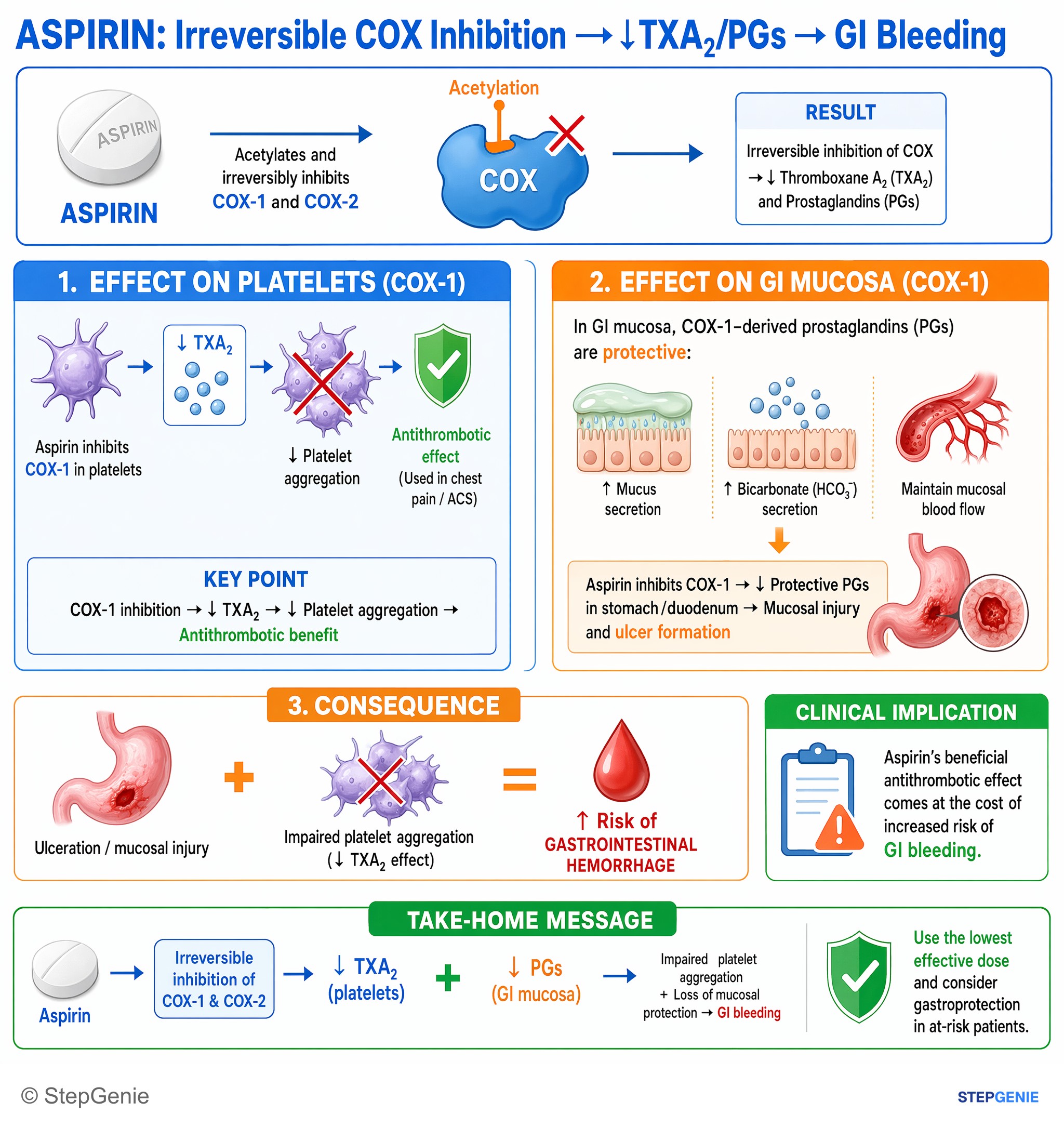
Aspirin irreversibly inhibits COX → ↓TXA2/PGs, impairing platelet aggregation and mucosal protection, causing GI bleeding as a key adverse…
USMLE Step 1Frequently Asked Questions
What is the difference between competitive and noncompetitive inhibition?
A competitive inhibitor binds the active site of the free enzyme, so it competes with substrate and can be overcome by adding more substrate: Km increases and Vmax is unchanged. A noncompetitive inhibitor binds a different site on both the free enzyme and the enzyme-substrate complex with equal affinity, lowering the amount of functional enzyme: Vmax decreases, Km is unchanged, and extra substrate does not help.
Why does competitive inhibition increase Km but not change Vmax?
Because the inhibitor and the substrate compete for the same active site, more substrate is needed to reach half-maximal velocity, so the apparent Km rises; it equals Km multiplied by (1 + [I]/Ki). At a very high substrate concentration, substrate wins nearly every binding contest, the enzyme becomes saturated and reaches its normal maximum rate, so Vmax stays the same.
What is uncompetitive inhibition?
An uncompetitive inhibitor binds only to the enzyme-substrate complex, forming an inactive enzyme-substrate-inhibitor complex. Both the apparent Vmax and the apparent Km decrease, and the inhibitor becomes more potent as substrate builds up, the opposite of a competitive inhibitor. In drug labels, memantine is described as an uncompetitive (open-channel) NMDA receptor antagonist.
How do competitive and noncompetitive inhibition look on a Michaelis-Menten curve?
With a competitive inhibitor, the curve reaches the same plateau (Vmax) but rises more slowly, so the halfway point (Km) shifts to the right. With a pure noncompetitive inhibitor, the plateau is lower but the halfway point stays at the same substrate concentration. With an uncompetitive inhibitor, the plateau is lower and the halfway point shifts to the left.
What are examples of competitive and noncompetitive inhibitors in medicine?
Competitive inhibitors include fomepizole, which blocks alcohol dehydrogenase in methanol or ethylene glycol poisoning; statins such as atorvastatin, which inhibit HMG-CoA reductase; and sulfamethoxazole, which competes with PABA in bacterial folate synthesis. Noncompetitive examples include efavirenz on HIV-1 reverse transcriptase, cyanide on cytochrome c oxidase, and heavy metals such as lead and mercury.
How does irreversible inhibition affect Km and Vmax?
Irreversible inhibitors bind very tightly, often covalently, and dissociate very slowly, so they effectively remove active enzyme. Kinetically they behave like noncompetitive inhibitors: Vmax falls, and adding substrate does not restore activity. Classic examples are aspirin, which covalently modifies cyclooxygenase; penicillin, which covalently modifies bacterial transpeptidase; and organophosphates, which can bind acetylcholinesterase irreversibly.