A zymogen (proenzyme) is an inactive enzyme precursor that is switched on by cleavage of one or a few specific peptide bonds. Activation needs no ATP, happens once and cannot be undone. The Step 1 prototype is trypsinogen: enteropeptidase (enterokinase) on the duodenal brush border cuts off its activation peptide to make trypsin, which activates more trypsinogen and the other pancreatic zymogens. Trypsin activated inside the pancreas instead injures the gland: acute pancreatitis. The same on-switch runs pepsin, clotting, complement, fibrinolysis and apoptosis.
Zymogens at a glance
| Zymogen → active enzyme | Activated by | Where | Clinical hook |
|---|---|---|---|
| Trypsinogen → trypsin | Enteropeptidase, then trypsin itself | Duodenal lumen | Premature activation → acute pancreatitis; PRSS1 gain-of-function → hereditary pancreatitis |
| Chymotrypsinogen, proelastase, procarboxypeptidases → active proteases | Trypsin | Duodenal lumen | Fecal elastase-1 tests exocrine function |
| Prophospholipase A2 → phospholipase A2 | Trypsin | Duodenal lumen | Trypsin also converts procolipase to colipase, lipase's protein cofactor |
| Pepsinogen → pepsin | Acid (pH below about 3.5), then pepsin itself | Stomach (chief cells) | The classic acid-activated zymogen |
| Factors II, VII, IX, X, XI, XII → serine proteases | Upstream factors (XII on exposed collagen, VII via tissue factor) | Plasma, on cell membranes | II, VII, IX and X need vitamin K first |
| Plasminogen → plasmin | Tissue plasminogen activator (tPA), urokinase | Fibrin clot | Alteplase is recombinant tPA; tranexamic acid blocks activation |
| C1r, C1s, C2, factor B → complement proteases | C1r autoactivates when C1 binds; C1s, C2 and factor B are cut by upstream proteases | Plasma, microbial surfaces | Factor D is the classic exception: it circulates already active |
| Procaspases → caspases | Adaptor complexes (initiators); initiator caspases (executioners) | Cytoplasm | Apoptosis |
Why cells make enzymes in an inactive form
- Self-protection. Active peptidases would digest the pancreas, and pepsin the stomach lining, so both are released as zymogens.
- Ready on demand. Acinar cells store zymogens in acidic granules, and clotting and complement precursors circulate in plasma, ready to switch on without ATP.
- Amplification. Each activated protease cleaves many copies of the next zymogen, so a small trigger has a large effect.
- Location control. Enteropeptidase is expressed only at the brush border of the proximal small intestine, and tPA works best when bound to fibrin.
Cleavage is permanent, unlike reversible allosteric regulation or phosphorylation, so active proteases are switched off by inhibitors or degradation.
Trypsinogen: the master switch of digestion
- Acinar cells make the zymogens and store them in acidic zymogen granules; duct cells flush them into the duodenum.
- Enteropeptidase, a serine protease of the duodenal brush border, cuts a lysine–isoleucine bond in trypsinogen and releases an 8-amino-acid trypsinogen activation peptide.
- Trypsin, an endopeptidase that cuts after arginine or lysine, activates more trypsinogen and the other zymogens. It turns chymotrypsinogen into chymotrypsin by cutting one bond (arginine 15–isoleucine 16), activates proelastase, the procarboxypeptidases and prophospholipase A2, and converts procolipase to colipase.
- Amylase and lipase are not zymogens. They are stored and secreted in active form; lipase needs its protein cofactor colipase and bile salts for full activity.
How the pancreas protects itself
| Safeguard | How it works | What weakens it |
|---|---|---|
| SPINK1 (pancreatic secretory trypsin inhibitor) | Secreted with the zymogens; binds early trypsin and delays autoactivation until the zymogens reach the duodenum | SPINK1 loss-of-function variants |
| Degradation by chymotrypsin C (CTRC) and trypsin itself | Cleavage at leucine 81 (by CTRC) and arginine 122 (by trypsin) destroys trypsinogen; bound calcium protects both sites | CTRC loss-of-function variants; PRSS1 variants that resist cleavage (p.Arg122His); high calcium |
| Ductal flushing (CFTR) | Bicarbonate-rich duct fluid washes zymogens out, and high pH with low calcium inactivates trypsin | CFTR variants; duct obstruction |
When activation goes wrong: acute and hereditary pancreatitis
Acute pancreatitis. StatPearls names premature conversion of trypsinogen to trypsin inside acinar cells as the central initiating event; there, zymogens can mix with lysosomal hydrolases such as cathepsin B, which can activate trypsinogen. In experimental models, a sustained rise in acinar-cell calcium comes first and drives this intracellular trypsinogen activation. Trypsin then activates the other zymogens, causing autodigestion and inflammation that can progress to systemic inflammatory response syndrome (SIRS) and organ failure. Fatty acids released in peripancreatic fat bind calcium (saponification), which can cause hypocalcemia (fat necrosis; see cell injury).
- Diagnosis needs 2 of 3: typical pain, amylase and/or lipase above 3 times the upper limit of normal, or characteristic imaging.
- Causes: gallstones and alcohol are the most common. Others include triglycerides above 1,000 mg/dL, hypercalcemia, ERCP, drugs (azathioprine, 6-mercaptopurine, didanosine) and genetic variants. High calcium and low pH both favor trypsinogen activation.
- Current care (ACG 2024): moderately aggressive IV fluids (lactated Ringer solution preferred), early oral feeding within 24–48 hours in mild disease, and early ERCP (within 24 hours) for cholangitis but not for gallstone pancreatitis without it.
Genetic pancreatitis. The genes map onto the safeguards above:
| Gene | Normal role | Effect of disease variants | Inheritance or risk |
|---|---|---|---|
| PRSS1 | Cationic trypsinogen (about two-thirds of trypsinogen) | Gain of function: more autoactivation or less degradation | Autosomal dominant for high-penetrance variants (hereditary pancreatitis) |
| SPINK1 | Trypsin inhibitor | Loss of protection | Usually a risk factor needing other hits; homozygous p.Asn34Ser is linked to early, aggressive disease |
| CTRC | Degrades trypsinogen | Loss of protection | Risk factor (moderately raised risk) |
| CFTR | Duct bicarbonate and fluid secretion | Impaired flushing; some variants mainly impair bicarbonate secretion and cause little lung disease | Biallelic or complex; heterozygotes also at increased risk |
In PRSS1 hereditary pancreatitis, p.Asn29Ile or p.Arg122His is found in about 90% of affected people, with penetrance of about 80–96% in most series. Acute attacks begin by about age 10 on average and chronic pancreatitis by about age 20. Pancreatic cancer risk rises after age 50; a 2018 analysis put the cumulative risk at 7.2% by age 70, below older estimates of 18.8–40%.
Lab correlates: lipase vs amylase and other pancreatic enzyme tests
ACG guidance (2024) says amylase alone is unreliable and lipase is preferred:
- Amylase rises within hours and normalizes in 3–5 days; it can be normal at admission in up to one-fifth of patients and in alcohol-induced pancreatitis or hypertriglyceridemia. Macroamylasemia, reduced GFR, salivary disease and other inflammatory abdominal conditions raise it falsely.
- Lipase is more specific and stays elevated longer (useful for late presenters), though nonpancreatic illness can raise it too.
- Don't trend enzymes. After diagnosis, levels have no relationship to severity, prognosis, refeeding or discharge. Raised enzymes without typical pain do not predict pancreatitis, and ordering both tests adds no sensitivity (College of American Pathologists).
Fecal elastase-1, the elastase that survives intestinal transit, is a noninvasive test for exocrine pancreatic insufficiency and is unaffected by enzyme replacement. Immunoreactive trypsinogen (IRT) on the newborn screen flags cystic fibrosis: inspissated duct secretions push trypsinogen into the blood, and an abnormal screen leads to a sweat chloride test.
Stomach: pepsinogen → pepsin
- Secretion: chief cells release pepsinogen in response to acetylcholine (vagus), gastrin and low pH; somatostatin inhibits release.
- Activation: parietal cell HCl lowers the pH; below about 3.5, pepsinogen cleaves itself to pepsin, and pepsin activates more pepsinogen.
- Action: pepsin is an endopeptidase that works best around pH 2 and becomes inactive once the pH rises above 6 in the duodenum.
- Not essential: patients with achlorhydria still digest protein because the pancreatic proteases take over.
Coagulation: a zymogen cascade that needs vitamin K
Factors II (prothrombin), VII, IX, X, XI and XII circulate as zymogens of serine proteases, and each activated factor activates the next, amplifying the signal. Several clotting proteins are not proteases:
- Factors V and VIII are cofactors (Va for Xa, VIIIa for IXa) activated by thrombin.
- Factor XIII is a protransglutaminase; thrombin converts it to XIIIa, which cross-links fibrin.
- Fibrinogen is the substrate that thrombin cuts into fibrin monomers.
- Protein C is the zymogen of an anticoagulant serine protease, activated by thrombin bound to thrombomodulin; activated protein C cleaves Va and VIIIa.
- Protein S is a non-enzymatic cofactor for activated protein C.
Vitamin K is not an activator. It is the cofactor for γ-glutamyl carboxylase, which adds γ-carboxyglutamate (Gla) residues to factors II, VII, IX and X and proteins C, S and Z. Gla residues bind calcium so these proteins can assemble on phospholipid membranes. Warfarin blocks vitamin K epoxide reductase, and vitamin K deficiency leaves the proteins undercarboxylated and nonfunctional (PIVKA), prolonging the PT first and the aPTT in more severe cases. The full map is in the coagulation cascade review.
Fibrinolysis and complement: two more zymogen cascades
Plasminogen is a liver-made zymogen that binds lysine residues on fibrin. Endothelial tPA cleaves an arginine–valine bond in fibrin-bound plasminogen to make plasmin, which breaks down fibrin; alteplase, a recombinant tPA, is used as a thrombolytic. PAI-1 inhibits tPA and urokinase, and α2-antiplasmin inhibits plasmin. Tranexamic acid and aminocaproic acid are lysine analogs that stop plasminogen binding to fibrin.
Complement uses the same logic: several complement proteins are proteases activated by cleavage. C1r autoactivates and cleaves C1s, which cleaves C4 and C2; mannan-binding lectin-associated serine proteases (MASPs) do this in the lectin pathway; cleaved C2 or factor B supplies the protease of the C3 convertases. Factor D circulates as an active enzyme rather than a zymogen. C1 inhibitor blocks C1r, C1s, MASP-1, MASP-2, kallikrein and factor XIIa; its deficiency causes hereditary angioedema, bradykinin-mediated swelling without hives that responds poorly to antihistamines, steroids and epinephrine, with low C4 as the screening test.
Caspases: the zymogens of apoptosis
Caspases are cysteine proteases that cut after aspartate, made as inactive procaspases (pathways and morphology: apoptosis vs necrosis).
- Initiator caspases (2, 8, 9 and 10) are activated when adaptor proteins cluster them: death receptors such as Fas and TNFR1 recruit adaptors that aggregate procaspase-8 (extrinsic pathway), and cytochrome c released from mitochondria binds Apaf-1 to activate procaspase-9 (intrinsic pathway).
- Executioner caspases (3, 6 and 7) are cleaved by the initiators and dismantle the cell; the cascade is self-amplifying and irreversible.
- Cytotoxic T cells deliver granzymes through perforin pores to activate caspases; inhibitor of apoptosis proteins (IAPs) restrain them.
Zymogen or prohormone? Getting the terms right
"Zymogen" means the precursor of an enzyme. Other proteins are also trimmed into their final form, but the products are not enzymes:
| Precursor | Product | Product type | Zymogen? |
|---|---|---|---|
| Trypsinogen, pepsinogen, plasminogen | Trypsin, pepsin, plasmin | Enzymes | Yes |
| Proinsulin | Insulin + C-peptide (equimolar) | Hormone | No: prohormone |
| Procollagen | Collagen | Structural protein | No |
| Fibrinogen | Fibrin | Structural protein | No |
The prefix "pre-" marks a signal peptide: preproinsulin becomes proinsulin when its signal peptide is removed.
Congenital enteropeptidase deficiency
Without enteropeptidase, trypsinogen is poorly activated, so the protease cascade stalls and infants cannot digest protein adequately. This extremely rare autosomal recessive disorder is caused by loss-of-function variants in TMPRSS15. Infants usually present with chronic diarrhea, failure to thrive and hypoproteinemia, and about half also have vomiting, edema and anemia. The duodenal biopsy is histologically normal. Diagnosis classically rested on measuring trypsin activity in duodenal fluid and is now made by genetic testing. Patients respond well to pancreatic enzyme replacement.
Activation is one-way, so inhibitors are the off switch
| Inhibitor | Main targets | When it fails |
|---|---|---|
| SPINK1 | Trypsin inside the pancreas | Higher pancreatitis risk |
| α1-Antitrypsin | Neutrophil elastase | Emphysema; misfolded Z protein accumulates in hepatocytes and damages the liver |
| Antithrombin | Thrombin, factor Xa (also IXa) | Thrombosis; heparin boosts antithrombin at least a thousandfold |
| C1 inhibitor | C1r, C1s, MASP-1, MASP-2, kallikrein, factor XIIa | Hereditary angioedema |
Classic exam traps
- Amylase and lipase are secreted active; trypsin does activate prophospholipase A2 and procolipase.
- Enteropeptidase comes from the duodenum, not the pancreas, and activates trypsinogen; trypsin activates the rest.
- Pepsinogen is activated by acid, not by enteropeptidase.
- Vitamin K does not activate zymogens; γ-carboxylation lets the factors bind calcium and membranes.
- Not every clotting protein is a protease: V, VIII and protein S are cofactors, XIIIa is a transglutaminase and fibrinogen is a substrate.
- Caspases are cysteine proteases, whereas the clotting-factor proteases (IIa, VIIa, IXa, Xa, XIa and XIIa) are serine proteases.
- Proinsulin is a prohormone, not a zymogen.
Worked examples
Vignette 1. A 13-year-old girl is admitted with her third episode of acute pancreatitis. She does not drink alcohol, takes no medications and has no gallstones; triglyceride and calcium levels are normal. Her father has had recurrent pancreatitis since childhood and now has pancreatic insufficiency. A gain-of-function variant in which gene is most likely?
Answer: PRSS1 (cationic trypsinogen).
One-line reasoning: Recurrent pancreatitis from childhood with an affected parent suggests autosomal dominant hereditary pancreatitis, in which mutant trypsinogen autoactivates more or resists degradation inside the pancreas.
Vignette 2. A 38-year-old man with known hypertriglyceridemia has 10 hours of severe epigastric pain radiating to the back. Serum amylase is normal, lipase is 6 times the upper limit of normal and triglycerides are 2,400 mg/dL. Does the normal amylase argue against acute pancreatitis?
Answer: No. He meets 2 of 3 criteria (typical pain and lipase above 3 times normal).
One-line reasoning: Amylase can stay normal in hypertriglyceridemia and alcohol-induced pancreatitis, one reason current guidance prefers lipase.
Vignette 3. A 4-month-old has had watery diarrhea since early infancy, poor weight gain, generalized edema and low serum albumin. Sweat chloride is normal, a duodenal biopsy is histologically normal and duodenal fluid shows very low trypsin activity. Symptoms improve with pancreatic enzyme supplements. Deficiency of which enzyme best explains the findings?
Answer: Enteropeptidase (enterokinase), from TMPRSS15 variants.
One-line reasoning: Without enteropeptidase, trypsinogen is not activated normally, so protein is maldigested, causing diarrhea, failure to thrive and hypoproteinemic edema; normal sweat chloride points away from cystic fibrosis.
Key takeaways
- A zymogen is an enzyme precursor activated by irreversible, site-specific cleavage.
- Enteropeptidase activates trypsinogen; trypsin activates more trypsinogen and the other pancreatic zymogens, while amylase and lipase are secreted active.
- SPINK1, CTRC, trypsin autolysis and CFTR-driven duct flushing keep trypsin off inside the pancreas; PRSS1 gain-of-function variants overwhelm them.
- Lipase is the preferred test for acute pancreatitis, and enzyme levels are not trended.
- Pepsinogen is activated by acid; clotting factors, plasminogen, complement proteases and caspases form zymogen cascades, and vitamin K is needed for carboxylation, not activation.
More enzyme and metabolism reviews are on the biochemistry topic hub.
Sources
- Berg JM, Tymoczko JL, Stryer L. Biochemistry, 5th ed. Section 10.5: Many Enzymes Are Activated by Specific Proteolytic Cleavage (NCBI Bookshelf)
- Pandol SJ. The Exocrine Pancreas: Digestive Enzymes (NCBI Bookshelf)
- Physiology, Digestion (StatPearls, NCBI Bookshelf)
- Physiology, Pepsin (StatPearls, NCBI Bookshelf)
- Pancreatitis Overview (GeneReviews, NCBI Bookshelf)
- PRSS1-Related Hereditary Pancreatitis (GeneReviews, NCBI Bookshelf)
- Hegyi E, Sahin-Tóth M. Genetic Risk in Chronic Pancreatitis: The Trypsin-Dependent Pathway. Dig Dis Sci. 2017 (PubMed)
- Acute Pancreatitis (StatPearls, NCBI Bookshelf)
- Zaman S, Gorelick F. Acute pancreatitis: pathogenesis and emerging therapies. J Pancreatol. 2024 (PubMed)
- Tenner S, et al. American College of Gastroenterology Guidelines: Management of Acute Pancreatitis. Am J Gastroenterol. 2024 (PubMed)
- Lipase in the Diagnosis of Acute Pancreatitis: clinician guide (College of American Pathologists)
- Hypocalcemia (StatPearls, NCBI Bookshelf)
- Exocrine Pancreatic Insufficiency (StatPearls, NCBI Bookshelf)
- Cystic Fibrosis (GeneReviews, NCBI Bookshelf)
- Montoro-Huguet MA, et al. Small and Large Intestine (I): Malabsorption of Nutrients. Nutrients. 2021 (PubMed)
- Physiology, Coagulation Pathways (StatPearls, NCBI Bookshelf)
- Vitamin K Deficiency in Neonates and Adults (StatPearls, NCBI Bookshelf)
- Khider L, et al. Inherited Thrombophilia in the Era of Direct Oral Anticoagulants. Int J Mol Sci. 2022 (PubMed)
- Physiology, Plasminogen Activation (StatPearls, NCBI Bookshelf)
- Tissue Plasminogen Activator Therapy (StatPearls, NCBI Bookshelf)
- Tranexamic Acid (StatPearls, NCBI Bookshelf)
- Aminocaproic Acid (StatPearls, NCBI Bookshelf)
- Janeway CA Jr, et al. Immunobiology, 5th ed. The complement system and innate immunity (NCBI Bookshelf)
- Dobó J, et al. MASP-3 is the exclusive pro-factor D activator in resting blood: the lectin and the alternative complement pathways are fundamentally linked. Sci Rep. 2016 (PubMed)
- Hereditary Angioedema (StatPearls, NCBI Bookshelf)
- Apoptosis and Cell Death: Signaling in Health and Diseases (StatPearls, NCBI Bookshelf)
- Alberts B, et al. Molecular Biology of the Cell, 4th ed. Programmed Cell Death (Apoptosis) (NCBI Bookshelf)
- Biochemistry, C Peptide (StatPearls, NCBI Bookshelf)
- Holzinger A, et al. Mutations in the proenteropeptidase gene are the molecular cause of congenital enteropeptidase deficiency. Am J Hum Genet. 2002 (PubMed)
- Wang L, et al. Novel Compound Heterozygous TMPRSS15 Gene Variants Cause Enterokinase Deficiency. Front Genet. 2020 (PubMed)
- Alpha-1 Antitrypsin Deficiency (StatPearls, NCBI Bookshelf)
Visual explanations from the StepGenie QBank
Infographics StepGenie drew to explain questions in its own QBank, matched to this article's topic. Each caption is the takeaway of the question it explains.
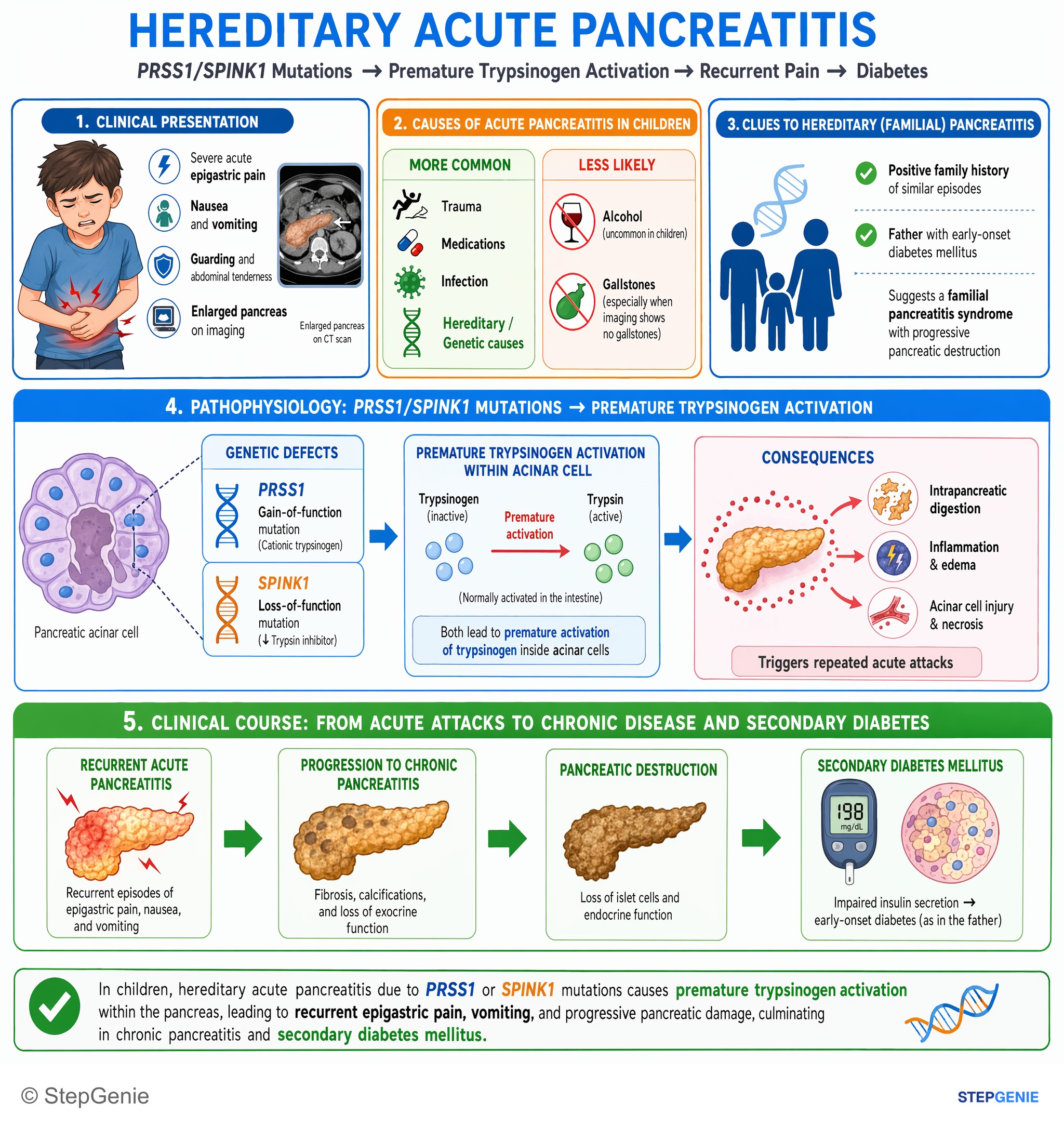
Hereditary acute pancreatitis from PRSS1/SPINK1 mutation causes premature trypsinogen activation, leading to recurrent epigastric pain…
USMLE Step 1Frequently Asked Questions
What is a zymogen? What are some examples?
A zymogen, or proenzyme, is an inactive enzyme precursor that becomes active when one or a few specific peptide bonds are cut. Classic examples are the pancreatic zymogens (trypsinogen, chymotrypsinogen, proelastase, procarboxypeptidases and prophospholipase A2), pepsinogen in the stomach, clotting-factor zymogens such as prothrombin, plasminogen, several complement proteases and the procaspases of apoptosis. Making these enzymes as precursors lets cells store them safely and switch them on only where they are needed.
What converts trypsinogen to trypsin?
Enteropeptidase (also called enterokinase), a serine protease on the brush border of the duodenum and proximal jejunum, cuts trypsinogen at a lysine–isoleucine bond and releases its activation peptide. The trypsin formed then activates more trypsinogen and the other pancreatic zymogens. Infants who lack enteropeptidase because of TMPRSS15 variants develop diarrhea, failure to thrive and hypoproteinemia, and they improve with pancreatic enzyme replacement.
Why are pancreatic enzymes secreted as zymogens?
Active proteases would digest the pancreas that makes them. The pancreas stores them as zymogens in acidic granules, secretes the trypsin inhibitor SPINK1 alongside them, destroys stray trypsinogen through chymotrypsin C and trypsin autolysis, and flushes the zymogens out with CFTR-dependent, bicarbonate-rich duct fluid. Activation normally starts only in the duodenum. When these safeguards fail, premature trypsin activation inside the gland leads to pancreatitis.
Is zymogen activation reversible?
No. Proteolytic activation is irreversible and happens only once in the life of an enzyme molecule, unlike allosteric regulation or reversible phosphorylation. Active proteases are switched off by specific inhibitors or by degradation: SPINK1 inhibits trypsin in the pancreas, alpha-1 antitrypsin inhibits neutrophil elastase, antithrombin inhibits thrombin and factor Xa, and C1 inhibitor controls C1r and C1s. Their deficiencies are linked to pancreatitis, emphysema, thrombosis and hereditary angioedema.
Are lipase and amylase zymogens?
No. Pancreatic amylase and lipase are stored and secreted in active form, unlike the proteases and prophospholipase A2. Lipase needs bile salts and colipase, its protein cofactor, which trypsin activates from procolipase. For diagnosing acute pancreatitis, current ACG guidance prefers serum lipase because it is more specific and stays elevated longer than amylase, and neither level tracks severity.
Are clotting factors zymogens?
Many are. Factors II (prothrombin), VII, IX, X, XI and XII circulate as zymogens of serine proteases, and protein C is the zymogen of an anticoagulant protease. Factors V and VIII are cofactors, factor XIII is the precursor of a transglutaminase, fibrinogen is a substrate and protein S is a non-enzymatic cofactor. Vitamin K does not activate these proteins; it is needed to γ-carboxylate factors II, VII, IX and X and proteins C, S and Z so they can bind calcium.