Pellagra questions are classic Q-bank bait: the stem screams one vitamin deficiency, but the answer choices are packed with other “lookalike” deficiencies that can steal points if you don’t slow down. The goal isn’t just to recognize niacin deficiency—it’s to know why the other choices are wrong and what clinical clues would make them right.
Tag: Biochemistry > Vitamins & Cofactors
The Clinical Vignette (What You’re Supposed to See)
A 52-year-old man with chronic alcohol use and a corn-based diet presents with a painful rash on sun-exposed skin, chronic watery diarrhea, and progressive confusion/irritability. On exam, he has hyperpigmented, scaly dermatitis in a “necklace” distribution. Labs show a low NAD/NADP-dependent enzyme activity.
Most likely diagnosis: Niacin (vitamin B3) deficiency → Pellagra.
Correct Answer Deep Dive: Niacin (B3) Deficiency → Pellagra
The high-yield triad: the “3 D’s”
- Dermatitis (photosensitive, hyperpigmented, scaly)
- Classic: Casal necklace (rash around the neck)
- Diarrhea
- Dementia (can include depression, irritability, confusion)
And the optional fourth:
- Death (if untreated)
Why niacin deficiency causes these findings (Step-relevant mechanism)
Niacin is the precursor to:
- NAD+ and NADP+
These are essential electron carriers in:
- Redox reactions (glycolysis, TCA cycle, oxidative phosphorylation, fatty acid synthesis)
- Lots of tissues get hit, especially high-turnover or high-energy areas:
- Skin (photosensitivity/inflammation)
- GI tract (diarrhea from mucosal dysfunction)
- CNS (neuropsychiatric symptoms)
Big risk factors to memorize
- Malnutrition / chronic alcoholism
- Corn-based diet (niacin in untreated maize is poorly bioavailable)
- Hartnup disease (↓ absorption of neutral amino acids like tryptophan)
- Carcinoid syndrome
- Tryptophan gets diverted to serotonin production → less tryptophan available for niacin synthesis
- Isoniazid therapy
- Mainly associated with B6 deficiency, but can secondarily contribute via impaired tryptophan metabolism in some contexts
High-yield association: tryptophan → niacin
- Tryptophan can be converted to niacin (requires B6 among other factors)
- Clinical test writers love this:
- Carcinoid syndrome → ↓ tryptophan available → pellagra-like picture
Q-Bank Skill: Why Every Distractor Matters (Common Answer Choices)
Below are the usual suspects that show up next to niacin—and how to separate them fast.
Distractor 1: Thiamine (B1) Deficiency
Why it’s tempting: alcohol use + neuro symptoms.
How it differs:
- Thiamine deficiency causes:
- Wernicke encephalopathy: confusion, ophthalmoplegia, ataxia
- Korsakoff syndrome: confabulation, memory impairment
- Wet beriberi: high-output heart failure
- Dry beriberi: peripheral neuropathy
- No photosensitive dermatitis + diarrhea triad.
High-yield biochem:
- B1 is a cofactor for:
- Pyruvate dehydrogenase
- -ketoglutarate dehydrogenase
- Branched-chain -ketoacid dehydrogenase
- Transketolase (PPP)
- Clinically: give thiamine before glucose in alcohol use disorder to avoid precipitating Wernicke.
Distractor 2: Riboflavin (B2) Deficiency
Why it’s tempting: dermatitis-ish findings.
How it differs:
- B2 deficiency causes:
- Cheilosis (cracks at corners of mouth)
- Angular stomatitis
- Glossitis
- Corneal vascularization
- Not the 3 D’s, and not classically photosensitive rash + diarrhea + dementia.
High-yield biochem:
- Riboflavin → FAD, FMN
- Think redox enzymes (e.g., dehydrogenases, ETC).
Distractor 3: Pyridoxine (B6) Deficiency
Why it’s tempting: neurologic symptoms + alcoholism/INH.
How it differs:
- B6 deficiency causes:
- Peripheral neuropathy
- Seizures (↓ GABA synthesis)
- Sideroblastic anemia (↓ ALA synthase activity)
- Skin findings can occur (dermatitis), but the classic pellagra triad is more B3.
High-yield triggers:
- Isoniazid, hydralazine, penicillamine, oral contraceptives
High-yield biochem:
- B6 is used for:
- Transamination (ALT/AST)
- Decarboxylation (neurotransmitters)
- Heme synthesis (ALA synthase)
- Niacin synthesis from tryptophan (why B6 can indirectly affect B3)
Distractor 4: Folate (B9) Deficiency
Why it’s tempting: diarrhea/malnutrition.
How it differs:
- Folate deficiency → megaloblastic anemia
- Hypersegmented neutrophils
- ↑ homocysteine, normal methylmalonic acid
- Symptoms: fatigue, pallor, glossitis (not classically dermatitis + dementia triad)
Risk factors:
- Alcohol use disorder
- Pregnancy
- Methotrexate, TMP-SMX, phenytoin
Distractor 5: Cobalamin (B12) Deficiency
Why it’s tempting: neuro symptoms.
How it differs:
- B12 deficiency → megaloblastic anemia plus neurologic deficits
- Subacute combined degeneration (dorsal columns + lateral corticospinal tracts)
- Paresthesias, ataxia
- Labs: ↑ homocysteine and ↑ methylmalonic acid
Key point: neuro symptoms with anemia ≠ pellagra unless you also see the dermatitis/diarrhea picture.
Distractor 6: Vitamin C Deficiency (Scurvy)
Why it’s tempting: rash/skin findings + malnutrition.
How it differs:
- Scurvy causes:
- Bleeding gums
- Petechiae/purpura
- Perifollicular hemorrhage
- Poor wound healing
- It’s a collagen problem, not NAD/NADP.
High-yield biochem:
- Vitamin C is required for hydroxylation of proline and lysine in collagen.
Distractor 7: Vitamin A Deficiency
Why it’s tempting: “skin” + malnutrition.
How it differs:
- Vitamin A deficiency causes:
- Night blindness
- Xerophthalmia
- Bitot spots
- Not diarrhea/dementia/photodermatitis.
Rapid Comparison Table (Exam-Speed Pattern Recognition)
| Deficiency | Hallmark Findings | Classic Associations | Key Biochem Hook |
|---|---|---|---|
| Niacin (B3) | Dermatitis (photosensitive), diarrhea, dementia | Corn-based diet, alcoholism, carcinoid, Hartnup | ↓ NAD/NADP |
| Thiamine (B1) | Wernicke-Korsakoff, beriberi | Alcoholism | PDH, KG DH, BCKA DH, transketolase |
| Riboflavin (B2) | Cheilosis, corneal vascularization | Malnutrition | ↓ FAD/FMN |
| Pyridoxine (B6) | Neuropathy, seizures, sideroblastic anemia | INH, OCPs | PLP: transamination, neurotransmitters, heme |
| Folate (B9) | Megaloblastic anemia, ↑ homocysteine | Alcohol, pregnancy, MTX | THF for 1-carbon transfers |
| B12 | Megaloblastic anemia + neuro deficits | Pernicious anemia | ↑ methylmalonic acid |
| Vit C | Bleeding gums, petechiae, poor healing | Malnutrition | Collagen hydroxylation |
How This Shows Up on USMLE (High-Yield “If You See X, Think Y”)
If you see…
- Photosensitive rash + diarrhea + neuro/psychiatric changes → Niacin deficiency
- Corn-based diet → pellagra (unless the question says “treated/alkali-processed corn,” which improves bioavailability)
- Carcinoid syndrome + pellagra symptoms → tryptophan diversion → niacin deficiency
- Alcohol + confusion + ataxia + eye movement abnormalities → thiamine deficiency (treat with thiamine first)
Take-Home Memory Hooks
- B3 = NAD/NADP = energy/redox → when low, skin + gut + brain struggle.
- Pellagra = 3 D’s: Dermatitis, Diarrhea, Dementia (± Death).
- Don’t let “alcohol use” auto-push you to B1—the rash pattern and diarrhea are the giveaway for B3.
Visual explanations from the StepGenie QBank
Infographics StepGenie drew to explain questions in its own QBank, matched to this article's topic. Each caption is the takeaway of the question it explains.
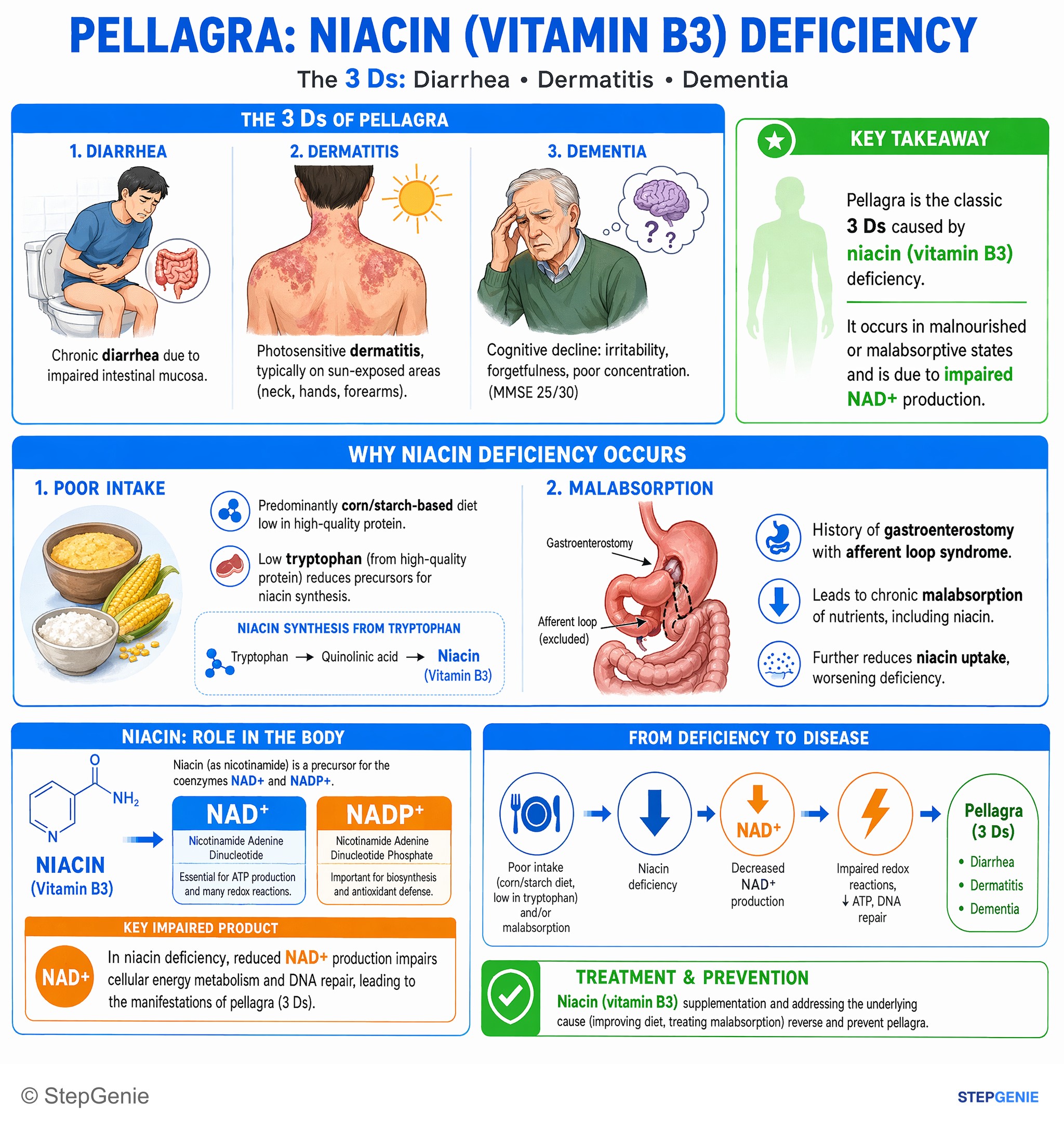
Pellagra from niacin (vitamin B3) deficiency → impaired NAD+ production, causing dermatitis, diarrhea, and dementia in malnourished or…
USMLE Step 1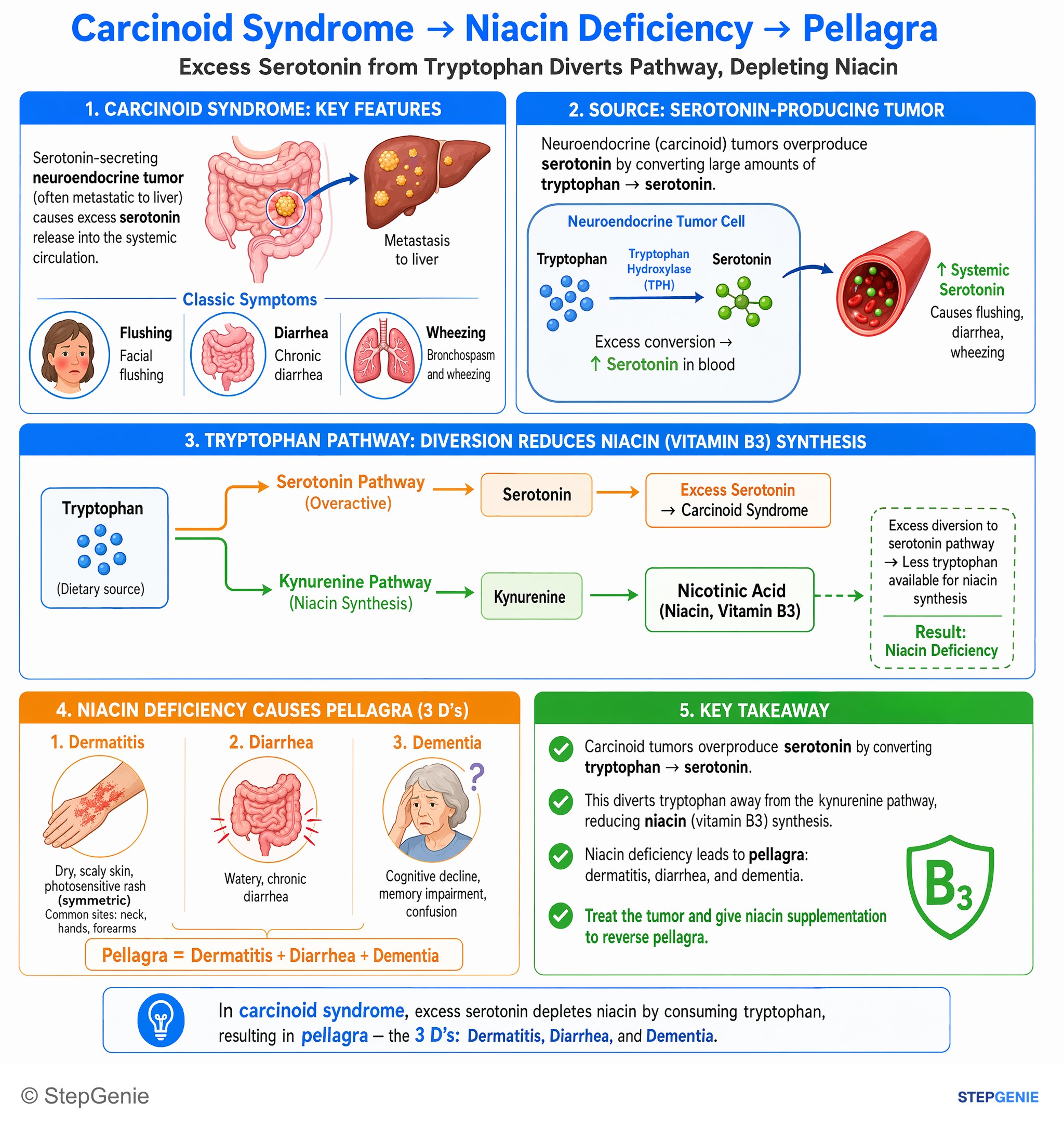
Carcinoid syndrome overproduces serotonin from tryptophan, depleting substrate for niacin synthesis → pellagra (diarrhea, dermatitis…
USMLE Step 1Frequently Asked Questions
What are the classic signs of niacin deficiency in a vignette?
Niacin deficiency classically presents with the 3 D’s: dermatitis, diarrhea, and dementia. The dermatitis is photosensitive, hyperpigmented, and scaly, often appearing as a Casal necklace around the neck. Neuropsychiatric symptoms can include irritability, depression, or confusion, and severe untreated disease can progress to death. A stem with sun-exposed rash plus chronic diarrhea and mental status changes should strongly suggest pellagra.
Why does niacin deficiency cause dermatitis, diarrhea, and dementia?
Niacin deficiency causes these findings because niacin is the precursor to NAD+ and NADP+, which are essential electron carriers in redox reactions. When these pathways are impaired, high-turnover or high-energy tissues are affected most. That is why the skin develops photosensitive inflammation, the GI tract develops mucosal dysfunction leading to diarrhea, and the CNS develops neuropsychiatric symptoms such as confusion and irritability.
What risk factors should make you think of pellagra?
Major risk factors for pellagra include malnutrition, chronic alcoholism, and a corn-based diet because niacin in untreated maize is poorly bioavailable. Hartnup disease is another clue because impaired absorption of neutral amino acids reduces tryptophan availability. Carcinoid syndrome also points toward pellagra because tryptophan is diverted to serotonin production, leaving less available for niacin synthesis.
How do you tell niacin deficiency from thiamine deficiency on an exam?
Niacin deficiency is distinguished by the triad of photosensitive dermatitis, diarrhea, and dementia. Thiamine deficiency can also appear in patients with alcohol use and neurologic symptoms, but it causes Wernicke encephalopathy, Korsakoff syndrome, beriberi, and peripheral neuropathy rather than the classic pellagra rash and diarrhea. If the stem emphasizes a sun-exposed scaly rash with GI symptoms, niacin deficiency is the better answer.
How do you separate pellagra from B12 or folate deficiency when neuro or GI symptoms are present?
Pellagra is separated from B12 and folate deficiency by its characteristic dermatitis and diarrhea pattern. Folate deficiency causes megaloblastic anemia with hypersegmented neutrophils and increased homocysteine, but not the classic dermatitis-dementia picture. B12 deficiency causes megaloblastic anemia plus neurologic deficits such as paresthesias and ataxia, with increased homocysteine and methylmalonic acid, but it does not classically cause photosensitive pellagra dermatitis.