A good Q-bank question doesn’t just test whether you can recognize scurvy—it tests whether you can exclude everything else on the list. Vitamin deficiencies love to overlap clinically (fatigue, rash, anemia, neuropathy), so the highest-yield move on Step is learning the “signature” findings and the biochemical logic behind them.
Clinical Vignette (Q-bank style)
A 54-year-old man with alcohol use disorder and housing insecurity presents with 2 months of progressive fatigue, diffuse muscle aches, and “easy bruising.” He reports bleeding gums when brushing and poor wound healing. Exam shows perifollicular petechiae on the legs with coiled “corkscrew” hairs and gingival swelling. Labs show a mild normocytic anemia.
Question: Which deficiency best explains this patient’s findings?
Correct Answer: Vitamin C (Ascorbic acid) deficiency — Scurvy
Why it’s correct (what you should immediately key in on)
This vignette is basically waving a neon sign:
- Bleeding gums
- Perifollicular hemorrhage + petechiae
- Corkscrew hairs
- Poor wound healing
- Risk factors: malnutrition, alcohol use disorder, food insecurity, elderly, restrictive diets
The core biochemistry (Step 1 gold)
Vitamin C is required for:
- Hydroxylation of proline and lysine in collagen synthesis (via prolyl/lysyl hydroxylases)
- Iron absorption: reduces to in the gut
Without vitamin C → weak collagen → fragile blood vessels and connective tissue → bleeding, bruising, impaired wound healing.
High-yield clinical associations
- Perifollicular hemorrhages and corkscrew hairs are very classic.
- Can cause anemia (often from bleeding + decreased iron absorption).
- Symptoms can include arthralgias and bone pain (especially in kids due to impaired osteoid formation).
How to Systematically Kill the Distractors (and learn from them)
Below is a USMLE-style breakdown of common answer choices that show up in the same neighborhood of symptoms.
Distractor 1: Vitamin K deficiency
Why it tempts you: bleeding is the headline.
Why it’s wrong here:
- Vitamin K deficiency causes coagulopathy from impaired -carboxylation.
- Classic findings are elevated PT/INR, bleeding/bruising, and risk factors like:
- warfarin use
- broad-spectrum antibiotics
- fat malabsorption (cholestasis, CF)
What’s missing in this vignette:
- No mention of prolonged PT/INR
- No malabsorption/antibiotics/warfarin context
- Doesn’t explain corkscrew hairs or poor wound healing nearly as cleanly as collagen failure does
High-yield pearl:
Vitamin K is for clotting factors 2, 7, 9, 10 + Proteins C and S (the “1972 + C&S” mnemonic).
Distractor 2: Niacin (Vitamin B3) deficiency
Why it tempts you: malnutrition + systemic symptoms.
Why it’s wrong here: Niacin deficiency causes pellagra:
- Dermatitis (classically photosensitive and hyperpigmented)
- Diarrhea
- Dementia (± death)
What’s missing:
- No diarrhea, neurocognitive decline, or sun-exposed rash pattern
- The perifollicular hemorrhage/corkscrew hairs are not pellagra features
High-yield pearl:
Niacin is a precursor for NAD/NADP. Isoniazid can indirectly contribute by depleting B6 → decreasing tryptophan → less niacin.
Distractor 3: Thiamine (Vitamin B1) deficiency
Why it tempts you: alcohol use disorder is a major risk factor.
Why it’s wrong here: Thiamine deficiency presents as:
- Wernicke encephalopathy: confusion, ophthalmoplegia, ataxia
- Korsakoff syndrome: memory impairment, confabulation
- Dry beriberi: peripheral neuropathy
- Wet beriberi: high-output heart failure, edema
What’s missing:
- No eye findings, ataxia, confusion, neuropathy, cardiomyopathy
High-yield pearl:
Give thiamine before glucose to avoid precipitating Wernicke.
Distractor 4: Riboflavin (Vitamin B2) deficiency
Why it tempts you: can cause mucocutaneous findings and malnutrition.
Why it’s wrong here: Riboflavin deficiency causes:
- Cheilosis (cracked lips)
- Angular stomatitis
- Glossitis
- “Magenta tongue” is sometimes cited
Not a bleeding/bruising/collagen story.
High-yield pearl:
B2 is a precursor for FAD and FMN (redox reactions).
Distractor 5: Pyridoxine (Vitamin B6) deficiency
Why it tempts you: anemia + neuropathy overlap, alcohol use is a risk.
Why it’s wrong here: B6 deficiency causes:
- Sideroblastic anemia (microcytic) due to impaired ALA synthase
- Peripheral neuropathy
- Seizures (↓ GABA)
- Often due to isoniazid, OCPs, hydralazine, penicillamine
What’s missing:
- No neuropathy or seizures
- No microcytosis/sideroblast clues
- Still doesn’t explain corkscrew hairs/perifollicular hemorrhage
High-yield pearl:
B6 is a cofactor for transamination, heme synthesis, and neurotransmitter synthesis.
Distractor 6: Folate (Vitamin B9) deficiency
Why it tempts you: anemia + malnutrition.
Why it’s wrong here: Folate deficiency causes megaloblastic anemia with:
- Macrocytosis
- Hypersegmented neutrophils
- Possible glossitis
It does not cause neurologic deficits (that’s B12).
What’s missing:
- No macrocytosis picture
- Bleeding gums + perifollicular hemorrhage is not the folate signature
High-yield pearl:
Folate deficiency risk: alcohol use, pregnancy, methotrexate, TMP-SMX, phenytoin.
Distractor 7: Vitamin B12 (Cobalamin) deficiency
Why it tempts you: anemia and fatigue are common.
Why it’s wrong here: B12 deficiency causes:
- Megaloblastic anemia
- Neurologic deficits (posterior column + corticospinal): paresthesias, ataxia, loss of vibration/position sense
- Elevated methylmalonic acid and homocysteine
What’s missing:
- No neuro findings
- Again, the collagen/bleeding findings point away from B12
Distractor 8: Vitamin A deficiency
Why it tempts you: malnutrition association.
Why it’s wrong here: Vitamin A deficiency causes:
- Night blindness
- Xerophthalmia
- Bitot spots
- Increased infection risk (epithelial integrity)
Not a bruising/bleeding/wound healing vignette with corkscrew hairs.
Quick Comparison Table (High-Yield)
| Deficiency | “Signature” USMLE findings | Risk factors/clues |
|---|---|---|
| Vitamin C (scurvy) | Bleeding gums, perifollicular hemorrhage, corkscrew hairs, poor wound healing | Malnutrition, alcoholism, food insecurity, elderly |
| Vitamin K | Bleeding + ↑ PT/INR | Warfarin, antibiotics, fat malabsorption |
| Niacin (B3) | Dermatitis (photosensitive), diarrhea, dementia | Malnutrition, carcinoid syndrome, Hartnup |
| Thiamine (B1) | Wernicke-Korsakoff, beriberi | Alcohol use, malnutrition |
| B6 | Sideroblastic anemia, neuropathy, seizures | Isoniazid, OCPs, hydralazine |
| Folate (B9) | Megaloblastic anemia, no neuro | Alcohol, pregnancy, MTX |
| B12 | Megaloblastic anemia + neuro, ↑ MMA | Pernicious anemia, veganism, ileal disease |
Exam-Day Takeaways (What to remember under time pressure)
- Corkscrew hairs + perifollicular hemorrhage = scurvy until proven otherwise.
- Vitamin C deficiency is a collagen problem, not a coagulation-factor problem.
- Bleeding in scurvy is from fragile vessels (bad connective tissue), whereas vitamin K deficiency is from bad clotting factor activation.
- Alcohol use disorder can point to several deficiencies—let the physical exam “signature” decide.
Visual explanations from the StepGenie QBank
Infographics StepGenie drew to explain questions in its own QBank, matched to this article's topic. Each caption is the takeaway of the question it explains.
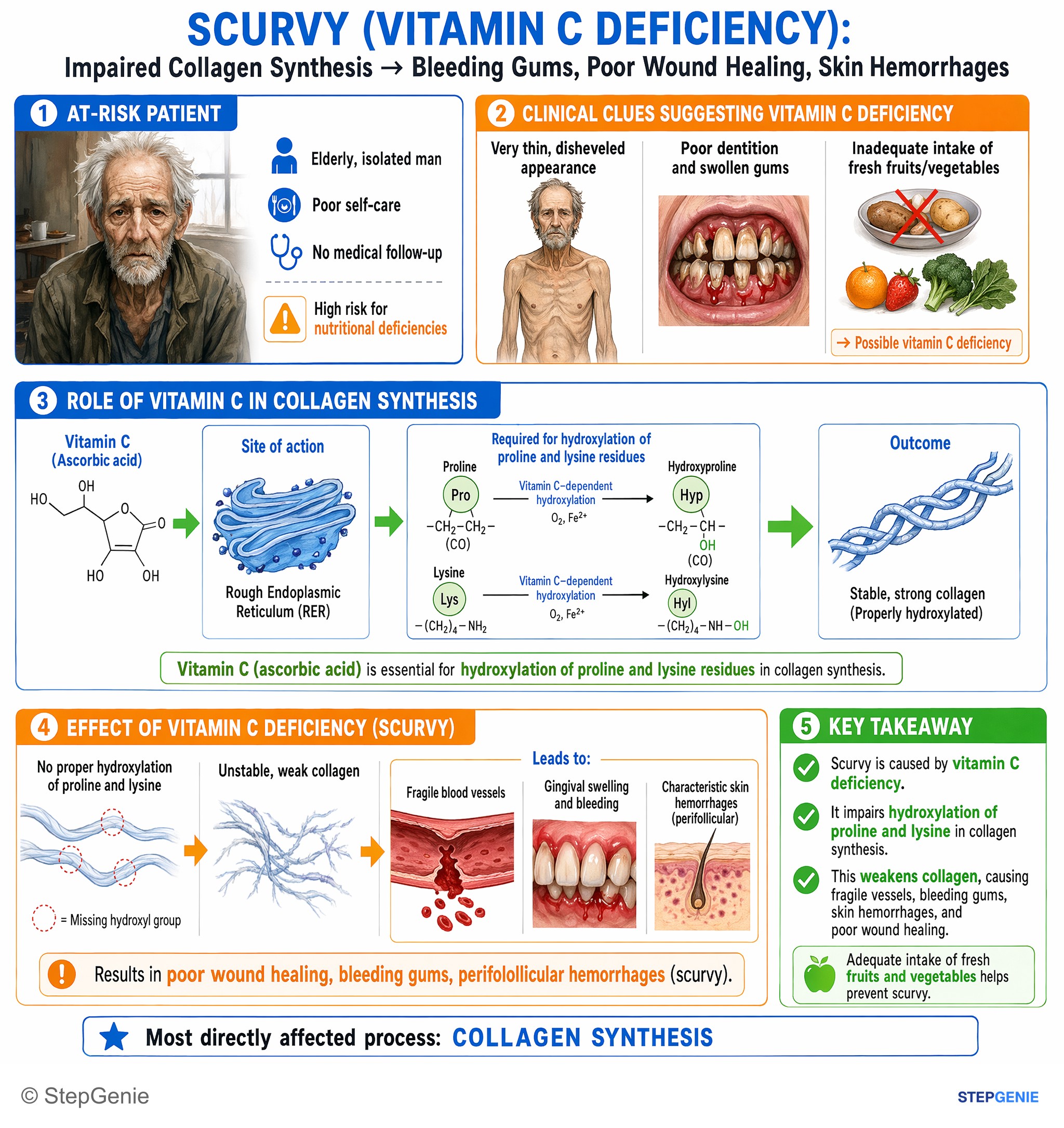
Scurvy (vitamin C deficiency) impairs hydroxylation of proline and lysine in collagen, causing poor wound healing, bleeding gums, and…
USMLE Step 1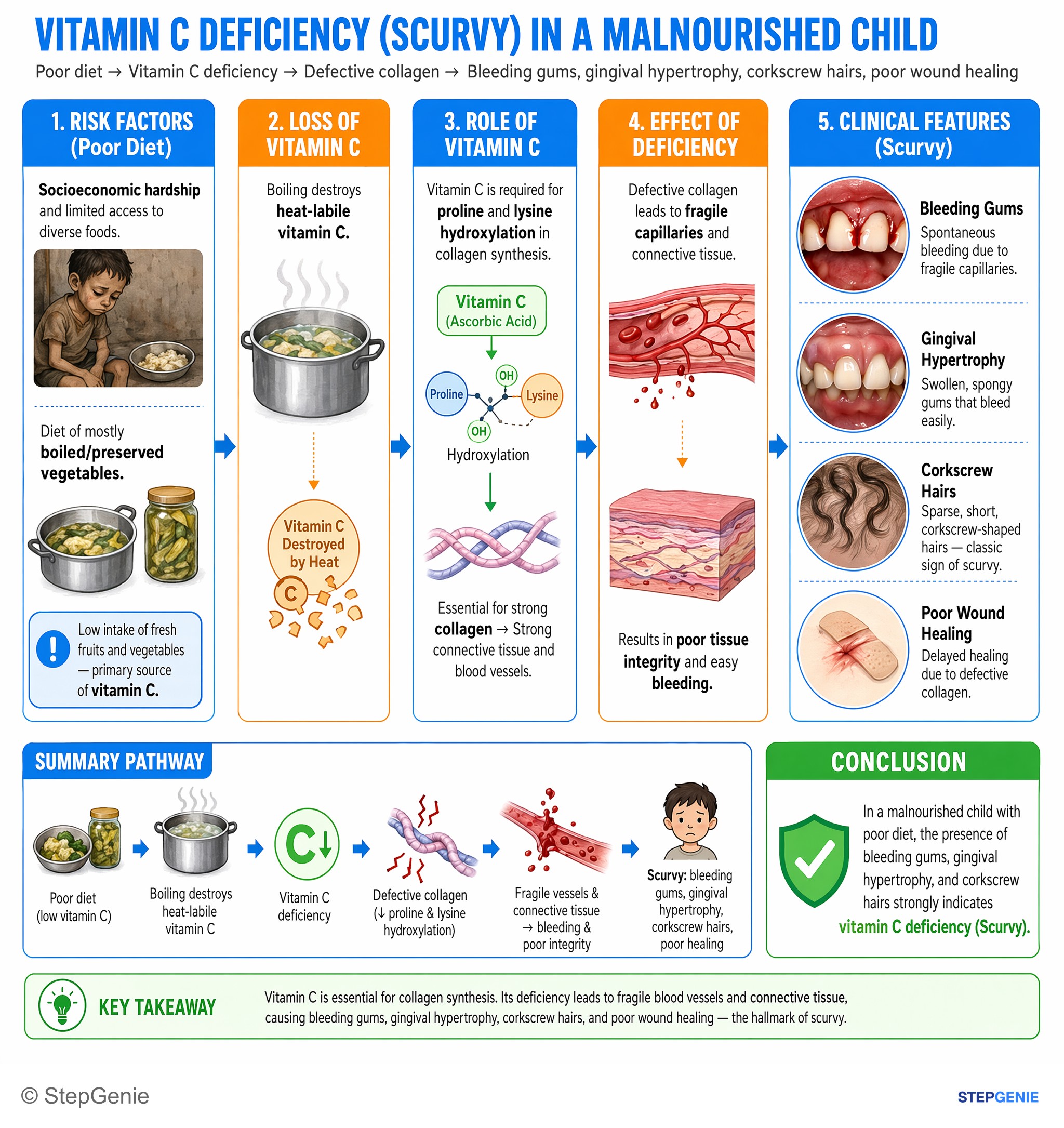
Scurvy from vitamin C deficiency → impaired collagen synthesis → bleeding gums, gingival hypertrophy, corkscrew hairs, poor wound healing…
USMLE Step 1Frequently Asked Questions
What findings should make you think of vitamin C deficiency instead of another vitamin deficiency?
Bleeding gums, perifollicular hemorrhages or petechiae, corkscrew hairs, and poor wound healing strongly point to vitamin C deficiency. This pattern reflects defective collagen formation, which makes blood vessels and connective tissue fragile. In a patient with malnutrition, alcohol use disorder, food insecurity, an elderly age, or a restrictive diet, those clues fit scurvy much better than other vitamin deficiencies.
Why does vitamin C deficiency cause bleeding, bruising, and poor wound healing?
Vitamin C deficiency causes weak collagen, which leads to fragile blood vessels, bruising, bleeding, and impaired wound healing. Ascorbic acid is required for hydroxylation of proline and lysine during collagen synthesis through prolyl and lysyl hydroxylases. Without that step, connective tissue loses strength, so the classic manifestations are bleeding gums, perifollicular hemorrhage, petechiae, and delayed healing.
How can vitamin C deficiency cause anemia?
Vitamin C deficiency can cause anemia through bleeding and decreased iron absorption. Scurvy leads to fragile vessels and bleeding, which can contribute to anemia, and vitamin C also helps reduce ferric iron to ferrous iron in the gut to support absorption. Because of those two mechanisms, a patient with scurvy may have anemia along with fatigue, easy bruising, and mucocutaneous bleeding findings.
How do you tell scurvy from vitamin K deficiency on a question stem?
Scurvy is favored when bleeding occurs with corkscrew hairs, perifollicular hemorrhages, and poor wound healing, whereas vitamin K deficiency is a coagulopathy pattern. Vitamin K deficiency classically causes elevated PT/INR and is associated with warfarin use, broad-spectrum antibiotics, or fat malabsorption such as cholestasis or cystic fibrosis. Those features do not explain the collagen-related skin and hair findings that are classic for scurvy.
How do you distinguish vitamin C deficiency from niacin or thiamine deficiency in a malnourished patient?
Vitamin C deficiency is distinguished by bleeding gums, perifollicular hemorrhage, corkscrew hairs, and poor wound healing. Niacin deficiency instead causes pellagra with photosensitive hyperpigmented dermatitis, diarrhea, and dementia. Thiamine deficiency is more associated with confusion, ophthalmoplegia, ataxia, peripheral neuropathy, or high-output heart failure. In a malnourished patient, the collagen-related bleeding and hair findings specifically favor scurvy.