You’re cruising through a Q-bank and hit the classic trap: macrocytic anemia + neurologic symptoms. Half the answer choices sound right because they are right in a different vignette. This is exactly why folate vs vitamin B12 (cobalamin) deficiency shows up constantly on Step 1 and Step 2—because it rewards careful reading and punishes pattern-matching.
Below is a clinical-style vignette, followed by the reasoning for the correct answer and a systematic teardown of common distractors (with the “what would need to be different for this to be correct?” mindset).
Clinical Vignette (Q-bank style)
A 62-year-old man presents with 4 months of fatigue and progressive difficulty walking. He reports tingling in his feet and has had several recent falls. Past history includes chronic gastritis and long-term use of a proton pump inhibitor. He eats “normally” but has lost weight unintentionally. Exam shows decreased vibration and proprioception in the lower extremities and a positive Romberg sign. Labs:
- Hemoglobin: low
- MCV: 112 fL
- Reticulocyte count: low
- LDH: high
- Indirect bilirubin: high
- Peripheral smear: macro-ovalocytes and hypersegmented neutrophils
Which additional finding is most likely?
A. Decreased methylmalonic acid levels
B. Increased homocysteine levels
C. Normal methylmalonic acid levels
D. Low ceruloplasmin level
E. Decreased orotic acid levels
Step-by-Step: What’s going on?
This is megaloblastic anemia (macro-ovalocytes + hypersegmented neutrophils) from impaired DNA synthesis. The key discriminator is the neurologic dysfunction:
- Loss of vibration/proprioception + ataxia → think subacute combined degeneration → vitamin B12 deficiency, not folate deficiency.
Correct answer: B. Increased homocysteine levels
In B12 deficiency, you typically see:
- ↑ homocysteine (B12 and folate are both needed for homocysteine → methionine)
- ↑ methylmalonic acid (MMA) (B12 is needed for methylmalonyl-CoA → succinyl-CoA)
So the “biochem fingerprint” of B12 deficiency is:
| Deficiency | Homocysteine | Methylmalonic acid | Neuro findings? |
|---|---|---|---|
| Folate (B9) | ↑ | Normal | No |
| B12 (cobalamin) | ↑ | ↑ | Yes |
Why the stem screams B12 (and not folate)
Clues pointing to B12 deficiency:
- Posterior column dysfunction: ↓ vibration and proprioception, +Romberg
- Age + chronic gastritis + PPI use: impaired B12 absorption is plausible
- B12 absorption requires gastric acid (to release B12 from food), then binding to intrinsic factor, then absorption in terminal ileum
Mechanism recap (high yield):
- B12 is a cofactor for:
- Methionine synthase: homocysteine → methionine (requires folate too)
- Methylmalonyl-CoA mutase: methylmalonyl-CoA → succinyl-CoA (unique to B12)
Why neuro symptoms happen: accumulation of odd-chain fatty acids and abnormal myelin synthesis associated with ↑ MMA (classic teaching).
Now, let’s dismantle each answer choice (how distractors work)
A. Decreased methylmalonic acid levels
Why it’s wrong: B12 deficiency causes increased, not decreased, MMA.
When would MMA be decreased? Not a typical clinical scenario. MMA is more of a “normal vs elevated” discriminator.
Exam tip: If the vignette points to B12 deficiency, expect ↑ MMA. If it points to folate deficiency, MMA should be normal.
B. Increased homocysteine levels ✅
Why it’s correct: Both folate and B12 deficiency cause ↑ homocysteine due to impaired methionine synthase activity (functional folate trap can occur in B12 deficiency).
How Q-banks use this: Homocysteine is not sufficient to distinguish folate vs B12—so they add neuro findings or MMA.
C. Normal methylmalonic acid levels
Why it’s wrong here: Normal MMA points toward folate deficiency, but this patient has neurologic deficits strongly suggestive of B12 deficiency.
What would make C correct?
A vignette with:
- Similar megaloblastic anemia (macrocytosis, hypersegmented neutrophils)
- No neurologic symptoms
- Risk factors like poor diet, alcoholism, pregnancy, hemolytic anemia (high cell turnover), or methotrexate use
D. Low ceruloplasmin level
Why it’s wrong: That’s Wilson disease (ATP7B mutation → copper accumulation).
Wilson disease clues would include:
- Liver disease (hepatitis/cirrhosis)
- Psychiatric symptoms
- Movement disorder (tremor, dystonia)
- Kayser–Fleischer rings
- Hemolytic anemia (can occur), but not classic megaloblastic smear with hypersegmented neutrophils
Q-bank pattern: They’ll throw Wilson in if neuro symptoms are present—but the anemia morphology here is megaloblastic, not hemolytic micro/macro patterns typical for Wilson prompts.
E. Decreased orotic acid levels
Why it’s wrong: Orotic acid is associated with pyrimidine synthesis and urea cycle crossovers—not folate vs B12.
- Orotic aciduria (UMP synthase deficiency) → ↑ orotic acid, megaloblastic anemia not responsive to B12/folate, developmental delay
- OTC deficiency (urea cycle) → ↑ orotic acid + hyperammonemia, low BUN, no megaloblastic smear as the central feature
What would make orotic acid relevant?
A pediatric vignette with failure to thrive, developmental delay, hyperammonemia, or a megaloblastic anemia that doesn’t improve with vitamin supplementation.
Folate vs B12: Rapid-fire high yield
Shared features (both can do this)
- Megaloblastic anemia: macro-ovalocytes, hypersegmented neutrophils
- Glossitis
- ↑ homocysteine
- Ineffective erythropoiesis → ↑ LDH, ↑ indirect bilirubin, low retic count
B12-only
- Neurologic deficits: subacute combined degeneration (dorsal columns + lateral corticospinal tracts)
- ↑ methylmalonic acid
- Causes: pernicious anemia, gastric surgery, chronic gastritis, ileal disease/resection (Crohn), Diphyllobothrium latum
Folate-only
- No neurologic symptoms
- Normal methylmalonic acid
- Causes: alcoholism, malnutrition, pregnancy, hemolysis (increased demand), methotrexate/trimethoprim/phenytoin
Classic “don’t miss” clinical pitfall
Giving folate can mask B12 deficiency
Folate supplementation can improve the anemia (by restoring nucleotide synthesis enough to help RBC production) but will not fix—and may allow progression of—neurologic damage from B12 deficiency.
USMLE move: In macrocytic anemia, especially with neuro symptoms, check B12 (and often MMA) before “just giving folate.”
Quick approach to test-day vignettes
- Confirm megaloblastic anemia: macrocytosis + hypersegmented neutrophils
- Ask: Any neuro symptoms?
- Yes → B12 until proven otherwise
- Use labs to lock it:
- B12 deficiency: ↑ homocysteine, ↑ MMA
- Folate deficiency: ↑ homocysteine, normal MMA
Visual explanations from the StepGenie QBank
Infographics StepGenie drew to explain questions in its own QBank, matched to this article's topic. Each caption is the takeaway of the question it explains.
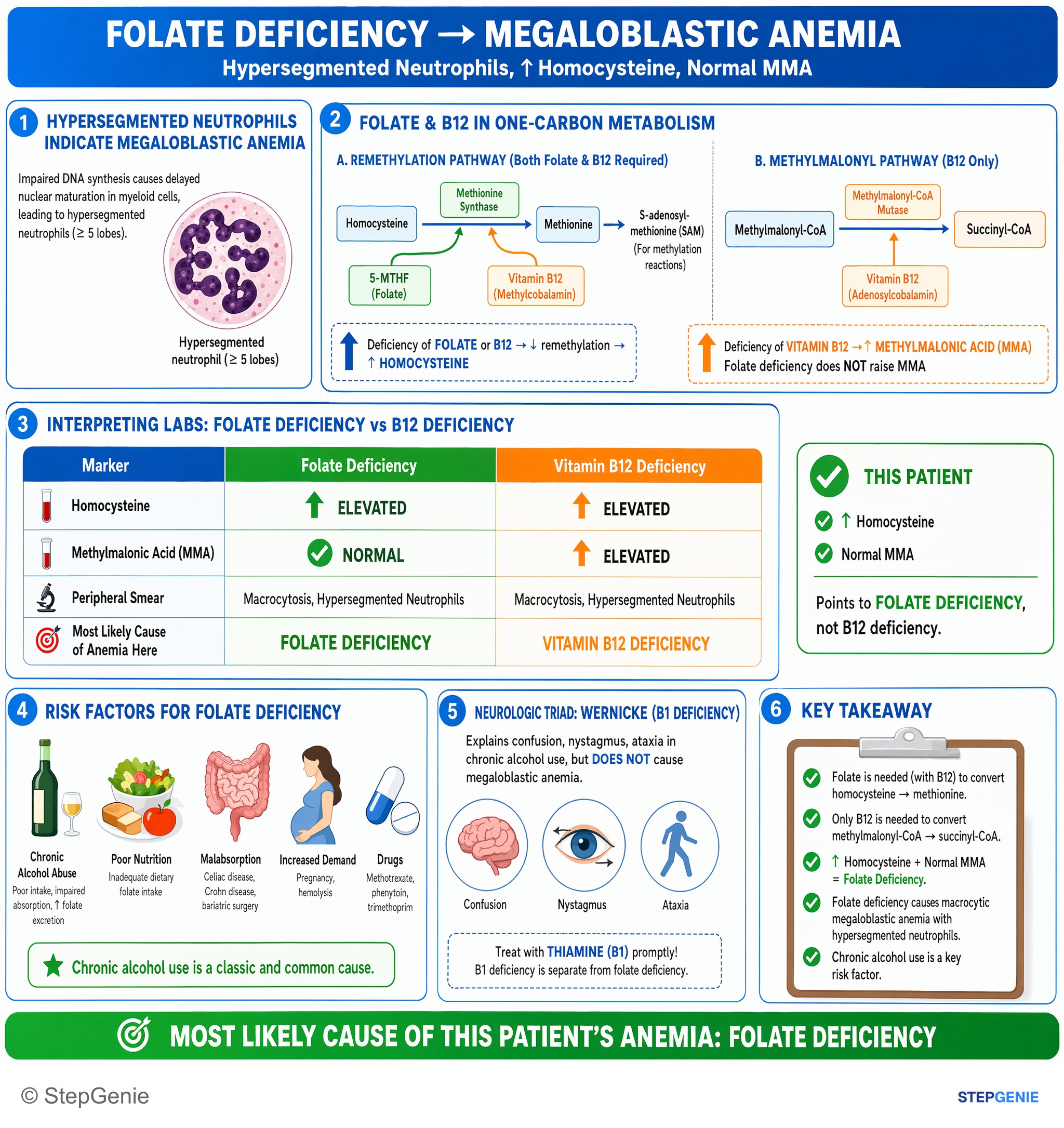
Folate deficiency causes macrocytic megaloblastic anemia with hypersegmented neutrophils, ↑homocysteine, normal methylmalonic acid…
USMLE Step 1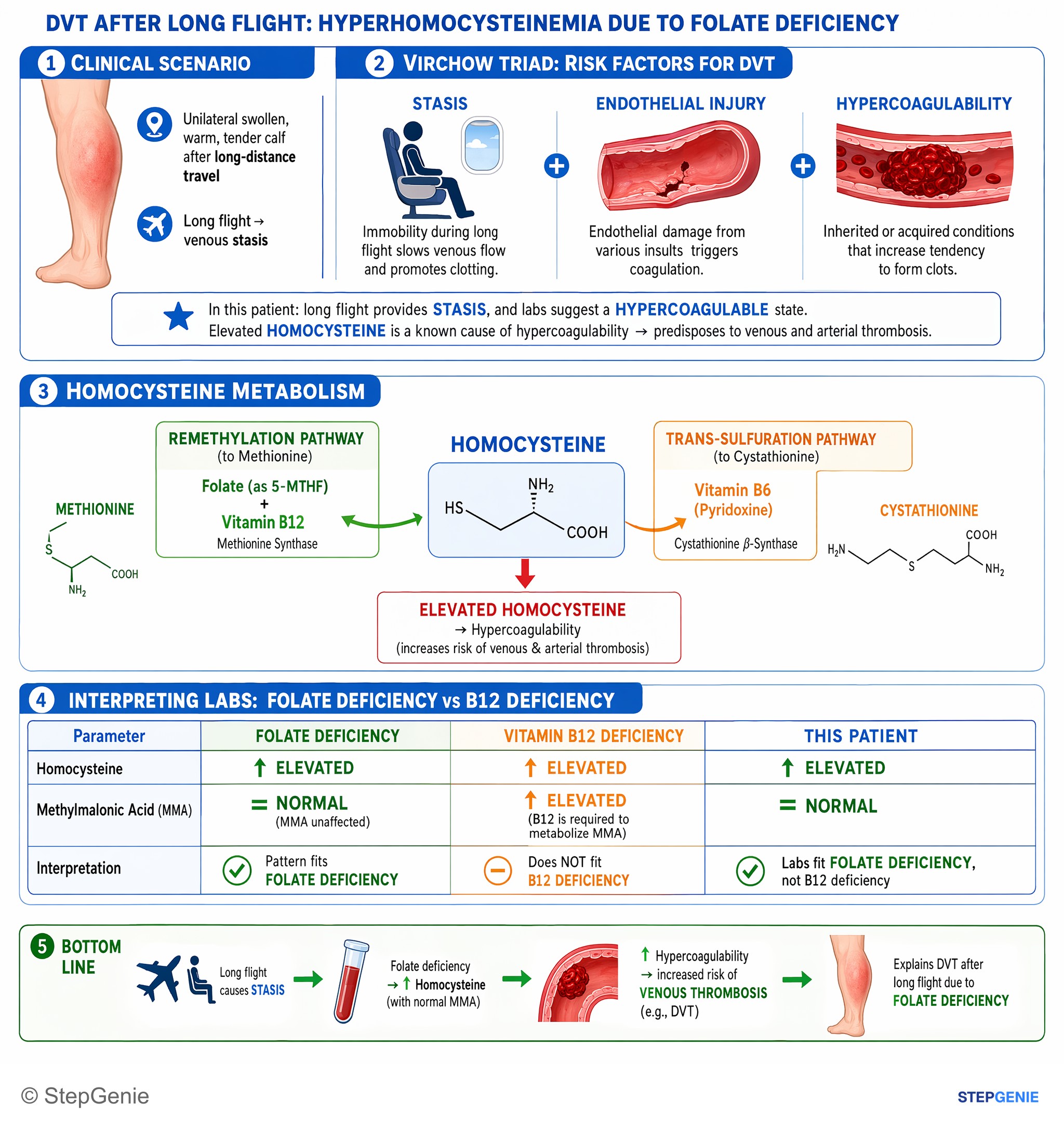
Folate deficiency causes isolated elevated homocysteine with normal methylmalonic acid and increases risk of venous thrombosis (e.g., DVT…
USMLE Step 1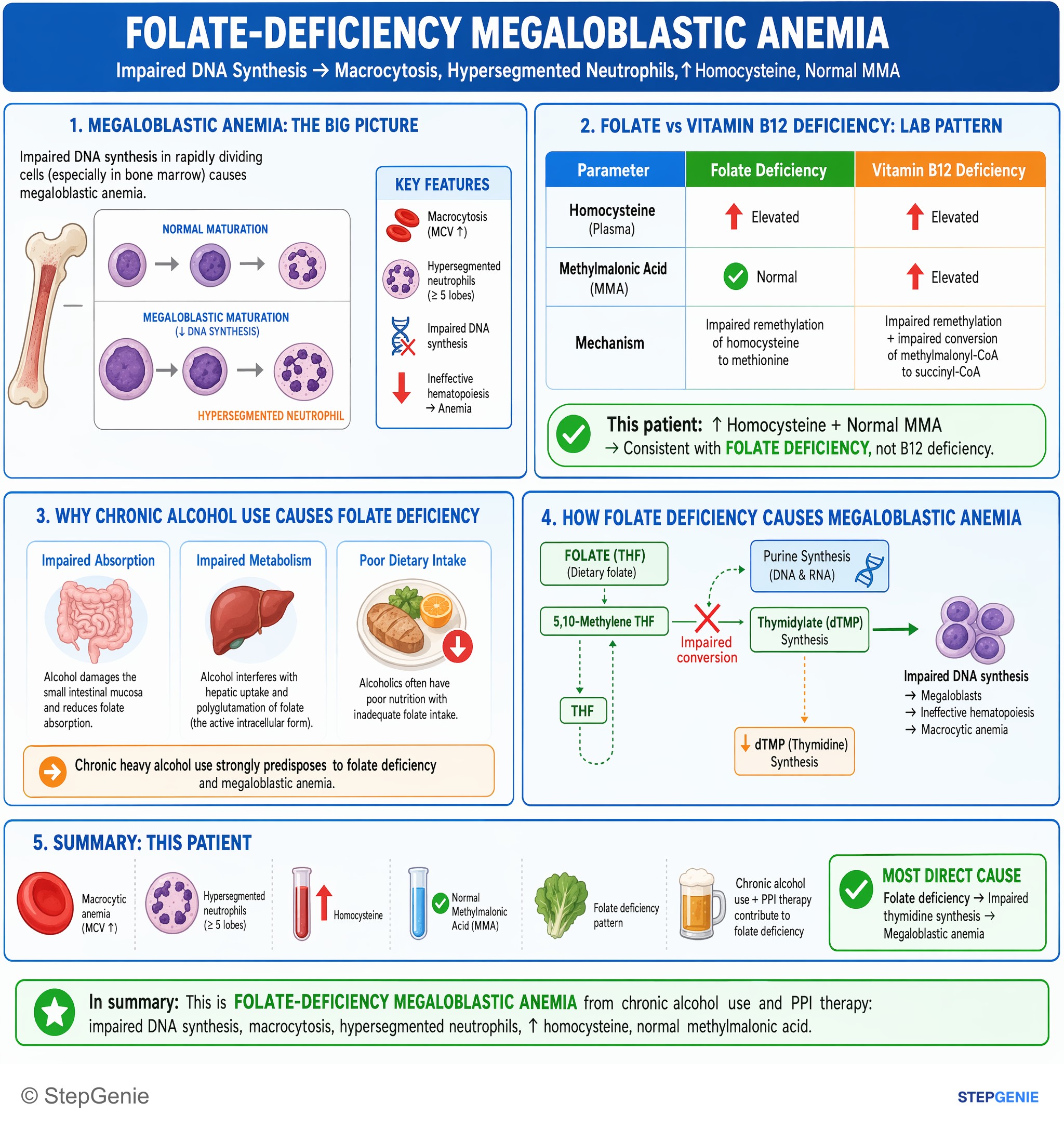
Folate-deficiency megaloblastic anemia from chronic alcohol use and PPI therapy: impaired DNA synthesis, macrocytosis, hypersegmented…
USMLE Step 1Frequently Asked Questions
How do you tell vitamin B12 deficiency from folate deficiency in a macrocytic anemia question stem?
The best discriminator is neurologic involvement. Both deficiencies can cause megaloblastic anemia with macro-ovalocytes, hypersegmented neutrophils, and elevated homocysteine, but vitamin B12 deficiency also causes neurologic deficits such as loss of vibration and proprioception, ataxia, and a positive Romberg sign. Folate deficiency instead has normal methylmalonic acid and no neurologic symptoms.
Why does vitamin B12 deficiency cause increased homocysteine and methylmalonic acid?
Vitamin B12 deficiency raises both homocysteine and methylmalonic acid because B12 is required for two key reactions. It serves as a cofactor for methionine synthase, which converts homocysteine to methionine, and for methylmalonyl-CoA mutase, which converts methylmalonyl-CoA to succinyl-CoA. When B12 is deficient, both pathways are impaired, so homocysteine and methylmalonic acid increase.
Why do neurologic symptoms in megaloblastic anemia point toward vitamin B12 deficiency instead of folate deficiency?
Neurologic symptoms point toward vitamin B12 deficiency because B12 deficiency causes subacute combined degeneration, which affects the dorsal columns and can produce loss of vibration and proprioception, ataxia, and falls. The neurologic findings are associated with increased methylmalonic acid, accumulation of odd-chain fatty acids, and abnormal myelin synthesis. Folate deficiency can also cause megaloblastic anemia, but it does not cause neurologic deficits.
What clues in a vignette make impaired vitamin B12 absorption more likely?
Clues suggesting impaired vitamin B12 absorption include chronic gastritis, long-term proton pump inhibitor use, and older age. B12 absorption depends on gastric acid to release B12 from food, then binding to intrinsic factor, followed by absorption in the terminal ileum. A vignette pairing these risk factors with megaloblastic anemia and posterior column findings strongly supports B12 deficiency.
Why is homocysteine not enough by itself to distinguish folate from vitamin B12 deficiency?
Homocysteine alone cannot distinguish them because both folate deficiency and vitamin B12 deficiency increase homocysteine through impaired methionine synthase activity. To separate the two, question stems usually add neurologic findings or methylmalonic acid results. Vitamin B12 deficiency causes elevated methylmalonic acid and neurologic deficits, whereas folate deficiency has normal methylmalonic acid and no neurologic symptoms.