Central pontine myelinolysis (CPM), now called osmotic demyelination syndrome (ODS), is demyelination of the central pons, and sometimes of extrapontine areas, after chronic hyponatremia is corrected too fast. The course is classically biphasic: confusion from the low sodium improves, then a few days later the patient develops dysarthria, dysphagia and spastic quadriparesis, and in severe cases a locked-in syndrome. The ceilings on the rise in sodium differ by source: 10-12 mEq/L in 24 hours, or 8 mEq/L in high-risk patients (2013 US expert panel) and 10 mmol/L in 24 hours (2014 European guideline), both as summarized in a 2025 meta-analysis, and 8 mEq/L over the first 24 hours (Merck Manual). Prevention is the treatment: an overshoot is reversed by re-lowering the sodium, and established ODS gets supportive care only.
The q-bank question
A 56-year-old man with alcohol use disorder is brought to the emergency department after 4 days of diarrhea, poor oral intake and increasing confusion. His mucous membranes are dry, and he has no focal neurologic deficits. Serum sodium is 108 mEq/L and potassium is 2.8 mEq/L. He is given 0.9% saline and potassium chloride. Over the next 24 hours his urine output rises sharply, his sodium reaches 125 mEq/L and his confusion clears. On hospital day 4 he develops slurred speech, difficulty swallowing and weakness of all four limbs, with brisk reflexes and bilateral extensor plantar responses. Two days later he is awake and answers questions by blinking and looking up or down, but he cannot speak or move his limbs.
Which of the following is the most likely cause of his new deficits?
A. Occlusion of the basilar artery with infarction of the ventral pons B. Demyelination caused by too-rapid correction of chronic hyponatremia C. Thiamine deficiency with lesions of the mammillary bodies D. Autoantibody-mediated demyelination of peripheral nerves E. Anti-aquaporin-4 antibody-mediated inflammation of the optic nerves and spinal cord
Answer: B, osmotic demyelination syndrome
Read the numbers first. Sodium rose 17 mEq/L in 24 hours (108 to 125), above every published limit, in a man with the classic risk profile: hyponatremia of more than 48 hours (or unknown duration), alcohol use disorder, poor intake and hypokalemia.
Then find where the overshoot came from. In hypovolemic hyponatremia, replacing volume removes the stimulus for vasopressin (ADH) release, and the kidneys suddenly excrete large amounts of free water (Merck). The "brisk urine output" line is the clue: the kidneys corrected the sodium faster than the saline alone would have.
Then match the course. Improvement followed by deterioration days later is the biphasic pattern of ODS (StatPearls places the decline about 3-5 days after correction). The deficits are upper motor neuron signs from the basis pontis:
- Corticobulbar tracts: dysarthria, dysphagia, pseudobulbar palsy
- Corticospinal tracts: spastic quadriparesis, hyperreflexia, extensor plantar responses
- Locked-in syndrome: awake and aware, quadriplegic, lower cranial nerves paralyzed, communicating only by vertical eye movements and blinking (vertical gaze is controlled above the pons)
Why every other answer is wrong
A. Basilar artery occlusion. The strongest distractor: locked-in syndrome typically results from a pontine stroke, an infarct or a hemorrhage (Merck). But a stroke strikes suddenly, usually in a patient with vascular or embolic risk factors, and does not follow a "better, then worse" course days after a sodium jump. If this were the stem, you would expect abrupt onset and an occluded basilar artery on CT or MR angiography. Map the territories with the stroke localization guide.
C. Thiamine deficiency (Wernicke encephalopathy). Same patient profile, different lesion. Wernicke causes confusion, ataxia and eye findings (nystagmus, lateral rectus palsy, conjugate gaze palsies) from symmetric lesions around the third and fourth ventricles and aqueduct: mammillary bodies, dorsomedial thalamus, periaqueductal gray. It does not cause spastic quadriparesis or a locked-in state. The risks overlap, so this patient still needs IV thiamine before any glucose (see the thiamine and Wernicke guide).
D. Guillain-Barré syndrome. GBS can cause quadriparesis, bulbar weakness and even a locked-in-like state, but it is a peripheral polyneuropathy: ascending flaccid weakness with lost reflexes, often 5 days to 3 weeks after an infection such as Campylobacter jejuni, and CSF albuminocytologic dissociation. Brisk reflexes and extensor plantars put this lesion in the CNS. More in the Guillain-Barré guide.
E. Neuromyelitis optica spectrum disorder (NMOSD). AQP4-IgG targets astrocytes and produces severe optic neuritis, longitudinally extensive transverse myelitis over 3 or more contiguous cord segments and the area postrema syndrome (intractable hiccups, nausea and vomiting). This patient has no vision loss, no spinal cord level and an obvious sodium trigger.
Sodium correction limits: who says what
| Source | What it says for chronic hyponatremia |
|---|---|
| US expert panel (Verbalis et al., Am J Med 2013), as summarized in a 2025 Kidney Medicine meta-analysis | Do not exceed 10-12 mEq/L in 24 h; 8 mEq/L in 24 h in high-risk patients |
| European clinical practice guideline (Spasovski et al., 2014), as summarized in the same meta-analysis | 10 mmol/L per 24 h |
| Merck Manual Professional (full review 2025) | Rise of no more than 8 mEq/L over the first 24 h; no faster than 0.5 mEq/L/h except during the first few hours of treating severe hyponatremia |
| StatPearls, Hyponatremia (updated 2026) | Severely symptomatic hyponatremia: a hypertonic saline bolus to raise sodium 4-6 mEq/L within 1-2 h, but no more than 10 mEq/L in the first 24 h (its summary of more recent US and European guidelines) |
1 mEq/L of sodium equals 1 mmol/L, so the numbers compare directly. The exam-safe rule: a rise of 8 mEq/L or less per 24 hours is inside every limit in this table, and a rise of more than 12 mEq/L breaks all of them. In high-risk patients, treat 8 as the ceiling.
How common is ODS? A 2025 Kidney Medicine meta-analysis of 11 cohort studies (26,710 hospitalized patients with hyponatremia) found ODS in 0.23% overall: 0.73% after rapid correction versus 0.1% after slower correction (the studies defined "rapid" variously as a rise of at least 8, more than 10 or more than 12 mmol/L in 24 hours). Patients who developed ODS had a mean starting sodium of 109 mmol/L, and liver disease, alcohol use, malnutrition and hypokalemia were common among them. Some observational studies have linked faster correction with lower mortality (StatPearls), which keeps the exact limits under debate; the direction of the advice has not changed.
Why chronic hyponatremia is the setup
| Acute hyponatremia (under 48 h) | Chronic hyponatremia (over 48 h or unknown) | |
|---|---|---|
| Brain adaptation | Incomplete: cells have had too little time to shed osmolytes, so water floods in | Cells have exported organic osmolytes (glutamate, taurine, glycine) to limit swelling |
| Main danger | Cerebral edema: seizures, herniation | ODS if corrected too fast |
| Pace of correction | Rapid correction with hypertonic saline when symptomatic | Slow, within daily limits |
In chronic hyponatremia the adapted brain cannot recapture its lost osmolytes quickly. A fast rise in plasma tonicity therefore pulls water out of brain cells; the osmotic injury falls mainly on astrocytes, and the white matter loses its myelin, classically in the central pons (StatPearls). The mnemonic runs both ways: "From low to high, your pons will die; from high to low, your brains will blow." Lowering a chronic high sodium too fast causes cerebral edema, which is why Merck spreads correction of chronic hypernatremia over 48 hours (compare the hypernatremia and diabetes insipidus case).
Who is at risk, and how overshoot happens
- Chronic, severe hyponatremia: StatPearls flags sodium below 120 mEq/L and duration over 48 hours.
- Alcohol use disorder, malnutrition, chronic liver disease and liver transplantation (StatPearls reports 63% one-year mortality when ODS follows liver transplant).
- Hypokalemia.
- Also hyperemesis gravidarum, severe burns and anorexia nervosa.
- Hidden overshoot: a water diuresis once the ADH stimulus disappears, as when volume is restored in hypovolemic hyponatremia (Merck). The cause of the low sodium sets the trap; work it up with the SIADH vs psychogenic polydipsia guide.
Presentation, MRI and management
Timeline. Symptoms usually start 1-14 days after correction, with the classic decline about 3-5 days out (StatPearls); Merck describes deficits evolving over a few days or weeks.
Extrapontine myelinolysis occurs in at least 10% of cases, in the midbrain, thalamus, basal nuclei and cerebellum (StatPearls), which is why the broader name ODS replaced CPM. Other reported features include ataxia, tremor, lethargy, catatonia and, in the most severe cases, coma.
MRI is the test. Diffusion-weighted imaging shows restricted diffusion in the central pons with sparing of the periphery, usually within 24 hours of symptom onset; T2/FLAIR shows a "bat-wing" central pontine signal later. Changes can lag by up to 2 weeks, so an early normal scan does not exclude ODS.
Management:
- Prevent it. Check sodium often during active correction (Merck: every 3-4 hours on 3% saline, and every 2 hours in the ICU for rapid-onset hyponatremia with neurologic symptoms), and stay inside the limits.
- Overshoot? Stop hypertonic fluids and re-lower the sodium with 5% dextrose in water (D5W) plus desmopressin. Merck notes that inducing hyponatremia again with hypotonic fluid may limit permanent damage. StatPearls gives desmopressin 2-4 mcg IV or subcutaneously and D5W 6 mL/kg lean body weight over 1-2 hours, which lowers sodium by about 2 mEq/L.
- Clamp in advance. Desmopressin can also be started up front, alongside hypertonic saline, to block an unpredictable water diuresis (Merck: 1-2 mcg every 8 hours).
- Established ODS has no cure: supportive care, airway and ventilation if needed, swallowing support and physical therapy.
Prognosis. Damage is often permanent (Merck), but survival has improved: recent series cited by StatPearls report 94% survival, with 25-40% recovering fully and 25-30% left incapacitated.
How USMLE tests it
- Alcohol use disorder + low sodium + "improved, then worse days later" = ODS. The same patient on admission with confusion, ataxia and nystagmus = Wernicke.
- Locked-in with no sodium story and a sudden onset = basilar artery occlusion. Use the brainstem syndromes mnemonic to place pontine lesions.
- "Sodium rose 15 mEq/L overnight; the patient is still well. Next step?" Re-lower the sodium (D5W plus desmopressin); don't wait for symptoms.
- Acute (under 48 hours) symptomatic hyponatremia is corrected promptly with hypertonic saline; the slow-correction rule is for chronic or unknown duration.
- UMN signs (brisk reflexes, Babinski) separate ODS from Guillain-Barré, which is areflexic.
Key takeaways
- CPM = ODS: osmotic demyelination of the central pons (± extrapontine sites) after chronic hyponatremia is corrected too fast.
- Biphasic course: improvement, then dysarthria, dysphagia, spastic quadriparesis and possibly locked-in syndrome, usually days later (1-14 days; classically 3-5).
- Limits: US panel 10-12 mEq/L/24 h (8 if high risk) and European guideline 10 mmol/L/24 h (both as summarized in a 2025 meta-analysis); Merck 8 mEq/L over the first 24 h. Stay at 8 or less and you are inside all of them.
- High risk: alcohol use disorder, malnutrition, liver disease or transplant, hypokalemia, very low starting sodium.
- Hidden overshoot: water diuresis when the ADH stimulus disappears.
- MRI: DWI first; T2 "bat-wing" pons later; may lag up to 2 weeks.
- Overshoot: stop hypertonic saline; re-lower with D5W + desmopressin. Established ODS: supportive care only.
Sources
- Hyponatremia — Merck Manual Professional Edition (2025)
- Central Pontine Myelinolysis — StatPearls, NCBI Bookshelf (2023)
- Hyponatremia — StatPearls, NCBI Bookshelf (2026)
- Hyponatremia Correction and Osmotic Demyelination Syndrome Risk: A Systematic Review and Meta-Analysis — Kidney Medicine (2025)
- Osmotic demyelination syndrome — MedlinePlus Medical Encyclopedia (2026)
- Locked-In Syndrome — Merck Manual Professional Edition (2026)
- Hypernatremia — Merck Manual Professional Edition (2025)
- Wernicke Encephalopathy — Merck Manual Professional Edition (2025)
- Guillain-Barré Syndrome (GBS) — Merck Manual Professional Edition (2026)
- Neuromyelitis Optica Spectrum Disorder (NMOSD) — Merck Manual Professional Edition (2025)
- Overview of Demyelinating Disorders — Merck Manual Professional Edition (2025)
Visual explanations from the StepGenie QBank
Infographics StepGenie drew to explain questions in its own QBank, matched to this article's topic. Each caption is the takeaway of the question it explains.
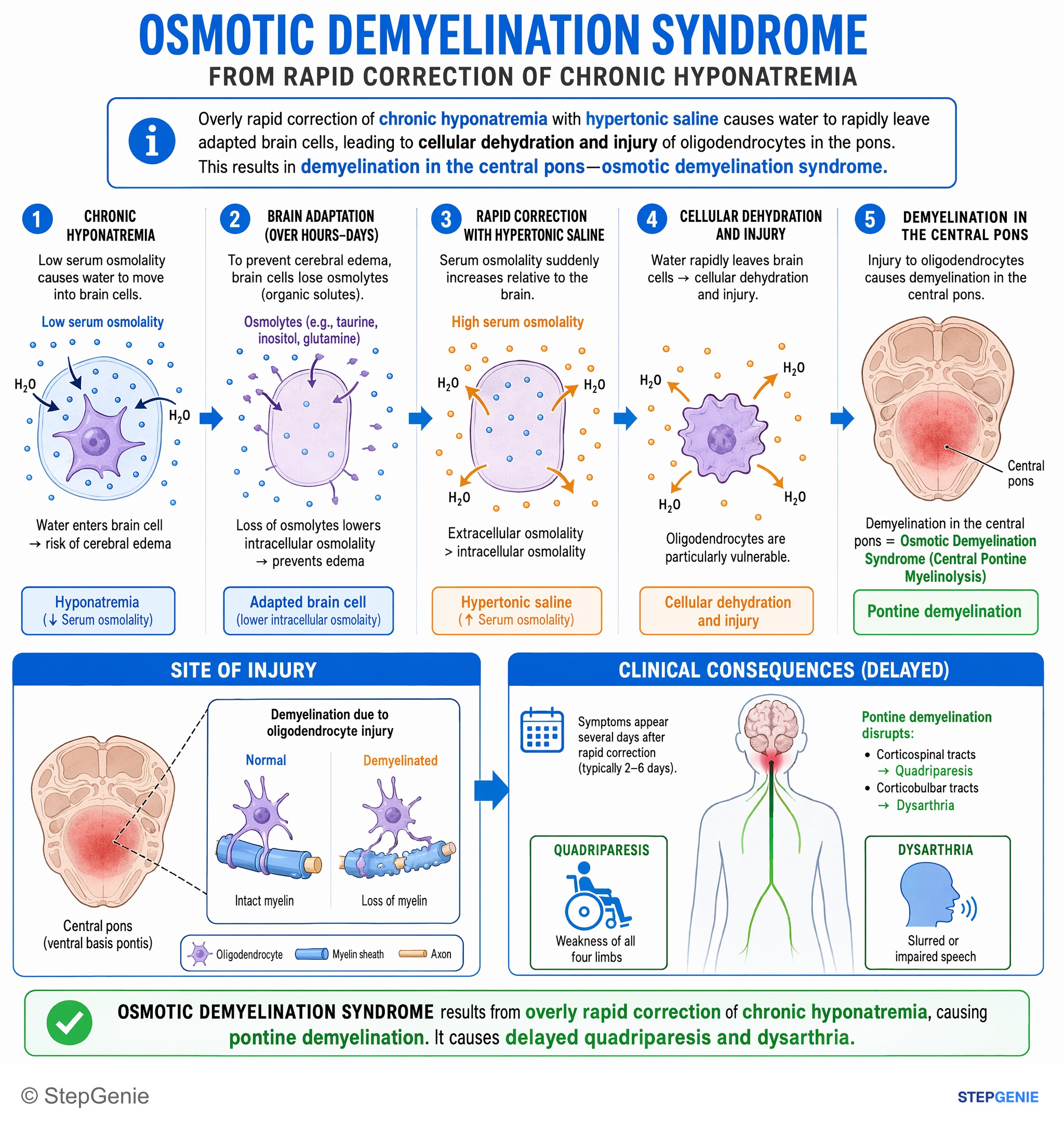
Osmotic demyelination syndrome from overly rapid correction of chronic hyponatremia causes delayed quadriparesis and dysarthria due to…
USMLE Step 1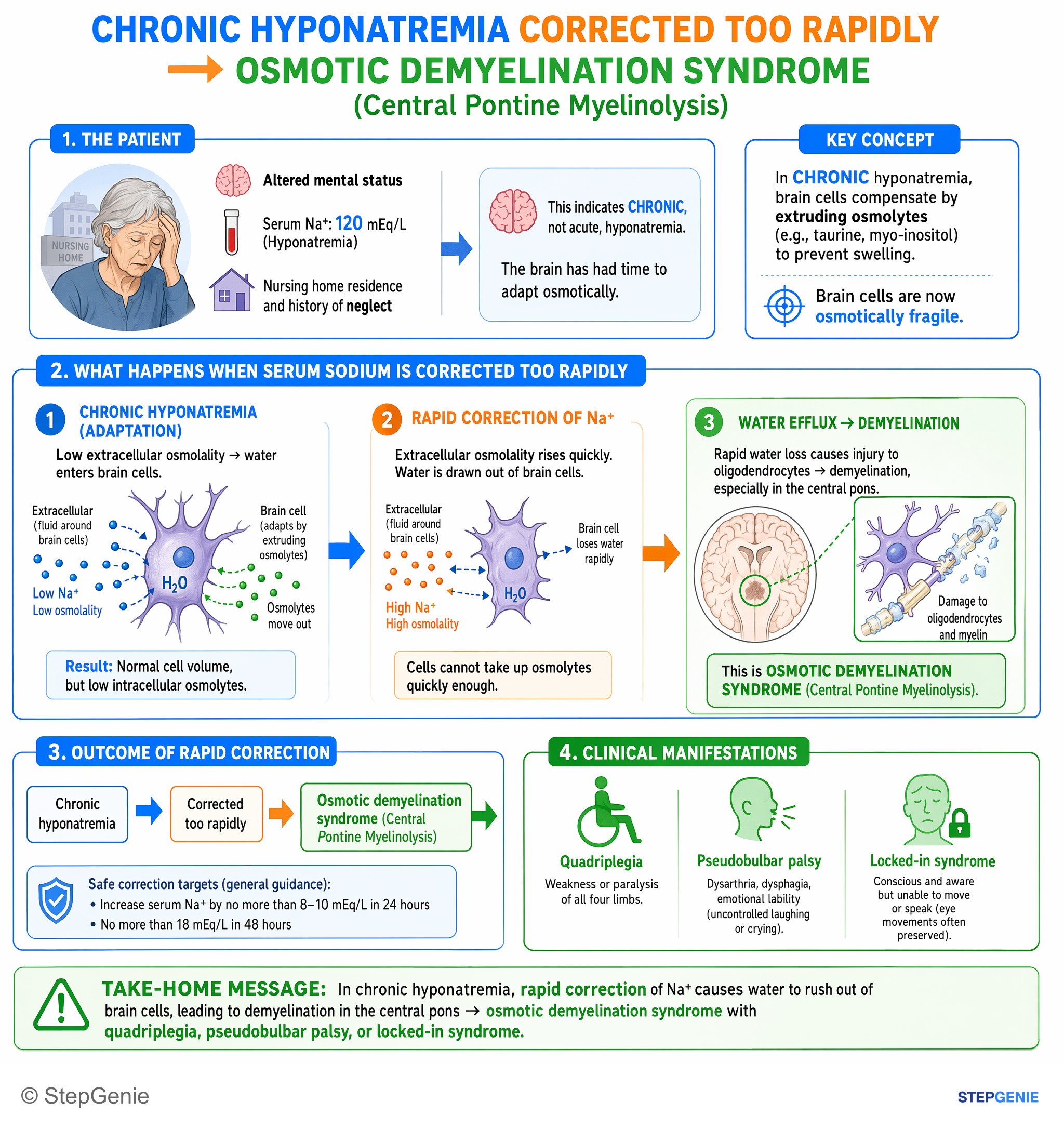
Chronic hyponatremia corrected too rapidly → osmotic demyelination syndrome (central pontine myelinolysis) with quadriplegia, pseudobulbar…
USMLE Step 1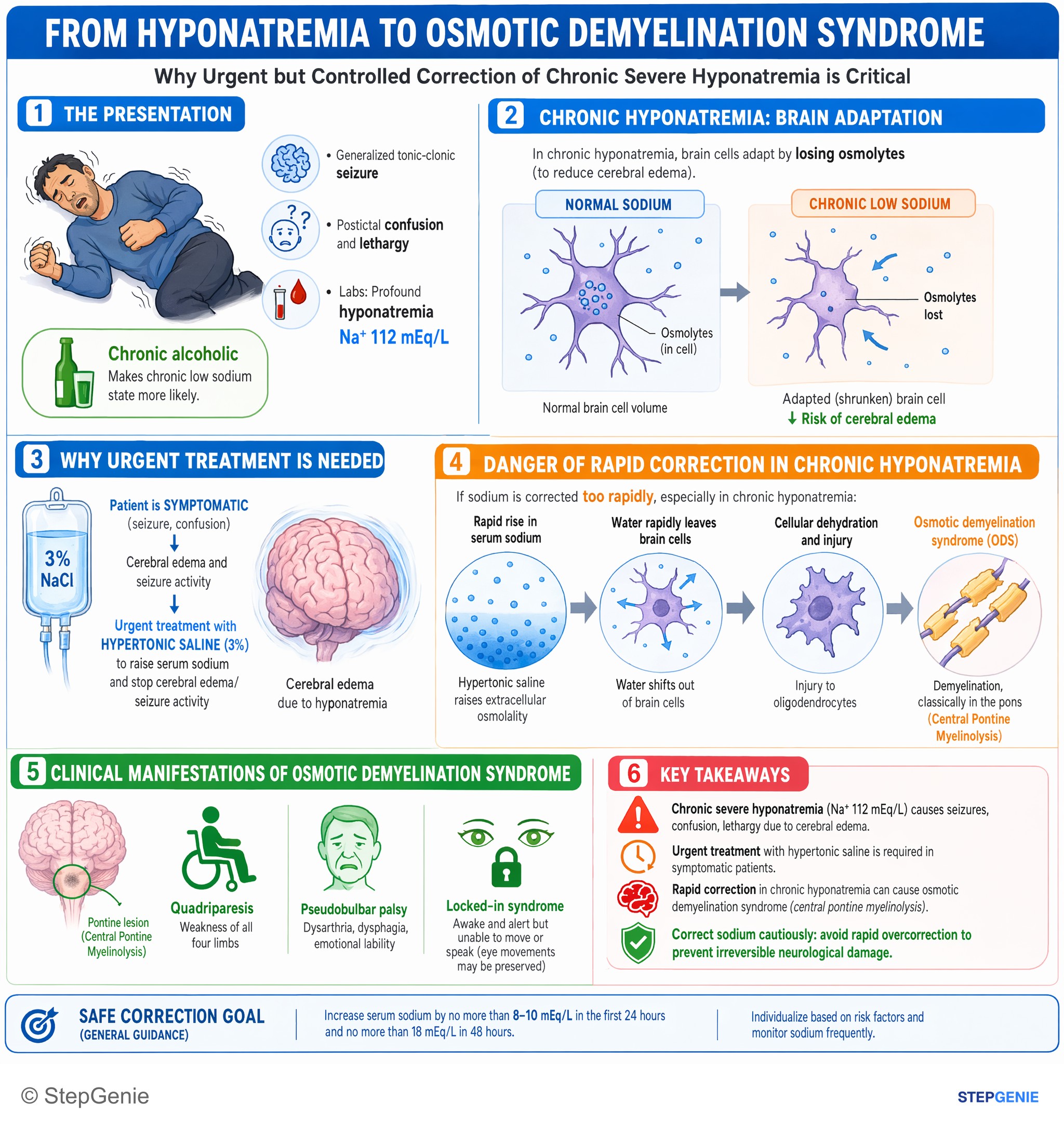
Chronic severe hyponatremia rapidly corrected with hypertonic saline can cause osmotic demyelination syndrome (central pontine…
USMLE Step 2Frequently Asked Questions
What is central pontine myelinolysis?
Central pontine myelinolysis, now called osmotic demyelination syndrome, is loss of myelin in the central pons, and sometimes in extrapontine areas such as the thalamus, basal ganglia and cerebellum, after chronic hyponatremia is corrected too quickly. It causes dysarthria, dysphagia and spastic quadriparesis, and in severe cases a locked-in syndrome in which the patient is awake but can communicate only with vertical eye movements and blinking.
How fast can you safely correct chronic hyponatremia?
Limits differ slightly by source. As summarized in a 2025 Kidney Medicine meta-analysis, the 2013 US expert panel advises not exceeding 10 to 12 mEq/L in 24 hours, or 8 mEq/L in 24 hours in high-risk patients, and the 2014 European guideline sets a limit of 10 mmol/L per 24 hours. The Merck Manual advises a rise of no more than 8 mEq/L over the first 24 hours. A rise of 8 mEq/L or less per day stays inside all of them.
When do symptoms of osmotic demyelination syndrome appear after sodium correction?
Symptoms usually appear 1 to 14 days after the correction, and the classic decline comes about 3 to 5 days later. The course is biphasic: the confusion or seizures caused by the low sodium improve as it is corrected, and then new dysarthria, dysphagia, quadriparesis or reduced consciousness develop. Because MRI changes can lag by up to 2 weeks, an early normal MRI does not rule it out.
Who is at highest risk of central pontine myelinolysis?
Risk is highest when hyponatremia has lasted more than 48 hours or is of unknown duration and when the starting sodium is very low, especially below 120 mEq/L. Alcohol use disorder, malnutrition, chronic liver disease, liver transplantation and hypokalemia add risk, as do hyperemesis gravidarum, severe burns and anorexia nervosa. In a 2025 meta-analysis, patients who developed the syndrome had a mean starting sodium of 109 mmol/L.
What does central pontine myelinolysis look like on MRI?
Diffusion-weighted MRI changes first, showing restricted diffusion in the central pons with sparing of the periphery, usually within 24 hours of symptom onset. T2 and FLAIR images later show a bat-wing shaped signal in the central pons. Extrapontine lesions can appear in the midbrain, thalamus, basal ganglia and cerebellum. Changes can be delayed by up to 2 weeks, so a repeat MRI may be needed when the first is normal.
What should you do if sodium has been corrected too fast?
Stop hypertonic fluids and bring the sodium back down toward the safe range, usually with 5% dextrose in water plus desmopressin; Merck notes that re-inducing hyponatremia may limit permanent damage. Desmopressin can also be started alongside hypertonic saline to prevent an unexpected water diuresis. Once osmotic demyelination is established there is no cure, and care is supportive: airway and ventilation if needed, swallowing support, nutrition and physical therapy.