Hospital-acquired pneumonia (HAP) is pneumonia that was not incubating at admission and starts 48 hours or more after admission; ventilator-associated pneumonia (VAP) starts more than 48 hours after endotracheal intubation. The leading pathogens are Staphylococcus aureus (including MRSA) and Pseudomonas aeruginosa, followed by other gram-negative rods such as Klebsiella, E. coli, Enterobacter and Acinetobacter; anaerobes contribute little. Under the 2016 ATS/IDSA guideline, which IDSA still lists as current in October 2026 (a joint ATS/IDSA update is in development, with publication estimated for late 2026), empiric therapy is an antipseudomonal agent such as piperacillin-tazobactam or cefepime, plus vancomycin or linezolid when MRSA risk is present, with a second antipseudomonal drug only for high-risk patients. Then de-escalate to culture results and treat for 7 days.
HAP vs VAP vs CAP: the definitions
| Term | Definition | Exam point |
|---|---|---|
| CAP | Pneumonia acquired in the community | Pneumonia in the first 48 hours of a hospital stay is usually from community organisms |
| HAP | Pneumonia 48 hours or more after admission, not incubating at admission, in a patient who is not intubated | Hospital flora: S. aureus, Pseudomonas and other gram-negative rods |
| VAP | Pneumonia more than 48 hours after endotracheal intubation | Some patients have already been extubated when it appears |
| HCAP ("healthcare-associated pneumonia") | Retired in 2016 | Nursing-home or dialysis contact did not reliably predict resistant organisms; such patients are now treated as CAP unless they have specific risk factors |
The working definition of pneumonia is a new lung infiltrate plus clinical evidence that it is infectious: new fever, purulent sputum, leukocytosis and a decline in oxygenation. There is no gold-standard test.
Why the hospital changes the bugs
- Microaspiration of bacteria colonizing the oropharynx and upper airways (and partly the upper GI tract) is the main route; bloodstream seeding and contaminated aerosols are less common.
- Colonization shifts fast. Over the first 48 hours in hospital, oropharyngeal and endotracheal-tube flora change from mostly streptococci and anaerobes to mostly gram-negative hospital organisms. That is why timing matters more than the aspiration story.
- The endotracheal tube bypasses airway defenses and blunts cough; secretions pool above the inflated cuff and leak down, and bacteria form a biofilm on and inside the tube that protects them from antibiotics.
- Acid suppression (proton-pump inhibitors, H2 blockers) lets hospital pathogens colonize the oropharynx and tube.
- Aspiration risk rises with age, recent surgery and neurologic admissions such as stroke with dysphagia.
The pathogens
| Organism | Clue | Empiric coverage |
|---|---|---|
| S. aureus (MSSA and MRSA) | One of the two most common causes; MRSA risk with recent IV antibiotics or a high-MRSA unit. See the S. aureus table | Vancomycin or linezolid for MRSA; once MSSA is confirmed, narrow to cefazolin, oxacillin or nafcillin |
| P. aeruginosa | The other leading cause; prior IV antibiotics, ventilation, bronchiectasis or cystic fibrosis. See the Pseudomonas case | Antipseudomonal β-lactam: piperacillin-tazobactam, cefepime, imipenem or meropenem |
| Other gram-negative rods (Klebsiella, E. coli, Enterobacter, Acinetobacter) | Resistance is common, especially carbapenem-resistant Acinetobacter | Guided by the local antibiogram, then by susceptibilities |
| Respiratory viruses | Up to about 20% of HAP and VAP | Respiratory viral PCR can spare antibiotics |
| Anaerobes | Do not contribute significantly to HAP | No routine anaerobic coverage |
Diagnosis
- Clinical picture: new infiltrate with fever, purulent sputum, leukocytosis and worsening oxygenation; in VAP, look for purulent tracheal secretions, tachycardia and rising ventilator requirements.
- No single sign or chest x-ray finding is sensitive or specific: atelectasis, pulmonary embolism and pulmonary edema can all look the same, and the absence of a new infiltrate makes VAP much less likely.
- Blood cultures for everyone: about 15% of patients with VAP are bacteremic, and some positive cultures reveal a different source of infection.
- Respiratory sample: for VAP, noninvasive sampling (endotracheal aspirate) with semiquantitative culture is preferred over bronchoscopy with quantitative culture; for HAP, a good-quality sputum sample.
- MRSA nasal PCR: a negative result is a stewardship tool for stopping anti-MRSA therapy, especially in HAP.
- Biomarkers: use clinical criteria alone, not procalcitonin, CRP or the Clinical Pulmonary Infection Score, to decide whether to start antibiotics; procalcitonin plus clinical criteria can help decide when to stop.
Empiric treatment: the 2016 ATS/IDSA rules
HAP (not ventilated)
| Patient | Empiric regimen |
|---|---|
| No MRSA risk factor and not at high risk of death | One agent active against Pseudomonas and MSSA: piperacillin-tazobactam, cefepime, levofloxacin, imipenem or meropenem |
| MRSA risk: IV antibiotics in the past 90 days, a unit where over 20% of S. aureus isolates are MRSA (or the rate is unknown), or high risk of death | Add vancomycin or linezolid |
| IV antibiotics in the past 90 days, high risk of death (ventilatory support for the pneumonia or septic shock) or structural lung disease (bronchiectasis, cystic fibrosis) | Two antipseudomonal agents from different classes, plus the MRSA agent if indicated |
VAP: every regimen covers S. aureus, Pseudomonas and other gram-negative rods. Add an MRSA agent if the patient has a risk factor for resistance, the unit's MRSA rate is over 10-20% or unknown; add a second antipseudomonal agent if the patient has a risk factor for resistance or over 10% of the unit's gram-negative isolates resist the planned single agent (or susceptibility data are unavailable). Risk factors for multidrug-resistant VAP: IV antibiotics within 90 days (the strongest), septic shock at onset, ARDS before VAP, 5 or more days in hospital before VAP, and acute renal replacement therapy before VAP.
Rules that cut across both:
- Never use an aminoglycoside as the only antipseudomonal drug; systemic aminoglycosides reach low concentrations in lung lining fluid. Avoid aminoglycosides and colistin in VAP when alternatives exist.
- De-escalate once cultures and susceptibilities return.
- Treat for 7 days; longer courses do not reduce relapse, treatment failure or mortality. Complications such as empyema or bacteremia need longer courses.
Where current references differ: Merck's September 2026 review gives patients in septic shock, on ventilatory support or treated with IV antibiotics in the past 90 days one antipseudomonal agent (such as meropenem) plus vancomycin or linezolid, and says dual antipseudomonal therapy is not indicated. An ATS/IDSA update is in development; until it is published, the 2016 rules are the US standard, and on exams "antipseudomonal β-lactam + vancomycin or linezolid" is the core answer.
Drug pearls Step 1 asks about
| Drug | Role in HAP | Testable point |
|---|---|---|
| Vancomycin | MRSA coverage; inhibits cell wall synthesis | Infuse over 60 minutes or more to avoid an infusion reaction with flushing and itching; nephrotoxicity, reversible neutropenia and thrombocytopenia |
| Linezolid | MRSA coverage; FDA-approved for nosocomial pneumonia due to S. aureus | Myelosuppression (weekly blood counts), serotonin syndrome with serotonergic drugs, lactic acidosis, neuropathy with courses over 28 days |
| Daptomycin | Not for pneumonia | It binds pulmonary surfactant, which cuts its activity in alveolar lining fluid |
| Aminoglycosides, colistin | Second-line gram-negative options | Low lung concentrations; colistin causes nephrotoxicity in about 19-33% of patients |
Mechanisms and spectra for every class are in antibiotic mechanisms and coverage.
How USMLE tests HAP: traps
- Count the hours. Pneumonia 48 hours or more after admission is HAP; don't reach for a community regimen.
- Aspiration in the hospital is not a clindamycin question. Hospital-acquired aspiration involves gram-negative rods and MRSA, and anaerobes contribute little to HAP. Even for community aspiration, anaerobic coverage is not routinely added unless a lung abscess or empyema is suspected.
- Aspiration pneumonitis is a chemical burn from gastric acid: acute dyspnea and cough that may resolve within a few days or progress to ARDS. The preferred approach is close observation, with antibiotics only if bacterial superinfection follows.
- MRSA pneumonia never gets daptomycin.
- Fever plus infiltrate is not always pneumonia: consider atelectasis, pulmonary embolism, pulmonary edema and ARDS.
- VAP prevention (SHEA/IDSA/APIC 2022): avoid intubation when safe (high-flow nasal oxygen or noninvasive ventilation), minimize sedation, head of bed at 30-45°, daily toothbrushing without chlorhexidine, early enteral nutrition, and change ventilator circuits only when soiled or malfunctioning; subglottic secretion drainage is an add-on. Nonventilated patients: incentive spirometry after surgery, early ambulation and toothbrushing.
Practice question
A 67-year-old man was admitted 5 days ago with an ischemic stroke complicated by dysphagia; he receives tube feeds and frequent suctioning. Over 24 hours he develops fever, cough with purulent sputum and worsening dyspnea. Temperature is 38.9°C (102°F), blood pressure 128/76 mm Hg, pulse 112/min, respirations 26/min, and oxygen saturation 90% on 4 L/min by nasal cannula. There are crackles over the right lower lobe, the WBC count is 17,800/mm³, and chest x-ray shows a new right lower lobe infiltrate. He has had no antibiotics in the past year and has no chronic lung disease. In this hospital, 30% of S. aureus isolates are methicillin-resistant. Which is the most appropriate empiric regimen?
A. Ceftriaxone and azithromycin B. Piperacillin-tazobactam and vancomycin C. Clindamycin D. Cefepime, levofloxacin and vancomycin E. Cefepime and daptomycin
Answer: B. Pneumonia on hospital day 5 is HAP. He is not on ventilatory support for the pneumonia and is not in septic shock, so he is not at high risk of death, and he has had no recent IV antibiotics: one antipseudomonal agent is enough. Because more than 20% of S. aureus isolates in his hospital are MRSA, vancomycin (or linezolid) is added. Piperacillin-tazobactam covers Pseudomonas and MSSA, and a β-lactam/β-lactamase inhibitor also suits an aspiration event. De-escalate to culture results and treat for 7 days.
- A: ceftriaxone plus azithromycin is a regimen for hospitalized community-acquired pneumonia; it misses Pseudomonas and MRSA. Compare the community-acquired pneumonia case.
- C: clindamycin covers anaerobes and some gram-positive cocci, but aerobic gram-negative bacilli are resistant, and anaerobes are not significant in HAP. It also carries the strongest link to C. difficile colitis.
- D: two antipseudomonal drugs are reserved for recent IV antibiotics, high risk of death or structural lung disease; none applies, so the extra drug adds toxicity without benefit.
- E: cefepime is a reasonable antipseudomonal choice, but daptomycin is not used for pneumonia because surfactant binds it.
Key takeaways
- HAP: 48 hours or more after admission; VAP: more than 48 hours after intubation; the HCAP category was retired in 2016.
- Top pathogens: S. aureus (including MRSA) and P. aeruginosa, then other gram-negative rods; anaerobes contribute little.
- Diagnose with a new infiltrate plus signs of infection; blood cultures for all; noninvasive semiquantitative sampling for VAP.
- Empiric therapy: one antipseudomonal agent; add vancomycin or linezolid for MRSA risk; a second antipseudomonal agent only for high-risk patients; never an aminoglycoside alone.
- De-escalate to cultures and stop at 7 days in uncomplicated cases.
- Traps: CAP regimens, clindamycin for hospital aspiration and daptomycin for pneumonia are wrong answers.
- Prevention: head of bed 30-45°, minimal sedation, toothbrushing without chlorhexidine, early enteral nutrition.
Sources
- ATS/IDSA Clinical Practice Guidelines for the Management of Adults With Hospital-Acquired and Ventilator-Associated Pneumonia — IDSA (2016)
- IDSA Practice Guideline Highlights and Status — Infectious Diseases Society of America (2026)
- Hospital-Acquired Pneumonia — Merck Manual Professional Edition (2026)
- Ventilator-Associated Pneumonia — Merck Manual Professional Edition (2026)
- Aspiration Pneumonitis and Pneumonia — Merck Manual Professional Edition (2026)
- Community-Acquired Pneumonia — Merck Manual Professional Edition (2026)
- Hospital-acquired and ventilator-associated pneumonia: Diagnosis, management, and prevention — Cleveland Clinic Journal of Medicine (2020)
- Strategies to prevent ventilator-associated pneumonia, ventilator-associated events, and nonventilator hospital-acquired pneumonia in acute-care hospitals: 2022 Update — Infection Control & Hospital Epidemiology (SHEA/IDSA/APIC)
- Vancomycin — Merck Manual Professional Edition (2024)
- Daptomycin — Merck Manual Professional Edition (2024)
- ZYVOX (linezolid) Prescribing Information — DailyMed (2026)
- Clindamycin — Merck Manual Professional Edition (2024)
Visual explanations from the StepGenie QBank
Infographics StepGenie drew to explain questions in its own QBank, matched to this article's topic. Each caption is the takeaway of the question it explains.
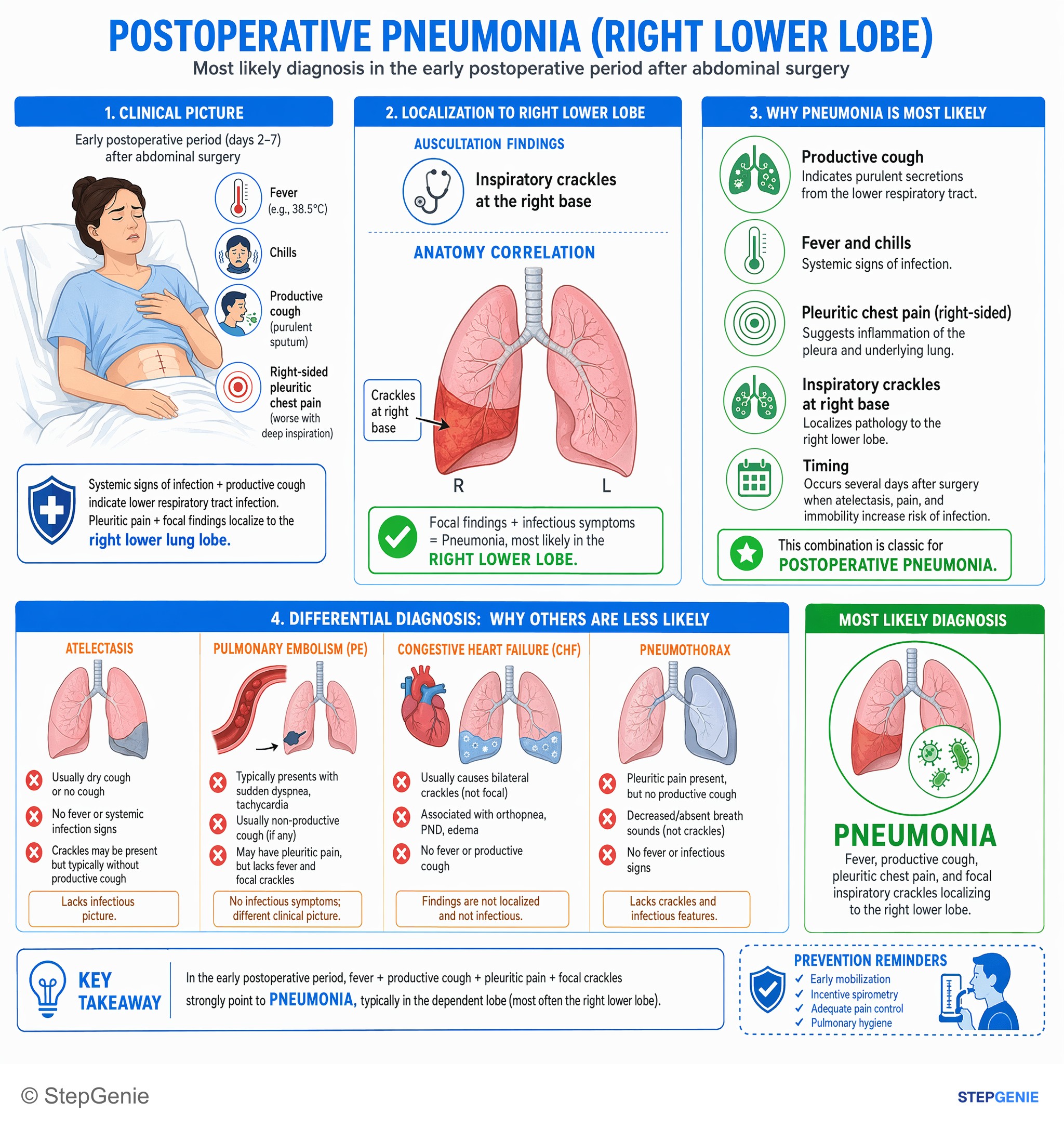
Postoperative pneumonia: fever, productive cough, pleuritic chest pain, and focal inspiratory crackles localize to affected lung lobe…
USMLE Step 2Frequently Asked Questions
What is the difference between hospital-acquired and ventilator-associated pneumonia?
Hospital-acquired pneumonia (HAP) is pneumonia that was not incubating at admission and develops 48 hours or more after admission in a patient who is not intubated. Ventilator-associated pneumonia (VAP) develops more than 48 hours after endotracheal intubation, and some patients have already been extubated when it appears. Both are caused mainly by Staphylococcus aureus, including MRSA, and by Pseudomonas aeruginosa and other gram-negative rods, but VAP guidance uses unit resistance rates and more risk factors to decide on broader coverage.
What are the most common organisms in hospital-acquired pneumonia?
Staphylococcus aureus (both MSSA and MRSA) and Pseudomonas aeruginosa are the two leading causes. Other gram-negative rods, including Klebsiella, Escherichia coli, Enterobacter and Acinetobacter, are also important, and antibiotic resistance is common. Respiratory viruses cause up to about 20% of cases. Anaerobes do not contribute significantly, because within about 48 hours of admission the flora of the mouth and airway shifts toward gram-negative hospital organisms.
What is the empiric antibiotic treatment for hospital-acquired pneumonia?
Under the 2016 ATS/IDSA guideline, patients without MRSA risk who are not at high risk of death get one agent active against Pseudomonas and MSSA, such as piperacillin-tazobactam, cefepime, levofloxacin, imipenem or meropenem. Vancomycin or linezolid is added for IV antibiotics in the past 90 days, a unit where over 20% of S. aureus isolates are MRSA, or a high risk of death. Two antipseudomonal drugs from different classes are reserved for high-risk patients. Therapy is then de-escalated and usually lasts 7 days.
When do you add MRSA coverage for hospital-acquired pneumonia?
For nonventilated hospital-acquired pneumonia, the 2016 ATS/IDSA guideline suggests vancomycin or linezolid when the patient received IV antibiotics in the past 90 days, is in a unit where more than 20% of Staphylococcus aureus isolates are methicillin-resistant or the rate is unknown, or is at high risk of death because of ventilatory support or septic shock. For ventilator-associated pneumonia the unit threshold is lower, 10 to 20%. Daptomycin is not used for pneumonia because pulmonary surfactant binds it.
How long do you treat hospital-acquired pneumonia?
The 2016 ATS/IDSA guideline recommends a 7-day course for both hospital-acquired and ventilator-associated pneumonia, because longer courses have not been shown to reduce relapse, treatment failure or mortality. Antibiotics should be de-escalated to the narrowest effective drug once cultures and susceptibilities return, and procalcitonin trends plus clinical criteria can help decide when to stop. Complications such as empyema or bacteremia need longer treatment.
Why isn't clindamycin used for hospital-acquired aspiration pneumonia?
Aspiration in a hospitalized patient brings in hospital flora, mainly gram-negative rods and MRSA, rather than the streptococci and anaerobes of community aspiration, and anaerobes contribute little to hospital-acquired pneumonia. Clindamycin covers anaerobes and some gram-positive cocci, but aerobic gram-negative bacilli such as Pseudomonas are resistant to it, and it has the strongest link of any antibiotic to C. difficile colitis. Empiric therapy should follow the hospital-acquired pneumonia rules instead.