De novo synthesis builds nucleotides from scratch (amino acids, CO₂, folate one-carbon units, PRPP) at a high ATP cost; salvage recycles preformed bases and nucleosides in one or two steps, mainly via HGPRT, APRT and nucleoside kinases. Dividing cells, especially activated lymphocytes, rely on de novo synthesis, the target of many antimetabolite drugs.
De novo synthesis and purine salvage run on the same activated sugar, PRPP, made from ribose-5-phosphate and ATP. Purines are assembled directly on PRPP; pyrimidines build their ring first and attach it to PRPP afterward. Salvage enzymes draw on the same PRPP pool, so when salvage fails, unused PRPP accelerates de novo purine synthesis and drives the uric acid overload of Lesch-Nyhan syndrome.
Boards test the committed enzymes, the classic defects and the drug that blocks each step.
De novo vs salvage pathway: comparison table
| Feature | De novo synthesis | Salvage pathway |
|---|---|---|
| What it does | Builds new purine and pyrimidine rings | Reuses bases and nucleosides from nucleic acid breakdown or uptake |
| Raw materials | Glutamine, glycine, aspartate, CO₂, N¹⁰-formyl-THF, ribose-5-phosphate (as PRPP) | Free bases (hypoxanthine, guanine, adenine) and nucleosides (uridine, cytidine) |
| Ribose-phosphate donor | PRPP | PRPP for purine bases; nucleoside kinases use ATP instead |
| Length | 10 steps from PRPP to IMP; 6 reactions to UMP | One or two steps |
| Energy cost | High: roughly 5–7 ATP per IMP, counting PRPP synthesis (from ribose-5-phosphate or glucose) | Low |
| Key purine enzymes | Glutamine-PRPP amidotransferase (committed step), IMP dehydrogenase | HGPRT (hypoxanthine, guanine), APRT (adenine) |
| Key pyrimidine enzymes | CPS II, DHODH, UMP synthase, thymidylate synthase | Uridine-cytidine kinase and other nucleoside kinases |
| Who depends on it | Most proliferating cells, especially activated lymphocytes | Red blood cells and brain (purine salvage) |
| Classic defect | Hereditary orotic aciduria (UMP synthase) | Lesch-Nyhan syndrome (HGPRT) |
| Drug angle | Methotrexate, 5-FU, mycophenolate and leflunomide block de novo enzymes | 6-MP and azathioprine need HGPRT to become active |
In one line: de novo makes new rings and is expensive and drug-sensitive; salvage reuses old ones cheaply. Rephosphorylating nucleotides released by RNA turnover refills the pools but adds no net nucleotides.
How salvage works, and which cells depend on it
Purine salvage attaches a free base to PRPP in one step: HGPRT turns hypoxanthine into IMP and guanine into GMP, and APRT turns adenine into AMP.
Pyrimidine salvage runs mostly through nucleosides: uridine-cytidine kinase phosphorylates cytidine, cytidine can be deaminated to uridine, and pyrimidine phosphorylases join free bases to ribose-1-phosphate. Essentially all cells can turn supplied uridine into uridine nucleotides, which is how uridine triacetate bypasses the block in hereditary orotic aciduria.
Who leans on which pathway
- Most proliferating cells make nucleotides de novo; activated T and B lymphocytes depend on de novo purine synthesis, which is why mycophenolate and azathioprine hit them preferentially.
- Red blood cells and the brain rely on purine salvage. Why HGPRT loss damages the brain is unsettled; basal ganglia dopamine dysfunction is the leading hypothesis.
How the two pathways interact
- Salvage spends PRPP and makes IMP and GMP, which restrain glutamine-PRPP amidotransferase. Without HGPRT, PRPP accumulates and de novo synthesis speeds up while unsalvaged hypoxanthine and guanine become uric acid, so urate climbs from both directions.
- Allopurinol shows the reverse: with xanthine oxidase blocked, more hypoxanthine and xanthine are reused, and feedback inhibition keeps total purine synthesis in check.
- In HGPRT disorders all tissue purines come from de novo synthesis, so methotrexate and similar drugs hit harder, and mycophenolate's label advises avoiding it because it can worsen uric acid overproduction.
Clinical detail: Lesch-Nyhan syndrome: HGPRT, PRPP, urate and self-injury.
Purines vs pyrimidines: where the ring is built
| Feature | Purines | Pyrimidines |
|---|---|---|
| Bases | Adenine, guanine | Cytosine, thymine (DNA), uracil (RNA) |
| Ring | Five-membered ring fused to a six-membered ring | Single six-membered ring |
| How it's built | Directly on PRPP | Ring first (orotate), then attached to PRPP |
| Ring atoms | Glycine (C4, C5, N7), glutamine (N3, N9), aspartate (N1), CO₂ (C6), N¹⁰-formyl-THF (C2, C8) | Aspartate (three of the four carbons) plus carbamoyl phosphate made from glutamine and bicarbonate |
| First nucleotide | IMP, then AMP and GMP | UMP, then UTP and CTP; dUMP → dTMP |
| Rate-limiting enzyme (exam answer) | Glutamine-PRPP amidotransferase | CPS II (first domain of CAD) |
| Feedback | Adenine and guanine nucleotides inhibit; PRPP activates | UTP inhibits; PRPP activates |
| Location | Entirely cytosolic | Cytosol, except DHODH in mitochondria |
| Breakdown | Uric acid (poorly soluble) | Products that feed the citric acid cycle |
De novo purine synthesis, step by step
- PRPP synthetase uses ATP to activate ribose-5-phosphate from the pentose phosphate pathway, releasing AMP. Purine nucleotides (ADP, GDP) inhibit it; an X-linked superactive form causes early gout.
- Glutamine-PRPP amidotransferase uses glutamine's amide nitrogen to convert PRPP into 5-phosphoribosylamine: the committed step boards call rate-limiting. Adenine and guanine nucleotides inhibit it at two sites; PRPP stimulates it, so a PRPP surplus pushes the pathway forward.
- Nine more steps (10 from PRPP, run by six enzymes) add glycine, a second glutamine, CO₂, aspartate and two formyl groups from N¹⁰-formyl-THF to reach IMP. Methotrexate slows this stage twice: less reduced folate (via DHFR) and direct inhibition of AICAR transformylase.
- IMP is the branch point. IMP → AMP takes its amino group from aspartate (through adenylosuccinate, releasing fumarate) and spends GTP. IMP → XMP → GMP runs through IMP dehydrogenase (the mycophenolate target), then GMP synthetase, which takes glutamine's nitrogen and spends ATP. AMP inhibits adenylosuccinate synthetase and GMP inhibits IMP dehydrogenase.
De novo pyrimidine synthesis, step by step
- CPS II in the cytosol joins glutamine, bicarbonate and 2 ATP into carbamoyl phosphate. It is the first of three activities of the trifunctional protein CAD (with aspartate transcarbamoylase and dihydroorotase), which closes the ring as dihydroorotate. UTP inhibits CPS II and PRPP activates it, linking pyrimidine and purine regulation.
- Dihydroorotate dehydrogenase (DHODH), on the inner mitochondrial membrane, oxidizes dihydroorotate to orotate while reducing ubiquinone. Leflunomide (through its active metabolite, teriflunomide) blocks it.
- UMP synthase is bifunctional: orotate phosphoribosyltransferase attaches PRPP (orotate → OMP), and OMP decarboxylase makes UMP. Its deficiency is hereditary orotic aciduria.
- UMP → UDP → UTP; CTP synthase aminates UTP to CTP, taking the nitrogen from glutamine and spending ATP.
- Ribonucleotide reductase turns ribonucleoside diphosphates (purine and pyrimidine) into deoxyribonucleotides. One allosteric site binds ATP (activating) or dATP (inhibitory), which is how dATP buildup in ADA deficiency starves cells of DNA precursors. Hydroxyurea inhibits the enzyme.
- Thymidylate synthase methylates dUMP to dTMP with N⁵,N¹⁰-methylene-THF, and DHFR must then reduce dihydrofolate back to tetrahydrofolate before folate can carry another carbon. 5-FU (as FdUMP) blocks thymidylate synthase; methotrexate blocks DHFR.
Purine breakdown: ADA, PNP, xanthine oxidase and uric acid
- Adenosine deaminase (ADA) deaminates adenosine and deoxyadenosine to inosine and deoxyinosine.
- Purine nucleoside phosphorylase (PNP) releases hypoxanthine and guanine from inosine, guanosine and their deoxy forms; guanine is then converted to xanthine.
- Xanthine oxidase catalyzes both final steps, hypoxanthine → xanthine → uric acid. Allopurinol (through oxypurinol) and febuxostat inhibit it.
- Humans stop at uric acid. Most mammals, but not humans or higher primates, have uricase, which turns urate into water-soluble allantoin; rasburicase and pegloticase are recombinant uricases.
- Most hyperuricemia (about 90%) is under-excretion. Overproduction comes from HGPRT deficiency, PRPP synthetase overactivity or rapid cell turnover such as tumor lysis; the joint disease is compared in gout vs pseudogout.
- Pyrimidine breakdown starts with dihydropyrimidine dehydrogenase (DPD), the first and rate-limiting enzyme for uracil and thymine, which also breaks down more than 80% of a 5-FU dose. Dihydropyrimidinase and β-ureidopropionase (β-alanine synthase) then yield β-alanine and β-aminoisobutyrate, which are excreted in urine or metabolized further toward citric acid cycle intermediates.
Enzyme defects at a glance
| Disorder | Enzyme and inheritance | Labs | Clues | Treatment |
|---|---|---|---|---|
| Lesch-Nyhan disease | HGPRT, near-absent (HPRT1); X-linked | High uric acid; urine urate-to-creatinine ratio above 2 | Orange "sand" (uric acid crystals) in diapers; action dystonia; self-injury, usually from age 2–4; vitamin-resistant macrocytic anemia | Allopurinol (febuxostat if hypersensitive) for urate only; neurologic features do not respond |
| Partial HGPRT deficiency | Residual HGPRT activity; X-linked | High uric acid | Gout and uric acid stones; neurologic dysfunction without self-injury (HND) or no overt deficit (HRH, Kelley-Seegmiller syndrome) | Allopurinol |
| APRT deficiency | APRT; autosomal recessive | Normal serum uric acid; urinary 2,8-dihydroxyadenine | Radiolucent stones; round brown crystals; crystal nephropathy and CKD | Allopurinol or febuxostat, fluids; avoid urine alkalinization |
| PRPP synthetase superactivity | PRPS1 overactivity; X-linked | High serum and urine uric acid | Uric acid stones, then gout, from the second or third decade; a severe childhood-onset form adds deafness, developmental delay, hypotonia and ataxia | Allopurinol or febuxostat, fluids |
| ADA deficiency | ADA; autosomal recessive | ADA activity under 1%; high red-cell dATP | SCID with low T, B and NK cells; rib cupping and scapular spurring in about half; hearing loss; about 12–15% of SCID | Elapegademase as a bridge, then HSCT (HLA-identical sibling preferred) or gene therapy |
| PNP deficiency | PNP; autosomal recessive | Low uric acid; dGTP accumulates | Profound T-cell deficiency (about 4% of SCID); neurologic problems in about two-thirds; autoimmunity | HSCT |
| Hereditary orotic aciduria | UMP synthase; autosomal recessive | Very high urine orotic acid; normal ammonia | Megaloblastic anemia unresponsive to B12 and folate; developmental delay; orotate crystals; fewer than 30 cases reported | Uridine triacetate (FDA-approved 2015) |
| DPD deficiency | DPD (DPYD); complete deficiency needs two nonfunctional variants | High uracil and thymine | An inborn error (developmental delay, seizures), or unmasked by 5-FU or capecitabine as early severe mucositis, diarrhea and neutropenia | Test DPYD before treatment; uridine triacetate for toxicity |
The immune side is mapped in SCID made easy: T-B-NK grid, genes, TRECs and adenosine deaminase deficiency: SCID, dATP and treatment; the stones are compared in nephrolithiasis: stone types, crystals and urine pH.
Orotic aciduria vs OTC deficiency: check the ammonia
Both raise urinary orotic acid, for different reasons. In OTC deficiency, carbamoyl phosphate that cannot enter the urea cycle spills into the cytosol and feeds pyrimidine synthesis. In hereditary orotic aciduria, orotate cannot be converted to UMP.
| Clue | Hereditary orotic aciduria | OTC deficiency |
|---|---|---|
| Pathway | Pyrimidine synthesis (UMP synthase) | Urea cycle (ornithine transcarbamylase) |
| Ammonia | Normal | High |
| Urea cycle labs | Citrulline normal or borderline | Low BUN, low citrulline, high glutamine |
| Signature finding | Megaloblastic anemia refractory to B12 and folate | Hyperammonemia with lethargy and respiratory alkalosis; neonatal crisis in boys |
| Inheritance | Autosomal recessive | X-linked; the most common urea cycle disorder; heterozygous girls can be symptomatic |
| Treatment | Uridine triacetate | Low-protein diet, nitrogen scavengers, arginine or citrulline, dialysis in crises; liver transplant for severe neonatal disease |
- CPS I and NAGS deficiency also cause hyperammonemia with low citrulline, but urinary orotic acid is normal or low because the block comes before carbamoyl phosphate. NAGS deficiency responds to carglumic acid (N-carbamylglutamate).
- Orotic acid also rises in citrullinemia type I, arginase deficiency and HHH syndrome.
- For the vitamin side of the differential, see megaloblastic anemia: B12 vs folate; the urea cycle enzymes are tabulated in rate-limiting enzymes in metabolism.
Drugs that block nucleotide synthesis: exact targets
| Drug | Exact target | Exam pearl |
|---|---|---|
| Methotrexate | Human DHFR; its polyglutamates also inhibit thymidylate synthase and AICAR transformylase | Leucovorin rescue bypasses DHFR; glucarpidase for toxic levels with renal impairment; weekly dosing for RA and psoriasis |
| Trimethoprim | Bacterial DHFR | With sulfamethoxazole blocks two consecutive folate steps; can cause folate deficiency and hyperkalemia |
| Pyrimethamine | Parasite DHFR (Toxoplasma, malaria) | Given with sulfadiazine plus leucovorin to protect the marrow |
| 5-Fluorouracil (capecitabine is an oral prodrug) | Thymidylate synthase (as FdUMP); FUTP enters RNA and FdUTP enters DNA | Leucovorin enhances it; uridine triacetate within 96 hours for overdose or early severe toxicity; test DPYD first |
| Hydroxyurea | Ribonucleotide reductase | Raises HbF in sickle cell anemia; macrocytosis; boxed warning for myelosuppression |
| Mycophenolate | IMP dehydrogenase (types I and II) | Depletes guanine nucleotides in lymphocytes; boxed warning for embryofetal toxicity; avoid in HGPRT deficiency |
| Ribavirin | IMP dehydrogenase (the classic answer, but only one of several proposed mechanisms) | Hemolytic anemia and teratogenicity (boxed warning) |
| Leflunomide; teriflunomide | DHODH | Leflunomide for RA, teriflunomide (its active metabolite) for relapsing MS; boxed hepatotoxicity and embryo-fetal toxicity; cholestyramine or charcoal washout |
| 6-Mercaptopurine; azathioprine (its prodrug) | Activated by HGPRT to thio-IMP and thioguanine nucleotides, which inhibit de novo purine synthesis and enter DNA | Inactivated by TPMT and xanthine oxidase: TPMT or NUDT15 variants and allopurinol raise the risk of severe myelosuppression |
| Allopurinol; febuxostat | Xanthine oxidase | Allopurinol is first choice (HLA-B*58:01 raises SJS/TEN/DRESS risk); febuxostat carries a boxed warning for cardiovascular death |
| Rasburicase | Recombinant urate oxidase (uric acid → allantoin) | Tumor lysis syndrome; contraindicated in G6PD deficiency because its hydrogen peroxide causes hemolysis and methemoglobinemia |
Hydroxyurea in context: sickle cell disease: crises and trait.
USMLE traps: classic teaching vs current evidence
| Trap | What's actually true |
|---|---|
| CPS I vs CPS II | CPS I is mitochondrial, uses ammonia, needs N-acetylglutamate and starts the urea cycle; CPS II is cytosolic, uses glutamine and starts pyrimidine synthesis |
| "Aspartate transcarbamoylase is the control point of pyrimidine synthesis" | In humans, UTP inhibits and PRPP activates the CPS II domain of CAD |
| "Each pathway has one rate-limiting enzyme" | Exam shorthand; flux control is shared, and both CPS II and DHODH have been called rate-limiting for pyrimidines |
| Orotic aciduria with hyperammonemia | A urea cycle block (OTC deficiency first), not UMP synthase deficiency |
| Macrocytic anemia that ignores B12 and folate means orotic aciduria | It is also common in Lesch-Nyhan disease and occurs with hydroxyurea and azathioprine |
| "5-FU is contraindicated in DPD deficiency" | Current US labels list no DPD contraindication; a boxed warning added in late 2025 advises DPYD testing before starting unless treatment is urgent and avoiding use in complete deficiency; dosing is individualized in partial deficiency |
| Leucovorin as the 5-FU antidote | Leucovorin rescues methotrexate but potentiates 5-FU by stabilizing the FdUMP–thymidylate synthase complex; the antidote is uridine triacetate |
| Allopurinol with azathioprine or 6-MP | Cut the thiopurine to about one-third to one-quarter of the usual dose; febuxostat is contraindicated with either |
| "PEG-ADA (Adagen) is the enzyme replacement" | Elapegademase (Revcovi), a recombinant PEG-ADA, replaced Adagen in 2019 and bridges to HSCT or gene therapy; the EU-approved gene therapy (Strimvelis) is offered only in Milan |
| Methotrexate controls RA by blocking DHFR | Its label calls the RA mechanism unknown; the proposed explanation is AICAR transformylase inhibition with adenosine accumulation |
| Allopurinol for established tumor lysis hyperuricemia | Allopurinol prevents new uric acid but does not treat existing hyperuricemia; rasburicase does |
Worked USMLE-style vignettes
Vignette 1: the anemia vitamins won't fix. A 7-month-old boy has pallor, poor weight gain and developmental delay. Hemoglobin is low with a high MCV, and the marrow is megaloblastic. Serum B12 and folate are normal, and a trial of both does not help. Urine shows crystals and markedly elevated orotic acid; plasma ammonia is normal. Which enzyme is deficient? (A) Ornithine transcarbamylase (B) CPS I (C) UMP synthase (D) DHODH (E) HGPRT
Answer: C, UMP synthase (hereditary orotic aciduria); treat with uridine triacetate.
- A: OTC deficiency raises orotic acid too, but with hyperammonemia.
- B: CPS I deficiency causes hyperammonemia without orotic aciduria.
- D: DHODH makes orotate, so a block there could not raise orotic acid.
- E: HGPRT deficiency can cause vitamin-resistant macrocytic anemia, but its signature is uric acid overproduction.
Vignette 2: orange sand. A 10-month-old boy has hypotonia and delayed milestones; his parents noticed orange, gritty material in his diapers. Over the next two years he develops dystonia and starts biting his lips and fingers. Serum uric acid is high. Which statement about allopurinol is correct? (A) It improves the dystonia (B) It prevents uric acid stones, gout and kidney damage but not the neurologic or behavioral features (C) It should push uric acid as low as possible (D) It is contraindicated (E) It replaces the missing enzyme
Answer: B. This is X-linked HGPRT deficiency (Lesch-Nyhan disease); allopurinol controls only uric acid overproduction.
- A, E: Urate-lowering therapy does not change neurologic or cognitive outcomes, and no enzyme replacement exists.
- C: Pushing uric acid below normal raises the risk of xanthine stones.
- D: Allopurinol is the mainstay; febuxostat is the option in allopurinol hypersensitivity.
Vignette 3: a positive newborn screen. A 3-week-old girl has absent TRECs on newborn screening. Lymphocytes are very low, with few T, B and NK cells, and a chest x-ray shows anterior rib cupping. Red-cell ADA activity is under 1% of normal and red-cell dATP is high. What explains the lymphocyte loss, and what is the first targeted treatment?
Answer: ADA-SCID. Deoxyadenosine is phosphorylated to dATP, which inhibits ribonucleotide reductase and blocks DNA synthesis in lymphocytes. Start enzyme replacement with elapegademase as a bridge to HSCT (from an HLA-identical sibling if available) or gene therapy, and avoid live vaccines.
- X-linked SCID affects boys, leaves B cells present and does not raise dATP.
- PNP deficiency is T-cell-predominant, with low uric acid.
Vignette 4: five days after FOLFOX. A 62-year-old man with stage III colon cancer starts infusional 5-FU with leucovorin and oxaliplatin, without pretreatment genotyping. Within 5 days he has severe mucositis, profuse diarrhea and an absolute neutrophil count of 200/µL. What is the most likely cause, and what is the antidote?
Answer: DPD deficiency from DPYD variants; give uridine triacetate within 96 hours of the end of the infusion, with supportive care.
- More leucovorin would worsen toxicity, because it stabilizes the FdUMP–thymidylate synthase complex.
- Glucarpidase clears methotrexate, not 5-FU; TPMT deficiency matters for thiopurines, not fluoropyrimidines.
Key takeaways
- De novo builds new rings (costly, drug-sensitive); salvage recycles bases and nucleosides (cheap). De novo synthesis and purine salvage share PRPP.
- Purines are built on PRPP (committed step: glutamine-PRPP amidotransferase); pyrimidines build the ring first (CPS II within CAD, DHODH in mitochondria, then UMP synthase).
- HGPRT loss (Lesch-Nyhan) raises PRPP, de novo synthesis and uric acid; allopurinol treats only the urate.
- Breakdown defects: ADA (dATP blocks ribonucleotide reductase; SCID with low T, B and NK cells) and PNP (dGTP; T-cell defect with low uric acid).
- Orotic acid with normal ammonia = UMP synthase deficiency (uridine triacetate); orotic acid with hyperammonemia = OTC deficiency.
- Drug map: methotrexate, trimethoprim, pyrimethamine (DHFR); 5-FU (thymidylate synthase); hydroxyurea (ribonucleotide reductase); mycophenolate, ribavirin (IMP dehydrogenase); leflunomide (DHODH); 6-MP, azathioprine (activated by HGPRT); allopurinol, febuxostat (xanthine oxidase).
More biochemistry walkthroughs are on the Biochemistry hub.
Sources
- Lane AN, Fan TW-M. Regulation of mammalian nucleotide metabolism and biosynthesis — Nucleic Acids Research (2015)
- Chen J, et al. De novo nucleotide biosynthetic pathway and cancer — Genes & Diseases (2023)
- Wu Z, et al. Electron transport chain inhibition increases cellular dependence on purine transport and salvage — Cell Metabolism (2024)
- Purine Bases Can Be Synthesized de Novo or Recycled by Salvage Pathways — Berg, Biochemistry, 8th ed. (2015)
- Biochemistry, DNA Structure — StatPearls (2023)
- Lesch-Nyhan Syndrome — StatPearls (2026)
- HPRT1 Disorders — GeneReviews (2020)
- Phosphoribosylpyrophosphate Synthetase Superactivity — GeneReviews (2022)
- Adenine Phosphoribosyltransferase Deficiency — GeneReviews (2019)
- Adenosine Deaminase Deficiency — GeneReviews (2025)
- Purine Salvage Disorders — Merck Manual Professional (2024)
- Purine Catabolism Disorders — Merck Manual Professional (2024)
- Pyrimidine Metabolism Disorders — Merck Manual Professional (2024)
- Pyrimidine catabolism — Reactome
- Purine Nucleoside Phosphorylase Deficiency — MedlinePlus Genetics, NLM
- Grunebaum E, et al. Partial Purine Nucleoside Phosphorylase Deficiency — Frontiers in Immunology (2020)
- Urea Cycle Disorders Overview — GeneReviews (2025)
- Ornithine Transcarbamylase Deficiency — GeneReviews (2022)
- Physiology, Urea Cycle — StatPearls (2023)
- Staretz-Chacham O, et al. Hereditary orotic aciduria identified by newborn screening — Frontiers in Genetics (2023)
- Xuriden (uridine triacetate) Label — DailyMed (2025)
- Vistogard (uridine triacetate) Label — DailyMed (2026)
- Revcovi (elapegademase-lvlr) Label — DailyMed (2026)
- Fluorouracil Injection Label — DailyMed (2026)
- Safety Labeling Update for Capecitabine and Fluorouracil on DPD Deficiency — U.S. Food and Drug Administration (2026)
- Fluorouracil Therapy and DPYD Genotype — Medical Genetics Summaries (2026)
- Leucovorin — StatPearls (2026)
- Methotrexate Injection Label — DailyMed (2026)
- Methotrexate — StatPearls (2024)
- Trimethoprim-Sulfamethoxazole — StatPearls (2026)
- Antiparasitic Drugs — StatPearls (2023)
- Droxia (hydroxyurea) Label — DailyMed (2026)
- CellCept (mycophenolate mofetil) Label — DailyMed (2026)
- Mycophenolate — LiverTox (2020)
- Ribavirin Capsules Label — DailyMed (2024)
- Graci JD, Cameron CE. Mechanisms of action of ribavirin against distinct viruses — Reviews in Medical Virology (2006)
- Arava (leflunomide) Label — DailyMed (2025)
- Aubagio (teriflunomide) Label — DailyMed (2026)
- Mercaptopurine — StatPearls (2023)
- Azathioprine — StatPearls (2026)
- Imuran (azathioprine) Label — DailyMed (2026)
- Allopurinol Tablets Label — DailyMed (2026)
- Uloric (febuxostat) Label — DailyMed (2025)
- Elitek (rasburicase) Label — DailyMed (2026)
- Hyperuricemia — StatPearls (2023)
- Tumor Lysis Syndrome — StatPearls (2024)
Visual explanations from the StepGenie QBank
Infographics StepGenie drew to explain questions in its own QBank, matched to this article's topic. Each caption is the takeaway of the question it explains.
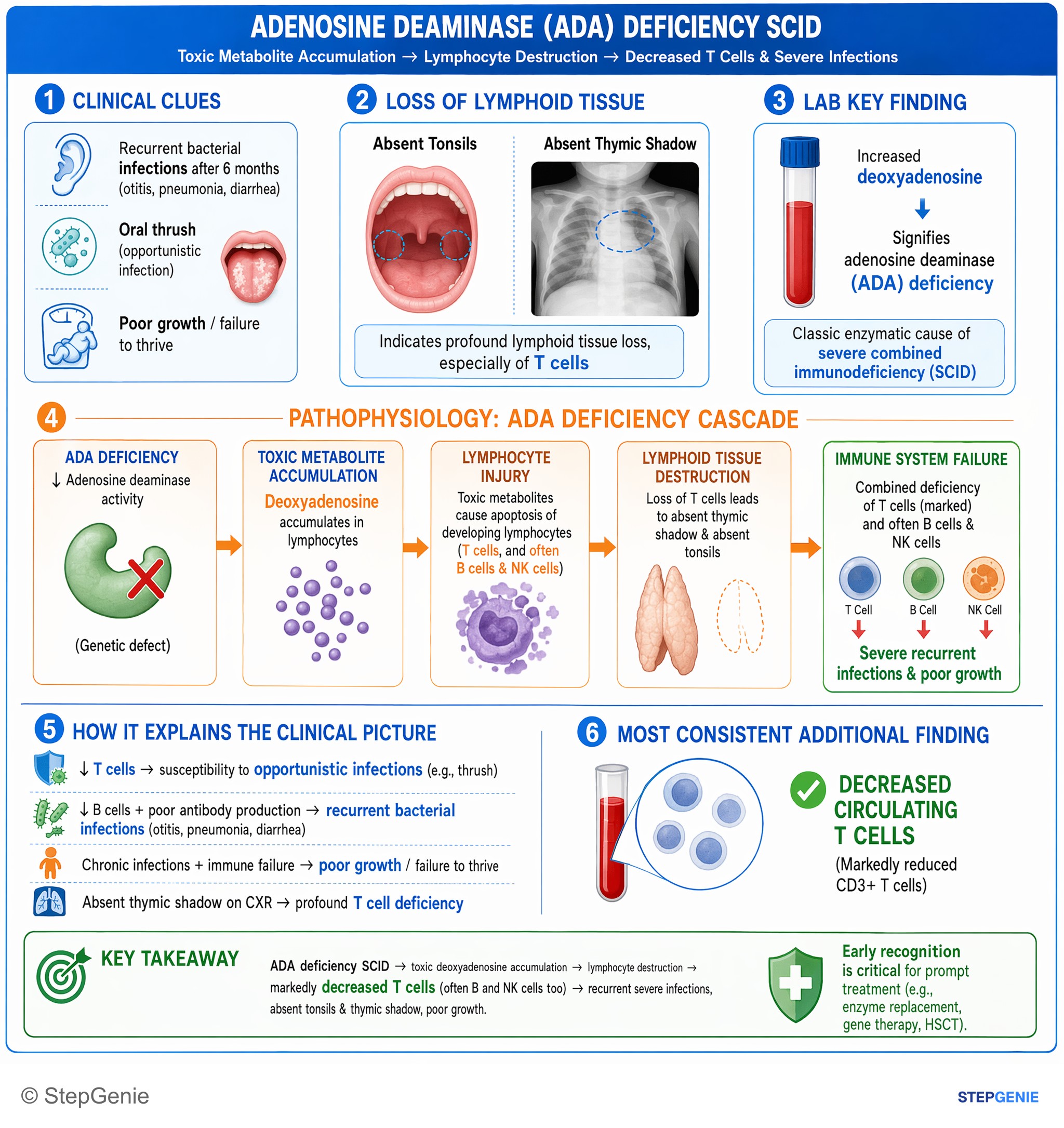
Adenosine deaminase–deficiency SCID → toxic deoxyadenosine accumulation → lymphocyte destruction → markedly decreased T cells (often B and…
USMLE Step 1Frequently Asked Questions
What is the difference between de novo and salvage pathways?
De novo synthesis builds purine and pyrimidine nucleotides from small precursors (glutamine, glycine, aspartate, carbon dioxide and folate-carried one-carbon units) plus PRPP and uses a lot of ATP. The salvage pathway recycles free bases and nucleosides from nucleotide breakdown in one or two steps, through enzymes such as HGPRT, APRT and nucleoside kinases. Dividing cells such as activated lymphocytes depend on de novo synthesis, while red blood cells and the brain rely on purine salvage.
What is the difference between purine and pyrimidine synthesis?
Purines (adenine and guanine) are assembled step by step directly on PRPP until the first purine nucleotide, IMP, forms; IMP then branches to AMP and GMP. Pyrimidines (cytosine, thymine and uracil) are built the other way round: the ring is made first as orotate, then attached to PRPP (forming OMP) and decarboxylated to UMP. Purine synthesis is entirely cytosolic, whereas one pyrimidine step, DHODH, is mitochondrial. Purines are broken down to poorly soluble uric acid.
What is the rate-limiting enzyme of purine and pyrimidine synthesis?
For de novo purine synthesis it is glutamine-PRPP amidotransferase, the committed step, which adenine and guanine nucleotides inhibit and PRPP stimulates. For pyrimidine synthesis it is carbamoyl phosphate synthetase II, the first activity of the cytosolic CAD protein, inhibited by UTP and activated by PRPP. Do not confuse it with mitochondrial CPS I of the urea cycle. Strictly, control is shared among several enzymes, but these are the standard exam answers.
How do you tell hereditary orotic aciduria from OTC deficiency?
Both raise urinary orotic acid. OTC deficiency is an X-linked urea cycle disorder with hyperammonemia, low BUN, low citrulline and respiratory alkalosis, classically in a newborn boy. Hereditary orotic aciduria is an autosomal recessive UMP synthase defect with normal ammonia and a megaloblastic anemia that does not respond to vitamin B12 or folate. It is treated with uridine triacetate, which supplies uridine and bypasses the blocked enzyme.
Which drugs inhibit nucleotide synthesis, and what are their targets?
Methotrexate inhibits human dihydrofolate reductase, trimethoprim the bacterial enzyme and pyrimethamine the parasite enzyme. 5-Fluorouracil inhibits thymidylate synthase, and hydroxyurea inhibits ribonucleotide reductase. Mycophenolate, and classically ribavirin, inhibit IMP dehydrogenase, while leflunomide and teriflunomide block dihydroorotate dehydrogenase. 6-Mercaptopurine and azathioprine are activated by HGPRT and inhibit de novo purine synthesis. Allopurinol and febuxostat block xanthine oxidase, the last enzyme of purine breakdown.
Which diseases affect the purine salvage pathway?
Lesch-Nyhan disease is X-linked HGPRT deficiency: uric acid overproduction from birth (orange crystals in diapers, kidney stones, gout), severe dystonia and self-injury. Partial HGPRT deficiency causes the same uric acid problems with milder or no neurologic features. APRT deficiency is autosomal recessive and causes radiolucent 2,8-dihydroxyadenine kidney stones with normal serum uric acid. Allopurinol or febuxostat treats both, but neither improves the neurologic features of Lesch-Nyhan disease.