Contact dermatitis is skin inflammation caused by something that touches the skin, and it comes in two forms. Irritant contact dermatitis is direct, non-immune damage from soaps, chemicals or chronic moisture; it can affect anyone, burns more than it itches when acute, and accounts for up to 80% of occupational dermatitis. Allergic contact dermatitis is a type IV (delayed, T-cell–mediated) hypersensitivity reaction in a previously sensitized person: an itchy, eczematous or vesicular rash appears 24 to 72 hours after re-exposure to an allergen such as nickel or poison ivy's urushiol, shaped like the contact, and patch testing identifies the culprit. Both are treated with avoidance and topical corticosteroids; extensive allergic disease needs oral corticosteroids for about 1 to 3 weeks (sources differ), because stopping too soon can cause a rebound.
Allergic vs irritant contact dermatitis at a glance
| Feature | Irritant (ICD) | Allergic (ACD) |
|---|---|---|
| Mechanism | Direct chemical or physical damage; non-immune | Type IV hypersensitivity: sensitized T cells |
| Prior sensitization | Not needed; severity depends on concentration, amount, duration and frequency of exposure | Required |
| Onset | Acute reactions peak within minutes to a few hours | Appears 24–72 hours after exposure, peaks around 72–96 hours |
| Main symptom | Acute: burning, stinging, more painful than itchy; chronic or cumulative ICD often itches | Itch; more pruritic than painful |
| Distribution | Wherever the irritant touched | Mirrors the contact (streaks, a watchband, a waistband); can spread by scratching or an id reaction |
| Typical causes | Soaps and detergents, acids, alkalis, solvents, chronic moisture from body fluids (urine, saliva) | Nickel, urushiol, fragrances, preservatives, neomycin, bacitracin, rubber accelerators, hair dye |
| Histology | Mild spongiosis, epidermal cell necrosis, neutrophils | Marked spongiosis, intraepidermal vesicles, lymphocyte-rich dermal infiltrate, often eosinophils |
| Confirmation | Clinical diagnosis; no confirmatory test | Patch testing |
The type IV mechanism in two phases
Sensitization (first exposure).
- A hapten, a small reactive chemical such as nickel or urushiol, penetrates the epidermis and becomes antigenic after binding to (modifying) skin proteins.
- Langerhans cells, the epidermal dendritic cells that express MHC class II, capture and process it and migrate to regional lymph nodes (see MHC I vs MHC II).
- Antigen-specific T cells expand and circulate as memory cells. Sensitization can take only 6 to 10 days for strong sensitizers such as poison ivy or years for weak ones (Merck).
Elicitation (re-exposure).
- Sensitized T cells meet the antigen in the skin. Type IV injury comes from direct cytotoxicity (CD8+ T cells) and from cytokines that recruit and activate macrophages, eosinophils, neutrophils and other cells.
- Merck: ACD takes at least 1 day to become noticeable and 2 to 3 days to worsen; StatPearls: lesions appear 24–72 hours after exposure and peak at about 72–96 hours.
- The result is an eczematous dermatitis (erythema, edema and vesicles, even bullae, when acute; scaling and lichenification when chronic) with spongiosis on biopsy.
Antibodies, complement and mast cells are not the drivers, which is how the exam separates it from types I to III (compare the type IV breakdown).
Classic allergens and where they show up
| Allergen | Found in | Exam clue |
|---|---|---|
| Nickel (most common contact allergen) | Jewelry, watch and belt buckles, eyeglass frames, scissors, razors | Earlobes, wrist under a watch, periumbilical skin |
| Urushiol (poison ivy, oak, sumac) | Plant oil, also carried on clothing, tools and pet fur | Linear streaks of vesicles on exposed arms and legs |
| Fragrances, balsam of Peru | Perfumes, toiletries, soaps, aftershave, shampoos | Rash after a new scented product |
| Preservatives (quaternium-15, formaldehyde) | Cosmetics, household cleaners, clothing resins | Rash where a cosmetic or cleaner is used |
| Topical antibiotics (neomycin, bacitracin) | First-aid ointments, ear and nose drops | A wound or ear canal that gets redder and itchier with treatment |
| Topical anesthetics ("caine" mix, e.g., benzocaine) | Dental and topical preparations | Rash where the anesthetic was applied |
| Rubber accelerators (thiuram, carba, mercapto mixes) | Gloves and other rubber products | Hand dermatitis in glove wearers |
| p-Phenylenediamine (PPD) | Hair dyes, textile dyes | Scalp, hairline, face and neck after dyeing |
| Chromate (potassium dichromate) | Cement, leather tanning solutions | Construction or leather exposure |
| Corticosteroids (tixocortol pivalate, budesonide on patch tests) | Corticosteroid preparations | Suspect when dermatitis worsens on steroid treatment |
Distribution is the diagnosis. Merck: linear streaks are almost always caused by an external allergen or irritant, and circumferential erythema under a wristwatch or waistband points to a specific exposure. Hands are a common site of allergic contact dermatitis.
Irritant contact dermatitis
- Mechanism: a nonspecific inflammatory reaction to substances that are directly toxic to the skin (Merck). No memory, no sensitization, no T-cell response.
- Who: anyone with enough exposure, and people with atopic disorders more easily because of their impaired skin barrier (Merck); up to 80% of occupational dermatitis is irritant. Soaps and detergents, frequent handwashing, solvents and chronic moisture from body fluids (urine, saliva) are typical causes.
- Feel: acute ICD burns, stings and hurts more than it itches; chronic, cumulative ICD is more often itchy (Merck).
- Course: acute irritant reactions peak within minutes to a few hours, and severity rises with the concentration, amount, duration and frequency of exposure.
Patch testing
- What it is: the gold standard to confirm ACD, and it reproduces a miniature type IV reaction.
- How: standard allergens are applied under occlusion on the back for 48 hours, then removed. The skin is read at 48 hours and again at 72 or 96 hours for erythema, swelling and vesicles, graded with International Contact Dermatitis Research Group criteria (negative, irritant, equivocal, weak positive, strong positive, extreme).
- Late readers: neomycin reactions can be delayed about 4–5 days, so Merck advises a day-7 reading when possible.
- Not a prick test: skin prick testing looks for IgE (type I) allergy and is read for a wheal and flare after 15–20 minutes. Immediate latex reactions (urticaria, anaphylaxis) are IgE-mediated type I; delayed eczema under rubber gloves is type IV ACD, often to rubber accelerators such as thiurams.
Treatment
- Identify and avoid the cause: the only definitive treatment. After poison ivy contact, wash the skin right away with soap and water or rubbing alcohol, and wash clothing, tools and pet fur, because the oil clings to them.
- Soothe: cool compresses (saline or Burow solution); wet-to-dry dressings for oozing blisters.
- Topical corticosteroids: mid- to high-potency agents (e.g., triamcinolone 0.1% ointment) for mild to moderate ACD; lower-potency agents such as desonide on thin skin (face, eyelids, flexures, anogenital area) to limit atrophy.
- Oral corticosteroids for extensive disease (more than about 20% of the body surface), severe blistering, or significant involvement of the face, hands, feet or genitals. Durations differ by source and rest on expert opinion, not trials: Merck describes a 7–14 day course; a 2020 AAFP review warns that a week or less can cause rebound in poison ivy and cites expert advice for 14 days; an older AAFP review (2010) suggests prednisone 0.5–1 mg/kg daily for 5–7 days, then half that dose for 5–7 days, tapering over 2 to 3 weeks in severe poison ivy (rhus) dermatitis, and calls a steroid dose pack insufficient.
- Itch: oral antihistamines; Merck finds sedating ones (hydroxyzine, diphenhydramine) more helpful than low-sedating ones, while AAFP notes antihistamines are generally not effective for ACD itch beyond their sedation. Do not apply antihistamines to the skin; AAD warns this can worsen the rash and the itch.
- Reassure: the poison ivy rash is not contagious; touching it does not spread it. New patches come from oil left on skin, clothes, tools or pet fur, or from scratching and autoeczematization (an id reaction).
Contact dermatitis vs atopic dermatitis
| Feature | Allergic contact dermatitis | Atopic dermatitis |
|---|---|---|
| Onset | Any age, after sensitization | Usually infancy (as early as 3 months) |
| Distribution | Where the allergen touched | Infants: face, scalp, extensor surfaces; older children and adults: flexures (antecubital and popliteal fossae, neck) |
| Mechanism | Type IV T-cell response to a hapten | Barrier defect (filaggrin loss-of-function variants) with Th2-dominant inflammation (IL-4, IL-13) and often high IgE |
| History | Specific exposure (metal, plant, product) | Personal or family history of atopy |
| Test | Patch test | Clinical |
| Treatment | Avoidance, corticosteroids | Moisturizers, topical corticosteroids, topical calcineurin inhibitors; dupilumab or oral JAK inhibitors for moderate to severe disease |
The two overlap: people with atopic dermatitis have a higher risk of allergic contact reactions and, because of their barrier defect, of irritant dermatitis (Merck), so keep contact dermatitis on the list when an eczema flare follows a new product. More in the atopic dermatitis guide. Other look-alikes: tinea corporis (annular, KOH-positive; see the dermatophyte mnemonic), contact urticaria (immediate wheals, type I) and psoriasis.
Practice question
A 28-year-old medical student develops an intensely pruritic, erythematous, vesicular rash on her left wrist, sharply limited to the area under the metal band of a new watch. It began 48 hours after she first wore the watch. As a teenager, she had an itchy rash on her earlobes from inexpensive earrings. She has no history of asthma or eczema.
Which mechanism best explains this rash?
- A. Cross-linking of IgE on mast cells with histamine release
- B. IgG binding to an antigen fixed on keratinocyte surfaces
- C. Immune complexes deposited in dermal vessels with complement activation
- D. Sensitized T cells responding to a nickel–protein antigen presented by skin dendritic cells
- E. Direct chemical injury to keratinocytes without immunologic memory
Answer: D, allergic contact dermatitis to nickel (type IV). The earrings sensitized her; the watch elicited the reaction. Delayed onset (48 hours), intense itch, vesicles and a rash that copies the band are classic, and nickel sulfate is the most common contact allergen.
- A (type I): IgE reactions start within minutes and cause wheals, angioedema or anaphylaxis, not vesicular eczema 2 days later (see the type I breakdown).
- B (type II): antibody against fixed tissue antigens causes disorders such as hemolytic anemia or anti-GBM disease; in the skin, autoimmune blistering disease, not a rash outlined by a watchband.
- C (type III): immune complexes cause a painful, hemorrhagic local Arthus reaction within hours, or systemic serum sickness; neither fits.
- E (irritant): possible in anyone with no memory involved, but acute irritant dermatitis burns more than it itches, and this patient's earlier earring reaction and 48-hour delay point to sensitization.
Key takeaways
- ICD = non-immune chemical or moisture damage; anyone; burning when acute; up to 80% of occupational dermatitis.
- ACD = type IV hypersensitivity: sensitization (hapten → Langerhans cell → lymph node T cells), then elicitation 24–72 hours after re-exposure.
- Nickel is the most common allergen (earlobes, wrist, umbilicus); urushiol causes linear vesicular streaks; topical neomycin and bacitracin make wounds worse.
- Patch test is read at 48 hours and again at 72–96 hours; prick tests are for type I allergy.
- Treat: avoid the trigger, topical corticosteroids, oral corticosteroids for extensive disease (Merck: 7–14 days; AAFP: about 2 weeks, up to a 2–3 week taper for severe poison ivy, not a short dose pack); no topical antihistamines.
- Atopic dermatitis is flexural and Th2-driven with a barrier defect, and those patients get more ACD.
Sources
- Contact Dermatitis — Merck Manual Professional Edition (2025)
- Contact Dermatitis — StatPearls, NCBI Bookshelf (2023)
- Allergic contact dermatitis — PathologyOutlines.com (2021)
- Diagnosis and Management of Contact Dermatitis — American Family Physician (2010)
- Short-Term Systemic Corticosteroids: Appropriate Use in Primary Care — American Family Physician (2020)
- Overview of Allergic and Atopic Disorders — Merck Manual Professional Edition (2026)
- Atopic Dermatitis (Eczema) — Merck Manual Professional Edition (2025)
- Contact dermatitis overview — American Academy of Dermatology (2020)
- Poison ivy, oak, and sumac: How to treat the rash — American Academy of Dermatology (2026)
- Poison ivy, oak, and sumac: Who gets a rash, and is it contagious? — American Academy of Dermatology
Visual explanations from the StepGenie QBank
Infographics StepGenie drew to explain questions in its own QBank, matched to this article's topic. Each caption is the takeaway of the question it explains.
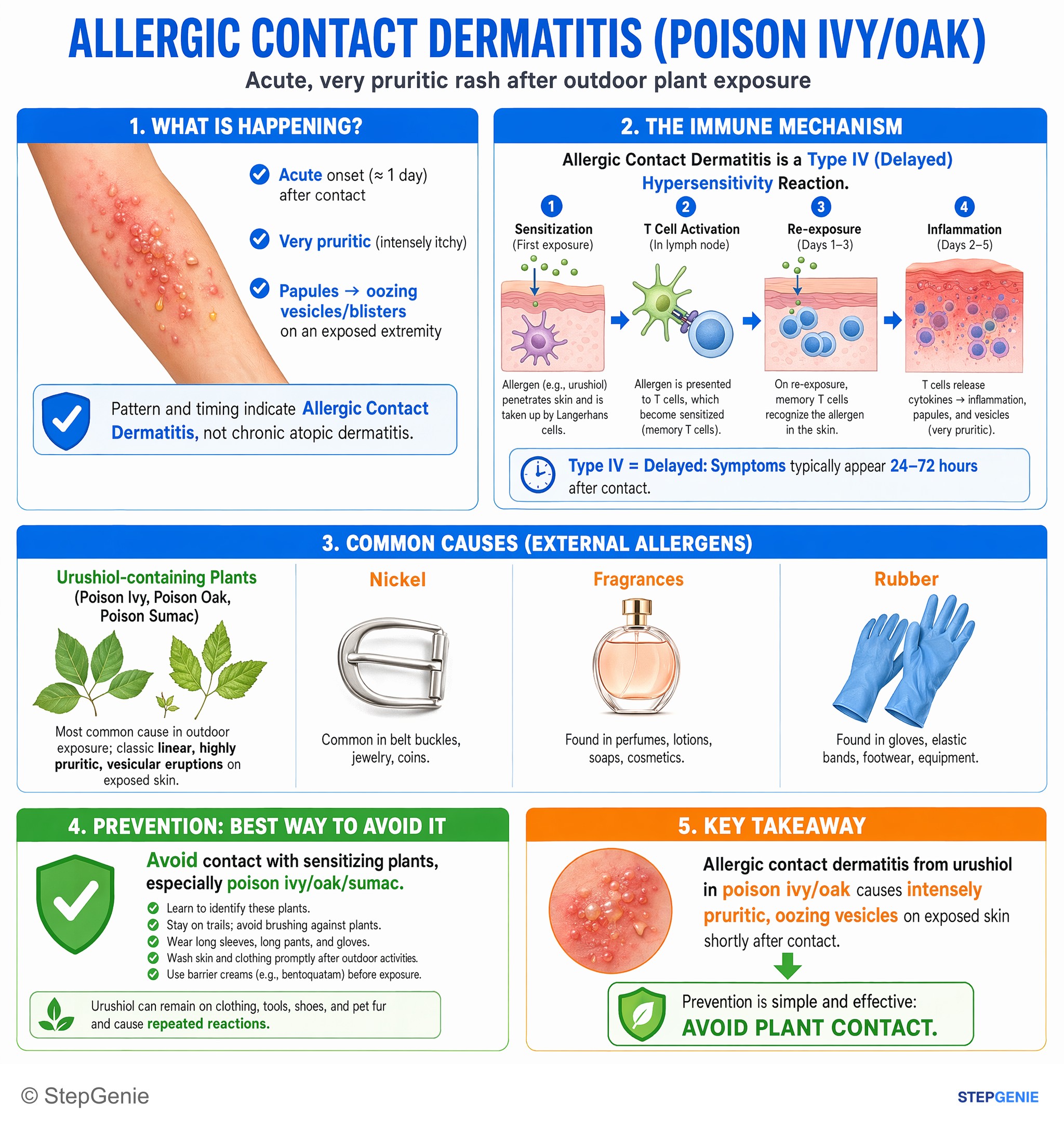
Allergic contact dermatitis from urushiol in poison ivy/oak causes intensely pruritic, oozing vesicles; prevention is by avoiding plant…
USMLE Step 1Frequently Asked Questions
What is the difference between allergic and irritant contact dermatitis?
Irritant contact dermatitis is direct, non-immune damage to the skin from soaps, detergents, solvents or chronic moisture; it can happen to anyone, burns or stings more than it itches when acute, and causes up to 80% of occupational dermatitis. Allergic contact dermatitis is a type IV, T-cell-mediated hypersensitivity reaction that occurs only in people previously sensitized to an allergen such as nickel or poison ivy. It is intensely itchy, appears 24 to 72 hours after exposure, and is confirmed with patch testing.
Why is allergic contact dermatitis a type IV hypersensitivity reaction?
Because it is caused by sensitized T cells, not antibodies. During sensitization, a small molecule called a hapten, such as nickel or urushiol, penetrates the skin, is captured by Langerhans cells and carried to lymph nodes, where specific T cells expand. On re-exposure, those T cells return to the skin and cause damage through cytotoxic CD8+ cells and cytokines that recruit macrophages and other inflammatory cells. Building that response takes time, so the rash is delayed by 1 to 3 days.
How long after exposure does allergic contact dermatitis appear?
Lesions usually appear 24 to 72 hours after contact and peak at about 72 to 96 hours, according to StatPearls; Merck describes the rash as taking at least a day to become noticeable and 2 to 3 days to worsen. Irritant reactions are faster, peaking within minutes to a few hours. Sensitization itself can take as little as 6 to 10 days for strong sensitizers such as poison ivy, or years for weak ones.
How is patch testing done and when is it read?
Small amounts of standard allergens are applied under occlusion to the skin of the back and left for 48 hours, then removed. The sites are read at 48 hours and again at 72 or 96 hours for redness, swelling and vesicles, using International Contact Dermatitis Research Group grading. Some allergens, such as neomycin, can react late, around 4 to 5 days. Patch testing detects type IV allergy; skin prick tests detect IgE-mediated type I allergy instead.
How is poison ivy dermatitis treated?
Wash the skin promptly with soap and water or rubbing alcohol, and wash clothing, tools and pet fur that carry the oil. Mild rashes respond to cool compresses, calamine or topical corticosteroids, with oral antihistamines for itch; antihistamine creams should not be applied to the skin. Extensive or severe disease needs oral prednisone for long enough to prevent rebound: Merck describes 7 to 14 days, AAFP reviews favor about 2 weeks and a 2 to 3 week taper in severe cases, and a short dose pack is too brief. The rash itself is not contagious.
How do you tell contact dermatitis from atopic dermatitis?
Allergic contact dermatitis follows the shape of an exposure, such as streaks from poison ivy, an outline under a watch or a periumbilical patch from a belt buckle, and it appears after contact with a specific allergen at any age. Atopic dermatitis usually begins in infancy, involves the face and extensor surfaces in infants and the flexures in older children and adults, and reflects a barrier defect with Th2-driven inflammation and a history of atopy. Patients with atopic dermatitis are also more prone to both allergic and irritant contact dermatitis.