Von Willebrand disease (VWD) is the most common inherited bleeding disorder: too little von Willebrand factor (VWF), or VWF that does not work. VWF glues platelets to injured vessel walls (by binding collagen and platelet glycoprotein Ib) and carries and protects factor VIII. The result is mucocutaneous bleeding (nosebleeds, easy bruising, heavy periods, bleeding after dental work) with a normal platelet count, a normal PT and a normal or mildly prolonged PTT. Type 1 (partial deficiency, autosomal dominant) is by far the most common; type 2 (2A, 2B, 2M, 2N) is qualitative; type 3 (virtually no VWF, autosomal recessive) is severe. Diagnosis rests on VWF antigen, VWF activity and factor VIII. Desmopressin treats most type 1 bleeding; type 3, most type 2 disease and major surgery need VWF-containing concentrates or recombinant VWF, often with tranexamic acid.
What VWF does, and why VWD bleeds the way it does
VWF is made by endothelial cells and stored in their Weibel-Palade bodies; its long multimers anchor to exposed subendothelial collagen.
- Job 1, platelet adhesion: VWF tethers platelets to the injured wall through the platelet glycoprotein Ib-IX receptor; platelets then aggregate through GPIIb/IIIa and fibrinogen (see the platelet plug mnemonic). No VWF, no adhesion: skin and mucosal bleeding.
- Job 2, factor VIII carrier: factor VIII circulates bound to VWF. Low VWF brings low factor VIII, so the PTT may be prolonged; in type 3 and type 2N, factor VIII can fall low enough to mimic hemophilia.
- VWF levels move: VWF is an acute-phase reactant that rises with bleeding, trauma, pregnancy and inflammation, and it runs lower in blood group O (as low as 40% of normal in healthy type O people, per Merck).
- How common: up to 1% of people in the US (CDC), but clinically significant disease affects only about 125 per million (StatPearls).
Types of VWD: not enough, doesn't work, none at all
| Type | Defect | Inheritance | Key lab pattern | Desmopressin |
|---|---|---|---|---|
| 1 | Partial quantitative deficiency; about 85% of treated patients (CDC) | Autosomal dominant, incomplete penetrance | VWF antigen, VWF activity and factor VIII reduced in proportion | Usually effective; trial first if VWF is below 0.30 IU/mL |
| 2A | Less platelet binding; loss of high-molecular-weight (HMW) multimers | Usually autosomal dominant (some recessive) | Activity-to-antigen ratio below 0.7; HMW multimers missing | Variable, short-lived |
| 2B | Gain of function: VWF binds platelet GPIb too avidly, so HMW multimers and platelets are cleared | Autosomal dominant | Low ratio; HMW multimers lost; often thrombocytopenia; exaggerated ristocetin-induced aggregation | Avoid: can worsen thrombocytopenia |
| 2M | Reduced binding to platelets or collagen; multimers normal | Autosomal dominant | Low ratio with normal multimers | Poor |
| 2N | Reduced binding to factor VIII | Autosomal recessive | Low factor VIII with near-normal VWF; mistaken for hemophilia A | Poor |
| 3 | Virtual absence of VWF; about 3% of patients (CDC) | Autosomal recessive | Undetectable VWF, very low factor VIII | Ineffective |
Presentation: platelet-type bleeding
- Easy bruising, gum bleeding and nosebleeds (CDC flags frequent nosebleeds lasting more than 10 minutes); small cuts ooze on and off for hours (Merck).
- Heavy menstrual bleeding, often from menarche: soaking a pad or tampon every 1-2 hours, or periods longer than 7 days (CDC), a common route to iron deficiency anemia.
- Bleeding after dental extraction, tonsillectomy, surgery or delivery.
- Petechiae, purpura and joint bleeds are rare (Merck): superficial bleeding points to platelets or VWF, deep bleeding (hemarthroses, muscle hematomas) to a factor defect. Type 3 adds spontaneous hematomas and can bleed like hemophilia because factor VIII is very low too.
Labs: what stays normal and what does not
| Test | Result in VWD | Why |
|---|---|---|
| Platelet count | Normal (can be low in type 2B) | The defect is VWF, not platelet number |
| PT/INR | Normal | Extrinsic pathway intact |
| PTT | Normal or mildly prolonged | Factor VIII falls when its carrier is low |
| Bleeding time / PFA-100 | Prolonged in classic exam tables | Not diagnostic; bleeding time is unreliable and no longer done (Merck) |
| VWF antigen (VWF:Ag) | Low in types 1 and 3; can be near normal in type 2 | Measures the amount |
| VWF activity (VWF:RCo or VWF:GPIbM) | Low; disproportionately low in 2A, 2B and 2M | Measures platelet-binding function |
| Factor VIII activity | Normal or low; low in 2N, very low in type 3 | VWF carries factor VIII |
- Confirm with the triad: VWF antigen, a platelet-dependent VWF activity assay and factor VIII. The 2021 ASH/ISTH/NHF/WFH guideline prefers the newer GPIb-binding assays (VWF:GPIbM, VWF:GPIbR) over the classic ristocetin cofactor assay because they are more reproducible.
- What ristocetin does: it makes VWF bind platelet GPIb in the test tube. The cofactor assay adds the patient's plasma to normal platelets (low activity = low or dysfunctional VWF); ristocetin-induced platelet aggregation (RIPA) uses the patient's own platelets: usually reduced in VWD, exaggerated even at low ristocetin doses in type 2B, absent in Bernard-Soulier syndrome.
- 2021 thresholds: VWF below 0.30 IU/mL confirms type 1 regardless of bleeding, or below 0.50 IU/mL with abnormal bleeding. ABO-specific reference ranges are not required. Test at baseline health: pregnancy, inflammation, bleeding and trauma raise VWF and can mask type 1, so repeat borderline results.
- Typing: an activity-to-antigen ratio below 0.7 suggests 2A, 2B or 2M (sorted by multimer analysis or collagen binding); the guideline prefers genetic testing over low-dose RIPA for 2B, and a factor VIII-binding assay or genetic testing for 2N.
- Normal screening tests do not exclude VWD when bleeding symptoms and family history fit (Merck).
Treatment
Most patients are treated only for bleeding or before procedures (Merck); the table follows the 2021 ASH/ISTH/NHF/WFH management guideline.
| Situation | Treatment |
|---|---|
| Type 1, minor bleeding | Desmopressin IV (0.3 mcg/kg over 15-30 minutes, Merck) or intranasal |
| Minor procedures | Raise VWF activity to ≥0.50 IU/mL (desmopressin or concentrate) plus tranexamic acid; tranexamic acid alone for minor mucosal procedures in mild type 1 with baseline VWF activity above 0.30 IU/mL |
| Heavy menstrual bleeding | Hormonal therapy (combined hormonal contraception or levonorgestrel IUD) or tranexamic acid rather than desmopressin; tranexamic acid if trying to conceive |
| Type 3, most type 2, serious bleeding, desmopressin failure | VWF replacement: plasma-derived VWF-containing concentrate or recombinant VWF; long-term prophylaxis for severe, frequent bleeds |
| Major surgery | Factor VIII and VWF activity ≥0.50 IU/mL for at least 3 days |
| Neuraxial anesthesia in labor | VWF activity 0.50-1.50 IU/mL |
| After delivery | Tranexamic acid (type 1 or low VWF) |
- Desmopressin (DDAVP), a vasopressin analog, releases stored VWF and factor VIII from endothelial cells. It works in most type 1, is useless in type 3 and should not be used in type 2B (it can induce platelet aggregation and worsen thrombocytopenia). Repeat doses work less well (tachyphylaxis), and it can cause hyponatremia, so fluids are restricted; the label contraindicates it with current or past hyponatremia or a creatinine clearance below 50 mL/min. It also treats central diabetes insipidus.
- VWF concentrates: virally inactivated plasma-derived products are preferred over cryoprecipitate; high-purity factor VIII concentrates contain no VWF and should not be used (Merck).
- Recombinant VWF (Vonvendi) treats bleeds and covers surgery in adults and children, and is used for routine prophylaxis in adults. It contains no factor VIII, so for a bleed the first dose is given with recombinant factor VIII if baseline factor VIII is below 40% or unknown.
- Antifibrinolytics (tranexamic acid, aminocaproic acid) reduce fibrinolysis of formed clots.
Acquired von Willebrand syndrome
Suspect it when bleeding starts later in life with no family history.
- Aortic stenosis: shear stress across the narrowed valve degrades VWF multimers, and the coagulopathy can make angiodysplasia bleed: Heyde syndrome (see the aortic stenosis breakdown). Ventricular assist devices and mechanical valves are other high-shear causes (StatPearls).
- Other causes (Merck): lymphoproliferative and myeloproliferative disorders, particularly essential thrombocythemia, and autoimmune disorders.
VWD vs hemophilia A vs Bernard-Soulier vs Glanzmann
| Feature | VWD (type 1) | Hemophilia A | Bernard-Soulier syndrome | Glanzmann thrombasthenia |
|---|---|---|---|---|
| Defect | Low or abnormal VWF | Factor VIII deficiency | Missing GPIb-IX (the VWF receptor) | Missing GPIIb/IIIa (the fibrinogen receptor) |
| Inheritance | Autosomal dominant (2N and 3 recessive) | X-linked recessive | Autosomal recessive | Autosomal recessive |
| Bleeding | Mucocutaneous | Deep: hemarthroses, muscle hematomas | Mucocutaneous | Mucocutaneous |
| Platelets | Normal | Normal | Low count, giant platelets | Normal count |
| PT / PTT | Normal / normal or prolonged | Normal / prolonged | Normal / normal | Normal / normal |
| Ristocetin aggregation | Reduced (exaggerated in 2B) | Normal | Absent | Present (transient) |
| ADP, collagen, epinephrine | Normal | Normal | Normal | No aggregation |
| Serious bleeding | Desmopressin or VWF concentrate | Factor VIII | Platelet transfusion | Platelet transfusion |
Compare clotting patterns in the PT/INR vs PTT guide and the hemophilia A vs B mnemonic.
How USMLE tests VWD
- Mucosal bleeding + heavy periods + normal platelets and PT + normal or mildly long PTT = VWD until proven otherwise.
- A long PTT is not automatically hemophilia: a female patient, a dominant family history and no hemarthroses favor VWD; low factor VIII with near-normal VWF and recessive inheritance suggests type 2N.
- VWD with thrombocytopenia that worsens after desmopressin = type 2B.
Practice question
A 16-year-old girl is evaluated for heavy menstrual periods since menarche at age 12; on her heaviest days she changes pads every 1-2 hours. She has nosebleeds lasting more than 10 minutes several times a year and bled for 2 days after a wisdom tooth extraction. Her father has frequent nosebleeds and bled heavily after dental surgery. She has never had joint swelling. She has a few shin bruises and no petechiae. Hemoglobin is 10.9 g/dL with a low ferritin, the platelet count is 260,000/mm³ with normal-sized platelets on the smear, the PT is normal and the PTT is mildly prolonged.
Which of the following is the most likely cause of her bleeding?
A. Partial deficiency of von Willebrand factor
B. Factor VIII deficiency from an F8 gene mutation
C. Absent platelet glycoprotein Ib-IX
D. Absent platelet glycoprotein IIb/IIIa
E. Autoantibodies against platelet glycoproteins
F. Vitamin K deficiency
Answer: A. Lifelong mucocutaneous bleeding, an affected father (dominant inheritance), normal platelets, a normal PT and a mildly prolonged PTT (factor VIII lowered with its carrier) is type 1 VWD.
- B: hemophilia A is X-linked recessive and causes hemarthroses and deep muscle bleeds, with normal VWF. A daughter of an affected man would be a carrier, and carriers can bleed, but lifelong mucosal bleeding in both her and her father, without joint bleeds, points to dominant VWD.
- C: Bernard-Soulier syndrome (recessive) causes thrombocytopenia with giant platelets; her count and platelet size are normal.
- D: Glanzmann thrombasthenia (recessive) blocks aggregation to ADP, collagen and epinephrine, with a normal PTT.
- E: immune thrombocytopenia lowers the platelet count and causes petechiae; it is acquired, not a lifelong family trait.
- F: vitamin K deficiency prolongs the PT and is not a lifelong family trait.
What next? Order VWF antigen, VWF activity and factor VIII at baseline health; for her periods the guideline suggests hormonal therapy or tranexamic acid over desmopressin, plus iron.
Key takeaways
- VWD is the most common inherited bleeding disorder: mucocutaneous bleeding, normal platelets and PT, normal or mildly prolonged PTT. VWF glues platelets (via GPIb) and carries factor VIII.
- Type 1 partial (dominant, most common); type 2 dysfunctional (mostly dominant; 2N recessive); type 3 absent (recessive, severe).
- Diagnose with VWF antigen, VWF activity and factor VIII: VWF below 0.30 IU/mL, or below 0.50 IU/mL with abnormal bleeding, confirms type 1; a ratio below 0.7 suggests type 2.
- Desmopressin for type 1 (avoid in 2B, useless in type 3, watch sodium); VWF concentrate or recombinant VWF for type 3, most type 2 and major surgery; tranexamic acid for mucosal bleeding.
- Aortic stenosis + GI bleeding = Heyde syndrome (acquired VWD).
Sources
- Von Willebrand Disease — Merck Manual Professional Edition (2026)
- ASH ISTH NHF WFH 2021 guidelines on the diagnosis of von Willebrand disease — Blood Advances (2021)
- ASH ISTH NHF WFH 2021 guidelines on the management of von Willebrand disease: executive summary — American Society of Hematology (2023)
- About von Willebrand Disease — Centers for Disease Control and Prevention (2024)
- Von Willebrand Disease — StatPearls, NCBI Bookshelf (2023)
- VONVENDI (von Willebrand factor, recombinant) prescribing information — DailyMed (2026)
- Desmopressin acetate injection prescribing information — DailyMed (2019)
- Inherited Platelet Function Disorders — Merck Manual Professional Edition (2026)
- Hemophilia — Merck Manual Professional Edition (2025)
- Excessive Bleeding — Merck Manual Professional Edition (2025)
- Overview of Hemostasis — Merck Manual Professional Edition (2025)
- Aortic Stenosis — Merck Manual Professional Edition (2025)
Visual explanations from the StepGenie QBank
Infographics StepGenie drew to explain questions in its own QBank, matched to this article's topic. Each caption is the takeaway of the question it explains.
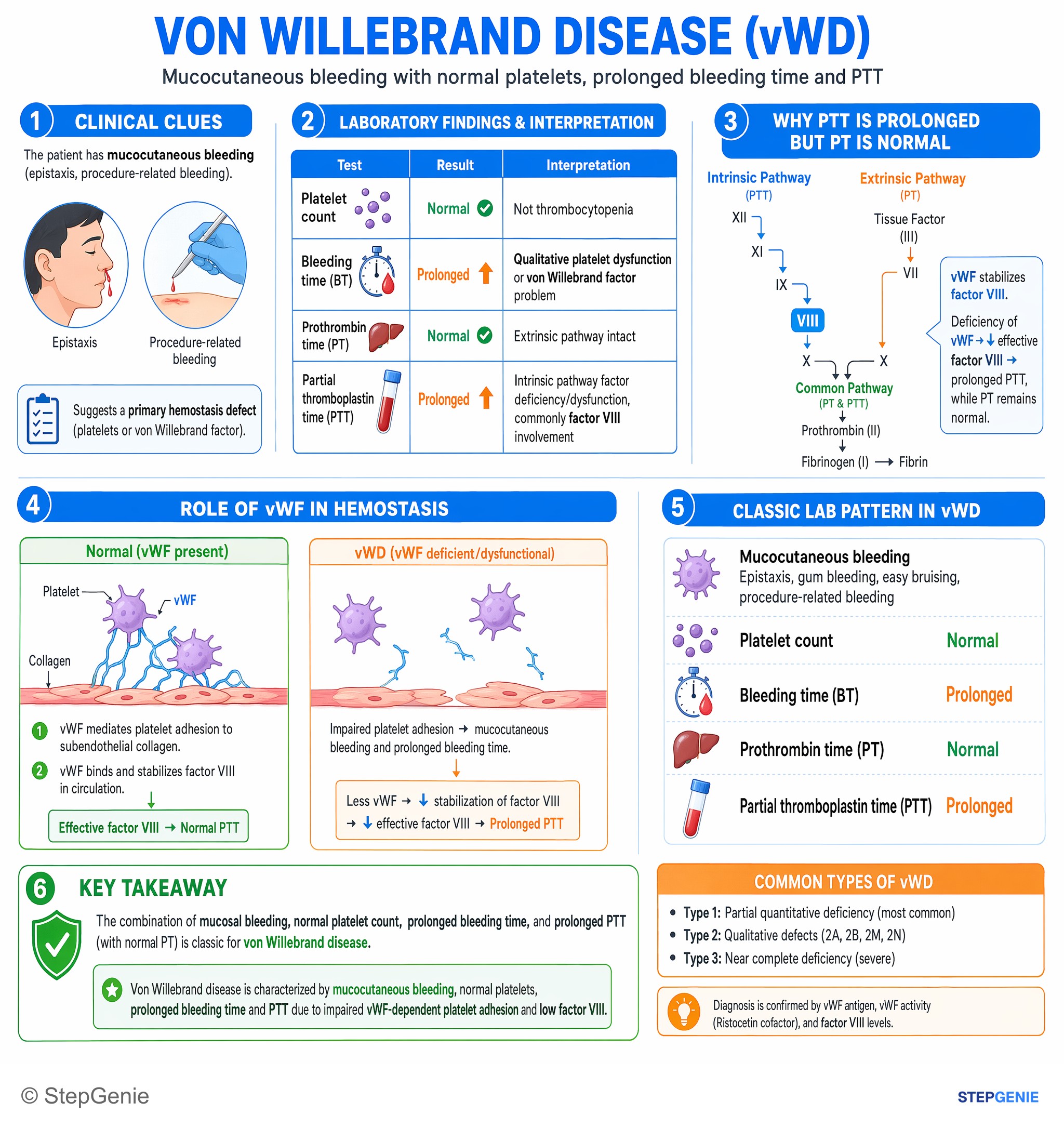
Von Willebrand disease: mucocutaneous bleeding, normal platelets, prolonged bleeding time and PTT due to impaired vWF-dependent platelet…
USMLE Step 1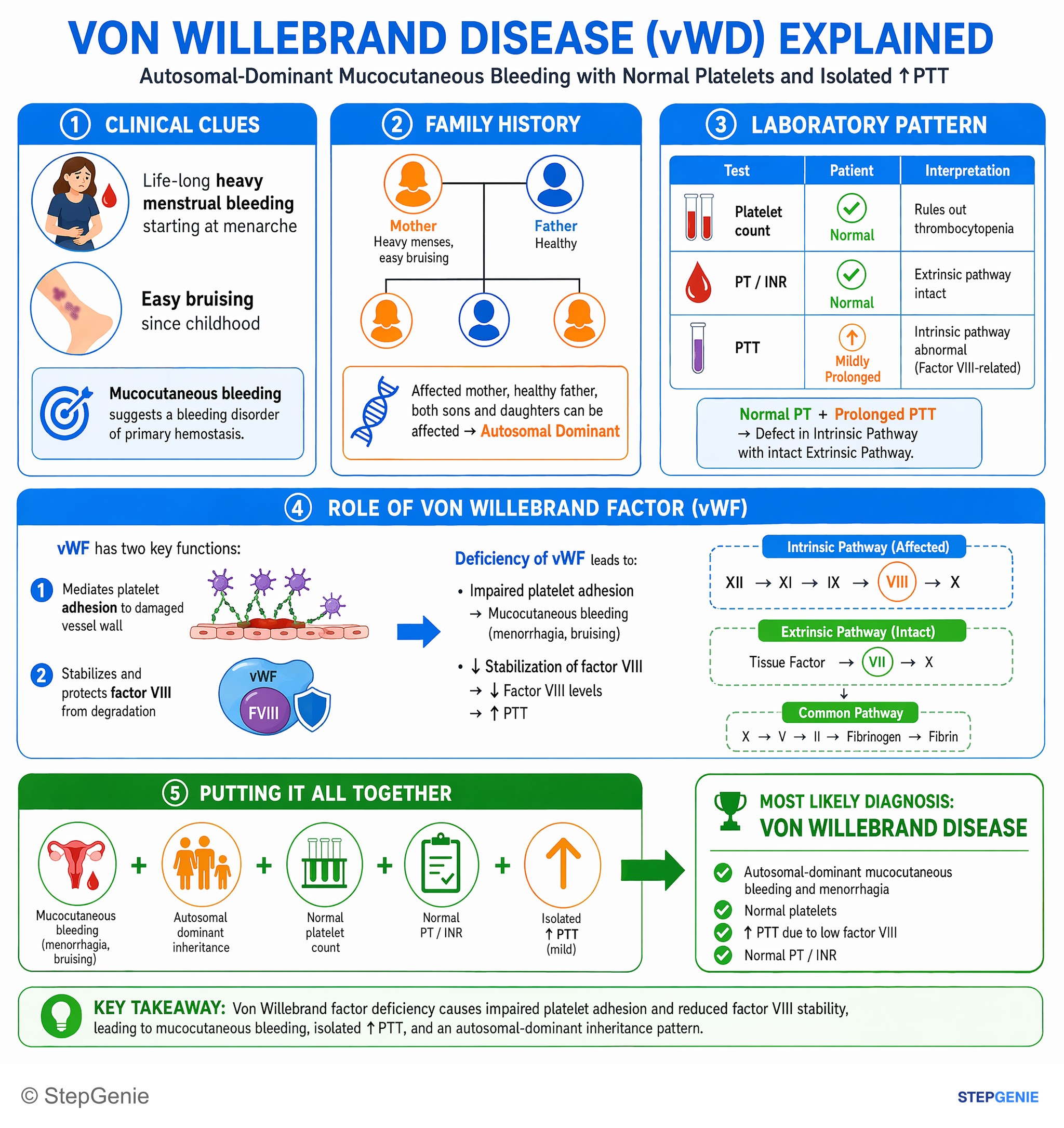
Von Willebrand disease causes autosomal-dominant mucocutaneous bleeding and menorrhagia with normal platelets, ↑PTT from low factor VIII…
USMLE Step 1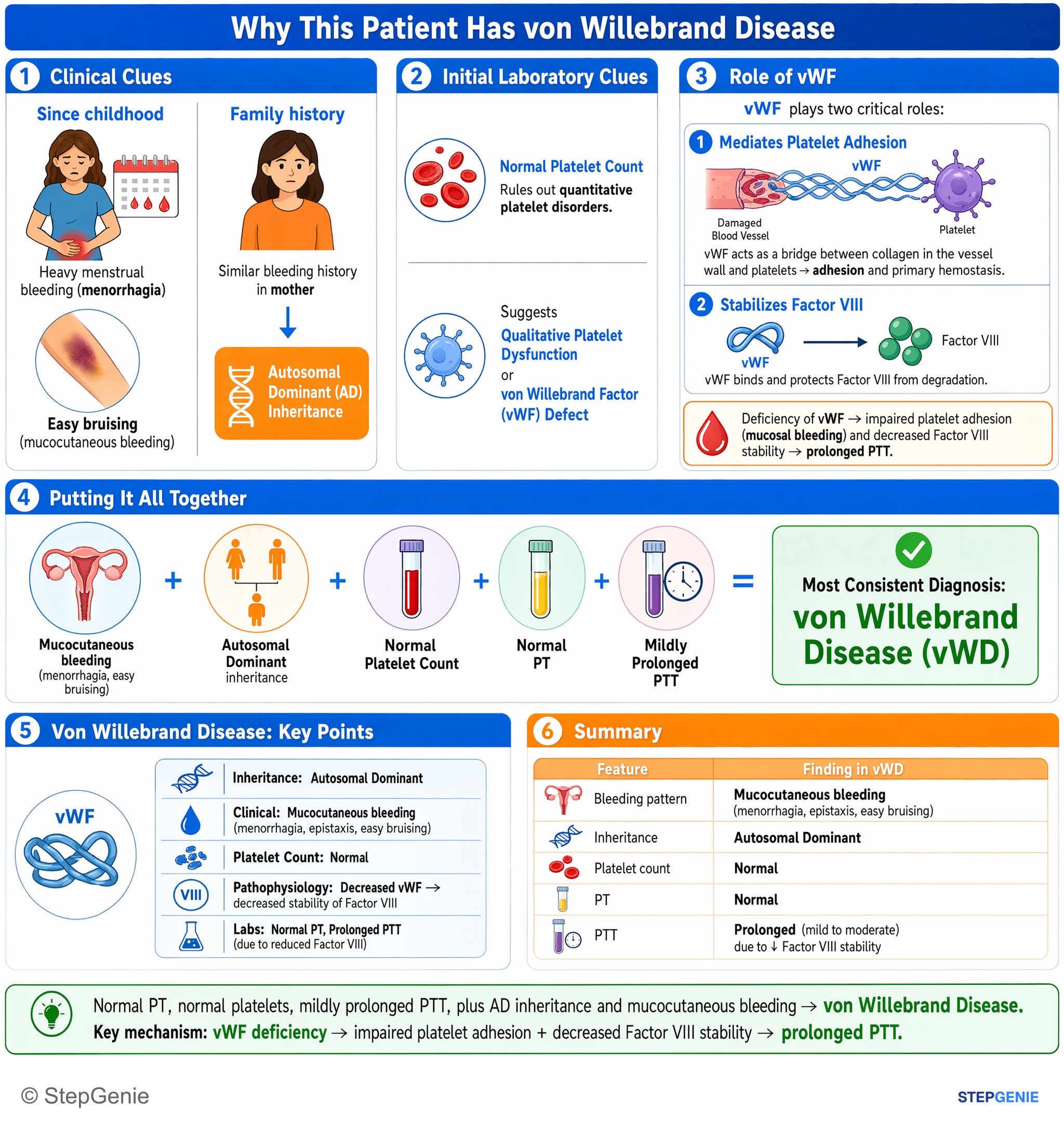
Von Willebrand disease: autosomal dominant, mucocutaneous bleeding, menorrhagia, normal platelets, prolonged PTT from decreased factor…
USMLE Step 1Frequently Asked Questions
What is von Willebrand disease?
Von Willebrand disease is the most common inherited bleeding disorder. It is caused by a deficiency or dysfunction of von Willebrand factor (VWF), a protein that helps platelets stick to injured blood vessels by binding platelet glycoprotein Ib and that also carries and protects factor VIII. People typically have mucocutaneous bleeding: easy bruising, nosebleeds, heavy menstrual periods and prolonged bleeding after dental work or surgery. The platelet count and PT are normal, and the PTT is normal or mildly prolonged.
What are the types of von Willebrand disease?
Type 1 is a partial quantitative deficiency of VWF; it is autosomal dominant and the most common type. Type 2 is a qualitative defect with four subtypes: 2A (loss of large multimers), 2B (gain of function with thrombocytopenia), 2M (reduced platelet or collagen binding with normal multimers) and 2N (reduced binding to factor VIII, mimicking hemophilia A and inherited recessively). Type 3 is a virtual absence of VWF with very low factor VIII; it is autosomal recessive and severe.
What lab results are typical of von Willebrand disease?
Screening shows a normal platelet count (it can be low in type 2B), a normal PT and a normal or mildly prolonged PTT, because factor VIII falls when its carrier VWF is low. Diagnosis needs VWF antigen, a VWF activity assay such as ristocetin cofactor or a GPIb-binding assay, and factor VIII activity. Under the 2021 ASH/ISTH/NHF/WFH guideline, a VWF level below 0.30 IU/mL, or below 0.50 IU/mL with abnormal bleeding, confirms type 1, and an activity-to-antigen ratio below 0.7 suggests type 2.
What is the ristocetin test in von Willebrand disease?
Ristocetin makes von Willebrand factor bind platelet glycoprotein Ib in the test tube. In the ristocetin cofactor assay the patient's plasma supplies the VWF, so low activity means low or dysfunctional VWF. Ristocetin-induced platelet aggregation uses the patient's own platelets: it is usually reduced in von Willebrand disease, exaggerated even at low ristocetin doses in type 2B and absent in Bernard-Soulier syndrome. The 2021 ASH/ISTH/NHF/WFH guideline suggests newer GPIb-binding assays over the ristocetin cofactor assay because they are more reproducible.
How does desmopressin treat von Willebrand disease, and when should it be avoided?
Desmopressin (DDAVP) is a vasopressin analog that releases stored VWF and factor VIII from endothelial cells, so it works for most people with type 1 disease, given IV or intranasally before minor procedures or for bleeding. Patients with VWF below 0.30 IU/mL should have a desmopressin trial first. It does not work in type 3, is often inadequate in type 2, and should be avoided in type 2B because it can worsen thrombocytopenia. Repeated doses lose effect, and it can cause hyponatremia.
How do you tell von Willebrand disease from hemophilia A?
Von Willebrand disease is usually autosomal dominant, affects both sexes and causes mucocutaneous bleeding such as nosebleeds and heavy periods, with low VWF levels. Hemophilia A is X-linked recessive, mainly affects males and causes deep bleeding into joints and muscles, with low factor VIII but normal VWF. Both can prolong the PTT with a normal PT. Type 2N von Willebrand disease is the classic trap: low factor VIII from poor VWF binding can be mistaken for hemophilia A.