Hemophilia A is factor VIII deficiency and hemophilia B (Christmas disease) is factor IX deficiency. The mnemonic: A "ate" eight; B is Christmas, and Christmas has nine reindeer. Both are X-linked recessive, cause deep bleeding into joints and muscles, and give an isolated prolonged aPTT with a normal PT and platelet count that corrects on a mixing study, so only factor VIII and IX assays tell them apart. Hemophilia A makes up 80–85% of cases, responds to desmopressin when mild, develops inhibitors more often, and is the only one treated with emicizumab.
The mnemonic: A ate eight, B is Christmas
- A = "ate" = eight → factor VIII. The alphabet and the factor numbers run in the same order: A before B, VIII before IX.
- B = Christmas disease → nine → factor IX. Hemophilia B is named after Stephen Christmas, the first person diagnosed with it, in 1952. Picture Santa's sleigh: eight reindeer plus Rudolph makes nine.
- C breaks the pattern. "Hemophilia C" is factor XI deficiency: autosomal (usually recessive) rather than X-linked, much more common in Ashkenazi Jewish people, with bleeding mainly after surgery or injury, especially in the mouth, nose and urinary tract. Spontaneous bleeding is uncommon, and bleeding risk does not track the factor level well.
What hemophilia A and B share
- X-linked recessive inheritance. Affected males inherit it through carrier mothers, but about 30% of boys with hemophilia A have no family history. About 30% of female carriers have factor activity below 40% and can bleed like males with mild disease.
- Deep bleeding. Hemarthroses (knees, elbows and ankles are the joints most often hit), muscle hematomas, and prolonged bleeding after circumcision, tooth extraction, surgery or trauma. Intracranial hemorrhage is the leading bleeding-related cause of death, and chronic joint damage (hemophilic arthropathy) is the main cause of disability.
- Severity is set by factor activity:
| Severity | Factor VIII or IX activity | Typical bleeding |
|---|---|---|
| Severe | Below 1% | Spontaneous joint and muscle bleeds; usually diagnosed as a newborn or in the first year of life |
| Moderate | 1–5% | Bleeding after minor trauma; occasional spontaneous bleeds |
| Mild | Above 5% to below 40% | Abnormal bleeding mainly with surgery, tooth extraction or major trauma |
Hemophilia A vs B vs von Willebrand disease
| Feature | Hemophilia A | Hemophilia B | von Willebrand disease |
|---|---|---|---|
| Missing protein | Factor VIII | Factor IX | von Willebrand factor, which also carries factor VIII |
| Inheritance | X-linked recessive | X-linked recessive | Autosomal dominant (types 1 and 2); recessive (type 3) |
| How common | 80–85% of hemophilia; about 1 in 5,000 male births | About one-fifth as common as A | About 1% of people |
| Bleeding pattern | Deep: joints, muscles | Deep: joints, muscles | Mucocutaneous: nose, gums, heavy menses, bruising |
| aPTT / PT / platelets | Long / normal / normal | Long / normal / normal | Normal or long / normal / normal |
| Desmopressin | Works in mild disease after a test dose | Doesn't work | Works in type 1 |
| Main treatment | Factor VIII; emicizumab prophylaxis | Factor IX; gene therapy | Desmopressin (type 1), vWF replacement (type 3), tranexamic acid |
| Inhibitors | About 30% of severe cases | About 3–10% of severe cases; linked to anaphylaxis and nephrotic syndrome | — |
For the mucocutaneous side of the comparison, see von Willebrand disease.
Labs: the isolated long aPTT, step by step
- Screen. The aPTT is prolonged; the PT, platelet count and bleeding time are normal. Factors VIII and IX belong to the intrinsic pathway, which the aPTT measures, while the PT depends on factor VII, which is intact. For the full PT vs aPTT logic, see PT/INR vs PTT.
- Mix patient plasma 1:1 with normal plasma. A factor deficiency corrects immediately and after incubation. An inhibitor does not correct. A factor VIII inhibitor may correct at first and then prolong after 1–2 hours of incubation, so an immediate mix alone can miss it.
- Assay factors VIII, IX and XI to name the deficiency, and test von Willebrand factor when the bleeding is mucocutaneous.
- Remember the long aPTTs that don't bleed: lupus anticoagulant fails to correct on mixing but causes thrombosis, and factor XII deficiency causes neither bleeding nor clotting. Heparin also prolongs the aPTT.
Treatment: what to give for A vs B
- Hemophilia A: factor VIII concentrate to treat bleeds, and as prophylaxis in severe disease. Desmopressin releases von Willebrand factor from endothelial cells, and a single IV dose often doubles or triples factor VIII activity, so it is reserved for mild (occasionally moderate) hemophilia A with a documented response to a test dose. Emicizumab is a subcutaneous bispecific antibody that bridges activated factor IX and factor X, standing in for activated factor VIII. It is approved as prophylaxis for hemophilia A with or without inhibitors, dosed weekly to every 4 weeks, and it falsely shortens aPTT-based tests.
- Hemophilia B: factor IX concentrate. Desmopressin does not work, and emicizumab is a hemophilia A drug. An AAV5 gene therapy (etranacogene dezaparvovec) was FDA-approved in 2022.
- Both: tranexamic acid for mucosal and dental bleeding (not joint or muscle bleeds); avoid aspirin, NSAIDs and intramuscular injections; don't circumcise an infant boy with a family history until hemophilia is excluded or covered with factor.
- Inhibitors: bypassing agents (recombinant factor VIIa or activated prothrombin complex concentrate) for bleeds, and immune tolerance induction, which clears inhibitors in about 70% of patients with hemophilia A. Emicizumab carries a boxed warning for thrombotic microangiopathy and thrombosis when given with more than 100 U/kg of activated prothrombin complex concentrate in 24 hours.
Acquired hemophilia A: the adult look-alike
An older adult or a postpartum woman with no bleeding history who suddenly develops extensive bruising and soft-tissue bleeding, with an isolated long aPTT that does not correct on mixing, has autoantibodies against factor VIII. About half of cases have no identifiable trigger; the rest follow pregnancy or occur with autoimmune disease or cancer. Unlike congenital hemophilia, hemarthrosis is uncommon. Bleeding is treated with bypassing agents, and the antibody with prednisone, with or without cyclophosphamide, or rituximab.
Exam traps
- Joint bleeds point to a factor problem; nosebleeds, gum bleeding and heavy menses point to platelets or von Willebrand factor.
- Desmopressin for hemophilia B is always the wrong answer.
- A mixing study that fails to correct means an inhibitor: acquired hemophilia A if the patient bleeds, lupus anticoagulant if the patient clots.
- A girl or woman can bleed from hemophilia: about 30% of carriers have factor levels below 40%.
- Emicizumab shortens the aPTT, so a normal aPTT on emicizumab does not reflect true hemostasis.
- Hemophilia C (factor XI) is autosomal and seen more in Ashkenazi Jewish patients; it is not "the next X-linked one."
Worked example
Vignette. A 2-year-old boy has a swollen, warm right knee after a minor fall. His maternal uncle bled heavily after surgery. The aPTT is prolonged, the PT and platelet count are normal, and the aPTT corrects when mixed with normal plasma. Factor VIII activity is normal; factor IX activity is 0.5%. What is the most appropriate treatment for this bleed?
Answer: Factor IX concentrate.
Reasoning: A correcting isolated aPTT with factor IX activity below 1% is severe hemophilia B. Desmopressin raises only von Willebrand factor and factor VIII, and emicizumab is a hemophilia A therapy, so neither helps here.
Key takeaways
- A ate eight (VIII); B is Christmas, nine reindeer (IX); C is factor XI and autosomal.
- Hemophilia A and B: X-linked recessive, deep bleeding, isolated long aPTT that corrects on mixing; factor assays separate them.
- Severity: below 1% severe, 1–5% moderate, above 5% to below 40% mild.
- Desmopressin and emicizumab are hemophilia A tools; hemophilia B needs factor IX.
- Inhibitors are far more common in hemophilia A (about 30% of severe cases); a non-correcting mix in an older or postpartum patient means acquired hemophilia A.
Sources
Visual explanations from the StepGenie QBank
Infographics StepGenie drew to explain questions in its own QBank, matched to this article's topic. Each caption is the takeaway of the question it explains.
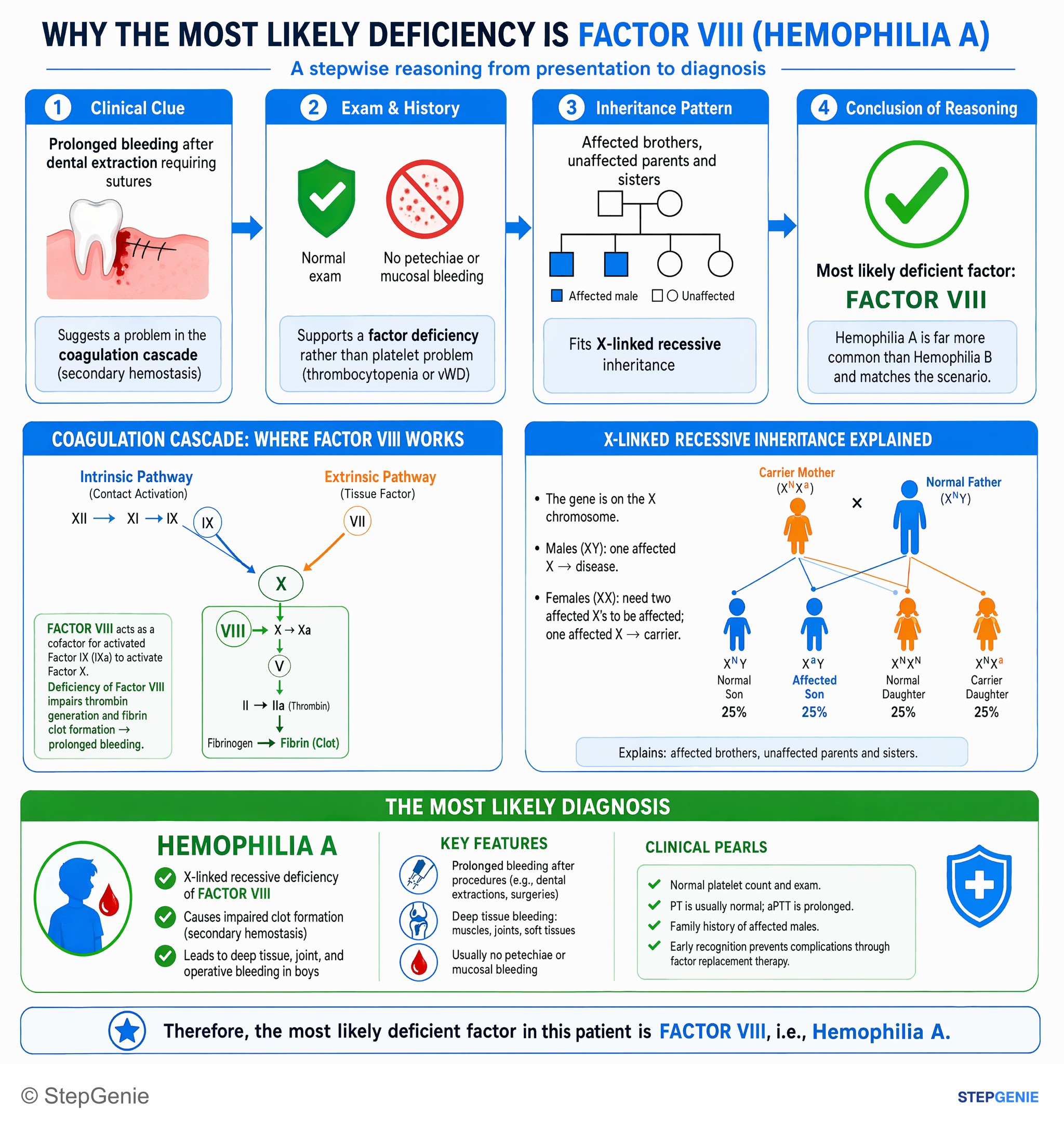
Hemophilia A is an X-linked recessive deficiency of factor VIII, causing deep tissue/operative bleeding in boys with affected male…
USMLE Step 1Frequently Asked Questions
What is the difference between hemophilia A and B?
Hemophilia A is a deficiency of factor VIII, and hemophilia B, also called Christmas disease, is a deficiency of factor IX. Both are X-linked recessive, cause joint and muscle bleeding, and show an isolated prolonged aPTT that corrects on mixing, so factor assays are needed to tell them apart. Hemophilia A accounts for 80 to 85% of cases, and only hemophilia A responds to desmopressin and emicizumab.
Why is hemophilia B called Christmas disease?
Hemophilia B is named after Stephen Christmas, the first person diagnosed with factor IX deficiency, in 1952. A handy memory link is that Christmas brings nine reindeer, eight plus Rudolph, for factor IX. Hemophilia A, by contrast, is factor VIII deficiency.
Why does desmopressin work for hemophilia A but not B?
Desmopressin releases von Willebrand factor, the carrier that keeps factor VIII in circulation, from endothelial cells, and a single dose often doubles or triples factor VIII activity. That is usually enough only in mild (occasionally moderate) hemophilia A with a documented response to a test dose. It does not raise factor IX, so it has no role in hemophilia B.
Does the aPTT correct on a mixing study in hemophilia?
Yes. In hemophilia A or B the prolonged aPTT corrects when patient plasma is mixed 1:1 with normal plasma, both immediately and after incubation, because the normal plasma supplies the missing factor. Failure to correct suggests an inhibitor, such as a factor VIII autoantibody or a lupus anticoagulant. A factor VIII inhibitor can correct at first and then prolong after 1 to 2 hours of incubation.
Can women have hemophilia?
Yes. About 30% of female carriers of hemophilia A or B have factor activity below 40% and have a bleeding risk similar to males with mild hemophilia, and some carriers with normal levels still report increased bleeding. Each son of a carrier has a 50% chance of being affected.