Platelet plug formation (primary hemostasis) happens in three platelet steps: adhesion, activation and aggregation. In adhesion, strings of von Willebrand factor (vWF) anchored to exposed collagen catch platelets by their glycoprotein Ib (GpIb-IX-V) receptor. In activation, platelets release ADP and make thromboxane A2 (TXA2), and ADP acting on the P2Y12 receptor switches on GpIIb/IIIa. In aggregation, fibrinogen bridges GpIIb/IIIa on neighboring platelets. Add the step before (vasoconstriction) and after (fibrin) and you get the 5 S's: Spasm, Stick, Signal, Stack, Seal, where each S points to its disease (vWD and Bernard-Soulier break Stick, Glanzmann breaks Stack) and its drugs (aspirin and P2Y12 blockers hit Signal, GpIIb/IIIa blockers hit Stack).
The mnemonic: the 5 S's
| S | Step | What happens | Key molecules | Broken by | Blocked by |
|---|---|---|---|---|---|
| Spasm | Vasoconstriction | The injured vessel narrows at once | Endothelins; serotonin keeps it going | — | — |
| Stick | Adhesion | vWF strings on exposed collagen catch platelets | vWF ↔ GpIb-IX-V | von Willebrand disease, Bernard-Soulier syndrome | — |
| Signal | Activation and release | Platelets release ADP from dense granules and make TXA2 | ADP → P2Y12; arachidonic acid → TXA2 via platelet cyclooxygenase | Storage pool disease; aspirin-like defects | Aspirin (COX); clopidogrel, prasugrel, ticagrelor (P2Y12) |
| Stack | Aggregation | Fibrinogen links GpIIb/IIIa on adjacent platelets | GpIIb/IIIa (integrin αIIbβ3) + fibrinogen | Glanzmann thrombasthenia | Eptifibatide, tirofiban (IV) |
| Seal | Stabilization (secondary hemostasis) | Thrombin turns fibrinogen into fibrin that binds the platelets; factor XIIIa cross-links it | Thrombin, fibrin, factor XIIIa | Clotting factor deficiencies (hemophilia) | Anticoagulants |
Receptor hook: "One sticks, two-three stacks." GpIb does the first job (sticking to the wall); GpIIb/IIIa does the later job (stacking platelets on each other). Then pair the diseases: Bernard-Soulier has Big platelets that can't stick (GpIb), while Glanzmann platelets can't glue together (GpIIb/IIIa).
Step by step
- Spasm. The damaged vessel constricts immediately. Endothelins from the vessel lining trigger it, and serotonin released by platelets helps maintain it.
- Stick (adhesion). Long strings of vWF, secreted by endothelial cells and anchored to exposed subendothelial collagen, bind the platelet GpIb-IX-V complex. vWF also carries factor VIII and keeps its plasma level normal.
- Signal (activation and release). Anchored platelets activate and release ADP from their granules. Arachidonic acid is converted to TXA2 by platelet cyclooxygenase, which aspirin inhibits irreversibly and other NSAIDs reversibly. ADP binding to P2Y12 suppresses adenylate cyclase, lowers cAMP and activates GpIIb/IIIa. Activated platelets also expose phosphatidylserine, the surface on which clotting-factor complexes assemble.
- Stack (aggregation). Fibrinogen binds GpIIb/IIIa on adjacent platelets, connecting them into an aggregate; vWF can bind GpIIb/IIIa too.
- Seal. Thrombin converts fibrinogen into fibrin, which binds the aggregated platelets into a platelet-fibrin plug; thrombin-activated factor XIII cross-links the fibrin. The clotting side is laid out in the coagulation cascade tips.
The brakes: healthy endothelium releases prostacyclin (PGI2) and nitric oxide, which prevent platelet aggregation and keep the plug local.
Platelet granules: what gets released
| Granule | Contents to know | Deficiency syndrome |
|---|---|---|
| Dense (δ) | ADP (and ATP), calcium, serotonin; also histamine and polyphosphate | Hermansky-Pudlak syndrome: oculocutaneous albinism plus easy bruising and bleeding (autosomal recessive) |
| Alpha (α) | Fibrinogen, vWF, factor V, platelet factor 4 (PF4); GpIIb/IIIa and P-selectin in the membrane | Gray platelet syndrome: large, gray-looking platelets |
Hook: dense granules carry the "ACS" kit (ADP, Calcium, Serotonin), fitting for the drugs used in acute coronary syndrome.
Disorders of primary hemostasis
| Disorder | Defect | Broken S | Platelet count and size | Aggregation studies | Clue |
|---|---|---|---|---|---|
| Bernard-Soulier syndrome | GpIb-IX-V (usually autosomal recessive) | Stick | Low count, large platelets | No aggregation with ristocetin; normal with ADP, collagen, epinephrine | Macrothrombocytopenia with mucosal bleeding |
| Glanzmann thrombasthenia | GpIIb/IIIa (autosomal recessive) | Stack | Normal count in most patients | No aggregation with ADP, collagen or epinephrine; transient with ristocetin | Bleeding from infancy despite a normal count |
| von Willebrand disease | vWF: type 1 (low level, autosomal dominant, most common), type 2 (dysfunctional, autosomal dominant), type 3 (absent, autosomal recessive) | Stick | Normal count (low in type 2B) | Low ristocetin cofactor activity: the patient's plasma cannot support ristocetin agglutination of normal platelets | Mucosal bleeding, heavy periods; aPTT sometimes slightly long (low factor VIII) |
| Storage pool disease | Missing dense-granule ADP (or α-granule contents) | Signal | Varies (gray platelet syndrome: large platelets, low count) | Abnormal aggregation and secretion tests | Mild to moderate bleeding |
Reading the ristocetin result: in vWD the defect is in the plasma (not enough functional vWF); in Bernard-Soulier it is on the platelet (no GpIb receptor), so the patient's own platelets fail to aggregate with ristocetin.
Bleeding pattern: platelet and vWF problems cause skin and mucosal bleeding (petechiae, nosebleeds, gum bleeding, heavy menses) with a normal PT and, apart from some vWD, a normal aPTT; deep bleeding into joints and muscles points to a clotting factor instead. Exams still use a prolonged bleeding time as shorthand for a primary hemostasis defect; in practice, platelet aggregation and secretion tests make the diagnosis. More on vWF in the von Willebrand disease guide.
Acquired platelet dysfunction:
- Aspirin: irreversible COX inhibition → no TXA2; each exposed platelet stays inhibited for its lifespan, so the effect lasts 5-7 days, until new platelets replace them. Other NSAIDs act for under a day.
- Uremia: bleeding may improve with vigorous dialysis, desmopressin or cryoprecipitate, and raising the hemoglobin above 10 g/dL also helps.
- Cardiopulmonary bypass: platelets passing through the pump oxygenator become dysfunctional.
Antiplatelet drugs, mapped to the S's
| Drug | Target (S) | Must-know facts |
|---|---|---|
| Aspirin | Irreversible COX inhibition → ↓ TXA2 (Signal) | Effect lasts 5-7 days |
| Clopidogrel | Prodrug; active metabolite irreversibly blocks P2Y12 (Signal) | CYP2C19 poor metabolizers make less active drug (boxed warning); avoid omeprazole and esomeprazole; hold 5 days before surgery when possible |
| Prasugrel | Prodrug; irreversible P2Y12 blocker (Signal) | Contraindicated after a TIA or stroke |
| Ticagrelor | Reversible P2Y12 blocker (Signal) | Dyspnea in about 14% in the PLATO trial; pair with aspirin 75-100 mg a day, since higher aspirin doses reduce its effect |
| Eptifibatide, tirofiban | Reversibly block fibrinogen binding to GpIIb/IIIa; eptifibatide also blocks vWF binding (Stack) | IV; US labels: eptifibatide for ACS and PCI, tirofiban for non-ST-elevation ACS; bleeding and profound thrombocytopenia |
| Abciximab | Fab fragment of a chimeric monoclonal antibody against GpIIb/IIIa (Stack) | Still in review books, but DailyMed lists no current US label |
| Desmopressin | Releases vWF into plasma (helps Stick) | Type 1 vWD and uremic bleeding; can worsen thrombocytopenia in type 2B vWD |
Each platelet exposed to clopidogrel stays inhibited for the rest of its 7-10 day life, but aggregation and bleeding time drift back to baseline in about 5 days after the drug is stopped, as new platelets replace the old. The full drug comparison is in the antiplatelets guide.
Practice question
A 15-year-old girl has had frequent nosebleeds and gum bleeding since early childhood and now has very heavy periods. She takes no medications. Platelet count is 260,000/mm³ and the platelets look normal in size on the smear. PT and aPTT are normal. On aggregometry, her platelets do not aggregate with ADP, collagen or epinephrine but do aggregate transiently with ristocetin. A defect in which of the following proteins best explains her findings?
A. Glycoprotein IIb/IIIa B. Glycoprotein Ib-IX-V C. Von Willebrand factor D. Factor VIII E. Platelet cyclooxygenase
Answer: A. This is Glanzmann thrombasthenia: an autosomal recessive defect in GpIIb/IIIa, so fibrinogen cannot bridge platelets and the plug never stacks. Adhesion through vWF and GpIb still works, which is why ristocetin produces a response, and the platelet count is normal.
- B: Bernard-Soulier gives the opposite aggregation pattern (no ristocetin response, normal ADP, collagen and epinephrine responses) plus large platelets and thrombocytopenia.
- C: von Willebrand disease also causes mucosal bleeding and heavy periods, but platelets aggregate normally with ADP, collagen and epinephrine; the lab clue is low vWF antigen and ristocetin cofactor activity, sometimes with a slightly long aPTT.
- D: factor VIII deficiency (hemophilia A) is X-linked, prolongs the aPTT and causes deep bleeding such as hemarthroses, with normal platelet aggregation. Compare it in the hemophilia A vs B mnemonic.
- E: an aspirin-type defect is acquired and wears off 5-7 days after aspirin is stopped; she takes no drugs and has bled since childhood.
Key takeaways
- 5 S's: Spasm, Stick (vWF-GpIb), Signal (ADP-P2Y12, TXA2), Stack (GpIIb/IIIa-fibrinogen), Seal (fibrin).
- "One sticks, two-three stacks": GpIb = adhesion, GpIIb/IIIa = aggregation.
- Bernard-Soulier: GpIb, big platelets, low count, no ristocetin response. Glanzmann: GpIIb/IIIa, normal count, no response except to ristocetin.
- vWD: vWF is the glue for adhesion and the carrier for factor VIII, so mucosal bleeding plus a sometimes-long aPTT.
- Dense granules = ADP, calcium, serotonin (Hermansky-Pudlak); α-granules = fibrinogen, vWF, factor V, PF4 (gray platelet syndrome).
- Aspirin blocks COX irreversibly (5-7 days); clopidogrel and prasugrel block P2Y12 irreversibly; ticagrelor reversibly; eptifibatide and tirofiban block GpIIb/IIIa.
Sources
- Overview of Hemostasis — Merck Manual Professional Edition (2025)
- Inherited Platelet Function Disorders — Merck Manual Professional Edition (2026)
- Acquired Platelet Dysfunction — Merck Manual Professional Edition (2026)
- Von Willebrand Disease — Merck Manual Professional Edition (2026)
- Excessive Bleeding — Merck Manual Professional Edition (2025)
- Hemostasis (Anatomy and Physiology 2e, section 18.5) — OpenStax
- Sharda A, Flaumenhaft R. The life cycle of platelet granules — F1000Research (2018)
- Nurden AT. Glanzmann thrombasthenia — Orphanet Journal of Rare Diseases (2006)
- PLAVIX (clopidogrel) prescribing information — DailyMed (2025)
- EFFIENT (prasugrel) prescribing information — DailyMed (2022)
- BRILINTA (ticagrelor) prescribing information — DailyMed (2026)
- Eptifibatide injection prescribing information — DailyMed (2024)
- AGGRASTAT (tirofiban) prescribing information — DailyMed (2025)
Visual explanations from the StepGenie QBank
Infographics StepGenie drew to explain questions in its own QBank, matched to this article's topic. Each caption is the takeaway of the question it explains.
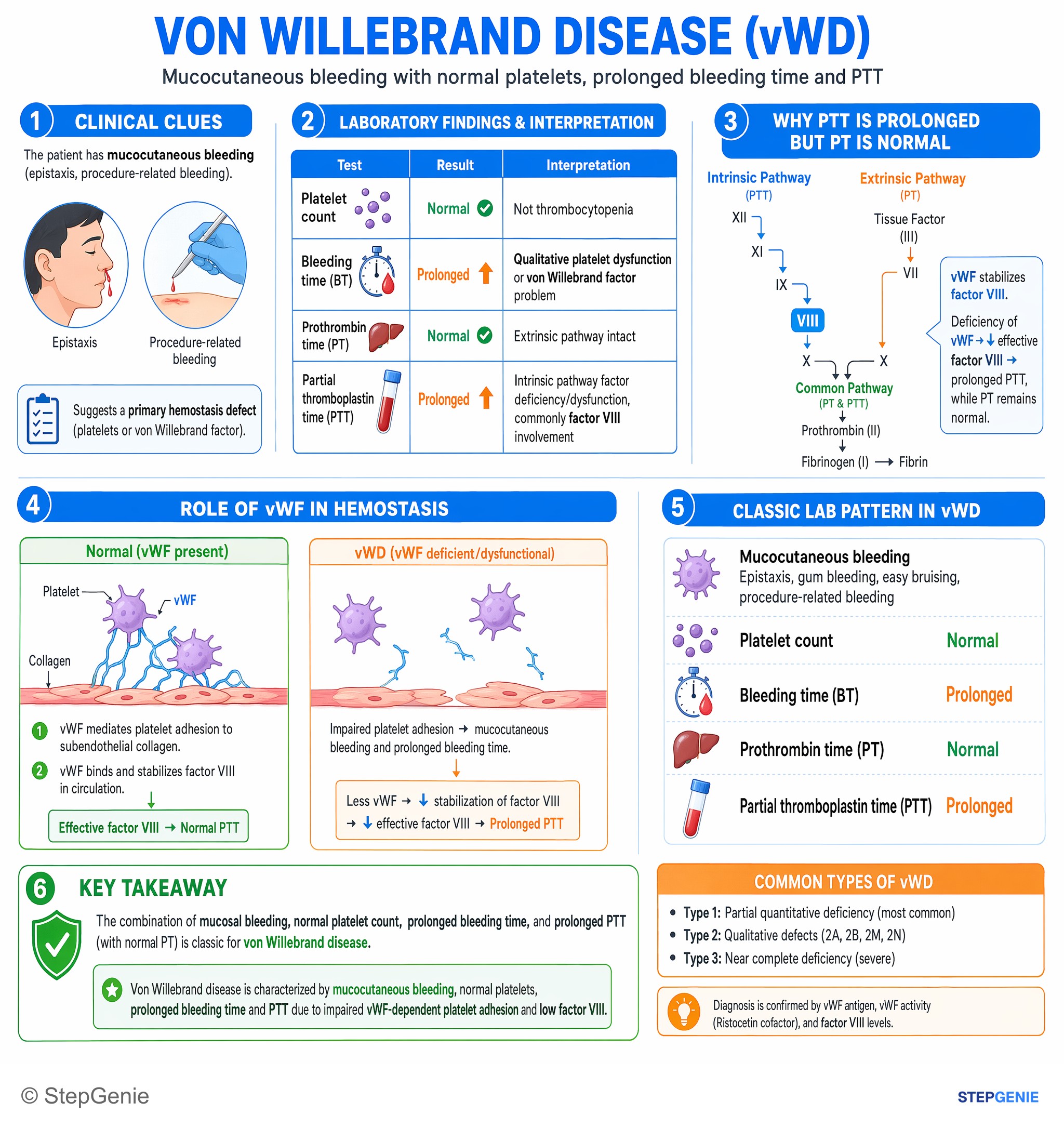
Von Willebrand disease: mucocutaneous bleeding, normal platelets, prolonged bleeding time and PTT due to impaired vWF-dependent platelet…
USMLE Step 1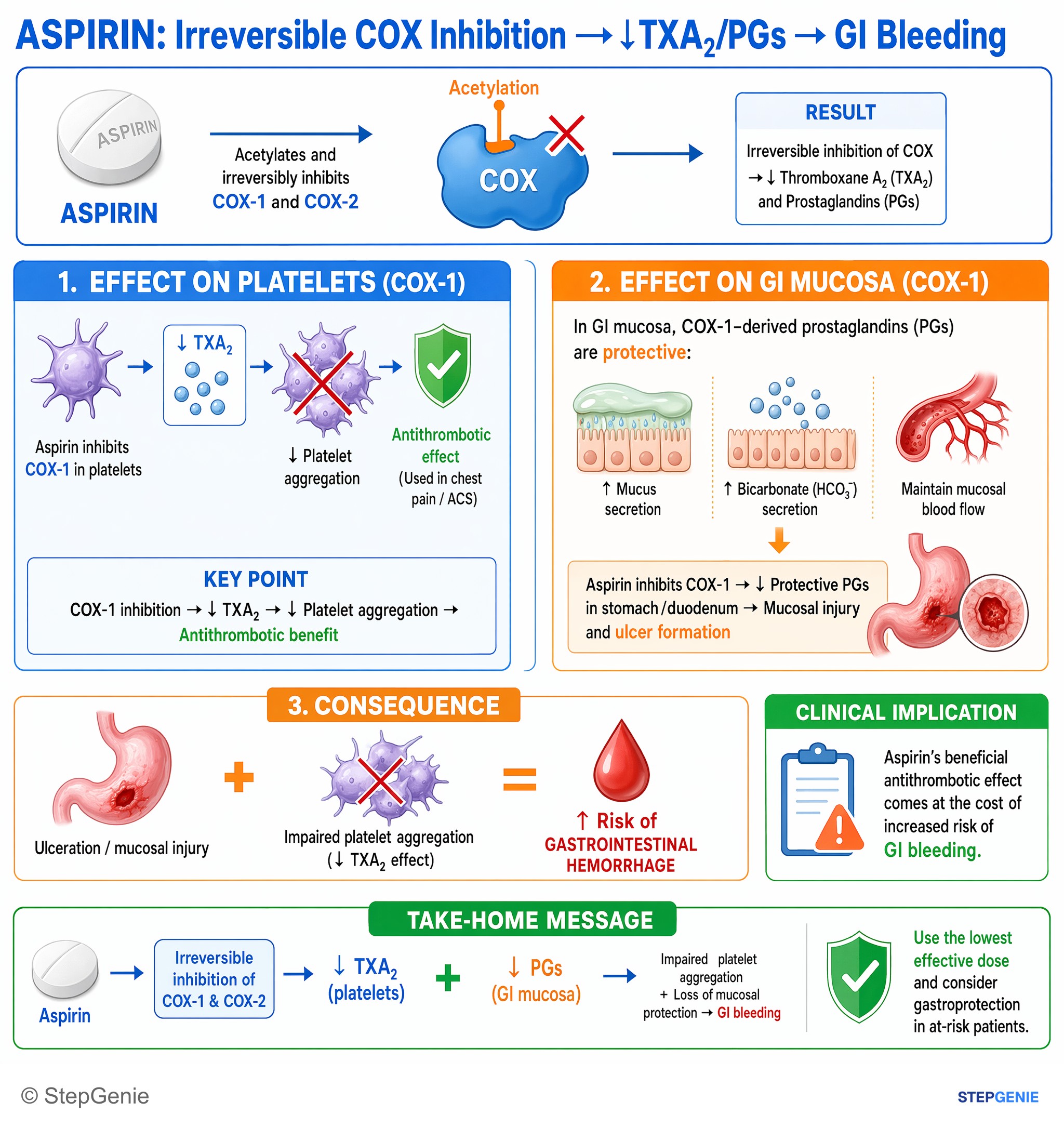
Aspirin irreversibly inhibits COX → ↓TXA2/PGs, impairing platelet aggregation and mucosal protection, causing GI bleeding as a key adverse…
USMLE Step 1Frequently Asked Questions
What are the steps of platelet plug formation?
The three platelet steps are adhesion, activation and aggregation. In adhesion, von Willebrand factor anchored to exposed collagen binds the platelet GpIb-IX-V receptor; in activation, platelets release ADP and make thromboxane A2, and ADP acting on P2Y12 switches on GpIIb/IIIa; in aggregation, fibrinogen bridges GpIIb/IIIa on neighboring platelets. Fibrin made by thrombin then binds the platelets into a stable plug.
What is the difference between platelet adhesion and aggregation?
Adhesion is platelet-to-vessel-wall binding, with von Willebrand factor linking exposed collagen to the platelet GpIb receptor. Aggregation is platelet-to-platelet binding, with fibrinogen linking GpIIb/IIIa receptors on adjacent platelets. Von Willebrand disease and Bernard-Soulier syndrome impair adhesion, while Glanzmann thrombasthenia impairs aggregation.
How do you tell Bernard-Soulier syndrome from Glanzmann thrombasthenia?
Bernard-Soulier syndrome is a GpIb-IX-V defect with large platelets and a low platelet count; the platelets do not aggregate with ristocetin but respond normally to ADP, collagen and epinephrine. Glanzmann thrombasthenia is a GpIIb/IIIa defect with a normal count in most patients; the platelets fail to aggregate with ADP, collagen or epinephrine but aggregate transiently with ristocetin. Both are usually autosomal recessive.
How does aspirin affect platelet plug formation?
Aspirin irreversibly inhibits platelet cyclooxygenase, so platelets cannot convert arachidonic acid into thromboxane A2 and activation and aggregation are weakened. Each exposed platelet stays inhibited for the rest of its roughly 7 to 10 day life, so the effect lasts 5 to 7 days after the last dose, until new platelets replace them. Other NSAIDs inhibit cyclooxygenase reversibly and act for less than a day.
What do platelet dense granules and alpha granules contain?
Dense granules hold ADP and ATP, calcium and serotonin, plus histamine and polyphosphate; they are deficient in Hermansky-Pudlak syndrome, which combines albinism with bleeding. Alpha granules hold fibrinogen, von Willebrand factor, factor V and platelet factor 4, with GpIIb/IIIa and P-selectin in their membranes; they are missing in gray platelet syndrome.
How do clopidogrel and ticagrelor differ?
Both block the platelet P2Y12 ADP receptor. Clopidogrel is a prodrug whose active metabolite binds irreversibly, and people who are CYP2C19 poor metabolizers form less active drug, which is the subject of a boxed warning. Ticagrelor binds reversibly, causes dyspnea in about 14% of patients (PLATO trial), and should be paired with a daily aspirin dose of 75 to 100 mg, because higher aspirin doses reduce its effectiveness.