Heparin-induced thrombocytopenia (HIT) is one of those Step 1 “don’t-miss” complications: it looks like a bleeding problem (low platelets) but behaves like a clotting problem (thrombosis). If you can quickly recognize the timeline, the mechanism, and what to do immediately, you’ll pick up easy points—and avoid dangerous real-life mistakes.
Where HIT Fits in Hemostasis (Big Picture)
Heparin is an anticoagulant that accelerates antithrombin → inhibits IIa (thrombin) and Xa (UFH > LMWH for IIa).
HIT is paradoxical: heparin exposure triggers a prothrombotic immune reaction, causing:
- Thrombocytopenia (platelet consumption/clearance)
- Thrombosis (arterial and/or venous)
- Possible skin necrosis at injection sites and systemic reactions after bolus dosing
First Aid cross-reference (typical locations):
- Heme/Onc → Coagulation disorders: HIT, DIC, TTP/HUS (compare/contrast)
- Pharm → Anticoagulants: heparin MOA, monitoring, adverse effects (HIT)
Definition (Step-Style)
Heparin-induced thrombocytopenia (HIT) is an immune-mediated adverse drug reaction (classically Type II HIT) due to IgG antibodies against the heparin–platelet factor 4 (PF4) complex, leading to platelet activation and a hypercoagulable state.
Two “Types” You Should Know (but Step usually cares about Type II)
| Feature | Type I HIT (“non-immune”) | Type II HIT (“classic HIT”) |
|---|---|---|
| Mechanism | Direct platelet activation (mild) | IgG anti–PF4-heparin |
| Onset | 1–2 days | 5–10 days (or <24h if prior exposure) |
| Platelets | Mild drop, usually >100k | Often >50% drop from baseline |
| Thrombosis risk | No | High |
| Management | Observe, often continue heparin | Stop heparin + start non-heparin anticoagulant |
USMLE takeaway: When someone says “HIT,” they mean Type II unless otherwise specified.
Pathophysiology (The “Why It Clots” Explanation)
- Heparin binds PF4 (released from platelet α-granules).
- Some patients form IgG antibodies against the PF4–heparin complex.
- IgG binds platelets via Fc receptors → platelet activation and degranulation.
- Activated platelets:
- Release more PF4 (amplifies the cycle)
- Promote thrombin generation
- Result: thrombocytopenia from consumption/clearance + thrombosis from intense coagulation signaling.
High-yield phrasing:
HIT is a prothrombotic thrombocytopenia.
Epidemiology & Risk Factors (HY Associations)
HIT is more likely with:
- Unfractionated heparin (UFH) > LMWH
- Surgical patients (especially cardiac/orthopedic) > medical patients
- Longer duration exposure
- Prior heparin exposure within ~100 days (can cause rapid-onset HIT)
Step-friendly pearl: If the stem highlights UFH and post-op status with a platelet drop around day 5–10, think HIT first.
Clinical Presentation (What Shows Up on Exams)
Classic timing
- Platelet count falls 5–10 days after starting heparin
- Or within 24 hours if there was recent heparin exposure (preformed antibodies)
Degree of thrombocytopenia
- Often moderate: platelets may be ~50–100k
- Key clue: >50% decrease from baseline matters more than the absolute number.
Thrombosis manifestations (the “dangerous” part)
- DVT/PE (common)
- Arterial thrombosis → limb ischemia, stroke, MI
- Skin necrosis at injection sites
- Acute systemic reaction after IV heparin bolus (fever, chills, HTN, dyspnea)
Testable paradox:
Low platelets, but bleeding is less common than thrombosis in HIT.
Diagnosis (Step 1 Algorithm Mindset)
1) Start with clinical probability: the 4Ts score
The 4Ts estimate pretest probability:
- Thrombocytopenia (degree of drop)
- Timing (day 5–10, or rapid with prior exposure)
- Thrombosis (new clot or skin necrosis)
- oTher causes of thrombocytopenia absent
| 4Ts total | Probability | What to do |
|---|---|---|
| 0–3 | Low | HIT unlikely; consider other causes |
| 4–5 | Intermediate | Stop heparin, start alternative anticoag, send labs |
| 6–8 | High | Same as above (treat while testing) |
USMLE move: If intermediate/high suspicion → do not wait for confirmatory testing to stop heparin.
2) Lab testing: screening vs confirmation
- Immunoassay (ELISA) for anti–PF4-heparin antibodies
- Sensitive (good rule-out), less specific
- Functional assay (serotonin release assay)
- More specific, confirms platelet activation
Practical exam logic:
Clinical scenario + positive PF4 ELISA = likely HIT; serotonin release assay confirms.
Treatment (Most Tested Part)
Immediate steps (do these first)
- Stop all heparin (including heparin flushes and LMWH).
- Start a non-heparin anticoagulant because thrombosis risk is high:
- Direct thrombin inhibitors: argatroban, bivalirudin
- Factor Xa inhibitors: fondaparinux (commonly used in practice; Step may mention)
What NOT to do
- Do NOT give warfarin initially in acute HIT.
- Warfarin drops protein C first → transient hypercoagulability → can worsen thrombosis and cause skin necrosis.
- If warfarin was started, hold it and consider vitamin K depending on scenario.
When warfarin is okay
- Start only after platelets recover (classically >150k) and patient is stable on a non-heparin agent.
Platelet transfusion?
- Generally avoid unless life-threatening bleeding or emergent surgery—can feed the thrombotic process.
High-Yield Associations & “Trap” Differentials
HIT vs DIC vs TTP/HUS (fast compare)
| Condition | Platelets | PT/PTT | Key features |
|---|---|---|---|
| HIT | Low (often moderate) | Usually normal | Thrombosis after heparin, anti-PF4 |
| DIC | Low | ↑ PT, ↑ PTT, ↑ D-dimer, ↓ fibrinogen | Bleeding + microthrombi, sepsis/trauma/OB |
| TTP | Low | Normal | MAHA + neuro + renal + fever; ADAMTS13 |
| HUS | Low | Normal | MAHA + renal failure after diarrheal illness (EHEC) |
Step clue: If PT/PTT are prolonged, HIT becomes less likely; think DIC.
Heparin adverse effects (First Aid-style list)
- Bleeding
- HIT
- Osteoporosis (long-term)
- Hyperkalemia (↓ aldosterone)
Micro-Questions USMLE Loves
“Patient on heparin has new thrombosis + low platelets. Next best step?”
- Stop heparin immediately and start argatroban/bivalirudin/fondaparinux.
“Why is it prothrombotic?”
- Antibody-mediated platelet activation → thrombin generation.
“When does it occur?”
- 5–10 days after initiation (or sooner with recent exposure).
“UFH or LMWH more likely?”
- UFH > LMWH.
“Can you use LMWH if they had HIT?”
- No—cross-reactivity exists; treat as avoid all heparin products.
Quick Memory Anchors (Exam-Day Ready)
- HIT = IgG against PF4–heparin → platelet activation → thrombosis
- Timing: day 5–10 (or <24h with prior exposure)
- Platelets drop >50%, thrombosis > bleeding
- Stop heparin + start non-heparin anticoagulant
- No warfarin until platelets recover
Visual explanations from the StepGenie QBank
Infographics StepGenie drew to explain questions in its own QBank, matched to this article's topic. Each caption is the takeaway of the question it explains.
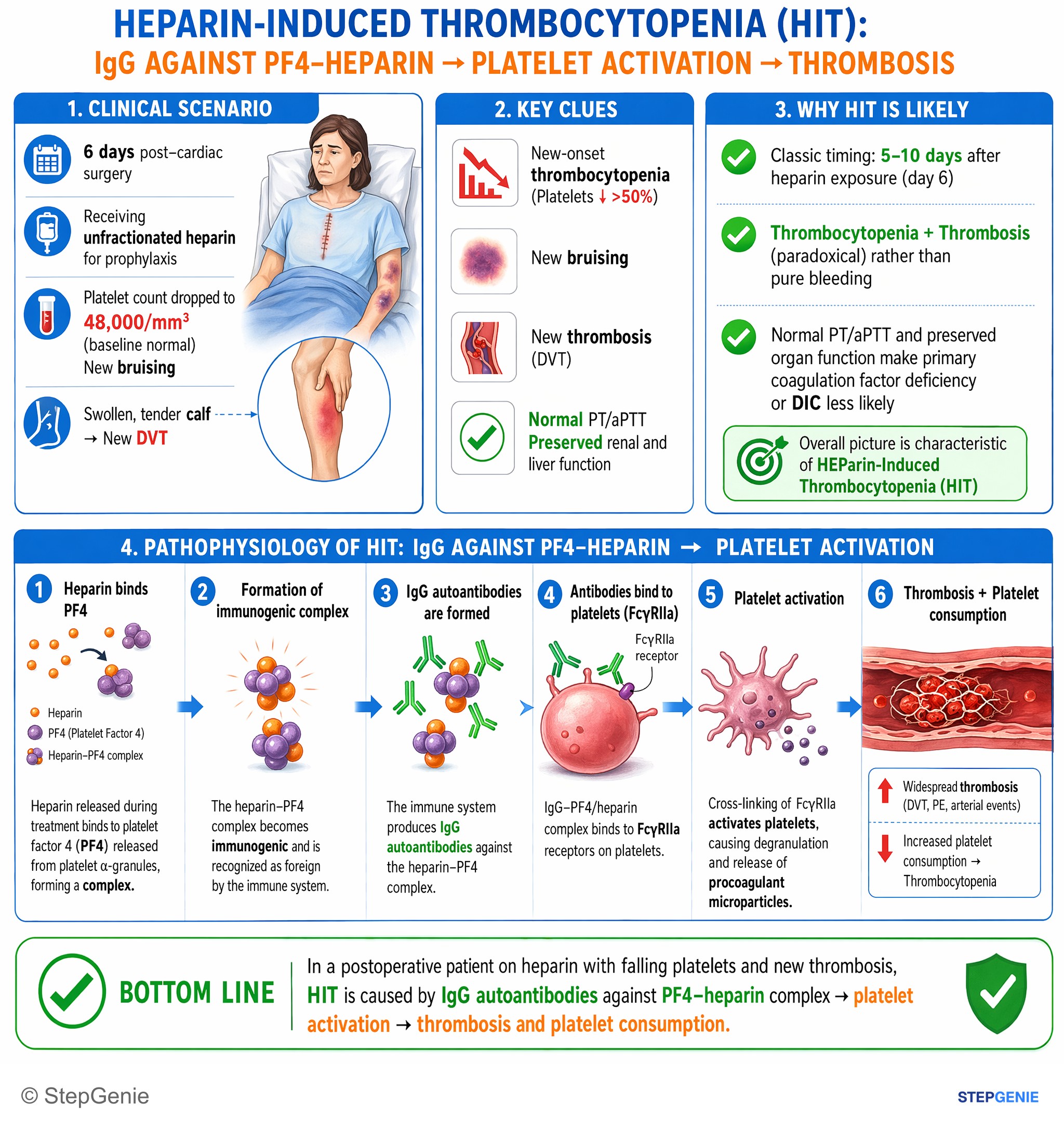
Heparin-induced thrombocytopenia (HIT): postoperative patient on heparin, falling platelets, thrombosis; due to IgG against PF4–heparin →…
USMLE Step 1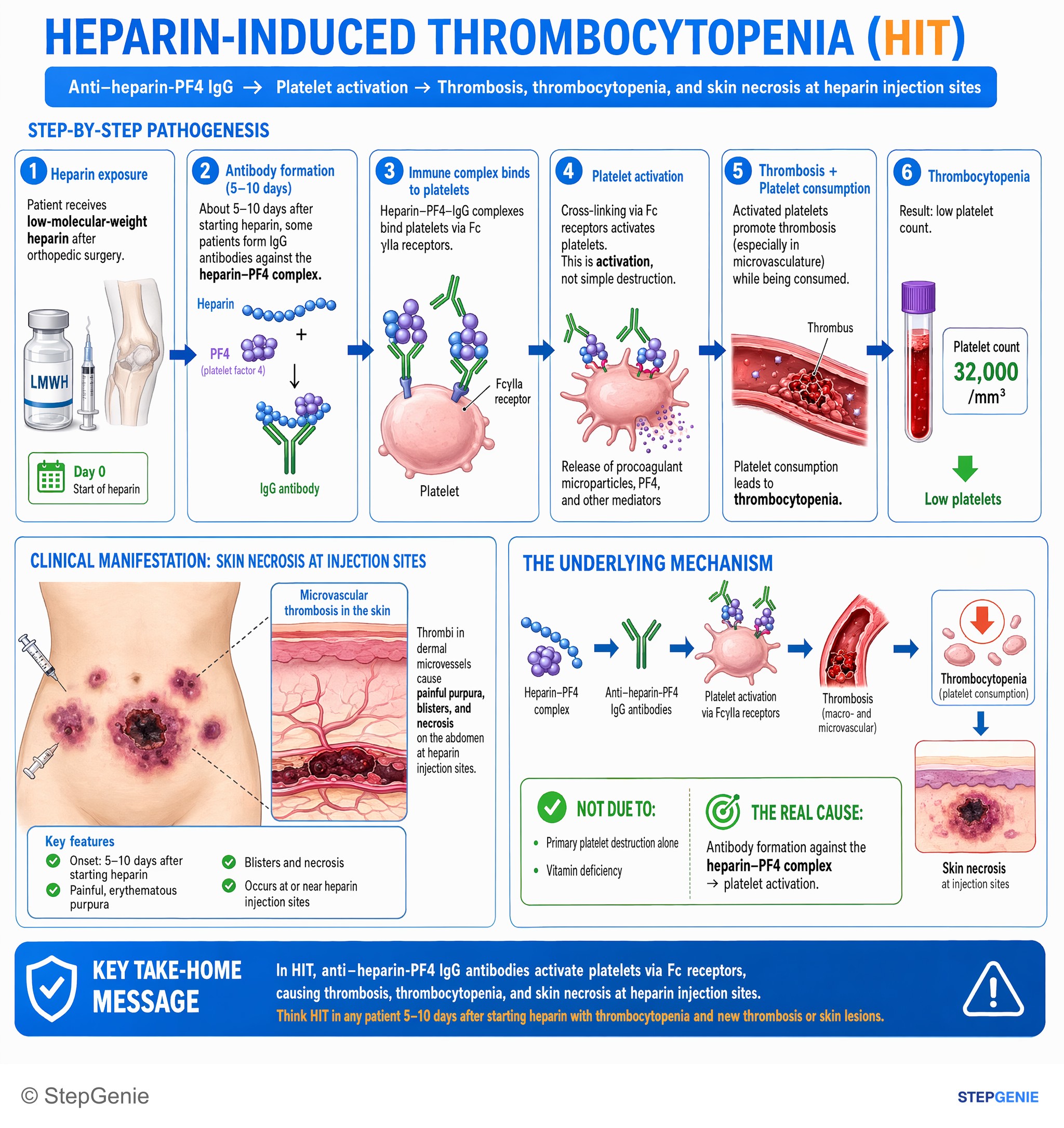
Heparin-induced thrombocytopenia (HIT): anti–heparin-PF4 IgG → platelet activation → thrombosis, thrombocytopenia, and skin necrosis at…
USMLE Step 1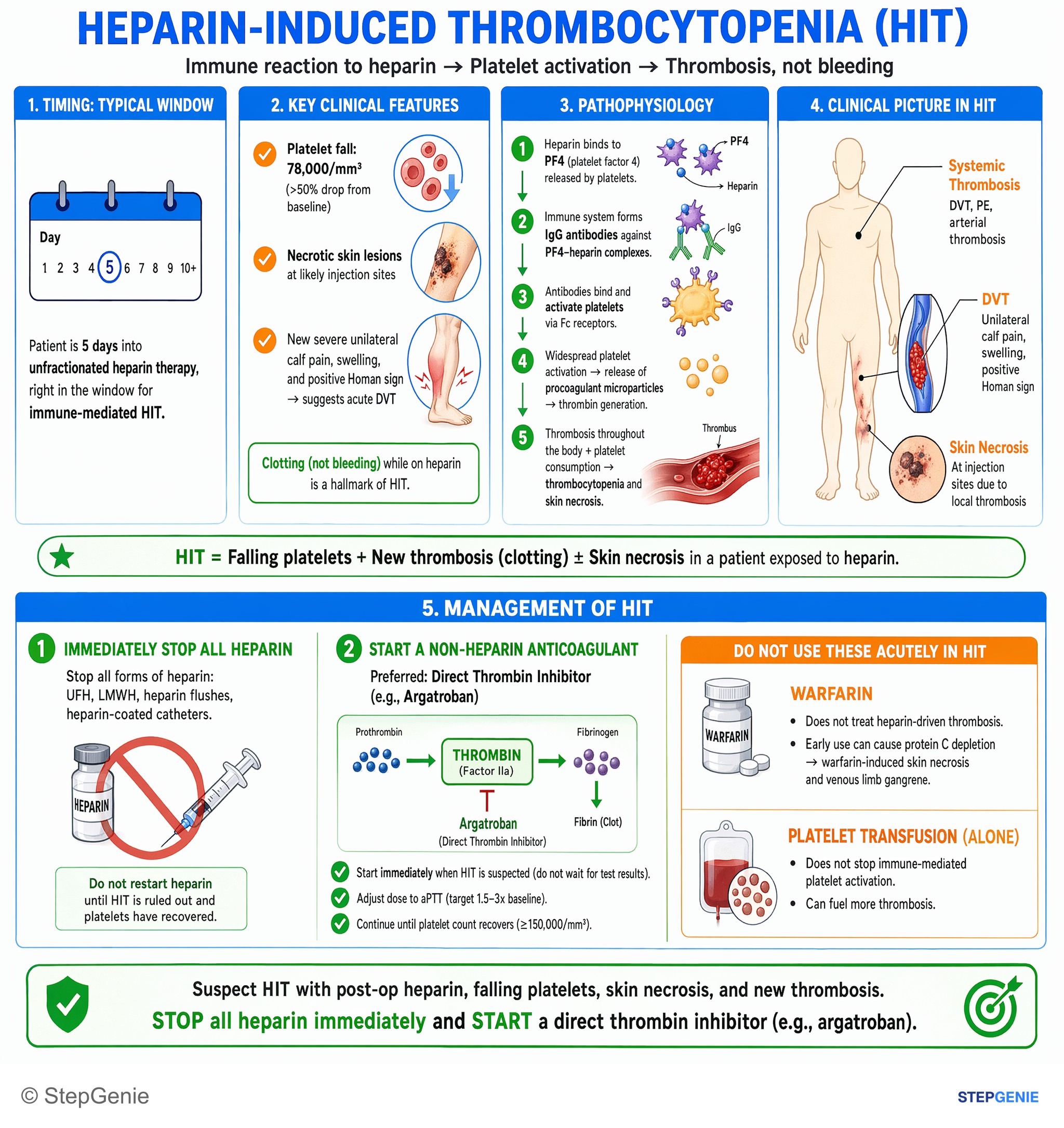
Heparin-induced thrombocytopenia: post-op heparin, falling platelets, skin necrosis, new thrombosis → stop heparin and start direct…
USMLE Step 2Frequently Asked Questions
Why does heparin-induced thrombocytopenia cause clots even though the platelet count is low?
HIT causes clotting because it is a prothrombotic immune reaction, not a simple bleeding disorder. In classic Type II HIT, IgG antibodies form against the heparin-PF4 complex and bind platelet Fc receptors, which activates platelets and increases thrombin generation. Platelets are then consumed and cleared, causing thrombocytopenia, but the dominant clinical effect is thrombosis rather than bleeding.
When should you suspect HIT after starting heparin?
You should suspect HIT when platelets fall 5 to 10 days after starting heparin, especially if the drop is greater than 50% from baseline. HIT can also appear within 24 hours if the patient had recent heparin exposure and already has preformed antibodies. A stem that features unfractionated heparin, postoperative status, and new thrombosis is especially classic.
How do you tell HIT from DIC or TTP on an exam?
HIT is suggested by thrombosis after heparin exposure with usually normal PT and PTT. DIC also causes thrombocytopenia, but it typically has increased PT, increased PTT, increased D-dimer, decreased fibrinogen, and is linked to settings like sepsis, trauma, or obstetric complications. TTP has low platelets with normal coagulation studies and is characterized by microangiopathic hemolytic anemia plus neurologic and renal findings.
What is the first-line treatment for suspected HIT?
The first-line treatment is to stop all heparin immediately and start a non-heparin anticoagulant. This matters because thrombosis risk is high, so you should not wait for confirmatory testing if suspicion is intermediate or high. Agents mentioned include the direct thrombin inhibitors argatroban and bivalirudin, as well as the factor Xa inhibitor fondaparinux.
Why should you avoid warfarin at the start of acute HIT?
Warfarin should be avoided initially because it lowers protein C first and can create transient hypercoagulability. In acute HIT, that can worsen thrombosis and even cause skin necrosis. Warfarin is only started after the platelet count has recovered, classically above 150,000, and the patient is stable on a non-heparin anticoagulant.